The Beeb is currently going on about the closure of manned ticket offices at railway stations, and I suppose that, as a disability access issue, I should probably say something about it. Truth be told, I don’t use national rail much these days, and haven’t had to buy a rail ticket in years. I use London transport and the tube quite a bit of course, and wrote about my issues with oyster cards etc a couple of weeks ago (Incidentally, the Freedom Pass I ordered still hasn’t arrived for some reason). Yet when it comes to national rail, I haven’t had that much experience recently. When I was first going out with Lyn and coming to visit her from Crewe, however, I used to buy tickets from the offices: I used to talk to a member of staff there using my communication aid, where I could buy my ticket and arrange the wheelchair access ramps I needed. My concern is, without manned stations, these days that would be much harder. There is no way I could use a ticket machine, so I would need to bring a personal assistant with me to do it for me, or just order the ticket online. But then, how would I arrange ramps and make sure someone is there to put them in place when I need to get on and off the train?
To be honest the whole idea puts me off using national rail. That’s a shame, because the whole system used to be great: I remember how exuberant I felt when I first found I could use trains without having anyone with me – it was a huge step forward towards my independence. Now, though, trains might once again be out of bounds, not just for me but for many people with disabilities.
I seem to have developed a fear of the sight of kids, at least in my local area. Well, perhaps it’s not quite fear; more a mixture of concern and animosity. Whenever I see a group of school-age young people in the street when I’m out and about these days, my adrenaline and heart rate begin to rise and I automatically brace for trouble. School kids, particularly teenage boys in groups trying to impress one another, shout abuse at me or take the piss so often that I can’t help starting to worry. Almost unconsciously I prepare myself to shout something back at them.
It happened just now: coming back from quite an early coffee, I saw two young boys across the street from me coming in the opposite direction. I instantly felt my mood change as if I assumed they were about to shout something nasty and try to provoke me. Of course, this time nothing happened and everyone passed quietly; but I just hate the way I now react. I hate the fact that I’ve had so much trouble from these chavvy little shits, I now assume that all children will cause trouble. I don’t see why I have to put up with young people taunting or abusing me just because I use a chair, but at the same time I know it’s wrong for me to assume that they are all just as vile.
Bank holidays are usually quiet, soporific affairs for me, spent at home on my computer or watching TV. Yesterday, however, was another matter altogether. John stayed here overnight on Sunday, and it was he who came up with the fascinating idea of going to the Notting Hill carnival on Monday. Of course, me being me, I had already considered going up there on my own on Sunday, just to check it out, but both my parents and Serkan had put me off the idea as far too risky. Going there with someone, seemed another matter.
As I’ve said here before, getting into central London is now easier than ever thanks to the Elisabeth Line, so at about midday yesterday J and I headed to Woolwich, getting off at Paddington. We were there in about twenty minutes, and almost immediately were hit by a wall of sound and human energy unlike anything I had ever encountered. It was like that part of London had lost it’s mind! The streets were closed to traffic. and thousands upon thousands of people were walking about in all sorts of extravagant costumes, banging drums, singing and hooting horns. I was automatically mesmerised: I loved it – London had done it again, and showed itself to be the wonderful, vibrant, intoxicating place I know it to be.
If I’m honest, though, I must admit there were times yesterday when I grew quite scared. John and I walked through the crowds for a couple of hours, and I was scared to death of loosing him. I don’t know that part of London very well, and loosing contact with my friend amid all those people would have meant I would be in a lot of trouble. Thus I spent most of yesterday afternoon piloting my powerchair, concentrating rigidly on Johns arse as he lead me through the streets of Notting Hill. Mind you, it wasn’t that bad a view: there were many, many more arses to look at, sat at arse-hight in my powerchair, most far rounder and far more exposed than John’s!
One way or another I managed to stay with John all afternoon, and together we had a good tour of Carnival. I was struck most by how loud it was: some of the music was so loud, so throbbing, I could barely hear myself think. Yet that was the point. It was a party – a celebration of Caribbean culture, and indeed wider, human culture too. There were so many happy, charming people there that I couldn’t help being blown away, in spite of the noise.
After two or three hours up there (I quickly lost track of time) John and I went to meet Mitch, who we had planned to hook up with earlier, but he got delayed. The rest of the afternoon was spent in a far quieter spot, talking over some beer. As the evening drew in, I realised what a wonderful day it had been. I had never seen London like that before, closed to traffic and transformed into an intoxicating maelstrom of humanity. I resolved to go back next year, possibly in costume. I also couldn’t help wondering whether Lyn had ever been to carnival; I don’t think she did and she never mentioned it, but L would have loved it.
Due to a slight delay on the tube we got back here quite late but all in one piece. I had somehow survived the day! More to the point, the metropolis had once again made my jaw drop at all it’s richness and diversity; it had once again given me an experience which I can never possibly forget. Notting Hill carnival is about migration, about welcoming people coming here not just from the Caribbean but all over the world. It is a celebration of the spirit of diversity and inclusion which London is founded upon. For all the crowds and noise, for all the stress of keeping sight of John’s arse, I loved it, and now can’t wait until next year’s.
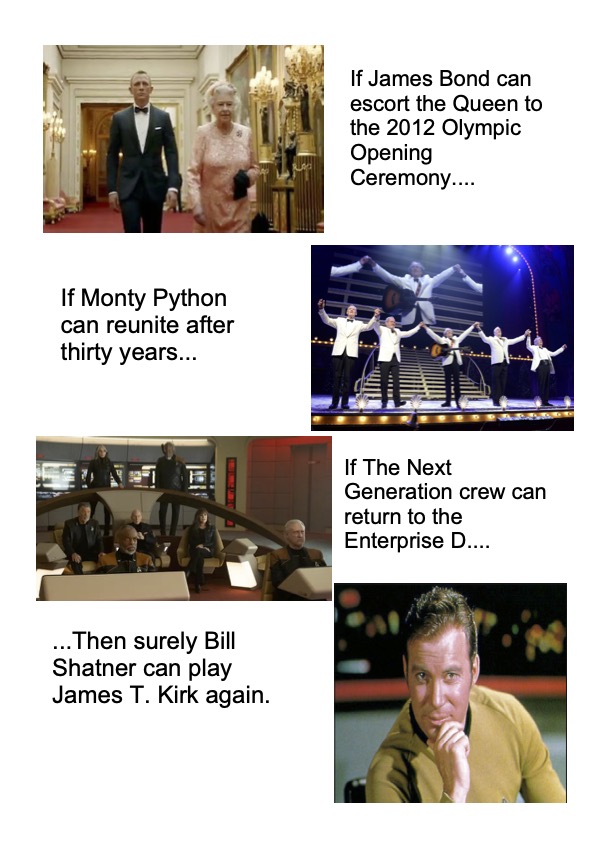
The only question is, how. I know Shatner’s Kirk was shown to have died in Star Trek Generations (1994), but all it would take is a little clever writing to put Starfleet’s most iconic captain back in his chair.
One of the bits of news which has puzzled me the most this week, although I have been slightly wary of writing anything about it for fear of saying anything out of line, was the news that India has now landed a spacecraft on the moon. Of course I think it’s wonderful that humanity as a whole is exploring space; any country surely has a right to have interstellar aspirations. Yet, not that I want to tell any country how to run itself, or think that we in the ‘developed west’ have a right to dictate to those in the ‘undeveloped east’, but I must say that countries like India have huge infrastructure and poverty issues which surely need sorting out before they spend billions of pounds/dollars/rupees launching anything into space.
When John and I visited India five years ago, I remember seeing gigantic undeveloped, dirty, poverty-stricken areas crying out for investment: people were living as they had done a century ago, in dilapidated housing, walking along unpaved roads. Yet between such areas, there were pockets of sleek, modern buildings: they were the areas which the Indian government obviously wanted us to see. To be honest it struck me as quite perverse that any government could spend so much developing such small places while leaving the rest of the country and millions of people to rot. This space program is obviously a vile continuation of that attitude: the Indian government want the country to look like a modern superpower so they start firing probes at the moon, hoping nobody notices the huge social and infrastructure problems which surely should have been it’s priority.
Early yesterday afternoon I was passing through Greenwich Park when I noticed that they were setting up for some kind of event next to the statue of Woolfe. At first I thought it could be some kind of filming, so I decided to take a closer look. I’m always interested in watching films being made of course, but it turned out to be something far cooler. Asking one of the young ladies working there what was going on, I was told that it was part of Greenwich and Docklands International Festival, and that there was going to be an aerial dance performance there the following day (today) involving an ambulant woman and a Maori man using a wheelchair.
Naturally this got me intrigued. I was told that there were going to be two performances today: one at 1pm and the second at 5.30. It occurred to me that going to watch both might be interesting, so earlier this afternoon I set off for Greenwich Park. I got there an hour or so before the performance itself, giving me time to mill around for a bit and get a good spot. Fortunately, that also meant I was able to meet the two dancers, Rodney Bell and Chloe Loftus, as well as watch their final rehearsal. They seemed almost as interested in me as I was in them, and we agreed to meet for a chat between their two performances.
A short while later the performance itself began, and I was almost instantly awe-struck. Bell was strapped firmly into his wheelchair while Loftus moved freely, and the two performed a fascinatingly beautiful duet, moving around one another both on the ground and suspended in the air. The Air Between Us was an utterly mesmerising work. I’m no dance critic, so I’m not sure I have the words or experience to capture it properly here, but it was like watching two atoms or planets orbiting one another, bouncing off each other, exploring each other. Set to quite modern, electric music, with the stunning backdrop of Greenwich Park and the Isle of Dogs beyond it, I and the audience around me was engrossed. When the twenty minute piece came to an end, there was an eruption of well deserved applause.
It was great to then give the two performers my congratulations. I thought it might be cool to show them some of my work on my Ipad, including my ‘Wheelchair Dancing’ screenplay, but I think they were pushed for time; there were also some very dark clouds gathering in the sky. A short while later I trundled back here, intending to grab some lunch and put a jumper on before heading back to the park for the second performance. The dark clouds were growing even darker though, so I decided it would be wiser to stay here than risk getting my powerchair drenched. Yet at least I managed to see one of the captivating performances, which was enough to remind me how beautiful dance can be as well as how exciting disability art is becoming.
Early yesterday afternoon, John messaged me to ask if I wanted to go to the cinema with him: he and Mitchel were going to see Gran Turismo in Peckham, and he wondered whether I would like to join them. I was in two minds about it at first: it would mean rescheduling dinner slightly, and, to be honest, from the trailer John sent me the film didn’t look great. Yet cinema is cinema and friends are friends, so after a few minutes I changed my mind and took him up on his suggestion.
Getting to Peckham was rather simple. I got there early, giving me time for a little look around. Frankly, Peckham seems like a bit of a shithole, but an interesting shithole. Many of the buildings along the high street look quite aged and run down; but if you look closer you can see there’s quite a bit of money in the area. It’s as if there are fragments of modern, stylish, swanky London amid a London from forty years ago. It also struck me as very cosmopolitan, and I told myself to go there again soon for a closer look.
As we had arranged, I met John and Mitch at five outside the Peckhamplex cinema. That gave us time for a quick walk, chat, and beer at the Peckham Levels, a multistorey car park converted into an arts venue where I once met Charlotte. Then, an hour or so later, it was time to go and watch the film.
It soon became clear that calling Gran Turismo a film was being far too kind: ‘frontal lobotomy on a screen’ would be more accurate, sadly. After watching the trailer I had decided to give it the benefit of the doubt: it’s core concept of a kid who plays racing computer games becoming a racing car driver seemed tenuous at best, but perhaps there would be fragments of self-knowledge or irony that would redeem the film. Unfortunately not: Gran Turismo is a pile of nauseating, cliched crap. Even if we put aside the idiocy of the idea that a so-called ‘gamer’ would ever be allowed anywhere near a racing car costing hundreds of thousands of pounds, the narrative is so riddled with saccharine, trite cliches and plot points so far fetched and stupid that it insulted one’s intelligence that it made me cringe. The way that the film tried to morph actual motorsport with the aesthetics of video games, as if they are somehow on the same physical or cognitive level, struck me as especially irritating and even patronising. It became hard to watch, and in fact the three of us left the screening before the end.
To be honest I was gobsmacked that such an awful, awful film could ever have been made. But of course, the whole thing was little more than an advert for a video-game, designed to glamourise gaming and flatter ‘gamers’ into thinking that they are more important and skilled than they are. It was an ad for Sony, pumped up into a ninety minute waste of time. If this is a sign of the way film is heading, then all cinephiles must despair: film is a fascinating, great, rich art-form capable of exposing humanity for all it’s beauty and depravity. But now it is being used to sell video games, insulting our intelligence in doing so. If this commercial, bullshit-strewn shyte is a sign of what is to come, then film really is dead.
A couple of weeks ago I wrote about how Woolwich was like an urban palimpsest: a modern area of London fast being redeveloped, but where you can still see fascinating fragments of the city’s history if you look. Of course, Woolwich isn’t the only suburb which you can say that about. Not far from Eltham is Lee Green, a small collection of houses and shops just south of Blackheath. I go through there fairly often on my way to Lewisham. It’s much smaller than suburbs like Greenwich, Woolwich or even Charlton, and indeed still has the aura of a compact little village. In fact I would even go as far as likening it to Alsager or even Swettenham in my native Cheshire: both are villages of less than a couple of thousand people, surrounded by fields.
Indeed, reading a bit about the history of Lee Green from one of the handy information boards in the area earlier, I learned that until the late nineteenth century, it was in fact a small village surrounded by fields. As you can read here, Eighteenth century maps show the area as little more than a collection of houses around a village green, surrounded by farmland and woodland. A large inn, The Old Tiger’s Head, dating back centuries, served customers coming through the village on their way between London and Dover; and in 1815 troops passed through the village en route to the Battle of Waterloo.
Such history fascinates me. Of course, the whole of London is full of stories like this, but it is only when you stop and look, when you take your time to find out about areas like Lee Green or Woolwich, that you realise how intriguing they are. Thousands of cars, busses and lorries thunder through that small area every day, around the roundabout which was once the green, oblivious to what was there a century or two ago. Yet to me, such areas are what make London so rich. It is a metropolis of thousands of such smaller spaces: all unique; all with their own fascinating histories; yet all coming together to form one vast, dynamic metropolis. London is a place where villages amid fields have grown and been absorbed into one vast, vibrant space, while retaining their history and diversity. That is what I find so fascinating, so intriguing, so engrossing about it, for what better metaphor could there be for humanity itself?
I think I have written here before about how irksome I find it when people who are capable of walking up stairs use lifts, or when prams take up the wheelchair space on busses. Today, though, I think I will add a third irritation to that list. I have recently found that it really gets on my nerves when, waiting at a pedestrian crossing, someone comes and presses the button to activate the traffic lights when I have already pressed it. I don’t know why, but it seems so condescending: they seem to assume that I don’t understand how traffic lights work, and so need to do it for me.
Out and about today, for instance, I was waiting patiently at a pedestrian crossing, the button pressed, when a woman came and reached over me to press it again. Could she not see the “wait” sign was lit up? The way that she reached over me, her arm in front of my face, without saying anything, felt almost invasive. In that moment I felt like shouting my head off at her that I had pressed the button, that I knew how pedestrian crossings work, that I wasn’t five and that I had zarking masters!
Of course I didn’t though. I just kept quiet and crossed the road. To say anything would have been pointless. Yet every time this happens – and it happens irritatingly often – it feels like people are making assumptions about my ability to live my life and get around the city. They assume that I don’t know how pedestrian crossings work, or that I can’t press a button. I know I’m probably overreacting, but would you not feel just as patronised?
Yesterday afternoon I had an idea. (Very) long term readers might recall that I once began to think about the relationship between Lacanian philosophy/psychoanalysis and the use of communication aids. How can one properly constitute yourself as a person if you cannot physically access language / the Symbolic? I was mulling this over again yesterday, and it struck me that it would be awesome if someone made a film in which the South Park characters Timmy and Jimmy were seen discussing such ideas. Both characters are often dismissed as ‘retards’; comic, often derogatory stereotypes of disabled people. Wouldn’t it be cool if they were in fact shown to be intelligent and astute?
I doubted that anyone would have made such a video of course, so it occurred to me to try to make it myself. Thinking about it though, it seemed to me it might be too complicated to perform any sort of conversation between the two characters, so I decided to have a go at making a short film where Timmy alone discusses Lacan. Taking the text from my original blog, last time I began to put together this short video. It’s far from perfect or well polished, but as a bit of fun I’m rather pleased with it. While I hope I don’t get any copyright issues, I find it very amusing to see a character so often dismissed as only capable of shouting his name discussing such complex ideas.
I think Walter Benjamin once wrote that the only real way to get to know a city is to walk around it: to become a subjective observer and enter into it. I would definitely agree: one can only really know a city if you live within it as one of its citizens. The only problem is, walking takes energy. No matter how fit anyone is, they can only walk so far before they get tired.
That’s why it’s much better, if you ask me, to use a powerchair. In my chair I can trundle for miles around London, absorbing all its wonderful labyrinthine diversity. Today, for instance, I had a good one: quite incredibly, today I managed to roll all the way along the Thames from Greenwich to London Bridge. It took about three hours or so, but thanks to my new incredible batteries I had no problem. For the most part the path was smooth and unproblematic, although at one point I suddenly came across a flight of stairs which I had to find my way around.
It was a wonderful trip, past all the old docks along the south bank of the Thames. There was an amazing amount of history to take in. For instance, at one point I came across the very wharf which the Mayflower departed from, carrying the pilgrims to America. At another, I had to roll along narrow paths between warehouses hundreds of years old, remnants of London’s former life as a commercial port but now immaculately restored and redeveloped.
To be honest, trundling contentedly along as I was, it came as something of a shock to see Tower Bridge roll into view – had I really come that far? The metropolis suddenly seemed much smaller than it once did. But then, that’s probably a result of getting to know it; a natural result of living in a city, of rolling around it and exploring all it’s streets and alleyways. Where London once seemed so sprawling, massive and unknowable, it now feels more compact and liveable. And where Londoners once seemed cold, defensive and distant, for the most part they now seem friendly, welcoming, and indeed charming in their own urban way. Thus Benjamin was right: you can only really know a city if, like the flaneur, you walk it’s streets. The only way I have got to know London is to roll around it in my powerchair. In a sense, then, I am a wheeled flaneur.
Something really weird is currently happening. After posting my entry earlier, I watched a couple of Youtube videos before taking myself to the shop for the evening’s supplies. Coming back, though, I noticed a helicopter over the collection of houses and flats where I live. That’s nothing too unusual – helicopters fly over fairly frequently on their way to places. I then noticed, though, that this helicopter wasn’t going anywhere: it was flying in circles and weird patterns over the houses, at an altitude of two or three hundred metres. I thought it might even be trying to land somewhere nearby. Intrigued, I decided to stay outside and watch for a bit, as I still have a liking for helicopters.
I assumed it would fly on after a few minutes, but I watched it for half an hour and it was still flying in the same strange patterns. In fact I still think it’s up there. It might be a police helicopter searching for something or someone, but then wouldn’t there also be police down here on the ground helping it? It could also be a pilot being trained, which could explain the odd flight patterns; but I don’t think such lessons would be held above a residential area like this. It’s all very curious, and I can’t help imagining that something clandestine or secretive might be involved: Who knows, maybe Double O Seven himself is up there. Of course it’s probably something much more mundane, and if anyone has any ideas about what it could be, please leave a comment.
Just as an update to this entry from a few days ago, I have now been issued a freedom pass and should receive it in a few days. After last week’s debacle, I trundled down to Woolwich town centre on Monday in order to sort it out. I still don’t think I’ll actually need it much, and indeed have been using the busses and tubes since last week without needing one, but at least now I’ll have one if I come across any more unmanned barriers. My parents have even got me a cool lanyard to put it into. It might be as much use as a chocolate teapot given how rarely I’ll need it, but I suppose even chocolate teapots are useful once in a while.
I had lunch with my parents earlier. They were here for one of their usual visits, just to check on me and that I hadn’t damaged anything too badly. It was great to see them of course. At one point, however, the subject of yesterday’s blog entry cropped up. Just as Serkan had when I showed the entry to him, Mum and Dad asked why I had reacted at all – why hadn’t I just ignored the woman, if I found what she did that offensive? Well, I did: I didn’t say or do anything at the time, but just carried on drinking my coffee. It was only later that I decided to write about what had happened on my blog.
I knew full well that trying to make an issue about it in the cafe would only have caused problems; it would have been pointless, especially given that I wasn’t totally certain of the woman’s intent. On the other hand, I think it is pretty vital that I write about things like that here on my blog. Only people in situations similar to mine will experience such issues. No ‘normal’ person will be shunned like that, or know what it feels like to be sneered at like something disgusting. That’s why I think it is essential that I record things like this, because only then can I tell the wider world what life is like for me. Thus, while I could easily have ignored the whole episode and forgotten about it, I think I have a duty to tell everyone about things like this.
I know I have written about incidents like this on here before, although not for quite a while. I was in Costa earlier, just for a cappuccino. I just go there once or twice a week: the staff there are friendly, and now know my coffee preferences quite well. I was sat in my usual spot, on the bench seat which runs along one side of the cafe, eating a cheese toastie. A few minutes into my meal a lady came to sit next to me. Not that it matters, but she was wearing a tight headscarf, and I would guess she was from North Africa. She sat down, but looking to her right she saw me and immediately got up again to go to another table.
I couldn’t help feeling extremely hurt: she didn’t say anything, but looked at me with such distain; the way she changed seats so soon after seeing me made me feel like she thought I was somehow contagious. I know that she may not have meant it that way, but when things like this happen I can’t help but feel hurt. It may have been some kind of cultural misunderstanding on either of our parts of course, but I’m sure anyone else would have felt just as hurt. Do I really smell that bad? Do I look so filthy? Would she have walked away so contemptuously if I wasn’t drinking my coffee through a straw? As I said, similar things have happened to me before, but such behaviour always makes me feel really unwelcome.
I think I need to share this here today, simply because the two-faced hypocrisy is so gut-wrenching. For Braverman to act so callously towards immigrant one moment, and then to try to pretend she cares for their welfare when a tragedy occurs, truly is sickening. I suppose it depends who she thinks is listening and who she wants to appeal to in a given moment, but that’s Tories for you.
One of the things I love most about London is it’s paths. I think I’ve written here before about how I love trundling along the footpaths around the city, just to see where they might lead. I don’t just mean the pavements along the roads of course, nor the paths through the many beautiful parks; but the lots of little paths and alleyways behind houses and between roads which just beg to be explored. And then there are the epic paths along the north and south shores of the Thames, as well as along the capital’s smaller rivers and canals, which I can spend hours following in my powerchair.
Today, however, I was struck by a suggestion I really need to make. Most of the city’s footpaths are wonderful: clean and well maintained. One thing they could really do with, though, is rain shelters. Every two or three hundred meters, there ought to be little shelters where people can take cover if it suddenly starts to rain. We all know what the weather is like around here: one minute it can be bright and sunny, and the next it can be bucketing it down. Out and about today, trundling along the river, I was enjoying the sunshine when it suddenly clouded over, and within five minutes I was looking for cover to try to avoid getting soaked. When I’m going along roads I usually head for bus shelters, but along footpaths it’s more of a problem. I can’t let my chair get too wet as it shorts the controller. Luckily I found a little bridge to hide under, but I wish there were some kind of small shelters dotted along footpaths, just in case it starts tipping down.
A couple of days ago my parents flagged this video about Ealing up for me. I knew almost nothing about the area, but from what I saw it looked interesting. I was especially taken by what I saw on the video about Ealing Studios. Checking the map, I saw that Ealing was conveniently on the Elizabeth Line, so I resolved to go that way soon.
That, then , is where I’ve just come back from. I was wondering where to head on my daily trundle earlier, and Ealing seemed the obvious answer. I now feel I know east London fairly well, but have yet to explore much of its west. Thanks to the Lizzie Line though, getting from one side of the city to the other is now easier than ever, and just over an hour after leaving home I was there
Ealing, then, is a lovely little suburb. It was fairly quiet, although that may just be because it’s a Sunday. There is a well stocked shopping arcade which is probably fairly new, but I was especially taken with Walpole Park. However, my day was made when I came across Ealing Studios: I could feel the cinematic history in the air.
Truth be told I never intended to stay that long. Today was just about establishing the feasibility of getting there. Now that I have established that getting there is so straightforward though, I now want to do a bit more research into exactly what films and tv programs were made at Ealing, when, and whether you can see much of the local area in them. Then I can go back and explore a bit more.
I must be one of very few Londoners who doesn’t actually own an Oyster Card. I have been living in the capital for thirteen years now and use public transport quite regularly, but I have never needed one of the payment cards ordinary Londoners use to get on to tube trains and busses. Bus drivers just put out their ramps for me of course, and tube station staff just open the gate without me having to produce anything. Because as a disabled person I travel for free, it usually isn’t an issue.
However, there is a problem when it comes to Woolwich DLR station. Most Docklands Light Railway stations are small and don’t have passenger barriers; and the larger ones which do, like Stratford, are always well staffed. Woolwich, though, has barriers at both its entrances, but there is rarely a member of TFL staff waiting at either.
This causes me quite a problem.
I just got back from a very nice afternoon with John. We went up to the Olympic park together, and whiled away the afternoon, walking, chatting and making plans. After a late but tasty lunch, we both got the DLR back, John getting off at Canning Town where I continued on to Woolwich. I was still full of Sluvaki Wrap so I was in a good mood, but as usual there were absolutely no staff at the DLR station. I looked everywhere but couldn’t find anyone to open the barrier for me. The afternoon had been going so well until that point. I waited and waited, but nobody appeared.
In the end two lads kindly forced open the barrier for me, but without them I think I would have been there all night. Such incidents make me rethink whether I need an Oyster Card after all: using one would be difficult as I would need to open my bumbag, take the card out and somehow tap it onto the detector. That wouldn’t be easy for me, which is part of why it has never seemed worthwhile getting one. Plus, I would never need to top it up as all public transport is free for me anyway. But do the rare occasions when I need one, such as at Woolwich DLR station, make getting one necessary, given that if I don’t I would either have to force my way through the barriers, possibly damaging my powerchair, or spend the night at the station?
It seems appropriate on my physicist brother Mark’s birthday that I direct everyone to this amazing news. “Scientists near Chicago say they may be getting closer to discovering the existence of a new force of nature. They have found more evidence that sub-atomic particles, called muons, are not behaving in the way predicted by the current theory of sub-atomic physics.” They say this implies a new, previously unknown, fifth force on physics. Of course, I won’t try to comment much on this because I can’t pretend to understand it, but I nonetheless think this is pretty incredible. As the BBC article explains, this could be a complete paradigm shift for physics, and could shed light on things which are currently alluding us such as Dark Matter and Dark Energy. I’m not sure what the implications of this would be for the area Mark works in, String Theory, but I’m sure, like most physicists, he will be very excited about these discoveries.
As I keep saying on here, no doubt to some of your increasing irritation, I go up to Stratford fairly often these days. It has become kind of a default destination for my daily trundles. I can take a stroll through the Olympic park or, if the weather isn’t so good, wander through the massive Westfield shopping centre. That area of London is now so built up and busy, it staggers me to think that, only twenty years ago, absolutely none of that was there: no shopping centre, no stadium, no riverside walks. It was all just a waste ground: deserted and rotting.
Yet that raises a question in my mind: are there currently any other areas, in London or beyond, in need of the attention which Stratford received? As I wrote here a few weeks ago, east London in particular is steadily becoming gentrified beyond recognition, and I have yet to come across an area larger than the occasional house which I would describe as derelict or neglected. Yet I’m sure that there will be areas of the country in need of the same kind of investment that that area of north east London got. I would now be interested to know where they are and what the prospects are for them. If we’re going to get serious about ‘levelling up’, Stratford and London in general cannot be the only places receiving such mind-boggling redevelopment.
As is explained in this fascinating Youtube video (among many), there’s a current school of thought which says that the age of the universe may be double what we previously thought: 27 rather than 13.8 billion years old. I find that intriguing I must say, although I just have to raise one small point: Could it be that the universe just feels older than it is? We all know what it feels like to age: you tire faster, your muscles feel tighter, you loose your temper more quickly. These days I sometimes feel closer to eighty than forty. Maybe this is what the scientists mean by ‘tired light’. If the universe now seems far older than it did, then, I can sympathise.
A lot is currently said about the Bibby Stockholm barge. For what it’s worth, I find it utterly repugnant that any country, let alone the UK, would choose to detain people coming here seeking refuge on what is essentially a prison hulk. The tories obviously just want to appear ‘tough on immigration’ in order to appeal to their thuggish electorate, but they are making the entire country appear as inhumane and heartless as they are. Here’s an idea though: why don’t we lock xenophobes like Braverman and Farage up in barges, and house asylum seekers humanely in our communities?
I just have a bit of a question to air on here today: what are the rules regarding wheelchairs using cycle lanes? When I’m out and about in my powerchair, it is often easier and smoother to trundle along a cycle lane than continue along a pavement. They are often clearly separated from the roads, so there’s no chance of me getting hit by a car. London’s cycle lane network may not be up there with European cities such as Amsterdam, but it is slowly and surely improving; I can tell that a lot of work and money has gone into it. However, when I decide to use a cycle lane in my chair, I occasionally get some very dodgy, grumpy looks from cyclists. Am I allowed to use the cycle lanes, or should I stick to the often degrading pavement? After all, as I wrote here a few days ago, cyclists themselves seem to think that the rules don’t apply to them and that they can go where they want – pavement, road or wherever. Why, then, shouldn’t I?
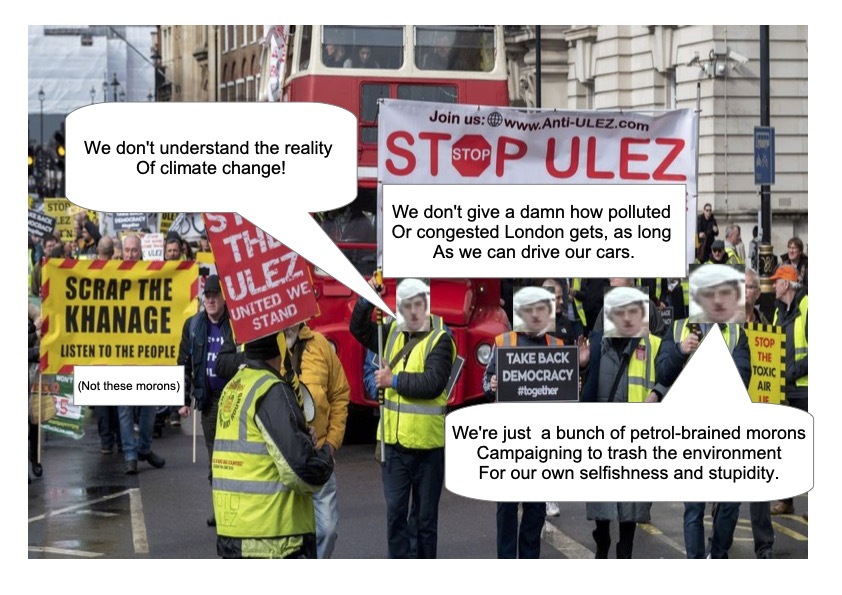
I was going through Westminster earlier when I came across a protest. It was only fifty people or so, but it struck me as so shortsighted and repugnant that it compelled me to make this picture.
I was out and about again earlier. Today I chose to stay local and explore a bit more of the nearby parks. I was going through Sidcup, though, when I suddenly heard a man’s voice telling me to stop. Slightly puzzled, I came to a halt in my powerchair, and was approached by a scruffy looking man. I didn’t recognise him and was slightly taken aback. The guy then started to explain that he was homeless and asked me for two pounds.
To be honest I felt slightly afraid. I chose not to say anything but just drove away in my chair. I didn’t want to seem rude or heartless, but what could I have done? If I wanted to give the man some money, it would have meant inviting him to open my bumbag and get it out himself – something which, I think you’ll agree, would have been downright idiotic. I think saying nothing and just driving away was the right thing to do, yet beggars always make me feel awkward and uncomfortable: part of me really would like to help them, but ultimately I know I can’t. As I said here last year, surely such people should have access to the same social support structures anyone else is entitled to, so why do they come up to people like me in the street, asking for small change? And why do I still feel so troubled for not being able to help?
I never learned to ride a bike, of course, so you could say I don’t have the experience to comment on this, but I really am starting to think that cyclists should have to pass some sort of Highway Code qualification before they’re allowed out on the road. This morning, before it began to bucket it down, I was on my way to Lewisham for my stroll. It’s a route I take quite a bit these days, of course sticking to the pavement as the road is so busy. As I was trundling quietly in my powerchair though, a cyclist swept out in front of me and tore right in front of an oncoming bus, nearly getting hit. It could have been utterly horrific, and I had to draw a sigh of relief. It made me wonder, though: do cyclists not know the rules of the road? I see things like this more and more these days. Some cyclists seem to think they own the road and can do whatever they like, from swerving in front of traffic to totally ignoring red lights. Not only is it arrogant, but it is downright dangerous. I really think that, as more and more people start to use bikes, they should have to complete some kind of road safety course.
One of the things I love most about London is, no matter how lost I get, no matter where I find myself, I know I can just hop on a bus and eventually I’ll get home. I just got back from quite a crazy afternoon: my initial plan was to just get the tube up to Stratford and have a nice walk around the Olympic park. Once up there, however, I happened upon a stretch of canal which I hadn’t followed before, and temptation soon overcame me.
I followed it and followed it. Pretty soon I had left the Olympic park, trundling north. It was still fairly early so I wasn’t worried. The canal was pretty, and I was heading through some wonderful little parks. An hour or so later, though, I was beginning to wonder how to get back to Stratford, having suddenly realised that I had absolutely no idea where I was.
I decided to leave the canal and look around for a bus. After all, I couldn’t be too far from Stratford, so there was bound to be a bus which would take me back there. When I found a bus stop though, there was no sign of Stratford on any of the destination lists. And it was then that the afternoon became interesting.
I put my hand out to request the first bus which came. I had no idea where it went, but I reasoned that it would get me back to Stratford somehow. Once aboard, however, I soon realised that the bus was not going anywhere near where I wanted to go: it was headed into central London rather than to Stratford.
I knew that I would get home eventually so I told myself not to panic. After all, the reason I leave my flat every day is to explore the city. The bus was going further and further into London though, and I had no clue how to get home. Of course, some would say that this was a stupid predicament to get myself into, and that I shouldn’t go off on these aimless wanderings all over London. Yet I have found that my trundles are the best way to get to know this wonderful,beguiling labyrinth in all its fascinating diversity. Thus simply retracing my steps seemed too much of a surrender. I thus stayed on the bus until it reached its destination at Wood Green, before getting off and looking for ways to get either to Stratford or somewhere I was familiar with, and from where I knew how to get home.
I looked around for a while. Wood Green seemed like a charming place which I told myself to revisit some time. Unfortunately when I investigated the tube station I found it was completely inaccessible, so getting home that way was out of the question. Luckily outside the station I found a bus stop with one of the buses going down to London Bridge.
Fortune, it seemed, was once again on my side. London Bridge station is on the Jubilee Line, of course, so getting home from there wouldn’t be a problem. The only down side was that I hadn’t realised how long the journey would take, and I then spent about two hours on the bus as it wound its way through central London. Oh well. At least I got to see a bit more of the metropolis, typing this blog entry into my iPad as we went. And at least I now know that, no matter how lost I get, I will always be able to find my way home. The system is far from perfect, but it is only because so much of London’s public transport system is now accessible that I can make such trips, and go out confident that, whatever happens, no matter how lost I get, I will be able to get back in time for dinner.




 The Ill-Informed Ramblings of a Cripple