Sandy Trails

I was just browsing Facebook on this dull wet afternoon, when I came across a link to this new blog on one of the disability related pages. The fact that it is focussed on travel got me interested of course, but I’d just like to flag up something I find problematic. It’s a blog written by the mum of a man called Corey, a 25-year-old American with Spinal Muscular Atrophy. She says her blog is about ‘Empowering caregivers’, and writes “At My Sandy Trail, I believe that every caregiver deserves to be healthy and happy. My blog shares inspiring stories and tips not only for making wheelchair accessible travel a reality, but also ensuring that you and your loved one can create unforgettable memories together in a safe and healthy way!”

Sorry if I’m being a bit grouchy, but this instantly sent my mind back to what I wrote here, about people speaking for disabled people when we’re perfectly able to speak for ourselves. Such so-called ‘advocates’ may mean well, but isn’t it a bit patronising for a mum to speak for her son, and document their adventures online? Can’t he do so hisself, so we get his own perspective on the issues he faces rather than that of his mother? After all, this blog would be vastly different if my parents were writing it for me (it would probably have a lot more about making marmalade!) On the other hand, it could well be the case that Corey does not want to blog and is fine with his mum documenting their adventures, so I better not read too much into it. Even so, I still think accounts of disability issues from disabled people rather than their ‘caregivers’ are always preferable.

Zahawi Defects

I got in from my trundle earlier to read the news that Nadhim Zahawi has now defected to Reform. Of course I automatically flew into a spasm of rage – anything to do with that group of deranged xenophobes irritates me like a bee sting. But now that I come to think about it, you have to wonder what it might mean. It’s obviously one of the biggest political news stories we’ve seen in a while: on the one hand, it’s obviously a sign that Reform are getting bigger and stronger as a political party, which should be an anathema to any sensible, intelligent person. On the other hand though, it’s also obviously a sign that the Tories are getting weaker. Zahawi was once their chancellor after all, so could the defection of someone once so high up in the party be a sign of something quite major? The beginning of the end of the whole Conservative party, perhaps? Then again, as fond of that thought as I might be, with global politics looking like it does, I dread to think what far right scumbaggery we might get in it’s place.

American Filmic Dick Waving

I watched Top Gun Maverick on Channel Four last night. There was nothing else on TV, I hadn’t seen it before, and I’m still looking for something new to get into. However, I soon started to find what I was watching utterly nauseating: as a film it is crammed with American bravado like sickly sweet ice cream piled onto a cone. It’s essentially about a fighter pilot who seems free to break any rule he wants, training a group of fellow pilots for a seemingly impossible mission against a vague, unnamed enemy. This group is always referred to as ‘the best’, probably just because they’re American, and is shown buzzing around in multi million pound fighter planes like they’re toys.

Look, I know I shouldn’t be too negative; I also know I can’t give any real, in-depth analysis in one short Sunday morning blog entry. But this really was American filmic dick waving*. It came across as a statement that Americans can do whatever they want and get out of any situation simply because they’re American. For example, towards the end of the film, the stranded Tom Cruise Maverick character just steals an enemy fighter plane they’ve just left lying around! It stretched the limits of plausibility far beyond breaking point, but the film treated the characters with such cheesy gusto and reverence that it made me want to puke. I don’t know how much my opinion of this film has been tainted by what I currently think of the USA, but in the current light, such tripe came across as nauseatingly arrogant and infantile.

*We Brits could obviously be accused of doing the same thing with James Bond. Yet it seems to me that, while everyone knows 007 is a mythological remnant of a long-faded empire, this was a reflection of how America actually perceives itself and it’s authority over the wider world.

Qa’Pla To The Silkmen!

Changing the subject entirely, my heartfelt congratulations must suddenly go to Macclesfield FC. I don’t mention football much on here, but, as a guy with roots down the road in Congleton, Macc are still one of the teams I keep an I on. My heart was in my mouth as I watched them play Crystal Palace just now. To be honest, just being able to watch such a football match on the BBC was awesome in itself; but watching the Silkmen pull off what many are now calling one of the biggest upsets in football history surely made my weekend.

Now to see how Charlton does….

When Utopias Become Dystopias

I really am getting old, aren’t I? I was looking into the new Star Trek series, Starfleet Academy, a bit earlier. There was a time, not that long ago, when the prospect of a new Star Trek series would have made me ridiculously excited. It would have been all I could think about. I knew how infatuated I had been by the previous Star Trek series, and would be looking forward to that continuing:: epic stories about wonderful characters exploring the galaxy.

Now though, that giddy excitement has been replaced with a deep resentful cynicism. Star Trek is not by any means what it once was: the epic stories it once told us of a United humanity’s exploring the galaxy have been replaced with puerile streams of cliches and nostalgia. I no longer have any interest in watching such tripe. Of course, a large part of the problem is the fact that I no longer respect the country Star Trek comes from. There is no denying the fact that Star Trek is an inherently American franchise, and that the vast majority of its characters are ultimately American. Despite its claims to multiculturalism, the future Star Trek shows us is ultimately an American one, and after so long letting it slide I’m afraid that is a notion which I now find repugnant.

The last future humanity needs is one where America dominates, or at least the America we now have. A future where yanks fly around in star ships, doing whatever they want having dominated all other cultures on earth. I have no interest in watching a television program made by the fools who elected Trump, whose country is now descending into the depths of fascism; a program portraying the world remade in their image, where their culture stands over all others. A future where everyone speaks English in American accents, plays baseball and listens to New York jazz. 

While I daresay that I will never stop loving characters like Picard, Worf or Miles O’Brian, the utopian future Star Trek shows us seems repugnant and dystopian under the current light. What we took to be a future of unity now seems like one of dominance and control. Or rather, the culture which such enticing stories came from has now transformed from a bastion of tolerance and opportunity to one of repression, dominance and hatred. The storyteller has transformed, so the stories change too: a realm of unity and acceptance now seems, in this deranged Trumpian epoch, like one of conformity. Contemporary America casts a deep shadow over all of Star Trek, so if Star Trek can be said to reflect America – as it always has – then I have no interest in it.

Blatant, Sickening Deception

I don’t think I have any choice today but to direct everyone here, to today’s Owen Jones video in which he discusses recent events in Minneapolis. What is unfolding there and in America at large is utterly shocking: as I understand it, an immigration officer shot dead a 37-year-old woman. She was behaving peacefully, but Trump has immediately attempted to rewrite what happened and claim she was breaking the law or attacking the officer. Evidence is obviously scant, but going by what Jones shows us, what Trump is trying to do here is a brazen act of fascism. There is no other word for such a clear attempt to distort the evidence. We are now watching. the world’s most powerful superpower being overtly manipulated and deceived by a right-wing autocrat while those who dare to oppose him are being shot in cold blood. We should all find that very worrying indeed.

Peter Hujar’s Day

By and large, film is a very accessible artform. Most of the time, I can just wheel into a cinema, watch a film, and get what it is about. I can understand the story the audience is being told. However, this wasn’t the case yesterday. John said he was going to watch a film at the Barbican, and once again invited me along. The film he intended to watch was called Peter Hujar’s Day. I’d never heard of it, but as usual try to be open to such opportunities.

We got into the screening room slightly late (my fault), but what I found myself watching was very odd indeed. It wasn’t a conventional film at all: it was just two people, a man and a woman, talking. They spoke and spoke, mostly about his apparent career as a photographer. Nothing else happened; there was no other action or any kind of establishing shots. While I recognised a few of the names the guy mentioned such as Susan Sontag, pretty soon I felt my mind wandering. To be honest when the film ended, I was baffled what I had just been watching.

In this case, however, context is all. When we got home John explained it to me: the film is essentially a dramatisation/visualisation of audiorecordings made in 1975 by Linda Rosenkrantz of her conversations with photographer Peter Hujar. The recordings tell of his interactions with all kinds of famous New York artists, such as Andy Warhol. They essentially give us a glimpse of the vibrant artistic landscape of New York fifty years ago. Being told that instantly put what I had just seen in a fresh light: it wasn’t just a piece of dull, pretentious fiction I’d assumed it to be, but an interesting fragment of reality and art history. Audio transposed into the visual. As soon as I was told that, I kicked myself for being such a luddite, and now feel the need to find out more.

Woman in Mind

John gave me quite a surprise yesterday. When he checked his calendar, he remembered that he had booked for us to go and watch Woman In Mind at the Juke of York’s theatre yesterday evening. I didn’t know anything about it – I hadn’t even heard of the play – but I’m always up for such things. When I googled it though, I saw that Ramesh Ranganathan was in it, who I still have quite large doubts about.

To be honest, what I found myself watching yesterday was very troubling indeed. A 1985 play by Alan Ayckbourn, Women in Mind purports to be a comedy, but frankly there is nothing comic about the subject it deals with. It depicts a woman with schizophrenia and her decent into severe mental illness: we see her interactions with various hallucinated characters as she becomes more and more troubled and uncomfortable. Frankly, knowing what I know about mental illness, I found nothing funny about it; but the fact that we were supposed to somehow find what we were watching humorous, as these hallucinations cavorted across the stage, left a very nasty taste in my mouth. It was as if the audience were being invited to laugh at the woman’s illness and clear, increasing discomfort, as if it was just all a big jolly game. I don’t know if I missed something, but as society in general becomes more aware of mental illness and it’s seriousness, I’m afraid to say I found it rather perverse.

Time for the American Epoch to End

We learn from history that there are often periods when certain distinct powers or cultures have risen to dominance: the Roman Empire, the Spanish Empire, the British Empire etc. Epochs when countries have been so large and powerful that they have more or less ruled over or dominated the known world. History also tells us that such empires also invariably come to a crashing end. For the last seventy years or so, since at least the end of the Second World War, the USA has been that dominant power: it has been the world’s richest country; American culture has dominated our screens.

Yet, since 2016 at least, so called American exceptionalism has been shown to be a sham, and Americans to be fools taking credit for the creativity and ingenuity of others. Ask any American and the internet was an american invention, used predominantly by Americans; the same goes for film, music, or any other staple of modernity. But just as the web was the invention of a Brit, Tim Berners-Lee, the time has come for Americans to get off the bloated cultural pedestal they claim as their birthright. From the sound of it, of course, Americans still think they dominate, and once Trump is removed from office things will return to what they perceive as normal. Yet I now think it’s time for the American epoch to end, and America to be put in it’s place: it’s recent aggression towards Venezuela puts that beyond all doubt.

It’s time for Americans to realise that the world isn’t theirs to dominate, and they aren’t the world’s police. We are perfectly capable of settling our disputes without the jumped up buffoon in the White House getting in the way or taking credit. Trump has transformed the USA from benign, welcoming superpower into an arrogant fascistic bully, and I’m afraid that change is now irreversible. The only question is, who could replace them?

A Hint Of Spring

I just got home from my daily trundle. It was just one of my regular routes, past the Royal Standard, through Charlton and Woolwich, along the river to North Greenwich then home via bus. It was cold but the sky was clear and blue, and as I was going I was struck by a feeling of pleasant familiarity. I was going through areas I know well, and which all now trigger warm, pleasant memories. Places which have a homely, relaxing quality for me: parks where I remember watching cricket matches, cafes where I remember drinking coffee; the path along the Thames, flowing imperiously eastward as it has done since before the beginning of history, along which I have now rolled many times. Thus in spite of the cold I couldn’t help feeling a hint of spring in the air, as if the metropolis about me was telling me that a wonderful new year was on the horizon. The future of the wider world may seem troubled and uncertain, yet the timeless beauty of this city, of its parks and rivers and grand historic buildings, will always shine through. In them there is always the potential for something incredible; and, like the river flowing through it, the city will remain constant as it has always been, no matter the folly of the world around it. Whenever I need to remind myself of that, I know I just need to head out for a trundle.

A Timely Allegory

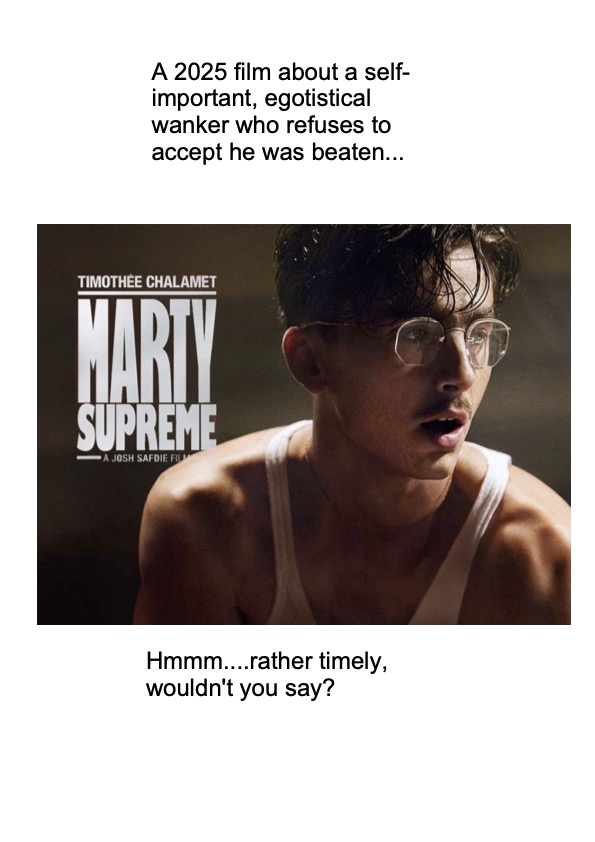
I went with John to watch Marty Supreme on Thursday evening. It’s a very odd film – a biopic set around a central character who I left the cinema despising.

The guy was so obnoxious, arrogant and cocky that I left the cinema wondering whether the audience was supposed to have any kind of sympathy with him, or why anyone would make a film about such a jerk. But then it struck me that the film was just a very timely allegory for Donald Trump, or even the USA itself.

Wild, Beautiful London

There is only one place I can possibly direct everyone to today. I just watched Wild London, having gone out to the cinema last night. What I just saw was a real treat: I’ve now lived in London for sixteen years or so, and like most people tend to think of London as a concrete urban sprawl. What Sir David Attenborough does in this amazing program is reveal the wildlife of the metropolis to us: it’s always there, if you just look, in the gardens and parks and canals. We tend to associate Sir David with the far-flung wild corners of the world – the great oceans and deserts and mountains. But what I love about this program is that he brings the same sense of wonder and beauty home to our very doorstep. Above all, this documentary makes me more eager than ever to go out into this city and explore Wild London for myself.

Moulin Rouge

John and I seem to have started quite an awesome New Year’s Eve Tradition. After going to watch Cabaret last December 31st, John proposed we go to see Moulin Rouge. I have seen the film a few times of course, so I was obviously up for it. What I didn’t really expect, though, was quite what a fantastic treat I was in for: as soon as the performance started at the Piccadilly Theatre last night, I was drawn into a world of singing and spectacle; proletarian revolutionaries and Montmartre whores, snapping into a vast array of pop songs and sophisticated dance routines at a moment’s notice. While I don’t feel like writing any form of in-depth review, this was west end theatre at it’s very, very finest.

In short, Moulin Rouge is a great piece of cinema adapted for the stage, resulting in a production which once again reminded me just how awesome life in this city can get. Yet the issue I have today was the same problem I had last year, and whenever I go to such wonderful performances: how can I recapture the sense of life and joy that I felt last night? It was a beautiful, heartbreaking love story, told through music and dance and humour: the tale of the doomed love affair between an English writer and a flamboyant dancer. The audience was pulled into the stage so that the whole theatre felt alive. One moment I was on the verge of tears and the next at the height of euphoria. It was the kind of experience you can only encounter in a west end theatre: impeccably timed, professionally performed, yet seething with humanity and pathos. I felt it resonated with me personally – as did, I daresay, everyone else there. Yet ultimately it was a truly sublime way to see in the new year, although to be honest my appetite has just been whetted for more.

2025

Truth be told, now that I’ve sat down to write my annual summary of the year, I simply find myself wanting to echo what I wrote about 2024. Rather like the last one, it wasn’t that spectacular a year: my trips to Cyprus and Paris were obviously great, but that’s about it. More widely, the picture grows ever more concerning, and I’m afraid that it now darkens every time I watch the news. If anything things are now even more ominous. The situation is now so unpredictable that what the new year will bring is anybody’s guess. Yet every morning I still wake up knowing that there is potential for something incredible to happen, so we can’t get too downhearted. I really hope everyone reading this has a great new year. The wider world might well be going crazy, and sociopolitical forces which humanity should have outgrown long ago may now be resurgent, but that’s no reason not to go out and have fun.

Meaningless Labels

I wrote recently about my experiences of growing up going to a special school, and about how that meant I came into contact with young people with a wide range of disabilities. That includes kids with autism. While, to my knowledge, none of the young people in my class was on the autistic spectrum, many of the kids at school were quite profoundly autistic, and my experiences there have done a great deal to inform my conception of what autism is. It is a profoundly debilitating condition, as severe and serious as any other disability. The young people at school who had it were profoundly disabled and could barely do anything for their selves.

The problem is, as I started to explain here, these days the term seems to be being used more and more flippantly. This morning, for instance, I was on the tube up to Stratford when I overheard a teenager describe someone as “Obviously on the spectrum”. I must admit it immediately caught my ear: the statement was made so flippantly and casually that it could almost have been a joke, as if Autism is now nothing more than a mere social trend. People have apparently began to pin such labels upon one another at will, probably thinking they sound clever for doing so but obviously having no understanding of what being autistic really entails. Yet in so doing the terms they use so casually loose all meaning. When I think back to the young people I saw at school, barely able to do anything for them selves, I can’t help finding it sickening to hear such terms now being used in this way, as if being autistic just means you have a few personal quirks, and is no more significant than someone’s hair colour.

The Woes of the Wider World

A couple of days ago I wrote how comforting it was to spend Christmas Day with my family. We were in the very North London house which used to belong to my grandparents, and which I still have extremely warm, happy memories of. For that day, the woes of the wider world seemed unfathomably distant. I have, however, just come across this article by John Simpson, and the woes of the wider world have come crashing back. I’m not sure how much of it is hyperbole or exaggeration, but it is the first time I have seen someone talking so openly about the prospect of an imminent Third World War. Simpson writes “I’ve reported on more than 40 wars around the world during my career, which goes back to the 1960s. I watched the Cold War reach its height, then simply evaporate. But I’ve never seen a year quite as worrying as 2025 has been – not just because several major conflicts are raging but because it is becoming clear that one of them has geopolitical implications of unparalleled importance.”

With Russia more warlike and confrontational than it has been in decades, and Putin’s puppet now installed in the States, the world clearly now stands at an extremely dangerous juncture. For the most part, my generation grew up in a world of peace: It’s all we have known, and it is what we have come to expect. Yet, from the sound of it, that is about to come to a crashing, catastrophic end. Largely thanks to things like Brexit and the rise of Trump, the old certainties we once depended upon have now evaporated. Russia is growing ever stronger and eager to dominate; America is becoming isolationist and inward-looking; Europe is becoming weaker and more powerless to intervene. As much as I hope this is just exaggeration and melodrama, reading articles like this should make us all gravely concerned.

The Rise Of Something Hideous

Sorry to get slightly heavy, but as someone becoming increasingly concerned about the rise of Christian Nationalism and religious fundamentalism, particularly in America, I think I need to flag this Jimmy The Giant video up. While I’m not sure I agree with absolutely everything he says, it is quite an excellent summary of the rise of the religious right in America, and how Christianity is now being used as an overtly political, reactionary tool with which to justify all kinds of bigotry and xenophobia. Whatever your personal religious beliefs, it should be becoming increasingly clear that what we’re currently witnessing in America is the rise of fascism. It’s leaders shroud it in the guise of religion, and that unless it is called out, it is on a path to somewhere truly horrific.

Cameras, Powerchairs and Laps

I suppose as usual, writing about a problem is the best way to find its solution. I’ve written before about the increasing issues I’ve been having with kids: when I’m out and about, young people seem to be talking more and more pleasure in winding me up and taking the piss. To try to combat it, for Christmas this year my parents gave me a body worn camera, the thinking being that if I could record the obnoxious youngsters perhaps it would deter them. On paper it was a good idea, but the problem is I’m not the world’s best camera person. When I ventured out yesterday afternoon, my new camera pinned to my jacket, it invariably drooped and panned down to take a shot of my knees. No matter what I did, I couldn’t keep it level and facing forward; we just got a long, steady film of my lap. It’s quite a shame, not least because if I’m going to give people an idea of the issues I’m having with young people these days, such a camera would obviously be the way to do it. I’m now trying to come up with ways to mount the camera on either my jacket or powerchair, and would be very much open to suggestions.

Constants at Christmas

Long term readers of this blog will probably know that I’m not a religious person. Today I could launch into a tirade about how Christmas is nonsense, and essentially a pagan midwinter festival hijacked by a Middle Eastern death cult. Yet I really, really don’t think it’s the day for that: This Christmas finds humanity more divided than it has been in a long time, with people finding it harder than ever to see eye to eye. The news from America especially gets more troubling by the day. It is becoming genuinely disturbing, and I frankly dread to think what news will come next. Yet, personally, this Christmas Day morning finds me with my parents, in the same old family house in Harlesden where I spent many Christmases as a child. It is quiet and warm, and there is the smell of roasting turkey in the air: there can be little more comforting or comfortable. It almost feels like my life has regressed thirty years, just for the day. Thus, as divided as the world is right now, and as furious as the news may make us, it is always good to remember that there are still some constants you can depend upon.

A Sensible Trip?

I’ve opted to stay home today and just stick to watching stuff on Youtube. I was just watching a video about New York, and caught myself thinking that it would be fantastic to go there. Perhaps, one day in a few months, I could head that way with John. The thing is, can I? These days, the news from the US is getting worse and worse: it is getting truly frightening, with Trump becoming more deranged and fascistic by the day. I don’t want to be melodramatic, but I can’t help wondering whether such a trip would be a good idea under current circumstances. Thus as awesome as a trip to New York might be, and as interested as I’d be to see how New York’s subway compares with London’s tube in terms of accessibility for example, as things stand I honestly have grave reservations. Frankly, that once shining beacon on the hill full of glitz and glamour and possibility, is starting to look like a cesspit of reactionary division, intolerance and hate.

Scrooge and Trump

It has been absolutely ages since I came across any particularly interesting literary analysis or criticism, but particularly given the time of year, I think I need to flag this Steve Shives video up. As a piece of political commentary, I think it’s especially astute. In it, Shives compares Donald Trump to Ebenezer Scrooge. The two obviously have quite a few touching points; both are utterly selfish, self-important bastards. But what I find cool is how Shives uses Dickens’s famous Yuletide miser to make astute points about current American politics: Scrooge may have had his faults, but at least at the end of the story he realised he had to reform, and was shown to have a modicum of humanity and compassion about him after all. At the end of the day, Scrooge listened to what he was being told, rather than just dismissing the three ghosts as some sort of woke conspiracy intended to manipulate him. It is frankly great to see classical literature still being used to make such wry, observant political points.

Another Great Ian Fleming Biography

I’m fairly pleased to report that I finished Nicholas Shakespeare’s 2023 biography of Ian Fleming, The Complete Man, a couple of days ago. Although I mentioned that I have a hardback copy a few days ago, it’s quite a thick, dense text, so I opted to be lazy and find an audio version too, enabling me to relax while getting through it. As a Bond fan, Fleming is still a historical figure who continues to intrigue me: obnoxious, arrogant, privileged, yet somehow also fascinating. For example, Shakespeare goes into a lot of detail about Fleming’s involvement with secret services during World War Two and the formation of 30AU and SOE, and you get a good idea of how such experiences could have lead to the creation of the character James Bond and the mythology surrounding him. For one, it was particularly clear the extent to which Admiral John Godfrey, Fleming’s intelligence boss during the war, was the basis for the character M. Shakespeare also takes care to place such information in quite a bit of contemporary context, updating the narrative with any relevant subsequent details. Thus I couldn’t help but get drawn in.

Shakespeare also includes a lot of cool details, such as about the meeting between Fleming and the actual James Bond, the Caribbean ornithologist. As I said about Andrew Lycett’s biography of the same writer, Fleming may have had his faults, but it is only through such background information that we can get any real understanding of the origins of a character which went on to be so prominent in popular culture. He may have been an arrogant snob and an anachronistic remnant of a fast fading empire, but the fact remains Fleming made a huge contribution not only to post-war literature and popular culture, but British history and wartime intelligence. Frankly, I find him as fascinating and enigmatic as the character he created, and biographies like this help bring that to light.

Truth To Power on Trump And The Beeb

Not that I like simply directing everyone to Youtube videos, but I think anyone as disgusted as I am at the fact that Trump is suing the BBC needs to check this analysis out. In it, Truth To Power lays out precisely what is going on. What the disgrace to human civilisation who Americans currently call their president is doing is actually rather disgusting: he’s actively, knowingly misleading people, overtly attacking a hugely respected public broadcaster, accusing them of something they manifestly did not do. I must say, as much as I like hyperbole, and as strongly as I think we should all get behind the Beeb, what Trump is trying to do as laid out in this video is beyond obscene; the broader picture of what he’s doing should frankly make us all furious. For one, what I didn’t know is that he’s now accusing the BBC of altering his Capital Hill Speech using CGI, to make it appear that he said things he didn’t – even though he actually did. It would be comic if it wasn’t so perverse; completely ignorable if it wasn’t so dark and ominous.

It Was Just An Accident

I’m glad to say yesterday was quite a treat. I went with John to see It Was Just An Accident at the Barbican, and I honestly don’t think I’ve seen a more compelling, interesting film in a long, long time. I would highly recommend everyone goes and sees it if you can, as you couldn’t get much more different than the usual, commercial tripe you see in cinemas these days. Essentially an experimental Iranian film, it has kind of a ‘chain of thought’ format, with one event leading to another in a fascinating way. I’m not going to say much about it, but direct everyone to Mark Kermode’s review here.

However, as a disabled commentator I have to point out that one of the things I found particularly interesting and striking was the fact the entire narrative was fuelled by the fact a character had a prosthetic leg. A lot can be said about the politics underpinning the film, and the fact that it was made by a maverick Iranian director; but I really think this disability theme needs to be pointed out, lest it gets ignored. The only reason the chain of events the film depicts is set in motion is because one of the characters has a fake leg. As fascinating and brilliant as the film is, from a disability perspective that detail left a nasty taste in my mouth. Call me a stickler if you wish, but I really don’t think such uses of disability, or the fact that a character can be identified by their disability in this way, can really be overlooked.

Even so, It Was Just An Accident is certainly one of the great films of this year.

Sir David Attenborough’s London 

It is awesome to see that, in these days of such turmoil, there are at least some constants we can still rely on. You may have already heard that the great Sir David Attenborough is about to present a new nature documentary, due to air 1st January. I must say I find that utterly remarkable. When you remember that this man has been a stalwart of the UK’s cultural life for the past seventy years, it is frankly jaw-dropping. The cool thing is, this new series will focus on the wildlife found in London: people often think of the city as a sprawling concrete labyrinth, and often don’t realise that there is far more natural beauty – and indeed peacefulness – than you might think.

More to the point, Sir David has done more than anyone to open our collective eyes to the beauty and sophistication of the natural world. These days, people make a lot of fuss about all kinds of things, but I honestly think we collectively need to do a bit more to show our appreciation for such a remarkable man, broadcaster and father figure.

Pillion

Most mornings after I’ve been to the cinema, I often wake up wondering what my parents might say about the film I’ve just been to see. Many films are so interesting that I’d be rather fascinated to get Mum and Dad’s opinion. This morning, however, was different. John and I went to see Pillion last night, and while I personally found it very interesting indeed, I really don’t think it’s one for my parent’s generation. That is not to say I don’t think they should watch it, but rather that it’s not quite their cup of tea.

At it’s best cinema opens our eyes to new worlds, and that’s exactly what Pillion did for me: I was totally unaware of the secretive biker BDSM society it depicts. Of course I like to think of myself as an open-minded, worldly sort of guy, but the culture I became aware of last night seemed truly, truly strange. Men being submissive to other men in a kind of kinky, fucked up yet somehow consensual relationship. It certainly wasn’t the kind of thing I’d expect to encounter at a cinema in Peckham on a dark Tuesday evening. At one point I found myself wondering why it was being shown to us, and given the nationalities of the two central characters, whether it was some kind of analogy for Anglo-American relations. Why was this specific culture being depicted; and – perhaps more to the point – how widespread is it inn reality? It was unexpected, illuminating, and to be honest quite fascinating. But then, isn’t that what all art is supposed to be?

Check out Mark Kermode’s review here.

Time To Get Behind The Beeb

I think I’ve said here before how passionately I support the BBC: as far as I’m concerned, it ranks alongside the NHS as one of the publicly funded institutions which make the UK worth living in. Thanks to the Beeb, I know I can wake up to fair, impartial news every day, as well as ad-free entertainment and first class documentaries. That is why I am, needless to say, appalled at the news that Trump is now suing it for defamation. I’m obviously not a legal expert, so I’m not going to say much about it; although surely I’m not the only person to suspect that Trump’s pal Nigel Farage had a lot to do with this, in his acrid quest to get the BBC out of his way. Nonetheless, this should be just another piece of news to deepen our contempt for the disgrace to human civilisation who the Americans now call their president. If we all respect the BBC and the cultural treasures it has brought us over the years, surely we must get behind it to oppose this bully.

Star Trek’s Next Decade

I wouldn’t be able to justifiably call myself a Star Trek fan if I didn’t direct everyone here today. While it may essentially be a list of rumours, I have a lot of trust in the source, Trek Culture, and the projects he notifies us of are potentially too thrilling or interesting to ignore. They include a lot of actors reprising their roles, including Scott Bacula as Captain Archer; but the one which caught my attention was the potential of A Star Trek-Dr. Who. crossover. Frankly that seemed too crazy for me to ignore. I may not be a Dr.Who fan, but Russel T. Davies has been talking to the guys at Paramount. This gives rise to the potential for something truly crazy, but given such strange mixtures are happening more and more these days, this is something I’ll certainly be keeping an eye on. It would be very interesting to see how the Beeb and Paramount might coordinate, and how they might fit the two fictions together in a convincing, satisfying way. After all, you know how excited I get about such crossovers and extra-textual play.

That aside, judging by what is outlined in this vid, it seems we Trekkies have quite a bit to look forward to.

What if Hitchcock had made a Bond film?

I just got wind of an absolutely fascinating tidbit of information. I’m slowly getting through Nicholas Shakespeare’s biography of Ian Fleming, which I’m thoroughly enjoying. On page 599, Shakespeare writes how, in 1959, Fleming was desperate to have a director like Alfred Hitchcock adapt Thunderball, going so far as to write to Hitchcock’s wife. He, however, was busy filming Psycho. Yet it seems to me that this is one of those great ‘what ifs’: What if Hitchcock had made an early Bond film? What if he had contributed to the foundation of the franchise? Would they have turned out the same way? Or might they have become edgier, darker and more suspenseful? I must admit I find that possibility tantalising.

Another Fantastic View

Just to expand upon what I was saying about the view from Greenwich Park a few days ago, today I found another, possibly equally wondrous view. I was trundling the other side of Lewisham, where I found a small park called – appropriately enough – Hilly Fields. It’s rather high, and from there you can see all of south London stretching out flat below. If ever you get chance it’s definitely worth a look. Unfortunately Google streetview doesn’t do it justice, but as soon as I saw it I knew it was worthy of a blog entry.

London may have a reputation as an ugly concrete, tarmac and steel labyrinth; yet the more I explore the city, the more beauty I find here.

Video Game Studies?

I saw on the news over breakfast today that the eleventh annual video game awards have just been held. You can probably tell I’m not much of a ‘gamer’: the last time I played anything resembling a computer game was well over twenty years ago. Yet the fact that there are now awards ceremonies associated with the computer game industry seems to me to give rise to a few interesting questions. These awards were established in 2014, and obviously attempt to emulate the Oscars. If so, could it be said that these awards are an attempt by the game industry to put itself on a cultural parr with film? An overt statement of equal intellectual and cultural importance; sort of like declaring computer games to just be films which you can play. After all, look at any first person game and it’s aesthetic is very similar to that of a film.

However, if that is the case, that gives rise to some quite interesting questions. If computer games can now be categorised alongside other art forms like film or literature, to what extent can they now be studied? Academic film studies has it’s origins in the 1950s (at least); it is a fascinating, complex intellectual discourse. Might a similar discourse now arise around games and gaming? After all, people have begun talking about games in great detail, particularly online: the question that interests me is whether such discussions have reached the same intellectual and philosophical level film studies reached largely due to the work of writers like Roland Barthes and Andre Bazin.

Could I Change Someone’s World?

For the last couple of weeks I’ve had a question rattling around in my head which won’t seem to pipe down. It first occurred to me on the day my powerchair broke down on the other side of London. Just before that catastrophe, I had been once again thinking about how wonderful it is to live in this fantastic city, and about how it all stemmed from the fact that I met Lyn. Had I never met her, I simply wouldn’t be here: I would never have moved to London and got to know this incredible metropolis. The chances are that I would still be living in Cheshire with my parents, and the notion that I could ever live in my own flat in south London would still seem absurd, or even frightening.

Meeting Lyn put an end to that: during my ten years living with her, not only did I start to get to know London, but I also learned that I didn’t need to rely on the cozy support structures which I had been used to since childhood. My world changed from a quiet, conservative two-storey Cheshire town to one of the greatest, most vibrant metropolises on earth.

When I think about it, it’s hard to sum up just how different those two existences are. Here I am, exploring this city, flitting on and off busses and tube trains, trundling around shopping malls and skyscrapers and royal parks; going to cinemas and concerts and shows, just like any other Londoner. I’m living a life which would once have seemed unimaginable. And it’s all because, around seventeen years ago, I received an email from someone called Lyn. Had that not happened, and had she not had the kindness to invite me to move in with her, zark knows how things would have turned out. That is not to say that life before Lyn was bad or uncomfortable; but that meeting Lyn took it in an energetic, thrilling, previously unthinkable new direction. She showed me what is possible.

What I find myself wondering now though, is could I one day make the same sort of difference to someone else? Could I change someone’s life as fundamentally as Lyn changed mine, and bring as much joy, wonder and potential for awesomeness into someone’s life as L brought into mine? I profoundly hope I can: It seems only fair, after all. The only question is, how?

Lifts and The Law

I now honestly believe that by law it should be illegal for anyone physically capable of climbing stairs to use the lift, at least at railway and tube stations. I know that might sound a bit extreme, but this problem is getting worse and worse. I keep coming across lifts which are broken, obviously due to overuse. Most of the time there are perfectly good escalators nearby, but it leaves those of us with no other option stuck. For. much of this week, for example, the lift at Woolwich’s Elisabeth Line station was broken, simply because so many people can’t be arsed to climb a short flight of stairs. It’s obviously only about two years old, so presumably would be perfectly fine if it was just used by people who needed to. Making unnecessary lift use illegal might be a big step, but I’m afraid this is another of those problems that the authorities need to get serious about.

Mind you, how it would be punished is another question: a fine? Community service? Jail? A day in the stocks? …I obviously need to think this through.

One Tree Hill

It worries me how much of an ignoramus I can be sometimes, especially when it comes to the arts. I was once again wasting time on Youtube earlier, when I came across this fantastic video recreating views of seventeenth and eighteenth century London. I naturally love that kind of thing, but interestingly it referred to a painting called One Tree Hill created in the mid seventeen hundreds. It is a painting of the Royal Greenwich Hospital, the Thames and the Isle of Dogs beyond, prefiguring almost exactly the view I wrote so adoringly a few days ago here. It would seem that that view has been popular for centuries.

Fooled Into A Spinoff

I was expecting to write my response to the BBC’s exciting new science fiction series today. From the trailers it had looked quite promising: at last something new to get into and blog about. Something which would potentially divert my intellectual energies away from the usual staples of Star Trek and James Bond. Thus last night I settled down to watch the first two episodes of The War Between the Land and The Sea full of optimism.

I freely admit I can be a dumbass sometimes, but it took me a few minutes to realise what I was watching. The opening struck me as somewhat cheesy, but I could let that slide. It wasn’t until I kept hearing references to “The Doctor” that I realised that, rather than the brand new science fiction series I was expecting, I had stumbled upon some sort of godawful Dr Who spinoff. The odd thing is, there had been no mention of Dr. Who in the trailers, leading me to feel rather misled.

I have not watched Dr. Who in years. It is, let’s just say, not my thing. As much as I love science fiction, I prefer it to be grounded in some semblance of reality – something which Dr. Who does not have. The plots are derivative and contrived, lapsing so far into the fantastical that it becomes nauseating; the special effects third rate at best. Thus to have been tricked into that fictional world when I was expecting something far more refined irritated me. More to the point, I quickly found that what I was watching wasn’t any better.

As an educated, aware man I have nothing against environmentalism. Of course we must do what we can to curb the damage we are now doing to the environment. However, to have such an ethos rammed down my throat with all the subtlety of a shovel wielded by a Eastend builder whose football team just lost five nill was another matter altogether. What we were witness to last night, with its mysterious sea-bound yet humanoid species emerging from the depths to reprimand us for filling the seas with shit, made Beavis seem like an expert in Lacanian psychoanalysis or a three-year-old with a well-loaded paintbrush look like Turner or Matisse.

Check out this no less critical Guardian article for slightly more detail, but if guys like Russel T. Davies want to spread the message of environmentalism, there are far better ways to do it than through something so crass and infantile. Of course, people need to be told about such issues, but to do so so heavy-handedly risks putting people off.

We Must Soon Step In

The stench coming from America is now growing by the day. I know I shouldn’t just keep directing everyone to videos I’ve just watched on Youtube, but I think this one is worth your attention. It details how Trump is now using the American Department of Justice to target his personal and political opponents, as if it was his own organisation to use as he pleases. This is the type of thing you hear about in Tsarist or Stalinist Russia. We may try to joke or brush it aside, but this is getting serious. I now see news and analysis like this coming from the US almost every day.

Of course, my concern may be being aroused by the videos Youtube suggests I watch, and other points of view will be being expressed elsewhere; yet more and more people are highlighting these issues. Trump is behaving like an autocrat, and saying that is no longer hyperbolic. We are fast reaching the point where something will need to be done, or not just America but the entire world will regret it. While I’d hope that the American political system has safeguards in place to prevent megalomaniacs taking total control, with Trump usurping their justice system like this, and with MAGA so rancid and fervent, that is looking more and more unlikely. That means outside forces will have no choice but to step in and restore order. The question is, what on Earth can we do?

Tech Billionaires And Star Trek

I think I’d be doing my blog, and everyone who reads it, a grave disservice if I didn’t direct everyone to watch this video essay by Jessie Gender. At over two hours it’s fairly long, and gets quite heavy at times, but it is the most impressive, interesting piece of Star Trek analysis I’ve come across in a long time. It is essentially an exploration of free-market neoliberalism and the role it plays in Star Trek and the future it presents to us: the utopian future of global unity and exploration which Gene Roddenberry set out for us, and which drew so many to Star Trek, has seemingly now been usurped and distorted by American hyper-capitalists intent on perverting it to suit their worldview. While I don’t want to offer any kind of half-baked synopsis, the conclusions it draws are far more complex and intriguing than you might at first assume. If you have the time, it’s certainly worth watching from beginning to end.

Long Lost Friends

A few days ago my mum told me something really interesting. Ever since I was very, very small, my family have been friends with a local Congleton family called the Pells. There was Carol, the mum, and two children: Andrew and Becky. We used to see each other quite regularly, crossing town to visit one another’s houses. It started well before I was born, and to be honest my memories of them are now fairly vague. However, a few days ago my Mum told me something I’m now keen to follow up: not only is she still in touch with Carol, but apparently Becky reads my blog! I can’t have seen her in over thirty years, so I think that’s rather incredible. Experience tells me how important to keep in touch with old friends, so Becky, if you read this, please drop me an email.