Probably the best place I’ll be able to direct everyone today is to this ARTE documentary on life inside MAGA and the shocking political extremism which has now taken hold of America. While you can of course point out that it has it’s own political agenda to pursue, what this film reveals is nonetheless utterly chilling: an extreme political cult which it is no longer hyperbolic to call fascist. We are watching such reports from America more and more though: a far right despotism seems to have taken hold of the working class there, bringing about a kind of cult of personality which surely can only recall the darkest episodes of human history. Who knows where this might lead, and you still have to hope that there are still enough intelligent people there to put the breaks on before it’s too late. But if documentaries like this are anything to go by, I honestly think we should all be very, very worried.
Still The Naive Eyes of a Newcomer?
It occurred to me recently that, even after almost seventeen years living in the metropolis, I still view London largely through the eyes of a newcomer. I managed to go out today after a couple of days stuck at home due to the weather. It was just one of my regular trundles around Canary Wharf and the Olympic Park. The thing is, whenever I head to such places, I am invariably stuck with awe. Both areas are sites of sleek, modern shopping centres which I can cruise around in my powerchair with ease. They are connected by a state of the art public transport system which I still derive great pleasure from using. The truth is, there is still something about this place, it’s infrastructure, architecture and history, which I still find incredible.
I find myself wondering why. I have now been living in the borough of Greenwich for nearly seventeen years: ten in Charlton, seven in Eltham. The city around me still somehow seems new and exciting to me. Had I been born here though, would I feel the same? If I had lived in London all my life, would it still be so captivating? Is it simply because I came from somewhere where such things did not exist – where public transport is still largely inaccessible and you rarely come across a building taller than four stories – the reason why I find a metropolis where they do so incredible? Am I still so enamoured simply because I once did not live here? Heading out on my daily trundles, in a strange way I almost still feel the wonder and curiosity of a tourist. As familiar as these streets, buildings and busses now are, might I still be looking at them through the naive eyes of a newcomer? And might that taint my impression of it, hiding underlying truths which might be clearer to native Londoners from me?
Screwy Priorities on the Evening News
I just watched the BBC evening news bulletin, and suddenly really think I need to point something out. The country is about to face the worst storm we’ve seen in months, possibly years – there could even be a serious threat to life. You would presume that any responsible national news broadcaster would have that as it’s lead story, at the top of the bulletin. But, bewilderingly, no! First the country had to hear about Meghan Markle’s dad being investigated by the MET police, as if this ‘royal news’ was somehow more important. When I saw that I was utterly aghast. Surely we have a major problem in this country if we are more concerned about this idiotic royal soap opera than we are about an imminent natural catastrophe!
Could a Northern Olympics be In The Works?
As both someone who is still strangely interested in the Olympic games as arguably the world’s biggest cultural event, and as a man who was born and brought up in Cheshire, I must admit to finding this news oddly exciting. “A £7m fund to explore how the Olympics could be brought to northern England will be announced in John Healey’s first Budget on Wednesday, the BBC has learned.” Having been fortunate enough to be living here in London in 2012, I think that is great, great news. I still remember what the metropolis felt like and the almost palpable sense of optimism in the air. If there is even the possibility of doing something similar in the north of the UK, then surely that is to be welcomed. Of course, it hasn’t been revealed what this ‘northern Olympics’ would look like, and exactly which cities and towns would be involved; but you can rest assured this is an embryonic possibility I’ll be keeping an eye on. There is a very long way to go and it could still come to nothing, but this might – just might – be the beginning of something awesome.
Why I Need To Go Out
Needless to say, today is a pretty good example of why I need to go out and trundle around London every day. Due to the rain, I’ve been stuck in all day, mostly at my computer, mostly on Facebook. The problem is, what I’ve been coming across has been making me more and more agitated. I’ve written here before about how wound up I get about things like politics, and today has been no exception. To calm myself down and cool off, every day I like to head out in my powerchair at about eleven or twelve to explore the metropolis. I find the change in activity really helps me refocus and think. Today, though, I’ve been stuck in due to the rain, getting more and more wound up by the increasingly idiotic things I’ve been coming across.
The thing is, it kind of makes me wonder: can a more general problem be read into this? Many other people have noted how we as a society all seem to be becoming increasingly uptight and adversarial with one another. Tempers seem to be growing shorter and shorter; people seem to be loosing their cool more and more easily. I wonder, could the rise of social media have something to do with this? I am no psychologist of course, but it seems to me that the way in which the Internet has made interpersonal communication easier than it ever has been, allowing billions of people from across the globe to exchange messages, thoughts and opinions in a way never seen before, may have had an adverse effect. On the web, we are just as likely to come across opinions which we don’t agree with than those we do; it also gives us the ability to comment on anything we come across, whether we agree with it or not. The problem is, we all seem to be finding this increasingly infuriating, and I can’t help wondering whether it could have something to do with the rise in right wing politics across Europe.
As for myself, I certainly hope the weather is good enough for me to go out tomorrow. Rain and powerchairs really don’t mix, but an afternoon at my computer starts to drive me bonkers. More broadly though, I suspect that is part of a larger issue. The internet may have brought everyone together in a way never seen before, but the downside of that may be a rise in echo chambers and political antagonism, the consequences of which might not be quite so cool.
A Chilling TV Experiment
I’m not sure how I didn’t notice it was on when it aired last night, but The Experiment must be one of the most important yet utterly chilling pieces of television I have ever seen. Ostensibly an investigation into Nazi eugenics, I would even go so far as. to call it essential viewing for anyone concerned with disability rights, equality and representation: in the documentary, facsimiles of the Nazi T4 extermination camps are set up in order to see how people today might react to ideas around the forced incarceration, sterilisation and extermination of people with disabilities. Quite frankly I found it horrifying to see how many of the people being shown around these fake institutions accepted what they were being shown. I wanted them to react with white hot rage, and I was glad to see some of them did. Anyone who knew anything about contemporary disability rights would have known that such a place would be totally unacceptable, and frankly part of me wanted to see one of them lose it and start demanding to see the place’s immediate closure. Needless to say, the relief shown on the participant’s faces when they are told it was all a fiction is a joy to behold.
We obviously need televisions like this. Attitudes towards disability are hardening and growing far more extreme. It was horrifying to see how easily people could accept the forced institutionalisation of disabled people, if it was presented to them as somehow humane. I must say, though, that I wasn’t sure I liked how the program towards it’s end segwayed into debates around assisted dying. I’m not saying the two issues are unrelated, but to overtly map quite a contentious political topic onto another might open the program up to accusations of political bias. Those in favour of assisted dying won’t see themselves as akin to nazis, but in the program they were conflated fairly overtly, which I fear opens up a completely new kettle of fish.
Writer’s Block
For a while now, I have been trying to start some sort of weighty writing project about Lyn. As a writer I think it’s more or less my duty to pay tribute to the most incredible person I know I’ll ever meet. I simply feel the need to sum her up in prose. Six years after her passing, I also feel it is time to start such a project. The thing is, I seem to keep hitting walls.
I really want to do this properly: I respected L enough to know that she deserves a proper, well researched piece of text. However, that raises the question, where to begin? The truth is, I don’t that much about her early life. I heard a few fragmentory stories, but I have no real substantial, reliable sources. I haven’t been able to get in touch with her brother Paul. I would really like to explore how Lyn came to be who she was, but to do that the academic in me is crying out that I need far more information than I have.
Then there’s the question of how to structure such a text. A straightforward biography would seem insufficient; but to go a step further and explore ideas around disability and gender would mean straying into notions of psychology, politics or both. To do so would seem to me to do a disservice to Lyn, who was never that concerned with such things. Above all, I think I need to convey what an amazing person Lyn was, and how much she meant to me.
I am thus confronted by the question of how to balance such a text: how do I even begin to sum up the most incredible, intriguing person I will ever meet in simple prose? To tell the truth this question has been frustrating me for a while. Lyn was an awesome person, and deserves something truly awesome written about her. The thing is, as I trundle every day around the world’s greatest city, thinking about the amazing times we shared, as well as the incredible debt I owe her for the life I now lead, I’m not sure I can do it.
We Need To Thank ITV
I just finished catching up with this ITV documentary exposing Reform as the xenophobic vermin they are. At about ninety minutes, it’s fairly long and involved, but I would entreat anyone even remotely concerned with UK politics to give it a watch. Mostly composed of undercover footage, it gives us an idea of just how sickening and abhorrent the views of the members of this party really are. I can’t deny being enraged by much of the xenophobic bullshit they are caught spouting. They can try to deny being racist all they like, but the fact remains there can be no room for the sort of disgusting regressive idiocy exposed here in any enlightened political discourse. Views like the ones exposed here will hold any modern society back, and I think we should surely be thanking ITV for showing us the truth of this putrid party. Naturally, there will be accusations of selective editing, and people will say we were only shown what the film makers wanted us to see; but the fact remains we surely should not have bigots like the ones displayed here, spouting puerile, sickening, xenophobic crap then claiming a kind of victimhood when they’re called out on it, anywhere near our political system. If anything, we should surely pity these people for being so unenlightened and misinformed; but it’s hard not to think they are an embarrassment to human civilisation in it’s entirety.
Finding a Palin Philippines Book
It seems that I have been happily corrected. Yesterday I wrote that I didn’t think there were any books to accompany Michael Palin’s new Channel Five programmes. To be honest that disappointed me slightly, as I feel the books add a certain depth and background to Palin’s travelogues. I was trundling through Lewisham a bit earlier though, and thought I’d pop into Waterstones, and to my surprise came across his book covering his journey to the Philippines. I didn’t buy it as I thought I had better pop home to make absolutely sure that it somehow wasn’t already on my bookshelf; but given that the book has only just been published, I think I’ll be heading back there soon to pick up a copy. Frankly, it’s good to see this televisual highlight staying up to form.
Channel Five has Nicked Michael Palin
I noticed something which I think is slightly odd recently about one of my favourite TV personalities: Micheal Palin seems to have been stolen by Chanel Five. I used to love his travel documentaries, and grew up watching series like Full Circle and Pole To Pole. They really made my feet itch, and want to go out and see the world for myself. The thing is, they were all made for and aired by the BBC, usually on Sunday evenings, and they all had books accompanying them. The odd thing is – at least, I find it odd – Palin has now started making very similar programmes for Channel Five. I noticed them a couple of days ago and naturally started to binge-watch. It wasn’t the first time I’d come across his C5 output of course, but I had had no idea he’d now done so many short, three or four episode series for them.
On the face of it, they’re very similar shows, and it was good to see Palin once again doing the travelogues I’m so fond of. I found his programme on Iraq especially interesting. The thing is, I can’t help noticing a difference in format. These new series seem to be a few episodes shorter than the ones for the Beeb, and focus on one specific country rather than a journey across several; there also doesn’t seem to be any accompanying book. More to the point, Palin himself seems less energetic than he used to be. Overall, then, I’m afraid I can’t help getting the impression that these shows are essentially knock-offs. As interesting as the places they focus on may be, this is just a commercial television channel gobbling up a well loved and respected presenter and getting him to make the same type of programmes he once made for their non-commercial rival. Whereas I seem to recall the BBC series had a bit of a cultural buzz about them, including hardback books, book signings and primetime Sunday night airings, these new shows have no such aura: I personally barely noticed they existed, and took them in casually on Channel Five’s online viewing platform. There also seems to be no mention of them on Palin’s official travel website, where you can still read his text accounts of his BBC series, although they are referenced on his other site.
To be honest, this departure seems rather sad: a man whose travel documentaries I once loved seems to have been gobbled up by a commercial TV channel to essentially make echoes of his past series. While you could say it’s a fair enough move for a man now in his eighties, and it’s good to see him still making travelogues, I can’t help thinking it fits a pattern of commercialisation we’re seeing more and more of these days.
News From America: Three Sickening Stories
I was just watching the morning news over my usual Saturday morning doughnuts, and I think I need to point out a striking – if not rather chilling – correlation between three of the top stories. First there was this news that White House press secretary Katie Zacharia has been fired after just five days in the job. They can dress it up all they want, but she was clearly unqualified, and surely it should be blatantly obvious that Trump just hired her because she looks good, and he wanted an attractive, pretty woman speaking for him at press conferences. He doesn’t give a flying fuck that geopolitics is now probably at it’s most critical point in eighty years – as long as he looks good.
On top of that, there was this story that Trump has waived sanctions on Russia in the wake of his row with Vlodimir Zelensky. Frankly, when I first saw that news when I turned my computer on earlier, I almost cried out in disgust. The international community should be defending Ukraine against the abject aggression of Russia, but instead Trump wants to buddy up to Putin in an effort to keep oil prices low. They are only as high as they are because Trump attacked Iran, but the disgrace to human civilisation prioritises them and thus his poll ratings over defending a European democracy from an imperial aggressor. How any democratic country, let alone the world’s leading economy, could let it’s president run so roughshod over international protocol and basic human decency is beyond me.
To cap it all, there was this story of yet another horrific American school shooting. A sixteen year old has gone into a school in Oregon and killed a five year old child and twenty-five year old teacher. I’m sorry but such news makes me want to puke: how can Americans keep hearing of such massacres, but still do nothing about their gun control laws? If such an atrocity happened in the UK, I would certainly hope we would do something to prevent it from happening again; yet the Yanks seem too wedded to their guns. I frankly find it totally unfathomable.
I really don’t like saying this, but as I wrote here a few days ago, I no longer see how we can respect America. It used to be an awesome nation: all the greatest films came from there. Yet now, since it re-elected Trump, it has descended into a global laughing stock: a nation of arrogant bullies and pseudo-fascists. I’m afraid these three stories on the news this morning just cemented that view. To be hit by all three in one bulletin made it clear how far this once great nation has dropped. It’s not that I now hate all Americans, or blame them for their current government; but I don’t think they have any right to be as proud of their nation as they often appear to be.
Hovering Cars
My jaw quite literally hit the floor when I news of the car written about here. I’ve always been a fan of new tech, but can’t help thinking things are now getting silly. “A new version of Tesla’s Roadster electric sports car, equipped with thrusters which apparently allow it to hover and turn in mid-air, has been unveiled in Texas.” The sight of the car quite literally jumping from the ground was enough to kick-start my day. It’s just a demonstration model of course, and probably won’t be road legal, although I can’t help wondering whether they plan to make a powerchair version.
Degrees as the Political Default
I glimpsed earlier, just on a friend’s facebook thread, that Reform councillors have now launched a campaign to introduce Christian prayer into council meetings. Of course, like any thinking, rational person, I find this utterly abhorrent: not only do I object to the imposition of religion into politics, but it is also a blatant ploy to exclude any non-Christians (and thus people whom they don’t perceive as British) from the political discourse. It is a sickening act of xenophobia and nothing more. Well, if they are going to do that, then we should also have a rule saying that only people with degrees can be elected to councils. That would obviously exclude every one of those barely literate Reform bigots.
Now, I realise how reactionary and draconian that may in itself sound; and also that I’m making quite a broad, unqualified assumption. But there is a reason why higher education and progressive ideals go hand in hand. University not only educates you about your given subject, but also how to actually think and engage with the world. At uni, not only do you come into contact with new ideas, but also vast arrays of new people and new cultures. Such an environment is inherently antithetical to the reactionary, exclusionary politics of Reform. More to the point, I would prefer anyone in the political sphere to have a degree because at least then we would know they have the critical thinking skills to engage with a given issue, rather than clinging dogmatically to any pre-conceived ideas that they might have.
Thus it seems to me that making having a degree some kind of default standard for being an elected politician would be a prudent way to go, and almost infinitely more sensible than forcing politicians to pray to a god which can not and does not exist. After all, if we expect doctors and teachers to have the level of education which comes with a degree, then surely we should expect the same standard of our politicians.
Stumbling Over a Sickening Delusion
Quite some time ago, I began to think about what I called the Paradox of Liberalism: the contradiction at the core of liberal/progressive philosophy which says one must be open to and tolerant of all views and perspectives, apart from the perspectives which say you cannot tolerate any views or lifestyles apart from your own. Of course, it still seems to me that this is still a valid problem for those who call ourselves liberals – how can one tolerate intolerance, or accept bigotry as a valid point of view like any other? The thing is, yesterday I came across something which is far more paradoxical, hypocritical, and even insidious for those currently in the opposite camp.
I was out and about as usual, trundling around the estates near Plumstead. It’s a fairly affluent area which I hadn’t really explored. Many of the roads were named after great writers like Chaucer and Keats. All of a sudden I came across something which really got me going: a well maintained, semi-detached house flying a Reform flag in the front garden. That in itself would make me want to vomit, but what I found truly objectionable was the fact that there were also several Help For Heroes banners and silhouettes in the garden too. It was quite clear that this was the home of someone who thought of themself as a patriot, but had confused, like so many other fools are currently doing, extreme right wing politics for patriotism.
What I find provocative is the fact that the ‘heroes’ and veterans who this person was obviously demanding we support all either died or risked their lives resisting the very political forces whoever was flying this flag also advocated. The Second World War was fought against people who espoused the very grotesque nationalist notions Reform now promote. Indeed, the EU was created specifically to ensure Europe never lapses into such brutality again. By flying this flag, this person was insulting every one of the heroes they claimed to support; that they had the gall to obviously be so proud and vocal about it made it even worse. It was a contradiction and juxtaposition which I frankly found truly vile when I came across it on my trundle yesterday; yet it is clear evidence of the sickening delusion at the heart of current right wing, reactionary politics. Liberalism may have it’s paradoxes, but they are nothing compared to such perverse self-deception: you can’t claim to support veterans while advocating the very politics they were fighting to resist.
Burnham Gets Real About Brexit
I’m extremely glad to hear that our politicians are getting real about Brexit. In the news yesterday evening, we heard that ‘Andy Burnham has said it is “inconceivable” to think that Russia did not try to interfere in the 2016 EU referendum’, adding that it was clear that there had been interference from Moscow. Of course, that is more or less a statement of the blindingly obvious: anyone who knows anything about the crime of 2016 knows that it was all a ploy by Vladimir Putin to weaken the European Union. What has really wound me up last night, however, is the fact that Nigel Farage has the barefaced audacity to call Burnham a liar in response. This is a man who, backed by his Russian handlers, knowingly mislead the country into voting to leave our nearest, biggest market. The consequences of such idiocy are now becoming clearer by the day, yet p’tahks like Farage still have the nerve to defend what they did. I’m just glad we finally have a PM who is unafraid to get real about Brexit, so the crime of 2016 might just be undone before it’s too late.
Time To Restore My Friend Count
This will probably be a bit of a lament (or moan) but I’ve been reflecting quite a bit recently on the fact that, since moving to Eltham six years ago, for some reason I don’t seem to have made many friends. When I was living back in Charlton there were various people who I used to see and interact with quite regularly, such as at the park, who I counted as mates. These says, though, I have no real regular acquaintances. Of course, I count my three personal assistants, John, Dom and Artur, as firm friends – if not almost brothers – but apart from them and the guys I keep in touch with online, I have no real frequent mates. I daresay the pandemic made quite an impact on this situation, and things have never really recovered. Well, there’s obviously only one thing for it: time to make an effort to restore my friend count.
The German-American Bund
I just came across this quite long but interesting PBS documentary on the German-American Bund, a fascist movement in America in the 1930s. Of course, it rose in large part out of the aftermath of the First World War, Jim Crow Laws, the great depression and so on, and the historians speaking in the film go to some length to emphasise that it was very much a minority movement. They also stress how much opposition there was to it. Yet to be honest, in the light of what is currently happening in the US, I can’t help thinking that this dark chapter of American history is suddenly becoming very salient, and that the Bund could well have been more popular than these historians will be comfortable with. In the film we see pictures of huge parades with people waving swastikas alongside American flags, and rallies in Maddison Square Garden. As much as mainstream liberal society may want to deny it, there always seems to have been a dark, racist or xenophobic undercurrent in American culture, stretching back to their civil war and beyond, which is sadly currently enjoying a resurgence.
Omega Nebula in Brixton
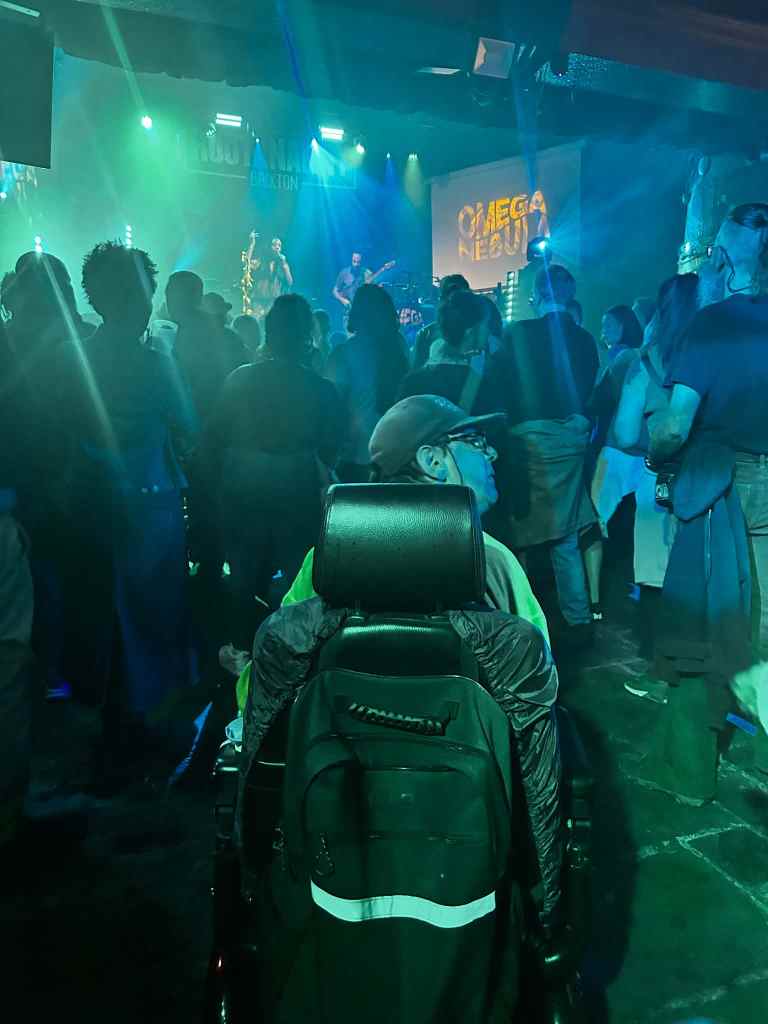
I think it’s safe to say that last night was the best I’ve seen in a long, long time, and one I certainly needed. When Dom and our friend Sergiusz proposed going to see a band called Omega Nebula in Brixton a couple of days ago, I was slightly in two minds: I had never heard of them, and from the videos he showed me they didn’t quite seem my type of thing. Yet, the Bond Prom a few weeks ago aside, it had been an age since I had been to see any live music, and the vast majority of my evenings these days are spent at home watching TV.
I certainly wasn’t disappointed. Hootananny, Brixton, is one of those awesome little venues which remind me of university: not that large, but space enough for a couple of hundred people to dance around in. After a bit of the usual faffing about with public transport, I got there early, rendezvousing with Dom in time for an alcohol free Guiness. Then, after a quick chat outside we went into the venue itself, and I instantly felt like I had been flung back ten or even twenty years. The music was throbbing; people were dancing all around me; lights were flashing. This was something I definitely needed but hadn’t realised.
Omega Nebula are a very interesting group. An electronic dub duo with hints of reggae, they reminded me of The Cat Empire minus the trumpet. As soon as they started playing I was hooked, and the evening seemed to pass in minutes. The lyrics of their songs seemed somewhat political, so there felt like there was a bit of an edge to the evening, which seemed to suit those dancing with me. It seemed the kind of venue where music fuses with political activism in a heady, intoxicating, urban way.
The evening frankly passed all too quickly, and as soon as I knew it the gig was over. To be honest I’d been slightly concerned that the temptation to ask for a beer might get too much, but I’m glad to say it wasn’t an issue. As I rode the bus home perfectly sober, Dominik beside me, I felt very happy to have enjoyed my first proper night out in ages: music, dancing, friends. Now I have established it’s still possible, I’m suddenly ravenous for more.
We Can No Longer Respect America
Like most people I suppose, I grew up with American culture: watching American films, cartoons and TV programmes. I suppose I have always had an affinity with our friends across the Atlantic. However, I take no pleasure whatsoever in saying that that respect has now been torn to shreds, and I frankly view America and Americans as utter embarrassments to humanity. I know how reactionary that might sound, but this news this morning has put the country far, far beyond the pale. Capital punishment is barbaric enough, and the news of the failed execution of Christa Pike earlier this week was already absolutely sickening; but any nation which would televise an execution can only be regarded as little more than a cesspit. Obviously, my disdain for Yankland had been growing since the re-election of Trump, and I had been becoming less and less comfortable with the news coming from there; but I fear this morning’s news drops them over the precipice into the swamp of outright fascism.
I know how reactionary this might sound; I also know that not all americans support their current government, or advocate vile things like this. Yet as it stands as a nation, the USA can no longer be respected and can only be seen as a fascistic cesspool which deserves little more than our collective disgust. Far from being the greatest nation on earth, it ought to be viewed, for the time being at least, as little more than a self-important backwater which should never have been allowed to rise to the prominence it now enjoys. Any nation which would make such a spectacle of death has no claim to be civilised let alone great, and for all it’s cultural ubiquity now deserves only our revulsion. Of course, as a country it may one day redeem itself, and I profoundly hope it does; but the news we received this morning absolutely dashes any standing the United States ever enjoyed. Any culture or society which could even contemplate something so abhorrent surely deserves nothing but our collective disdain and revulsion.
Busses, Kids and the Passage of Time
Here’s quite a weird realisation: every day I go out as usual, exploring London, hopping on and off buses. I’m now quite used to it. At certain times of day though, children also ride the bus, obviously on their way to or from school. The thought I currently can’t get out of my head, however, is that those kids would have been born after I moved down to London in 2010. Most are obviously now quite able and independent young people, yet the realisation that I’ve been living in this great metropolis for longer than they have been alive is one I must admit to finding rather astonishing. I still remember when this city felt new and alien to me, but I’m now riding public transport alongside kids born after I moved here. It certainly puts things into a new perspective, I must say.
An Utterly Sickening Political Charade
Needless to say, what is going on in Birmingham today only has my utter contempt and revulsion. Essentially a party of rich, quazi-aristocratic white men is using the black woman who they currently call their leader to articulate their draconian, right wing world view. At the end of the day, it’s an utterly sickening charade. Now, of course I realise how bigoted that pronouncement may well sound: obviously, there is nothing stopping anyone of any race or gender holding any political view they wish, or rising to the leadership of any political party, right wing, left wing or whatever. Yet surely the elephant in the room – the truth we all know to be true but dare not speak – is that the tories are just using Badenoch as their leader in order to appear like an open, tolerant, twenty-first century party while clinging desperately to the right wing views we as a society urgently need to grow out of. As I was saying a couple of days ago, low tax neoliberal politics boils down to greed: It is a disdain for sharing, designed to allow the wealthy, privileged few to retain their fortunes while those who need help are left to fend for their selves, often cap in hand. Thus Badenoch will argue today for a reduction in inheritance tax while saying that the state has grown too large and should be slashed.
I’m sure I won’t be the only person to find this perverse, even sickening. Here we have a party funded by and representing the most privileged people in society using a black woman to try to present their anachronistic intolerant views as somehow socially progressive. This is a group of people who think political authority should be their birthright; who think the wealth they had the good fortune to be born into is incontestable, socioeconomic class is simply part of who they are, and that they have a right to look down on everyone else. Never mind that such notions ultimately get us nowhere, and just perpetuate division, inequality and injustice. Never mind that they are simply a way to conserve authority in the hands of the few, while the rest of us go without. To the tories, their worldview cannot be argued with: class is part of who they are, social division cannot be contested, their wealth was earned rather than inherited and contributing to society via tax must be avoided wherever possible. For all their meritocratic pretensions (or delusions) the unwavering Tory belief in free market capitalism boils down to a mechanism of preserving wealth and therefore sociopolitical authority in the hands of those who are born into it: straight, white able bodied men.
Thus they will gather in Birmingham today and applaud Kemi Badenoch, thinking that they’re being oh-so-progressive and modern, while she simply spouts the same anachronistic Thatcherite platitudes they have always clung to. It is a spectacle I will find utterly obscene. Having a woman of non-European ancestry articulate such ideas does not change the fact that they are simply a way to maintain wealth, privilege and authority in the hands of the few while the rest of society is left to rot. I know we should avoid viewing things in such terms, and that someone’s skin colour should not matter. Yet how can anyone fail to observe that the tories are simply putting on a pantomime to make the views we rejected so vehemently last year somehow appear more up-to-date. Framed in that way, paradoxically perhaps, it is the use of a black woman as their leader which is in a way racist.
The Slob On The Bus
If there is one thing I can’t stand it’s littering. My parents always taught me and my brothers that rubbish should always be put in the bin, so I find the sight of people dropping litter utterly repugnant. I was on a bus earlier today: I was on my way home from my usual trundle, and the bus was becoming more and more crowded as it approached the centre of town. Sat in the wheelchair spot but facing towards the front of the bus, a man was sat in the chair almost opposite me. He carried a cane and wore quite an unusual bowler hat. I had to watch as he scoffed quite a large bag of crisps. That in itself was rather unedifying, but I didn’t say anything. However, what made me instantly furious and pushed me over the edge was the sight of him scrunching the empty crisp packet into a ball and stuffing it down the side of the bus seat. I don’t want to sound like a puritan or goody two-shoes, but it seemed so disrespectful that I couldn’t help shouting at him. There are bins everywhere in this city; it just takes a little care and respect to keep it clean. Needless to say the exchange didn’t end well: he obviously didn’t understand what I was saying, and I should probably have just kept myself to myself. Yet I suppose I’ve now grown so fond of London and its transport system that the sight of people treating it so disrespectfully really does boil my blood. But then, given that there is so little we can do to get such slobs to take more care of their surroundings, I suppose the most I can do is record the episode here.
So Many Words To Justify Greed
It feels like a while since I wrote anything here about mainstream party politics. I don’t think that was really intentional: it’s not that I stopped caring about what was going on in Westminster or was trying to avoid the subject, but rather that other, more interesting things caught my attention. Needless to say, my blood still has the potential to boil with rage whenever I come into contact with the increasingly idiotic, asinine spewings of the political right. Indeed, I hear that Kemi Badenoch has recently published a hundred page thesis in which she attempts to justify what she believes in as a tory. Such dross is always going to get me going and provoke a reaction.
The problem with those on the political right is that they think they are vastly more intelligent than they really are; or rather that their political beliefs have far more intellectual, altruistic grounding than they actually do. At the end of the day, their blindfold, unwavering belief in free market economics boils down to greed and selfishness: everyone should be able to hoard what they earn, and not have to contribute anything to wider society. Who cares if that just perpetuates social inequalities – if some people can’t earn as much as others, that’s simply due to their own laziness. Or rather, that’s what people like Badenoch tell themself in order to justify the privilege they were born into, as well as their distain for seeing a portion of their wages go towards assisting those who weren’t. They are like children who were never taught the necessity of sharing: they should be allowed to keep what they see as theirs, and if anyone else goes without it’s their own fault.
The thing is, I think deep down people like Badenoch realise this: she’s an intelligent woman, and deep down knows that free market economics is just a way to perpetuate longstanding ingrained social inequalities. Left unregulated, those who have remain free to exploit and dominate those who have not; wealth and privilege remains in the hands of the few while everyone else goes without; state structures like education are left deprived while those who can afford it send their kids to the best fee paying schools. Neoliberal economics is simply a way to perpetuate and justify social inequality. The problem is, those who advocate it will never admit this, even to themselves: they like to think they are as altruistic, caring and socially minded as anyone else.
Thus this article by Badenoch is clearly a form of self justification – a way to ground her greed and distain for contributing to society in some kind of intellectual guise, while deep down knowing that such principles are shortsighted and childish. As a black woman in particular, she must realise how socioeconomic privilege remains in the hands of the few if left unregulated, and how those born into wealth just continue to exploit and dominate those who aren’t. Not only is this inherently unjust but a waste of human potential. It is only through working together as a society that we can overcome such stratification. Thus the Tory leader can write as many articles as she likes, she can wrap herself in as many motherly terms as she wants; this doesn’t change the fact that she is the leader of the party of white male privilege whose primary goal is the perpetuation of socioeconomic stratification.
Straight To Rejoin
I don’t have anything to add to this, other than that I couldn’t agree more.
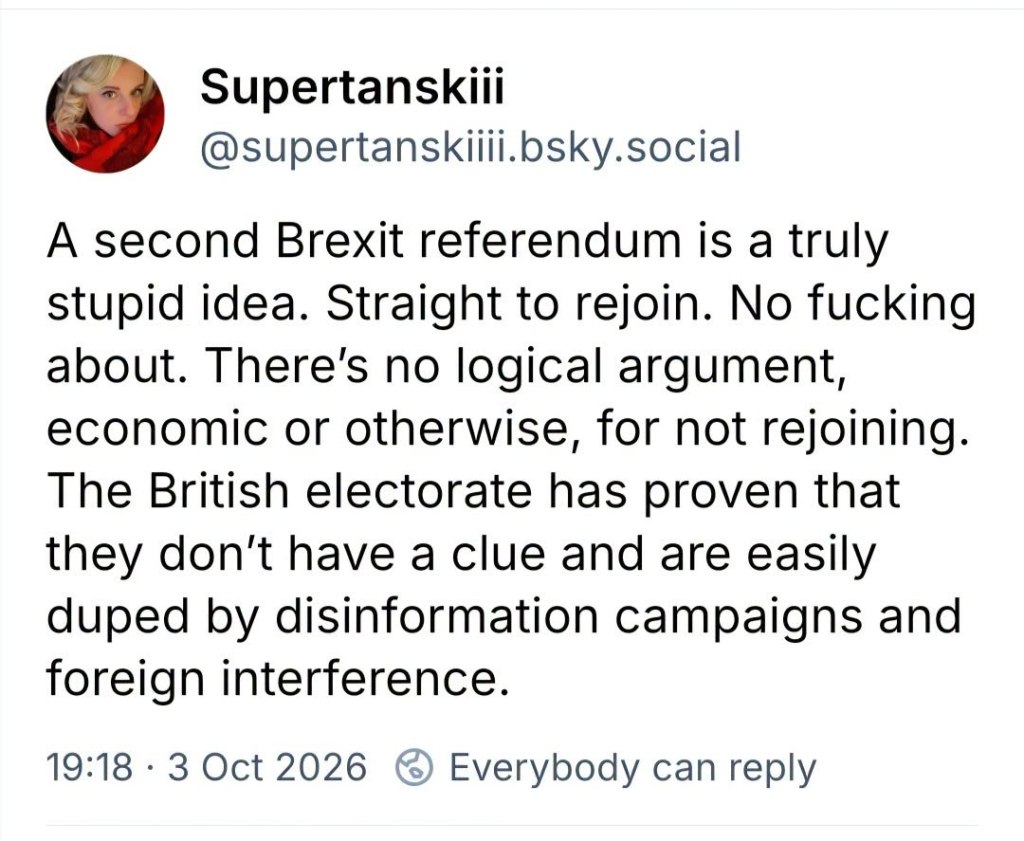
It’s becoming more and more obvious that this county’s only logical option is to undo the crime of 2016. As the blatant damage of Brexit becomes clearer and clearer, the movement to rejoin is only going to get louder and louder.
Digger
I honestly think I may have a new favourite film this evening, or at least I urgently want to watch again. John suggested going to watch Digger this afternoon. To be honest I hadn’t heard of it, so I was torn between that and going on my usual trundle, but frankly it came as a reminder of just how intriguing an artform film can be. I know I shouldn’t spoil anything or give anything away, but Digger is the kind of film which knows what it is: it knows it is a work of fiction and admits it. I would call it very rhyzomic in the way it reflected in upon it’s own status as a film, somehow simultaneously breaking the fourth wall, admitting it’s own status, yet also maintaining it’s fiction. I couldn’t help detecting distinct whiffs of Monty Python or Terry Gilliam, quite. frankly.
Having said that, it’s also the kind of film which it is hard to say what it is about, or whether it should be viewed as a comedy or taken deadly seriously. It can be seen as overt political satire and theatrical drama in equal measure. There were also more film references than I could shake a stick at, including a very Bondian white cat. I left the cinema absolutely dying to do some background reading. Just when I was beginning to worry about the quality of cinema these days, I’m treated to a doozy like this.
We Need Satire More Than Ever
It’s a bit of a long watch, but probably the best place I could direct everyone today is to this Newsnight interview with Ian Hislop. Many are saying that we live in increasingly troubled, fractured times, and as guys like Hislop are often first to point out, the only real remedy to such division is humour. To that end, I was glad to see the return of Have I Got News For You to TV last night. As The news we receive becomes more and more absurd with every bulletin, such satire obviously acts as a sort of release valve, giving us all permission to laugh at the sheer insanity of what is happening. We probably have a joint habit of treating politics and current affairs with the utmost reverence and seriousness, and we forget that, at the end of the day, it boils down to a bunch of over-privileged twits talking rubbish about things they barely understand.
Being Grunted At
I’m finding it more and more annoying that kids are now just grunting at me when I’m pass them in the streets: they grunt or make weird noises at me, their implication being that I have some kind of learning disability. It happened again this morning. I know that I should just ignore it, but it feels so derogatory and disrespectful, as though they think they are being clever in forcing a label onto me that I don’t necessarily want. The thing is, if they just took a few minutes to stop and talk to me, they would probably find that I’m not too different from them. But they never do, so all I can do is put up with them grunting at me in the street.
The Rise Is Real
Something very strange is clearly happening with regard to the number of disabled people around. I just got back from a trip into central London, and the number of people who I saw using powerchairs, wheelchairs or wearing sunflower lanyards was far higher than it was ten of even just five years ago. Back then, it was rather rare for me to come across just one fellow powerchair user, but it now happens every time I go out. I must have seen at least four or five fellow powerchair users today. I can’t help wondering why. Could I be imagining it? Is it just occurring here in London? Is my perception biased because I live in a large urban area, or is this rise happening elsewhere too? Part of me thought I was just being bitter and cynical when I started speculating about what I called cultural intrusion, and I told myself that if more people were identifying as disabled for whatever reason, I had no cause to be upset about it. But I’m becoming more and more certain this rise in disability rates is real, possibly caused in large part by the pandemic, and that I probably need to start looking into it properly. As easy as it is to dismiss it as a kind of sociopolitical bandwagon jumping, it’s becoming apparent that something more complex is now happening which is probably worth taking the time to explore. As I wrote with regard to autism a few days ago, the definition of such conditions seems to be becoming wider. Perhaps the same is happening with our perception of what constitutes ‘a disability’.
Who Knew LA Has a River?
I know this is going to seem rather random and out of the blue, but I’ve recently become interested in the fact that Los Angeles is now trying to re establish its river. It stems from my interest in the Olympic Games, and how different cities use them as occasions to present themselves to the world. LA is now going to host the games in 2028 of course, but they are now apparently trying to breathe new life back into their river, which has been largely concreted over since the 1930s. What pricks my attention is how it might change the character of the city. The river appears in films like The Terminator, but it isn’t something which immediately comes to mind when you think about Los Angeles, and looks rather forgotten and drab from the pictures. I’ve written here before about how fond I am of London’s waterways, so I can’t help wondering how Los Angeles might change in light of this. Flowing water seems to give a new dimension to lived in areas, so I wonder whether they could be trying to break the city free of its image in popular culture as a concrete sprawl ready to host the world in two years time. Perhaps more to the point, you’ll recall how their respective rivers were large features of both the London and Paris olympic opening ceremonies, so I’d be very curious to see whether the Angelenos take up that thread.
Behind The Times with AI
Something happened a few minutes ago which made me feel very out of date. My PA Dom has an Ipad, and he was using an AI function on it to ask it about coffee. He was just kidding around, but what made my jaw literally drop was the way in which Dom was able to have quite a natural conversation with it: The machine seemed to be talking back to him, thinking, hesitating, considering it’s answers, switching between Polish and English on request.
I must admit to being rather behind the times on this. AI isn’t something I use much. I tap the occasional question into Google, but because I don’t speak clearly, I have never had the kind of conversation with my Ipad which Dom seemed to be enjoying. It thus amazed me how responsive it was, and how lifelike – you could have thought it was a real person talking back to my friend. Just how advanced are these systems becoming? As enthusiastic for new technology as I usually am, what I saw earlier was so astonishing that it made me feel rather behind the times. Such tech seems to be primarily controlled with your voice, so I can’t help feeling somewhat left behind.
No Right Whatsoever

Frankly, the mere sight of this self-important, egotistical scumbag speaking at the UN makes my blood boil with rage. He may somehow currently represent Americans, but he does not, can not represent humanity.
More Bus Guilt
Just to update this entry from last Sunday about taking up the bus wheelchair space, I ought to report that something rather similar happened today too. I was up at North Greenwich after quite a long trundle. It was getting cloudy and I was getting eager to go home for lunch. If you don’t know, at North Greenwich there is a large bus station where all the local bus routes converge. It’s also by the O2. It was really busy there today because there was a tennis tournament on.
I got to the right stop for my bus , and found there was not only a lady pushing a pram there, but also a fairly young man wearing a disabled person lanyard and pushing a walking frame. To be honest I assumed it would not be a problem: he could fold his walker up, sit on a bus seat and the driver could let all three of us on. However, rather to my horror and shame, after he had let me on in my powerchair, the bus driver shut the back door and retracted his wheelchair ramp. The, after letting the lady on with her pram through the front door, he refused to let the guy with the walker on because I was in the wheelchair space. I didn’t say anything, but it immediately struck me as blatantly unfair – the dude had been there before me. I thought I’d better blog about it because, with so many more people using wheelchairs and mobility aids these days, I suspect things like this are going to become more and more of a problem.
Jimmy the Giant on the Rise of the Far Right
It’s rather long and involved, but I certainly think this video by Jimmy the Giant is worth a watch. In it, he summarises the current status of the British far right. As we’ll all be aware, the movement, born largely from 1980s football hooliganism, is now seeing a resurgence. Certain demographics of people seem to be being drawn towards figureheads like Tommy Robinson through a misguided sense of insecurity. He highlights a few of the oddities and contradictions in the kind of nationalism we’re currently seeing becoming more and more prevalent. I wont’t try to summarise what he says, but to be honest it’s as interesting as it is horrifying.
Coyote Vs Acme
I went to see Coyote Vs Acme this afternoon. I must admit I was sort of looking forward to it, but left the cinema in Peckham rather puzzled. Don’t get me wrong: the animation was first class, and a reminder of just how advanced it is becoming, especially when it comes to the fusion of cartoons and live action. The thing is, I’m not sure what the film overall was trying to say. It is famously about a law suit between Wiley Coyote and the Acme corporation, but I was left wondering what there was to read into that: some kind of comment on big business? Capitalism? The American judicial system? The way in which neither of the two animated characters spoke but communicated by holding up written signs even made me wonder whether something about nonverbal communication could be read into it. Yet to be honest I felt it didn’t make any firm statements on any of these things. Thus While the film has quite a few cool jokes, and it was nice to see a few of the cartoon characters I grew up with making a comeback, to be honest it ended so openly and blandly that I was left very puzzled over what it’s whole point was.
Check out Mark Kermode’s much fuller review here.
General Draft Dodger
Not that I’m a very military guy, but does anyone else find all the pictures we’re currently seeing of Donald Trump saluting revolting? I just came across this report of President Xi’s visit to the US, and the bastard is pictured saluting like some kind of war hero or great general, hand pressed to his forehead as if he had spent a lifetime in the army. Don’t forget that this is a guy who famously dodged the draft to get out of being sent to Vietnam. Only a minor point perhaps, but surely there is no more vivid an illustration or demonstration of what a pretender Trump really is.
Totally Different Attitudes Towards Disability
I had an absence this morning, just before breakfast. It wasn’t a particularly bad one and nothing to worry about, but it was one of my first in a while so it was more or less due. I was thinking recently, though, about how I always tried to ignore those things, even convincing myself that I was imagining them: on the whole I think playing them down was far healthier than letting them get to me. Yet that seems to me to contrast starkly with the prevailing attitude today: sorry to go on about this, but people currently seem very eager to play up whatever medical conditions they might have, even blatantly exaggerating them and using them as the basis for their online personas. As someone who was always taught to play down his disabilities and just get on with life, this growing mass hypochondria is starting to seem very strange. Surely it is wiser not to focus on whatever disabilities or impairments you might have, rather than using them as the basis of your entire personality in order to attract attention and pity.
Insultingly Undeserved Awards
This morning finds me furious, by which I mean absolutely seething with rage. Over the last few months I’ve had my eye on a number of online sickfluencers now increasingly polluting the web with nauseating, self-pitying tripe about their supposed disabilities. It’s becoming more and more virulent, and the blatant misrepresentation of disabled peoples’ lives is becoming more and more perverse. It is clear that these people don’t have the faintest clue what life is actually like for disabled people, yet they continue to post their insulting videos online, presuming to speak for us as if they know our worlds better than we do ourselves. As I’ve said before, the whole phenomenon feels like a punch in the gut which I refuse to tolerate. One of them, a Youtuber calling herself Chronically Jenni, struck me as particularly patronising: an arrogant, self pitying young woman jumping into a powerchair and making videos about things she knows absolutely nothing about.
What has my blood boiling this morning, however, is that this girl is now bragging about winning a National Diversity Award for her work on disability representation. Quite frankly, I don’t think there could be a bigger insult to disabled people; it is akin to awarding the Black and White Minstrels an Oscar for African-American Representation. Watch her videos and you’ll be subjected to a stream of insufferably lachrymose bullshit in which people with disabilities are depicted as poor defenceless victims demanding everyone else’s pity. Hell, the first clue is in her title: no self-respecting disabled person would label themselves ‘chronic’, using an overtly medical term as a central component of their online identity.
Thus for this girl to have won this award – or at least be claiming to – really takes the biscuit. For one, there are a great, great many other disabled people on the web doing a far better job of disability representation than she does, and who have been online far longer than the laughable five years she has been calling herself disabled. Yet she is one of a growing number of online influencers identifying as disabled who think their obviously tenuous connections to the disabled community give them the right to speak for and over the rest of us. She is obviously totally ignorant of many of the political issues currently confronting the disabled community, but uses her YouTube channel to dress up and pose in powerchairs. I don’t know who decided to give her this ridiculous award, and they couldn’t insult the disabled community more if they tried.
I know I shouldn’t get so worked up about things like this, but it really feels like these ‘sickfluencers’ are attempting to rob guys like me of our voice and identity, using disability as a gimmick with which to attract online attention without really knowing anything about what they are talking about. To hear that such people are now being given awards for their insulting, condescending, gross mischaracterisations of life for disabled people really is more than I can stand.
Labels and Definitions
If you ask me, the question of the day – or perhaps decade – is, why does everyone suddenly want a label? On the breakfast news this morning, the top story was the alarming rise in young people being diagnosed with conditions like Autism and ADHD. As I think I’ve mentioned before, people also seem to be far more eager to categorise themselves as being Autistic or having ADHD than they once were: I now seem to hear people declare “I’m autistic” almost daily. The term seems to be being thrown around more and more lightly, as though people are becoming more and more eager to highlight their perceived eccentricity or other-ness. It’s almost as if it has become essential to be seen as a member of a minority or subgroup, particularly on social media, and that not doing so groups you alongside the oppressors. If you ask me, something very, very strange is going on.
Perhaps the obvious initial question is what could be causing this abrupt rise. If this was any other medical condition, there would probably be talk of an epidemic in the air. But I don’t think the normal rules apply here. Prevalence levels for more ‘traditional’ conditions and disabilities seem to have remained fairly stable, whereas those for neurological conditions seem to have shot up. If autism was like any other condition, surely you would expect it to follow similar patterns. Rather, I really suspect the difference is the definitions of conditions like Autism and ADHD has been dramatically widened: it is no longer the severe, extremely debilitating condition I observed at school, but now encompasses a wide range of – previously fairly normal – behaviours.
The thing is I can’t help suspecting that there is some kind of political motivation behind this definitional change. People seem more and more eager to assign labels to themselves, to be seen as belonging to one subgroup or another. It’s not that I dispute that levels of ‘mental distress’ are rising; I think rather that we are becoming too eager to categorise such behaviours and feelings as specific conditions, rather than accepting them as part of everyday life. As the definitions of conditions like autism have become forcibly wider, they have become little more than a sociopolitical bandwagon people are becoming more and more eager to jump onto. Thus we hear people ‘outing’ themselves as autistic, dropping it into the conversation at any opportunity, like it is some kind of badge of honour or status symbol. In assigning themselves such labels though, using such terms so arbitrarily, they gradually strip them of any real meaning, and force us to forget that autism is in reality a highly debilitating condition often requiring a lot of support.
Bus Guilt
I really feel ashamed of myself sometimes. I was in Woolwich again earlier, coming back from visiting Battersea. There is an array of bus stops there, and I was waiting for a bus to Kidbrooke as I needed to buy a few things before heading home. I had waited about ten minutes for the bus, and when one came I put my arm out to hail it as usual. It came to a stop just passed me, and when I swung my powerchair round to start to get on I saw a lady pushing her young daughter in a manual wheelchair towards it. What I now feel deeply ashamed of is my reaction: I just exploded, shouting my head off as though someone was robbing me. The lady let me onto the bus, obviously taken aback, but I now deeply regret my behaviour. I don’t know why I reacted so indignantly, and obviously should have allowed the woman and her daughter onto the bus; as it rolled away with me in the wheelchair space, I reprimanded myself that another would have been along in a few minutes. I have always had such outbursts due to my CP, but that doesn’t make me any less embarrassed by them.
How Could I Ever Like That Song?
I have a bit of a confession to make this evening. When I was small I was really into Disney films. I used to get my parents to play the videos again and again. I’m not sure why, but I think a large part of it was the music: as I touch upon here, I used to adore songs from films like Beauty And The Beast and Aladdin, to the extent that I used to insist my brother Mark played A Whole New World ad nauseum on the piano. When I was ten it was just about all I would listen to.
Something rather strange happened earlier though. I was going through Woolwich as usual, where there was a small funfair for children in the square. One of the rides was playing music, and as I was passing I caught a hint of the song: A Whole New World. Today, however, I was immediately struck by how cheesy it was. It sounded so saccharine and grating, as I rolled away I was astonished at how I could ever be so besotted with it.
Perhaps I’m just getting old.

