When I was out on my trundle yesterday I had a bizarre idea which I now can’t get out of my head. An idea for a meeting of two fictional characters which I think would be so hilarious, so awesome that I simply have to make it happen. How it could possibly happen is another question, especially given one character was live action and the other is animated; but I’m now nonetheless set on seeing it come about. Surely it would be the most amazing thing ever if the French Taunter from Monty Python ant the Holy Grail could somehow meet Cornholio. I have no idea what they would do together or how they could possibly be shown to meet, but even so I suspect it would make me roll on the floor with laughter. The unnamed French Taunter, of course, was played by John Cleese in the 1975 film Monty Python and the Holy Grail, mocking King Arthur and his Knights from the battlements of a castle. Cornholio or The Great Cornholio is Beavis’s alter ego who he transforms into whenever he drinks too much coffee or any other stimulant. Both are, separately, probably the funniest things I have ever seen. The crazy idea of seeing them somehow meet may be far fetched, and I have no idea how I would get either of the actors to reprise their roles, but this is just too awesome for me to let go. The thought of those characters having some sort of dialogue is too magnificent. If it is indeed true that everything is possible, then this simply has to happen.
Month: January 2026
A Nice Threshold To Have Passed
I just have something rather trivial to record here today. I’ve been going to the branch of Nationwide on Eltham High Street since moving here six years ago. I go there once or twice a week, whenever I need more cash. I can’t physically use an ATM so I always go up to the cashier. As such the staff in that branch have come to know me quite well. Of course, until now I have always used my speech app to tell them what I need. Things like numbers can be especially difficult for me to articulate. Rather cooly, however, this morning was the first time I didn’t need to use my communication aid there: I was able to roll up to the desk and tell the dude what I wanted. As usual he then put it in my wallet. Nothing special really, but I think that was quite a nice threshold to have passed, and a sign that this area is becoming more and more my home.
Hoping Things Are Being Exaggerated
America is really beginning to scare me. Or rather, what I see from America is beginning to scare me. Every day the situation there seems to get worse, with more depictions of violence, anger and intolerance. The thing is, my prime source of information is my YouTube feed. I obviously don’t live in the United States, so almost everything I know about the situation there comes from YouTube. Every morning among quite a few other things I watch clips of guys like Stephen Colbert and Jimmy Kimmel doing their nightly routines, panting an increasingly dystopian picture of their county. The thing is, their acts are still so interspersed with jokes and throw-away remarks that you could almost assume things were perfectly normal. The mismatch between tone and content is quite jarring, but might that mean that I’m only seeing one side of the story? Could the violence and turmoil be being exaggerated for dramatic effect? As unlikely as that may be, to be honest I’m starting to hope with increasing desperation that it is.
The One Thing London Lacks
I have once again just got back from my usual daily trundle. Today I thought I would just go to Lewisham, take the DLR up to the Isle of Dogs, and head up to Canary Wharf. That area still amazes me: to think that, forty years ago, all that was there was a bunch of decaying docks is incredible. Going there is like suddenly stepping into Manhattan or Tokyo or any other great commercial centre of the world. The way skyscrapers keep shooting up is nothing less than jaw-dropping.
The thing is, I am starting to think that the very thing that makes that area so incredible is also what makes it dull. Ernest Hemingway once said he found London too normal. When I first moved here, I couldn’t disagree more: London seemed an amazing, innovative metropolis unlike anything I had experienced before. As someone used to a small, rural Cheshire town, to suddenly find myself trundling around one of the world’s greatest metropolises filled me with awe. Yet sixteen years on, I think I finally see what Hemingway meant. London is rich and affluent: the type of city capable of turning a wasteland of crumbling docks into a thriving commercial centre, creating multi billion pound rail networks, hosting the Olympic Games or anything else. It is rich, middle class and safe. Obviously it is multicultural and diverse, but that’s because people come here from all over the world because it is so safe. It’s wonderful to hear such a diverse array of languages being spoken in the streets and on public transport, but at its core London remains an affluent, middle class English city.
The thing is, in that middle class safety it looses something which I now find myself craving more and more. Everything may work here and the busses may come on time, but with that it looses something exotic and intriguing. Its ability to pile billions of pounds into all kinds of projects means it loses any sense of danger. Its coffee shops may be accessible and well maintained, but it feels like I am getting bored of cappuccino. Tube stations may all be clean and have working lifts, but with that they become sterile and inhuman. Busses and trains are brilliantly regular, yet that regularity is starting to feel soporific.
With privilege you lose thrill, and it is that which I now find myself yearning for. That touch of human limitation which carries with it a sense of cultural diversity. A kind of exotic fallibility or down-to-earth grit that I encountered in places like Jaipur or Tangier, but which London would just concrete over and turn into yet more ubiquitous blocks of flats. The grimy, gritty, working class docklands of east London have now been transformed into a phenomenally wealthy landscape of sleek skyscrapers, bling and decadence: Canary Wharf could be an area of any other big city. In that sense, it’s transformation and gentrification took away what gave that area it’s own unique character and rendered it normal.
These Peaceful Parks Might Burn
Out on my trundle yesterday, I was as usual thinking about the state of the world, and reflecting that, during the Second World War, this part of South-East London was very much on the front line of the defence of the capital. Sutcliffe Park in Kidbrooke, about ten minutes from my flat, was one of the areas where they anchored barrage balloons. Yet now it seems the very forces those guys were fighting against have returned. I used that as the springboard to put together this film. It isn’t perfect, and probably could have done with a bit more editing, but I think what I’m getting at is clear enough.
A Truly Frightening Interview
I know I shouldn’t just direct everyone to videos I’ve just watched on Youtube, but I certainly think this Channel Four interview between Krishnan Guru-Murthy and Mehdi Hasan is certainly worth watching. It’s rather a long, in-depth conversation, covering topics ranging from Brexit to Gaza, but I think it is particularly significant in that Hasan openly uses the word ‘fascism’ in relation to Donald Trump and what is currently unfolding in America. It is probably the first time I have heard that word being used so openly and on such a mainstream platform: As Hasan himself explains, he is openly liberal and left-of-centre, but tries to be as critical, balanced and objective as possible. Yet there is no getting away from the fact that what Trump is doing, in weaponising the US justice system and silencing his critics, equates to a form of fascism. We might not be seeing jack-boots on the streets there just yet – although ICE is drawing closer and closer to becoming an American gestapo – but the form of autocracy Trump is steering the country towards is no less chilling. Please watch the video for the details, but I have to say, watching it and videos like it is making me increasingly frightened about where the world is heading politically.
Who is this Vance Bloke Anyway?
If you would like a bit more background on the complete and utter car crash that America is becoming, as well as to chill out for an hour or so listening to a dude talk, I think this is well worth a watch. I’d previously dismissed JD Vance as just one of Trump’s lackeys and another right-wing scumbag, but the reality is far more complex and nuanced, if no less frightening. Vance is actually quite an intelligent person whose ideas were once well rooted in reality, but like Macbeth and so many others, greed and ambition got the better of him.
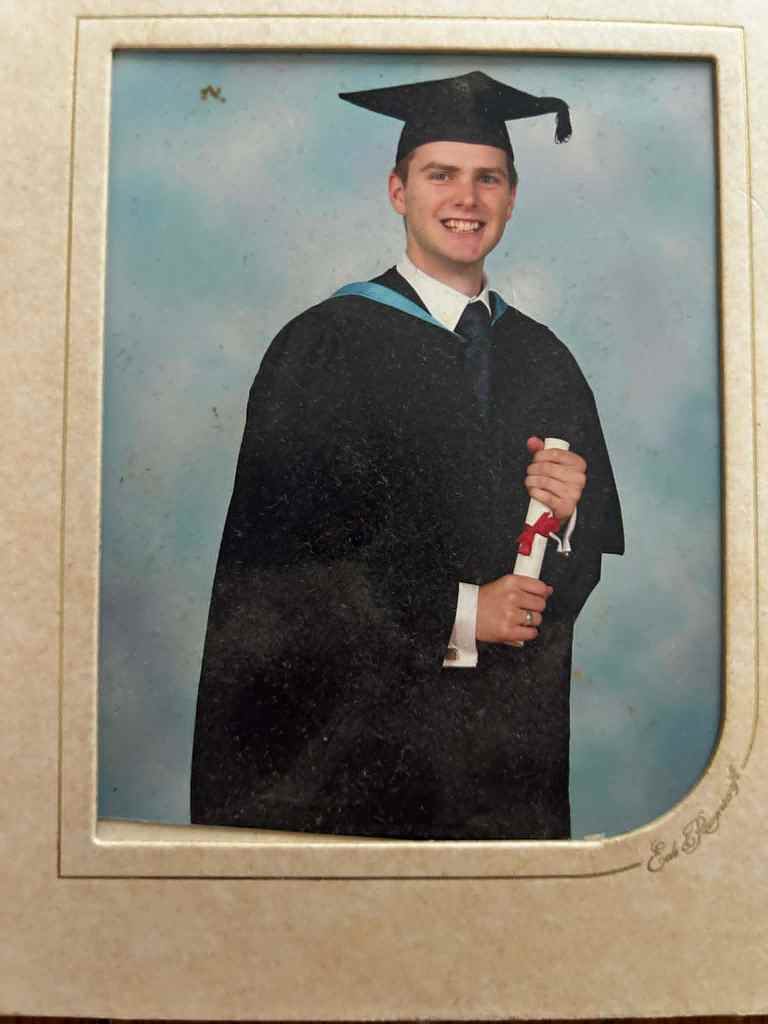
The Third Graduation Photograph
On my shelf I have three graduation photos. Two are mine, of course, from my Masters graduation eleven years ago, and I’m still immensely proud of them. The third, however, is of a young man I do not know. I think it’s of Lyn’s nephew. When I moved to Eltham six years ago, much of her stuff came with me, including many of her pictures. Lyn’s brother Paul had given her the small graduation photo, and it came with me. The thing is, I haven’t heard anything from L’s family since. No doubt the photo will be as special to someone as my graduation photos are to me; yet I have no idea who, what their name is or how to contact them. Naturally I’ve tried looking on Facebook without much luck. If anyone has any leads on this, please get in touch.
The Disgusting Words of a Coward
I think it’s fair to say that I’m not a military kind of person. I believe, quite firmly, that armed conflict is folly and must be avoided whenever at all possible. What on earth is the point of sending young men to brutally kill one another, when a conflict can more efficiently be resolved if people just get around a table and talk to one another? Yet I also know that there are times when physical conflict is unavoidable, and necessary to protect one’s community or friends. In the room behind me right now there are three Polish guys; they might not be here if Britain had not gone to war in 1939. Thus, as much as I detest conflict, I know the military deserves my respect.
War is famously hell: it is brutal, bloody and barbarous. Frankly, I can barely imagine what it must be like when you’re about to go into a conflict zone, knowing there is a good chance that you or your comrades will shortly be ripped apart by a bullet or shell. I know this comparison might be a bit stretched, but to be honest the closest I’ve come to it is looking into the eyes of my classmates. They knew they didn’t have long to live; they knew their Muscular Dystrophy would sap away their strength and rob them of their lives far sooner than they deserved, yet they carried on nonetheless. I see my friends as soldiers, on a par with those who fight to defend their communities.
Thus like many others I was disgusted by what Donald Trump said yesterday. I may not like war, and can certainly see that there were huge problems with the fact that British soldiers were in Afghanistan in the first place. But that is no reason to allow him to degrade or belittle their contribution or sacrifice. 457 British personnel died in Afghanistan, alongside many others from a diverse array of countries. Pacifist though I may be, to hear that draft-dodging piece of shit state yesterday that they somehow held back from the front line, so that only Americans did the fighting, was beyond the pale. To hear Trump utter such bile as though he were some kind of great military historian or commander, when he was famously too cowardly, arrogant and self-important to defend his country himself, made me want to rip his head off. Thus, as much as I don’t want to get caught up in any kind of patriotic furore, but Trump now owes them and this country a grovelling apology.
Another Westfield
I just got back from Westfield Shopping centre. Only today, it wasn’t the Westfield I usually go to up in Stratford. I can get to that one quite easily, and as huge and opulent as it may still be, I’m getting bored of it. I decided a while ago that I need to get out of East London a bit more, so today I decided to head to Shepherd’s Bush. I had had a glimpse of it a few days ago, having been on one of my canalside trundles; but today I decided to go back and check it out properly.
Getting there was somewhat novel in itself: the Jubilee line to Westminster, the District to Hammersmith, then a short walk from there rather then taking the circle line a single stop. I’m becoming more and more comfortable navigating london’s transport system and switching between lines, although some of the gaps between the train and platforms were slightly wider than I’d have liked. Even so, my journey was relatively swift and problem free.
I didn’t stay at the actual shopping centre that long, and decided to start making my way home after just a short cruise around it’s opulent shops. I realise how strange that might seem, having gone to so much trouble to get there. But that isn’t the point. The reason I have adventures like today’s is to sort of demonstrate to myself that I can get to places. It’s about establishing routes. Now I know I can get there though, and that this ‘other’ Westfield is just as big and impressive as the one in Stratford, I think I have a potential new rendezvous point for meeting mum and dad. Moreover, getting back turned out to be even easier than getting there, as I found a Superloop running directly to Ealing Broadway, where I could just hop onto the Elizabeth Line.
London is definitely feeling smaller and smaller. I’m not sure how many people will be interested in all this stuff about me going places and which trains I ride, but in a way feel compelled to record it. This city once seemed like a huge, inaccessible labyrinth; yet it is becoming increasingly familiar, homely and welcoming. I’m feeling more and more comfortable with getting around and exploring it, and as I do so it becomes ever more fascinating.
Pride In Normality
In a way you could say I have nothing to report here today. My parents came to visit for lunch, just as they visit every few weeks and just as they also visit my brothers, Mark and Luke. It was nothing special: we had a very nice lunch together, and we sorted some things out regarding my powerchairs. You know – normal, family stuff. Yet, whenever they pop by like this, I always feel a sense of intense pride and satisfaction. As I wrote here about a year ago, there was a time when I thought such visits would be absurd: when the idea that I would one day be living in my own flat, and that Mum and Dad would visit for brunch, would have seemed totally out of the question. But perhaps even more than that, I feel pride in it’s very normality. After all, whose parents don’t visit them? What’s so special about a man and a woman going to visit their son? It’s perfectly normal, and in that sense I’m just like Mark, Luke and just about anyone else. I’m just a normal bloke whose parents came to visit. Paradoxically perhaps, I feel great pride in that normality.
What the Zark is Bait?
Putting my James Bond hat on for a moment, could someone please tell me what the zark this is. It purports to be a trailer for something called Bait, an Amazon produced series about an actor cast as James Bond. I just came across a reference to it, and of course the online Bond fandom is abuzz with speculation. It’s only a short trailer, so I don’t know what to make of it or where Amazon intend to go with it. It’s quite odd: it just shows a fairly young man surprising his family with the news that he has been cast as James Bond, who then become extremely excited. But now they’ve acquired the rights to it, I can’t help worrying that Amazon intend to take Bond in all sorts of weird new directions to squeeze every penny they can out of it. The appearance of this trailer only increases that concern.
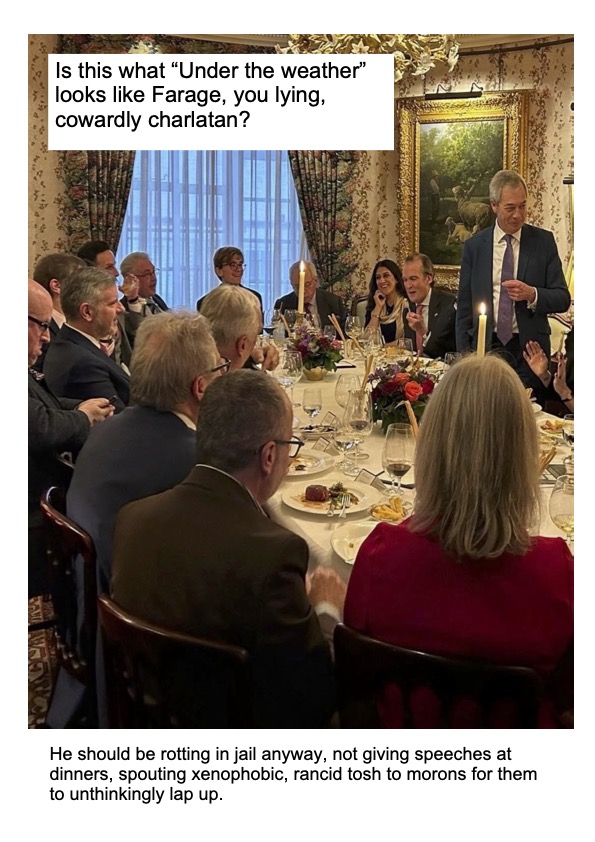
Under The Weather?
Apparently too ill to answer questions about his mate Trump on national TV, but seemingly fine to do his ‘statesman’ act for halfwits to allow them to think they are some kind of ‘elite’.
Our Last Hope
We all know what a dangerous state the world is in. I’m not going to go off on one of my spasticated rants about how Britain should now unilaterally void the Declaration of Independence and render all Americans British colonists, much as I might like to. In all seriousness though, I find myself baffled over Americans can put up with this. Many of them are intelligent people; they must realise what is going on, and the catastrophic damage which the deranged charlatan they’re currently forced to call their president is currently doing to their country. They must surely be as horrified as the rest of the world is.
Surely there is something they can do: surely what remains of the American intelligencia can somehow step in to remove the fool from office. They must be able to see the way things are going, just as the rest of us do, as well as the obvious truth that Trump is a highly unstable, mentally ill man. As Owen Jones explores here, his recent deranged tweets put that well beyond doubt. If that isn’t valid grounds for removing someone from office, what on earth could be? Thus I genuinely hope America gets a grip and does something to change course soon; otherwise the consequences could be horrifying. It might not be democratic in the strictest sense, but you’d think there would be a clause in their famous constitution which allows presidents to be stripped of office on medical grounds. Otherwise, what choice would we Brits have but to take back control of the American colonies?
Powerchairs Are Not Toys!
Powerchairs are not toys. For many disabled people, powerchairs are essential to living their lives. In my case, I simply couldn’t enjoy my life without my powerchair. I would be stuck in my flat, unable to go out without someone to push me. More to the point, most of my friends at school were powerchair users, and being completely nonambulent would have been totally stuck without them.
As a disabled man my powerchair is part of who I am: it is part of my identity, just as my communication aid is. I couldn’t be who I am without it. Yet these days, when I’m out and about , I see more and more people using powerchairs. Their use seems to have shot up in the last couple of years for some reason. I don’t know why, but it seems to have suddenly become cool to use a powerchair, at least around London. Perhaps access to free public transport has something to do with it, but it’s as if people are using them for more and more tenuous reasons.
I have been getting angrier and angrier about it. Whenever I see such a person, I want to shout “It’s not a toy!” because that is honestly what using powerchairs in this way feels like to me. Something they have started using because they feel a bit fragile or infirm, have diagnosed themselves with one fashionable condition or another, or think it would be cool to ‘identify’ as disabled. I know I keep returning to this subject, but it really is getting to me: it feels as if an integral part of my identity is being usurped or even stolen.
A lot is now being said about identity and identity politics; it is a highly charged political subject. What exactly constitutes ones identity, and how do people identify as members of one group or another? Having had cerebral palsy from birth, I have always identified as disabled. I have always had friends with disabilities and been accustomed to the mise en scene – the powerchairs, expanded keyboards and dribble-absorbing teatowels – of disability. It is part of my very being, without which I wouldn’t be who I am. It has also always felt like a very niche thing to be; an identity shared by very few others outside of a small special school just outside Winsford. Now, however, many more people are adopting that identity, seemingly simply by starting to use that paraphernalia.
It is weird because I don’t think I would mind if they were using scooters – the kind with handlebars often used by elderly people. It is the increased use in powerchairs specifically which gets to me, perhaps because I associate them with the most profoundly disabled people I have known. Such friends needed their powerchairs to get around, and without their chairs they would have been confined to their beds. They had absolutely no choice; so to see other people essentially choosing to use powerchairs for sociopolitical reasons, whatever other bullshit they might tell themselves, frankly feels like my friends are being mocked.
I realise how bizarre this may sound, but I am struggling to come up with a decent analogy. I once likened it to when white actors used to paint their faces black in order to play black characters; but in a way it’s deeper and more hurtful than that. Frankly, it’s as repugnant as Donald Trump and his MAGA goons starting to wear feathered headdresses and wave around tomahawks, calling themselves ‘Native Americans’ and structuring their entire politics around the notion of being ‘native’. It is the reduction of something absolutely essential to one person down to a sociopolitical plaything by another. By choosing to start using powerchairs, it feels like these people are intruding upon a world they have no idea about. Powerchairs are not just toys which people can just begin to use when they start feeling sorry for themselves; they are vital facets of who we are. Essential parts of our everyday lives, now being wheeled around in like go-carts by people who think identifying as disabled is sociopolitically cool. Such increased adoption feels like a trivialisation; and such trivialisation feels like an insult.
Powerchairs are not fucking toys!
Social Media and Emotional Regulation Questions
I’m probably just once again using my weblog to think things through, but I was just watching BBC Breakfast news. They had an item on the possible banning of social media for under 16s. Now, I’m very much on the fence on that issue as I can definitely see advantages and disadvantages to such a ban; but during the item, one academic stated that there was a link between the use of social media and ’emotional regulation’. That really caught my ear: we know that people with autism have trouble regulating their emotions, and it’s one of the defining features of the condition. Could there be some kind of connection between social media use and the dramatic rise in ASD we’re currently seeing?
I’m pretty certain I won’t be the first person to wonder about such a link. I’m just thinking openly here, before doing any googling or research (yes yes Dad). But you have to wonder what such a connection could mean, how it might be objectively established, how we might explore the way social media use effects how we interact with society, and what if anything could be done about it.
Interestingly, later in the Breakfast programme, they also had an item about a man with severe autism, and the techniques being used to cut his hair. He had what I’d recognise as autism from my school days, was non-verbal and clearly couldn’t really interact with the world as others do. To be honest I think there is still a real, clear distinction between this manifestation of autism and the one now being ascribed to so many more young people. They may be on the same vague spectrum, but I don’t see how they could relate. The boy with autism had apparently been diagnosed ten years ago, when he was very young; yet these social media-using kids will be in their teens and will still be highly capable of interacting with other people on some level. This situation is obviously very complicated and certainly worth looking into.
Jessie Gender on Reactionary Grifters And Star Trek
Staying on the subject of Star Trek, I surely wouldn’t be doing my duty as a blogger if I didn’t direct everyone here, to probably the greatest piece of Trek-related analysis I’ve come across in a long, long time. It’s long and detailed, but in it, Jessie Gender discusses modern Star Trek, and the criticism reactionary p’tahks now hurl at it that contemporary Star Trek is too woke or liberal. Trek has always been woke, of course, but as she explains, such grifters seem to be pining for a conservative past which never actually existed. My concerns about it’s underlying Americano-centric worldview notwithstanding, part of what has always made Star Trek great is it’s championing of inclusion and diversity, including, as Jessie explores really well, how it handles disability. The video is over an hour long, but if you have the time, I’d really encourage you to give it a watch.
Spot On Doctor!

Northern Transport Questions
It has been a pretty wet, miserable day to be honest. As usual though, I far preferred to go out than stay here at home, so it has been a case of darting between busses, shops and trains as quickly as possible. Fortunately, here in London we have a world class public transport system, so it hasn’t been too bad. Busses are frequent and accessible, and thanks to the DLR I actually managed not to get too wet. However, I have to wonder whether this would have been the case anywhere other than the capital. You’ll have seen yesterday the announcement of massive a new rail infrastructure project in the North of England, which will enable faster connections to Leeds, York, Manchester and Liverpool. I naturally think this is only to be welcomed, although yesterday I facetiously began to wonder what ‘Crossrail’ would sound like in a northern accent. However, I must say key questions remain: new rail lines are all well and good, but what about other improvements? Are busses in Cheshire any better, or are they as crap and inaccessible as they were twenty years ago? Linking the ‘big’ cities (what a subjective term that now seems) is cool, but what about access to the other smaller northern towns? If we are serious about ‘levelling up’, surely these are the kinds of questions which must be answered. As a wheelchair user, I remember getting between towns and villages was an utter nightmare: you waited ages for a bus, and then the driver had to reluctantly get out of his cab to unfold the ramp manually for you. My biggest concern now is that things haven’t improved.
Very Thin Ice
If like me you’re becoming increasingly concerned (read frightened) by what is currently unfolding in America, I have a couple of videos to flag up. Firstly, I think this Private Eye discussion is a good reflection of the bewilderment we all now feel. Hislop and co clearly have a good grasp of what is going on and what Trump is doing, but there is a definite rabbit-in-the-headlights dimension to their conversation. Secondly, I think this thorough debunking of what actually happened is certainly worth a watch. Details still seem to be quite hazy, but watching this yesterday gave me a much better grasp of the situation. Watching either video, however, makes things seem all the more horrific: as what actually took place – the cold-blooded murder of an unarmed woman – becomes clearer and clearer – the fact that the American president is still attempting to deceive us all over this should send shivers down our collective spines.
Sandy Trails
I was just browsing Facebook on this dull wet afternoon, when I came across a link to this new blog on one of the disability related pages. The fact that it is focussed on travel got me interested of course, but I’d just like to flag up something I find problematic. It’s a blog written by the mum of a man called Corey, a 25-year-old American with Spinal Muscular Atrophy. She says her blog is about ‘Empowering caregivers’, and writes “At My Sandy Trail, I believe that every caregiver deserves to be healthy and happy. My blog shares inspiring stories and tips not only for making wheelchair accessible travel a reality, but also ensuring that you and your loved one can create unforgettable memories together in a safe and healthy way!”
Sorry if I’m being a bit grouchy, but this instantly sent my mind back to what I wrote here, about people speaking for disabled people when we’re perfectly able to speak for ourselves. Such so-called ‘advocates’ may mean well, but isn’t it a bit patronising for a mum to speak for her son, and document their adventures online? Can’t he do so hisself, so we get his own perspective on the issues he faces rather than that of his mother? After all, this blog would be vastly different if my parents were writing it for me (it would probably have a lot more about making marmalade!) On the other hand, it could well be the case that Corey does not want to blog and is fine with his mum documenting their adventures, so I better not read too much into it. Even so, I still think accounts of disability issues from disabled people rather than their ‘caregivers’ are always preferable.
Zahawi Defects
I got in from my trundle earlier to read the news that Nadhim Zahawi has now defected to Reform. Of course I automatically flew into a spasm of rage – anything to do with that group of deranged xenophobes irritates me like a bee sting. But now that I come to think about it, you have to wonder what it might mean. It’s obviously one of the biggest political news stories we’ve seen in a while: on the one hand, it’s obviously a sign that Reform are getting bigger and stronger as a political party, which should be an anathema to any sensible, intelligent person. On the other hand though, it’s also obviously a sign that the Tories are getting weaker. Zahawi was once their chancellor after all, so could the defection of someone once so high up in the party be a sign of something quite major? The beginning of the end of the whole Conservative party, perhaps? Then again, as fond of that thought as I might be, with global politics looking like it does, I dread to think what far right scumbaggery we might get in it’s place.
American Filmic Dick Waving
I watched Top Gun Maverick on Channel Four last night. There was nothing else on TV, I hadn’t seen it before, and I’m still looking for something new to get into. However, I soon started to find what I was watching utterly nauseating: as a film it is crammed with American bravado like sickly sweet ice cream piled onto a cone. It’s essentially about a fighter pilot who seems free to break any rule he wants, training a group of fellow pilots for a seemingly impossible mission against a vague, unnamed enemy. This group is always referred to as ‘the best’, probably just because they’re American, and is shown buzzing around in multi million pound fighter planes like they’re toys.
Look, I know I shouldn’t be too negative; I also know I can’t give any real, in-depth analysis in one short Sunday morning blog entry. But this really was American filmic dick waving*. It came across as a statement that Americans can do whatever they want and get out of any situation simply because they’re American. For example, towards the end of the film, the stranded Tom Cruise Maverick character just steals an enemy fighter plane they’ve just left lying around! It stretched the limits of plausibility far beyond breaking point, but the film treated the characters with such cheesy gusto and reverence that it made me want to puke. I don’t know how much my opinion of this film has been tainted by what I currently think of the USA, but in the current light, such tripe came across as nauseatingly arrogant and infantile.
*We Brits could obviously be accused of doing the same thing with James Bond. Yet it seems to me that, while everyone knows 007 is a mythological remnant of a long-faded empire, this was a reflection of how America actually perceives itself and it’s authority over the wider world.
Qa’Pla To The Silkmen!
Changing the subject entirely, my heartfelt congratulations must suddenly go to Macclesfield FC. I don’t mention football much on here, but, as a guy with roots down the road in Congleton, Macc are still one of the teams I keep an I on. My heart was in my mouth as I watched them play Crystal Palace just now. To be honest, just being able to watch such a football match on the BBC was awesome in itself; but watching the Silkmen pull off what many are now calling one of the biggest upsets in football history surely made my weekend.
Now to see how Charlton does….
When Utopias Become Dystopias
I really am getting old, aren’t I? I was looking into the new Star Trek series, Starfleet Academy, a bit earlier. There was a time, not that long ago, when the prospect of a new Star Trek series would have made me ridiculously excited. It would have been all I could think about. I knew how infatuated I had been by the previous Star Trek series, and would be looking forward to that continuing:: epic stories about wonderful characters exploring the galaxy.
Now though, that giddy excitement has been replaced with a deep resentful cynicism. Star Trek is not by any means what it once was: the epic stories it once told us of a United humanity’s exploring the galaxy have been replaced with puerile streams of cliches and nostalgia. I no longer have any interest in watching such tripe. Of course, a large part of the problem is the fact that I no longer respect the country Star Trek comes from. There is no denying the fact that Star Trek is an inherently American franchise, and that the vast majority of its characters are ultimately American. Despite its claims to multiculturalism, the future Star Trek shows us is ultimately an American one, and after so long letting it slide I’m afraid that is a notion which I now find repugnant.
The last future humanity needs is one where America dominates, or at least the America we now have. A future where yanks fly around in star ships, doing whatever they want having dominated all other cultures on earth. I have no interest in watching a television program made by the fools who elected Trump, whose country is now descending into the depths of fascism; a program portraying the world remade in their image, where their culture stands over all others. A future where everyone speaks English in American accents, plays baseball and listens to New York jazz.
While I daresay that I will never stop loving characters like Picard, Worf or Miles O’Brian, the utopian future Star Trek shows us seems repugnant and dystopian under the current light. What we took to be a future of unity now seems like one of dominance and control. Or rather, the culture which such enticing stories came from has now transformed from a bastion of tolerance and opportunity to one of repression, dominance and hatred. The storyteller has transformed, so the stories change too: a realm of unity and acceptance now seems, in this deranged Trumpian epoch, like one of conformity. Contemporary America casts a deep shadow over all of Star Trek, so if Star Trek can be said to reflect America – as it always has – then I have no interest in it.
Blatant, Sickening Deception
I don’t think I have any choice today but to direct everyone here, to today’s Owen Jones video in which he discusses recent events in Minneapolis. What is unfolding there and in America at large is utterly shocking: as I understand it, an immigration officer shot dead a 37-year-old woman. She was behaving peacefully, but Trump has immediately attempted to rewrite what happened and claim she was breaking the law or attacking the officer. Evidence is obviously scant, but going by what Jones shows us, what Trump is trying to do here is a brazen act of fascism. There is no other word for such a clear attempt to distort the evidence. We are now watching. the world’s most powerful superpower being overtly manipulated and deceived by a right-wing autocrat while those who dare to oppose him are being shot in cold blood. We should all find that very worrying indeed.
Peter Hujar’s Day
By and large, film is a very accessible artform. Most of the time, I can just wheel into a cinema, watch a film, and get what it is about. I can understand the story the audience is being told. However, this wasn’t the case yesterday. John said he was going to watch a film at the Barbican, and once again invited me along. The film he intended to watch was called Peter Hujar’s Day. I’d never heard of it, but as usual try to be open to such opportunities.
We got into the screening room slightly late (my fault), but what I found myself watching was very odd indeed. It wasn’t a conventional film at all: it was just two people, a man and a woman, talking. They spoke and spoke, mostly about his apparent career as a photographer. Nothing else happened; there was no other action or any kind of establishing shots. While I recognised a few of the names the guy mentioned such as Susan Sontag, pretty soon I felt my mind wandering. To be honest when the film ended, I was baffled what I had just been watching.
In this case, however, context is all. When we got home John explained it to me: the film is essentially a dramatisation/visualisation of audiorecordings made in 1975 by Linda Rosenkrantz of her conversations with photographer Peter Hujar. The recordings tell of his interactions with all kinds of famous New York artists, such as Andy Warhol. They essentially give us a glimpse of the vibrant artistic landscape of New York fifty years ago. Being told that instantly put what I had just seen in a fresh light: it wasn’t just a piece of dull, pretentious fiction I’d assumed it to be, but an interesting fragment of reality and art history. Audio transposed into the visual. As soon as I was told that, I kicked myself for being such a luddite, and now feel the need to find out more.
Woman in Mind
John gave me quite a surprise yesterday. When he checked his calendar, he remembered that he had booked for us to go and watch Woman In Mind at the Juke of York’s theatre yesterday evening. I didn’t know anything about it – I hadn’t even heard of the play – but I’m always up for such things. When I googled it though, I saw that Ramesh Ranganathan was in it, who I still have quite large doubts about.
To be honest, what I found myself watching yesterday was very troubling indeed. A 1985 play by Alan Ayckbourn, Women in Mind purports to be a comedy, but frankly there is nothing comic about the subject it deals with. It depicts a woman with schizophrenia and her decent into severe mental illness: we see her interactions with various hallucinated characters as she becomes more and more troubled and uncomfortable. Frankly, knowing what I know about mental illness, I found nothing funny about it; but the fact that we were supposed to somehow find what we were watching humorous, as these hallucinations cavorted across the stage, left a very nasty taste in my mouth. It was as if the audience were being invited to laugh at the woman’s illness and clear, increasing discomfort, as if it was just all a big jolly game. I don’t know if I missed something, but as society in general becomes more aware of mental illness and it’s seriousness, I’m afraid to say I found it rather perverse.
Time for the American Epoch to End
We learn from history that there are often periods when certain distinct powers or cultures have risen to dominance: the Roman Empire, the Spanish Empire, the British Empire etc. Epochs when countries have been so large and powerful that they have more or less ruled over or dominated the known world. History also tells us that such empires also invariably come to a crashing end. For the last seventy years or so, since at least the end of the Second World War, the USA has been that dominant power: it has been the world’s richest country; American culture has dominated our screens.
Yet, since 2016 at least, so called American exceptionalism has been shown to be a sham, and Americans to be fools taking credit for the creativity and ingenuity of others. Ask any American and the internet was an american invention, used predominantly by Americans; the same goes for film, music, or any other staple of modernity. But just as the web was the invention of a Brit, Tim Berners-Lee, the time has come for Americans to get off the bloated cultural pedestal they claim as their birthright. From the sound of it, of course, Americans still think they dominate, and once Trump is removed from office things will return to what they perceive as normal. Yet I now think it’s time for the American epoch to end, and America to be put in it’s place: it’s recent aggression towards Venezuela puts that beyond all doubt.
It’s time for Americans to realise that the world isn’t theirs to dominate, and they aren’t the world’s police. We are perfectly capable of settling our disputes without the jumped up buffoon in the White House getting in the way or taking credit. Trump has transformed the USA from benign, welcoming superpower into an arrogant fascistic bully, and I’m afraid that change is now irreversible. The only question is, who could replace them?
A Hint Of Spring
I just got home from my daily trundle. It was just one of my regular routes, past the Royal Standard, through Charlton and Woolwich, along the river to North Greenwich then home via bus. It was cold but the sky was clear and blue, and as I was going I was struck by a feeling of pleasant familiarity. I was going through areas I know well, and which all now trigger warm, pleasant memories. Places which have a homely, relaxing quality for me: parks where I remember watching cricket matches, cafes where I remember drinking coffee; the path along the Thames, flowing imperiously eastward as it has done since before the beginning of history, along which I have now rolled many times. Thus in spite of the cold I couldn’t help feeling a hint of spring in the air, as if the metropolis about me was telling me that a wonderful new year was on the horizon. The future of the wider world may seem troubled and uncertain, yet the timeless beauty of this city, of its parks and rivers and grand historic buildings, will always shine through. In them there is always the potential for something incredible; and, like the river flowing through it, the city will remain constant as it has always been, no matter the folly of the world around it. Whenever I need to remind myself of that, I know I just need to head out for a trundle.
A Timely Allegory
I went with John to watch Marty Supreme on Thursday evening. It’s a very odd film – a biopic set around a central character who I left the cinema despising.
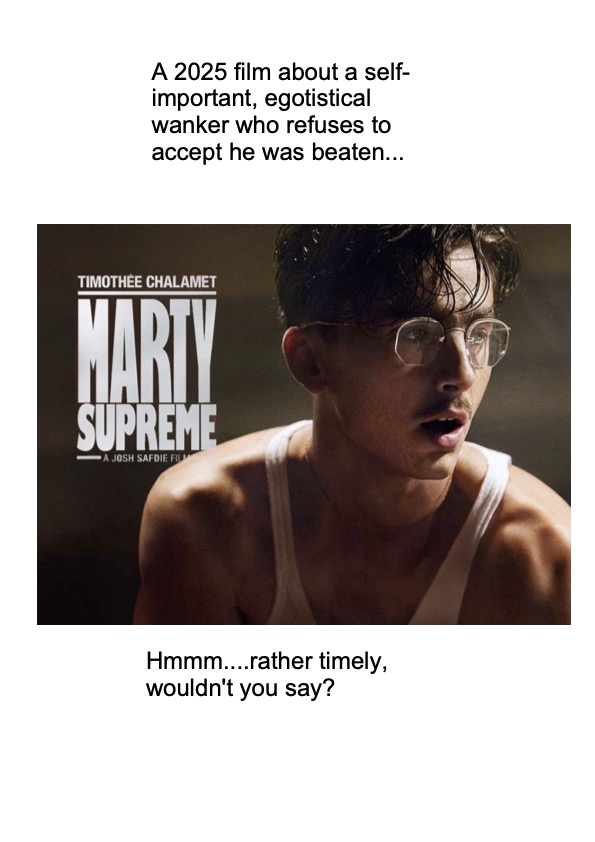
The guy was so obnoxious, arrogant and cocky that I left the cinema wondering whether the audience was supposed to have any kind of sympathy with him, or why anyone would make a film about such a jerk. But then it struck me that the film was just a very timely allegory for Donald Trump, or even the USA itself.
Wild, Beautiful London
There is only one place I can possibly direct everyone to today. I just watched Wild London, having gone out to the cinema last night. What I just saw was a real treat: I’ve now lived in London for sixteen years or so, and like most people tend to think of London as a concrete urban sprawl. What Sir David Attenborough does in this amazing program is reveal the wildlife of the metropolis to us: it’s always there, if you just look, in the gardens and parks and canals. We tend to associate Sir David with the far-flung wild corners of the world – the great oceans and deserts and mountains. But what I love about this program is that he brings the same sense of wonder and beauty home to our very doorstep. Above all, this documentary makes me more eager than ever to go out into this city and explore Wild London for myself.
Moulin Rouge
John and I seem to have started quite an awesome New Year’s Eve Tradition. After going to watch Cabaret last December 31st, John proposed we go to see Moulin Rouge. I have seen the film a few times of course, so I was obviously up for it. What I didn’t really expect, though, was quite what a fantastic treat I was in for: as soon as the performance started at the Piccadilly Theatre last night, I was drawn into a world of singing and spectacle; proletarian revolutionaries and Montmartre whores, snapping into a vast array of pop songs and sophisticated dance routines at a moment’s notice. While I don’t feel like writing any form of in-depth review, this was west end theatre at it’s very, very finest.
In short, Moulin Rouge is a great piece of cinema adapted for the stage, resulting in a production which once again reminded me just how awesome life in this city can get. Yet the issue I have today was the same problem I had last year, and whenever I go to such wonderful performances: how can I recapture the sense of life and joy that I felt last night? It was a beautiful, heartbreaking love story, told through music and dance and humour: the tale of the doomed love affair between an English writer and a flamboyant dancer. The audience was pulled into the stage so that the whole theatre felt alive. One moment I was on the verge of tears and the next at the height of euphoria. It was the kind of experience you can only encounter in a west end theatre: impeccably timed, professionally performed, yet seething with humanity and pathos. I felt it resonated with me personally – as did, I daresay, everyone else there. Yet ultimately it was a truly sublime way to see in the new year, although to be honest my appetite has just been whetted for more.
 The Ill-Informed Ramblings of a Cripple