The Sight Of Schoolchildren

I may well be becoming a bit paranoid when it comes to schoolchildren. I’ve described here before how, from time to time, kids seem to think it’s funny to try to wind me up: they see me coming along the street in my powerchair, and start mocking and jaunting me, calling me things like “Stephen Hawking”, “Spazz” or “Mong”. I know I should just ignore it and that they’re just trying to get a reaction, but part of me is too proud. Why should I have to put up with it, after everything I have achieved? I doubt any of them will ever get anywhere near a Master’s. It feels so unfair, so hurtful, I just want to tell them to shut the fuck up.

The thing is, it only seems to happen when they’re in groups. A group of three or four kids, usually boys between about eleven and fourteen, try to impress one another by taunting me and trying to get me going. On their own there usually isn’t a problem. It has thus reached the stage where, whenever I see a group of boys ahead of me, I feel a pang of trepidation. My adrenalin rises slightly, as if something bad is about to happen. Of course, most of the time when I come across such groups of boys, nothing bad happens and we pass without a word; yet I somehow can’t help worrying that I’m about to be taunted or mocked.

I just got back from Tesco. It was a simple, routine trip for supplies. It was about half three though, and the local schools were just emptying. On my way I passed quite a few groups of young boys in my chair, and I couldn’t help noticing feeling slight pangs of caution, fear and even anger as I passed each one. Nothing actually happened as it turned out, and the trip passed totally without incident. Yet, coming home, I couldn’t help reflecting to myself that I had reached this stage: that I have got to the point where the sight of a group of kids makes me fearful, or even angry. How can that be right? Why should I need to put up with this? Do other people fear kids like this? If anyone else described having such feelings – say, an elderly black man – society would rightly be appalled. Why, then, is it okay for me to be cowed by schoolchildren, just because I drive a powerchair and drool a bit?

Some Facets of the Beeb Remain Above the Current Nonsense

We all know what an absolutely ridiculous week it has been, at least nationally. I fear public trust in and support for the BBC has taken a real blow. To be honest I still don’t know what to make of it all: the beeb is the broadcaster I have most respect for; I see how it is funded, via the license fee, as akin to the NHS inasmuch as it guarantees us all access to a world class broadcaster free of adverts, irrespective of our ability to pay. Yet this week it has been shot to pieces on all sides, it’s independence from Tory control brought into real question. There is no doubt that the way it so obviously bowed to Tory pressure to get rid of Lineker, at least temporarily, has severely damaged it’s standing.

However, I’m very glad to see some facets of the beeb remain above all that crap. Tonight will see the airing of Sir David Attenborough’s new series, Wild Isles, about the nature of the British Isles. You can check out a few clips from it here. Needless to say, it looks spectacular, but that is what we have come to expect from the world’s greatest ever broadcaster. I find Attenborough utterly remarkable: when you remember that he joined the BBC in 1952, before either of my parents were born, and has fronted program after program, series after series, educating us about the natural world and bringing it’s beauty into our homes, one’s jaw can only drop in awe.

As dire as things are getting for the BBC, as large and ridiculous as this current shitshow is growing, I must say it still has my full respect, if simply because it still has the ability to produce such wonderful materiel. Hopefully when we watch Wild Isles this evening, we’ll all be reminded why the Beeb, as a national institution, is so precious, and why it needs defending against Tory attempts to compromise it.

Words Just Fail Me

From time to time, we get to a point where things have become so stupid – so mind-numbingly moronic – that you can’t actually say anything. A point at which a situation or news story grows so moronic that it becomes pointless to pass comment on it, simply because everyone can already see how stupid it is. I think we have reached that point regarding Gary Lineker, the BBC and the Tories. I know I’m supposed to be a political and social commentator, yet as much as I care about the Beeb and as much as I despise the current government, I seriously doubt I could say anything meaningful about the complete shitshow that seems to currently envelop the British mediascape. Digging into all that hypocrisy and selfishness would just wind me up too much. Besides, I’m sure we all have far more pressing issues to consider than who will present Match of the Day, such as what to eat for dinner or which pub to go to. Thus I think I’ll just wish anyone reading this a great evening, and hope this farce blows over as soon as possible.

Give Gary Lineker His Job Back NOW!

The breaking news this evening is that Gary Lineker has been asked to temporarily step down from presenting Match of the Day due to the row over his tweets. Needless to say, I am appalled. Surely Lineker has just as much a right to share his thoughts and opinions as anyone els. The fact that he presents sports programs for the Beeb shouldn’t matter – working for any company, mainstream media or otherwise, surely shouldn’t mean you have to tie your personal opinions to that company, or censor what you say unless it goes against it’s regulations. I don’t think I’m pissed off about this simply because I agree with Lineker: this is clearly a matter of freedom of speech, and writing tweets shouldn’t put anyone’s job at stake. Having said that, his tweets obviously ruffled a few feathers in the tory party; they hit a raw nerve, and were getting a lot of publicity, which is probably why, explicitly or not, the government forced the Beeb to do something. However, if you ask me, that’s all the more reason why we should demand Lineker be reinstated immediately.

Shouting At Strangers Trying To Be Friendly

I’ve described on here quite often how much I like to go out and about in my powerchair: I find just following my nose very relaxing. I usually head out in the mornings after breakfast, usually when Serkan needs me out of the way so he can clean my flat properly. When I’m out on such trundles, I’ve recently taken to trying to say ‘Good morning’ to the people I pass in the street, just out of politeness or friendliness. The thing is, when I try to do so I know I have to speak as clearly as possible for them to understand – there is no time to stop and type what I want to say into my Ipad – otherwise people won’t realise what I’m saying and just walk on. To say the two words as quickly and clearly as possible though, I tend to inadvertently just shout them out, raising my voice in the hope I’ll be understood. The result is that I head down the road shouting ‘Good Morning!’ at every stranger I pass, probably looking like a complete maniac. Believe me, it has earned me a few very strange looks.

It’s Clear Who The Country Agrees With

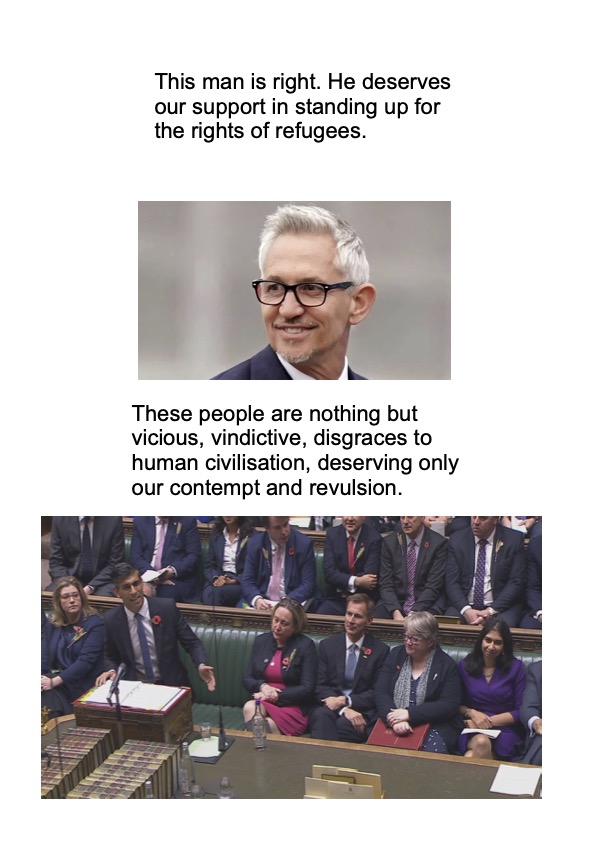
In a fit of rage yesterday I put this together and posted it on a couple of political Facebook groups. I’m pleased to say that the response has been overwhelmingly positive: on one group it has been ‘liked’ 141 times, and on the other 302 – a personal record. It seems the country sides with Gary Lineker, not the Tories.

Gary Lineker Has Nothing To Answer For

It has been a while since I said anything on here about my rages, but I had a really bad one just now. I read earlier that Gary Lineker is now in trouble at the Beeb for comparing what the Tories are doing re immigration to the attitudes of 1930s Germany. Lineker is, of course, spot on: as I wrote here a couple of days ago, Tory immigration policy is utterly repugnant, and he has nothing to answer for. Yet what really pissed me off is that the degenerate p’tahk Suella Braverman tried to attack him, as if the football commentator had unfairly wronged the tories. That she has the nerve and gall to call what her abhorrent little political party is doing ‘proportionate’ and ‘compassionate’ shows us that she hasn’t got the foggiest idea what either term means. In slamming our doors in the faces of desperate people, she spits in the faces of anyone who values humanity and cares about our fallow human beings. What kind of repugnant, arrogant disgrace to human civilisation do you have to be to try to argue that the Tories are acting out of compassion, and then to act hurt when someone calls them out on their disgrace?

In the end it got too much and I had to find something else to focus on, just to calm myself down. Braverman really was taking the piss, and my fury was white hot. What the Tories are doing is utterly wrong, the country does not support them, and we must get behind those, like Gary Lineker, who speak out against it.

Addendum: Femi explains why what Braverman is saying is so repugnant here.

Flogging Dead Horses

I don’t know whether anyone else ever thinks about things like this, but have you ever wondered what the phrase “flogging a dead horse” actually means? Of course, the phrase works as a metaphor for doing something pointless, or to continue to do something when there’s no hope of success, yet what strikes me as slightly curious is that the word “flog” has two meanings. It can mean beating someone very harshly, often as a punishment; or it can mean selling something. Both meanings obviously apply in this case: it would be just as pointless to beat a horse which has already died as it would be to try to sell it. What does the phrase actually mean then? Where might it have come from? Or is asking such questions just flogging a dead horse?

Just one of those quirks of the English language which prick my interest from time to time.

How Can Anyone Think Like This?

What sort of sickeningly malicious disgrace to humanity do you have to be to look at a group of refugees, huddled together in small boats coming across the English Channel, fleeing for their lives in search of a better life, and think “These people have no right to be here”? The issue of asylum seekers was the first thing I saw when I turned on the news this morning, and I must say that I find what the Tories are doing in using this issue to distract everyone from the failures of Brexit, whipping their brainless Daily-Fail reading voters up into a xenophobic frenzy, to be utterly abhorrent. It is sickening: no truly educated person could contemplate turning refugees away in the way in which the Tories are proposing, but they want to appeal to people who see the world in the simplest, crudest of terms – the type of people who voted for and still support Brexit; the type of people who cannot see charlatans like Farage for the scum they are.

The Tories may try to dress what they are proposing up as about safety, and say they are just trying to safeguard people from making dangerous journeys across the channel; but at the end of the day this is nothing but an unspeakably cruel, malicious plot to scapegoat people desperately trying to find safety in order to shore up the core Conservative vote. If they really were concerned for the safety of these people, they would be working to set up safe, legal ways for them to get into the country, not leaving them to the savages of the sea. Rather, this is just about preventing people who the tories and their voters see as ‘different’ from coming here, and Sunak’s insistence that it is neither cruel or unkind to want to turn these desperate people away, or that this is somehow about dealing with people-trafficking gangs, is nothing but a repulsive attempt to salve the consciences of bigots. These policies are thus motivated not by humanity but only by hatred. Thus I find the way this pandering to xenophobic morons has taken centre stage in British political discourse utterly repugnant. Surely such bigotry and cruelty has no place here.

Thinking of Esther

I just got in from a pleasant if rather chilly trundle around the Olympic park, and I saw on my friend Esther’s Facebook page that it has now been five years since her younger brother Richard passed away. I still think of Esther quite often, although it has now been far too long since we last got together. I would just like to assure my friend that my thoughts are with her and her family. It has been a long, hard few years for everyone: while some wounds simply cannot heal, however, we fortunately now appear to be coming out the other side of this dark patch. I’d thus love to invite my friend Est to visit me in my flat here in Eltham: her visit is long, long overdue, and it would be incredible if I could show her a bit of East London. I know she still misses Richard very much, and I feel myself wanting to spend a few hours with the person who was always there for me at university, if just to reassure her that I am there for her.

Olympic Whitewash?

Of course I still have fond and vivid memories of India: when I visited it with John in 2019, it struck me as an incredible, fascinating and beautiful country. Yet perhaps what I remember most vividly, what struck me the most, was the poverty and the stark, often shocking, imbalance in the distribution of wealth. That is, in cities like Delhi and Jaipur, there were pockets of modern development, where shed-loads of money had obviously been poured into constructing buildings of the kind you can find anywhere in Europe or America; yet these were surrounded by vast swathes of undeveloped, poverty-stricken expanses. The imbalance was often quite sickening, and I found myself wondering how the government of any country could spend so much money and effort in developing some areas – those most visible to tourists and visitors – yet leave areas where most Indians actually live to rot.

I was just mucking about looking at Olympic stuff again: the bidding race for the 2036 Games is in it’s early stages, and I wondered if New York could throw it’s hat into the ring again. As far as the UK is concerned, I still think it would be awesome if Manchester bid, but that’s another entry. I did, however, come across this article on the Inside The Games website. India is preparing a multi-city bid for the 2036 Olympic and Paralympic games, with opening and closing ceremonies taking place in the city of Ahmedabad. On one level, of course, this strikes me as a wonderful prospect: as the world’s primary sporting and cultural event, I see the olympics as a celebration of human diversity. For two weeks every four years, our combined attention falls on one city or region, allowing it to show itself off to the world. Surely it is time that India got such an opportunity: such countries are often overlooked, so it would be great to see Indian culture brought to the foreground.

On the other hand, I cannot forget what I saw in India. While it may well have progressed and developed quite a bit by 2036, to be honest I can’t see India or any Indian city being anywhere near the standard it would need to host the games; it just doesn’t have the infrastructure. I also worry that it would just make the inequalities in Indian society even worse: the government would pour yet more of the money it obviously has into the games while neglecting things which the country actually needs, letting it go to waste even more. India’s ruling elite would jump at the opportunity to show itself off to the world, highlighting what a glitzy, glamorous, wonderful place it is, hoping no-one notices the vast swathes of starving people and crumbling buildings in the background.

That is why I don’t like this idea. As much as I see the Olympics as a kind of global festival in which each country or city should have a turn at showing itself off, surely some countries must have bigger priorities. After all, it costs billions to put on – money which countries like India can ill afford. I fear that India would just use hosting the Olympics to whitewash itself, projecting a glamourised, sanitised image of itself onto the world’s screen while hoping we don’t see the far grimmer realities which lie beneath.

Fragments Of London’s Past

Just to illustrate what I was talking about yesterday, I’d like everyone to take a look at this. It’s a photo of the Iceland shop in Eltham high street. It caught my interest when I was up there earlier. You can clearly see that there are two distinct layers to the building: the bottom layer is, obviously, a pretty standard modern food shop. Yet above that are the remains of the building which the shop is built into: a much older building built in 1905. According to this history website, it was originally the building of David Greig, a provision merchant. I find it intriguing how, in London, so many of the things necessary for the metropolis to function as a modern city are now built into fragments of the past, so that you can often see past and present at the same time. With it’s shimmering modern shop front under two old, Edwardian balconies, I think this is a great illustration of that.

Urban Juxtapositions

I don’t write about architecture that much, but I suppose it’s something I’m becoming fairly interested in. It probably goes hand in hand with my curiosity about cities and urban geography. It’s a lovely day, so I decided to take myself through Greenwich Park and down to Greenwich town centre. Some of the buildings there really are fascinating: ancient royal palaces and naval colleges sit opposite musty old Victorian and Edwardian terraces, which in turn abut shiny new buildings of steel and glass. The result is a maelstrom of old and new which I think you only find in a city like London. The history of this place is still there and quite visible, yet is considering being built upon and renewed. In affluent areas like Greenwich especially, roads which you can tell horses pulling carts were once driven down are now straddled by expensive new blocks of flats and small supermarkets; terrace houses which were probably once occupied by dockers or market stall holders are being morphed into trendy coffee shops, bistros or fashionable clothes stores. It’s a juxtaposition which I find utterly fascinating, as if you can simultaneously read London’s two thousand year old roots and it’s relentless march towards a vibrant, diverse future in it’s very brickwork.

Quirky Ways to Spell Matt

Today I think I aught to explain something, just so it’s clear to everyone. You may have noticed that I sometimes sign my name as M@ on my blog, especially in comments. That is, I use an M followed by an ‘At’ sign. I’ve used it since I first started blogging: it seemed a fun, quirky way to write ‘Matt’. Of course, I realise that, technically, there should be a second T after the @, because ‘M@’ spells Mat, but never mind. However, I’ve noticed in my blog’s comments section, certain people who I won’t name are addressing me as M@@. I must say, this seems a bit strange to me: wouldn’t M@@ spell Matat, like someone with quite a bad stutter trying to call my name? Thus for future reference, only one @ is fine. I hope this clears things up.

Sunak Exposes what a Mistake Brexit Was

If you watch anything on Youtube today, watch this. It’s a video drawing our attention to the fact that Rishi Sunak just exposed what a catastrophic mistake Brexit was. In his speech in Northern Ireland, Sunak highlighted the privileged position that the province is now in, having access to both the UK market and the EU single market. As the video explains better than I can, that is a massive blunder from the Outist point of view, as we would all be in that position if we hadn’t left the EU. For Sunak to get so excited about Northern Ireland now having access to the Single Market, going on about all the opportunities this new deal will now create there, simply exposes how stupid it was to leave it in the first place. Things like this make it clearer than ever what an idiotic mistake Brexit was, and the sooner the process of rejoining the EU gets going, the better.

Thoughts in Costa

My thought chain in Costa this morning: “Dammit! Look at me, I’m disgusting! Cappuccino all over the table, crumbs all over the chairs. They won’t want me to come back here. [Looks to my right, sees a woman reading the Daily Mail] Meh, at least I’m not as disgusting as she is! Tory-supporting cow! [Devious, cynical chuckle] Better just keep quiet and drink my coffee.”

HBD Luke 2023

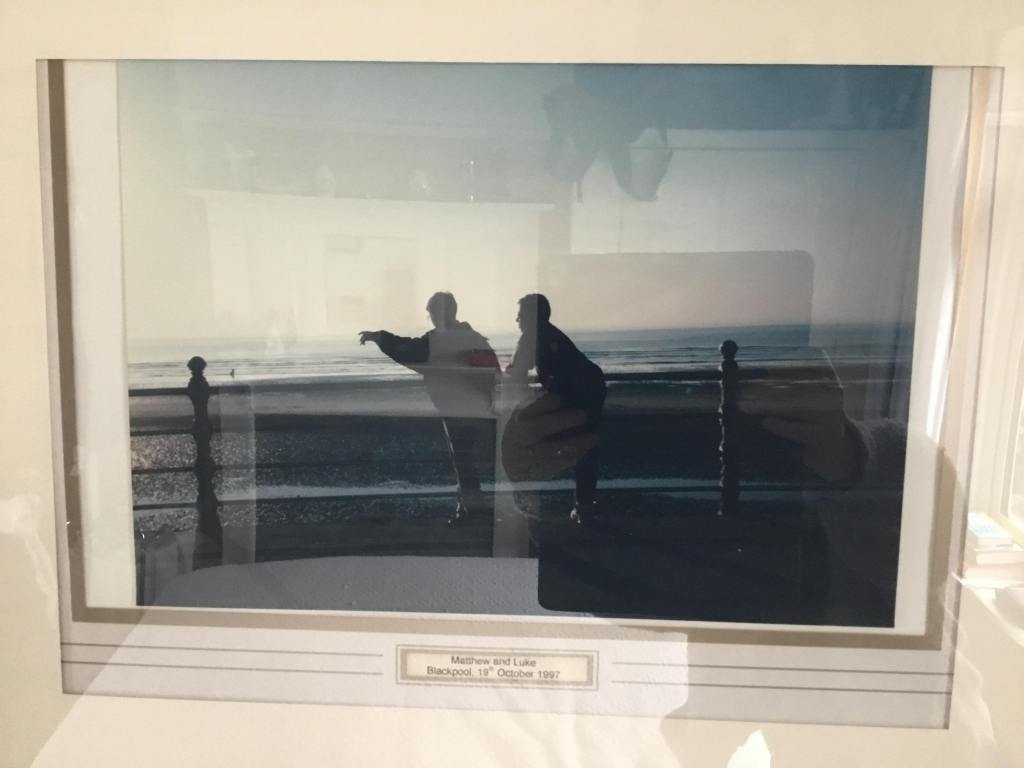
The time has come, once again, for me to wish my brother Luke a very happy birthday. I last saw Luke and Yan a few weeks ago for a family lunch. Fortunately now that the dark days of Covid are over, family get-togethers are much more feasible, so hopefully it won’t be too long before I see him again. Having said that, my little bro is very busy these days doing truly mind-boggling things with computers, so finding a time when we can all get together in the same place at the same time has become rather tricky. Thus, let me just use this entry to wish my brother Luke a very happy birthday, assure him that I think about him quite often, and say that I hope he enjoys the present I sent him.

The Franchisation of Tolkien Continues

It seems Hollywood is set on bleeding every last drop out of Tolkien’s work. I just came across this news of yet more film adaptations of Tolkien’s work, or at least films based in Middle-Earth. “Cinema is heading back to Middle-earth, with Warner Bros and New Line signing a deal to make more adaptations of The Lord of the Rings and The Hobbit. Warner Bros Discovery’s chief executive, David Zaslav, announced on Thursday on an earnings call that a deal had been brokered to make “multiple” films based on JRR Tolkien’s books.” My initial reaction upon hearing Warner were behind this was to cringe, as they are the studio behind Harry Potter and lots of other mass market dross, and I really don’t want to see Tolkien reduced to that kind of pap. Reading on, however, it seems “The films will be developed through the Warner Bros production company New Line Cinema, which produced the trilogy made by the director Peter Jackson between 2001 and 2003.” That is much, much better news: Jackson and New Line did an outstanding job with The Lord Of The Rings, and to hear they are once again at the helm is very reassuring, especially after the disaster that was Amazon’s Rings Of Power.

I still have concerns about where this will end. As I wrote here, I really don’t like seeing Tolkien reduced to yet another piece of mass market entertainment. What started with Jackson’s cinematic masterpieces, drawn as faithfully as possible from the books they were based on, is becoming more and more divergent: the two main texts have been successfully adapted to the screen; what is left of Tolkien’s writing is far more fragmentary and scholarly, and far harder to adapt. There may be many more narratives which were created by Tolkien, but I would argue that they are primarily literary, and should be allowed to remain as literature. What concerns me is that Hollywood will now get it’s hands on these stories and turn them into a nauseating mess, eager to evoke the original films at each turn, but adding nothing of worth to them while destroying the literary legacy of one of the twentieth century’s greatest writers.

I really, really hope I’m wrong. The fact that Sir Peter Jackson is involved makes me slightly more optimistic, but I can’t see what any new film or films could possibly add. One of the greatest skills an artist can have is knowing when something is finished.

Has Star Trek Returned to it’s Heyday?

If you ask me, the heyday of Star Trek was between around 1988 and 1998. As far as I’m concerned, that’s when all the best Trek was produced: The Next Generation really got into its stride, Deep Space Nine was produced, and we got Generations (1994) and First Contact (1996), in my opinion the two best Star Trek films. This was the era of Star Trek which made so many people fall in love with the franchise: plots were gripping, the characters interesting and most of the writing was spot on. There had obviously been absolutely fantastic Star Trek before then in the Original Series, and especially in films like The Wrath of Khan (1982), but that was slightly before my time. I came to trek after Gene Roddenberry brought it back in 1987. Beginning with Voyager, though, the franchise sort of went into decline: the films Insurrection (1998) and Nemesis (2002) missed the mark badly; Voyager was a poorly written mess and Enterprise just continued the downward trend. Since then, I’m afraid Trek hasn’t appealed to me as it once did, particularly after it got bogged down in nonsense about Spore Drives, alternative realities and in rewriting its own cannon.

Yet now we have a glimmer of hope, for in Picard we can glimpse Star Trek as it once was. Of course, a large part of this may be nostalgia, but in Picard we find the intriguing plots and characters that made us Trekkies in the first place. After watching the first episode of the third season last week, I found myself dying to watch the second, just as I once felt about the next episode of Deep Space Nine. It felt like Trek as it once was had finally returned, and it was awesome: I felt exactly the same pangs of excitement, glee and wonder that I remember feeling when I first watched TNG and DS9. The characters who captivated us all those years ago were back together at last, combatting duplicitous, deceitful enemies and saving the Federation just as they once did.

For me, though, something is still missing. The Next Generation and Deep Space Nine first came out when I was at school. I loved them, and couldn’t wait for the next Wednesday or Thursday evening when they were on BBC Two. I shared my love for Trek not only with my family, but also with one of my classmates, Andrew Fox. I think I’ve mentioned here before that Andy was an even bigger Trekkie than I was. He loved it so much that he got all the episodes of DS9 on video and watched them before they aired on TV. I remember practically begging him to tell me what was going to happen in upcoming episodes, especially when the Dominion War got going.

Andy had Muscular Dystrophy and passed away in 2001. He was such a Trekkie that Star Trekkin’ was played at his funeral. Now that the type of Star Trek we love seems to have been revived, I can’t help wondering whether he would be as enamoured with it as I am, or what he would have said about the sight of Worf with grey hair. His enthusiasm for Star Trek was infectious, and he used to love revealing DS9 plots to me – his eyes used to seem to light up when he was describing battles between star ships. I’ll thus always associate Star Trek, on some level, with my friend Andrew; the fact that it has returned to it’s heyday, and the characters who played such a big part in my youth have reappeared, only makes me reflect on how there are also things which can never return.

Disabled Musicians are Getting Bigger and Bigger

It looks like the world of disability music, if I can call it that, is getting bigger and bigger. I just came across this BBC article: “Professional disabled and non-disabled classical musicians are teaming up to perform a new work of specially-composed music. The Bournemouth Symphony Orchestra and the Royal Northern Sinfonia are bringing together their inclusive BSO Resound and RNS Moves ensembles.” Several ensembles of disabled and non-disabled musicians are apparently preparing for performances across the country. This is great news. Of course, I’m not a musician and haven’t had much to do with that scene since I broke up with Lyn, but the fact that it is getting bigger and bigger, and is getting more and more mainstream attention paid to it, is awesome. I can’t help wondering, though, to what extent this was kicked off by the British Paraorchestra in 2012. The article even mentions Clarence Adoo, who was in the paraorchestra and who I met. Of course, there were organisations for disabled musicians before 2012, such as Drake Music, but I think the Paraorchestra and their performance at the Paralympic Closing Ceremony really helped bring musicians with disabilities out of the shadows. I still find the fact that I was there with Lyn, as she and her fellow musicians were making history, an absolute privilege, and the fact that that now seems to have kicked off something even bigger, with disabled musicians now getting more and more recognition, makes it even better.

Intellectually Repugnant BS

As a blogger, I feel obliged to react whenever something especially noteworthy happens in politics or culture. Having now been blogging for so long, it sort of feels like my job. Yet how can anyone react to the stream of contemptible bullshit which came from Moscow this morning? I didn’t think anyone could spout more intellectually repugnant bullshit than Donald Trump until I heard Putin speak this morning. How anyone can have the arrogance to try to rewrite history so blatantly, trying to place the blame for the illegal war which everyone knows he chose to wage onto others, is beyond me. Thousands of people in Ukraine are dying due to Putin, yet he had the audacity to cast himself as some sort of heroic victim battling against the oppressive, elitist West, and the sheep listening to him just applauded their empty heads off like the embarrassments to human civilisation that they are. How can we, as a global civilisation, put up with such abhorrent spectacles?

Concerns for Stoke

Pretty much the first thing I saw when I turned on my computer this morning was this story about declining bus services in Stoke on Trent. I come from Congleton, a small town just north of Stoke, so it got my attention. When I was living in the area, Stoke had a bit of a reputation for being a run down, forgotten city. Having not lived there for so long, I can’t really say whether it still has or deserves that reputation, but what I read this morning and the bit of research I did after don’t make me optimistic. 

If that is the case though, it Stoke on Trent is still a largely forgotten city desperately in need of investment and attention, then what I wrote here about levelling up being a joke, seems even more perverse. Here in London, busses arrive every ten minutes; the city has one of the best public transport systems in the world. If any building starts to look run down, either it gets the attention it needs, or is demolished and brand spanking new buildings are put in its place. Here in east London especially, you can barely move without encountering a building site. That this isn’t the case outside the M25 seems utterly unfair to me. Is it really the case that London is  booming while the rest of the country is being left to go to ruin?

What gets to me most, though, is how this disparity is reflected in infrastructure and access for disabled people. If there is no money going into services everyone needs in places like Stoke, I dread to think what things must be like for my fellow wheelchair users. I’m now used to getting on and off busses quite easily, the wheelchair ramp coming out at the touch of a button. That such ease can still only be found in the capital really is shocking.

‘It’s Blocked!’

Just to give everybody an idea of the sort of crass, patronising stupidity I have to put up with sometimes, I think I ought to record the following. I think I have described here before how much I like walking along the river Lea up to Stratford; it’s one of my favourite routes to trundle, easily navigable in my powerchair and not too taxing on it’s motors. It’s a lovely day, so I thought I would head that way again this afternoon. However, today I found a short section of the path fenced off, obviously due to maintenance. On the fence there was a sign, which I decided to read in the hope of finding out when the path would reopen. As I was reading, though, a youngish man strode up to me totally out of the blue, and in a stern, authoritative voice announced “It’s blocked!” He then strode off before I had a chance to tell him that I was neither blind nor five years old, and that I could see that the path was shut perfectly well for myself.

Giving out a long sigh of exasperation, and, reconciling myself to people presuming I’m a total moron who doesn’t know what fences are, I decided that the only thing I could do about the entire incident was to blog about it.

Pinewood to be Expanded

Just before getting up just now, I was mulling over the possibility that we’ll see a new James Bond actor announced any time soon, and whether any forthcoming Bond film made in the near future would need to deal with Russia’s illegal invasion of Ukraine. I decided that the producer’s wouldn’t want to, which is probably one of the reasons why EON seem to have put 007 on the back burner. But I just turned my computer on to find this pretty cool news. It may not answer the Bond question directly, but the fact that Pinewood Studios is getting a massive redevelopment and expansion may be another contributory factor. “Pinewood Studios, near Iver Heath in Buckinghamshire, submitted plans for a 1.4m sq ft (130,064 sq m) expansion to build 21 new stages, a training hub and a publicly accessible nature reserve….Pinewood Group said the expansion would make it the “biggest studio complex in the world” and create 8,000 jobs.” Of course, this is outstanding news for the British Film Industry, as well as a sign of it’s current good health. Pinewood is a truly legendary place to film buffs and cinephiles, and to hear that it’s going to get even bigger, assuming these plans get the right approval, makes me eager to see what cinematic wonders come out of there next. This may mean we have to wait a bit longer before we see the next Bond film, but I suspect it will be worth it.

Mistitled Facebook Pages

I realise that I’m probably overreacting, but things like this really seem to aggravate me. We all know that Facebook is now full of pages and support groups for all kinds of things, from Star Trek fan groups to groups for people with epilepsy. It’s great how it brings people with common interests together and allows us to communicate. One such page which I came across a while ago is called Cerebral Palsy and Disabilities. I’m a member of lots of similar groups for the disability community on Facebook, so naturally I joined it. The thing is, it wasn’t actually a group, but turned out to be a page set up and ran by a young woman with CP in America. Only she could contribute to the page. It was the classic con trick where something is misnamed to draw people to it.

I suppose I should just let things like this slide, but it sort of feels like the girl behind this page has taken it upon herself to speak for everyone with cerebral palsy. By giving her Facebook page that title, does she not cast herself as the only person with cp, kind of like setting up a page called Star Trek fans but only it’s owner could contribute? She claims it is a support page for disabled people, but seems to use it entirely for self promotion, often posting pictures of herself in her wheelchair.

I hope I’ve made it clear why this gets to me, but I don’t want to be spoken for. She could have given her page many other titles, but by naming it after a disability she shares with many other people, she frames herself as speaking for everyone with that disability. I could have just dropped the matter, but what makes things worse is the fact that she has started to post nauseating memes about things like disabled children being angels and so on – things I, as a disabled man, find actively insulting.

On top of that, even though I have asked the young woman repeatedly to retitle her page, she blatantly, arrogantly refuses to do so. I know I’m one disabled person – ‘a cripple’ – of many; but if I had titled my blog something like ‘The Cerebral Palsy Hub’ and tried to speak for the entire CP community, as well as just using the page to promote myself, people would rightly tell me not to be so presumptive. By giving her personal page the title she has, not only does this young woman draw people in on a false premise, but she presumes to speak for an entire community when she has no right to do so. Am I wrong to be so agitated over this?

Justice

I realise that not everyone will get this, particularly if you haven’t watched the early episodes of Star Trek The Next Generation, but I must say that, while it isn’t unproblematic, this certainly strikes a chord. Sometimes you just have to do what you know is right.

See Star Trek TNG Season 1 Episode 8, Justice

The Secret Meeting

I’m not sure whether to see the meeting reported here as a good sign or not. “An extraordinary cross-party summit bringing together leading leavers and remainers – including Michael Gove and senior members of Keir Starmer’s shadow cabinet – has been held in high secrecy to address the failings of Brexit and how to remedy them in the national interest.” On one hand, we can take the fact that MPs are beginning to have such meetings as a sign that, on some level, they all know that Brexit was a catastrophic mistake which should never have been made. On the other hand, the Guardian article also reports hardline Outists such as Michael Gove, one of the chairs of the meeting, will never openly admit that Brexit was a mistake, and that the possibility of rejoining the EU was not discussed. “The summit papers referred to the need to move on from ‘the current mix of antagonism and nostalgia to excitement about what the future could bring for the UK and for Europe’… For those such as Gove who campaigned to leave the EU, there is also a clear interest in ensuring Brexit is not viewed as a failure over the long term.” In other words, p’tahks like Gove wanted the meeting to be about dressing Brexit up as some kind of success, so that they don’t have to admit their lies have done almost irreparable damage to the UK’s global standing.

That’s what frustrates me: every sensible, rational person can see that Brexit was an act of idiocy, that the 2016 referendum was ‘won’ based on lies, and that the only way out of this calamity would be to rejoin the EU as soon as possible. Yet because that would cost the careers and reputations of powerful politicians like Gove, they will never allow that truth to be openly admitted. They will argue black is white that Brexit was somehow good for the country, and try to shut those of us who still oppose Brexit as ‘antagonistic’. Well, I say it’s high time we got a grip, called the Outists to account and started the journey back into the EU. While the fact that they are having meetings like this is a sign that, deep down, they know the reality of Brexit, it’s time that they were forced to openly admit that they deliberately mislead the country into voting for something manifestly counter to it’s best interests.

Robots Looking For Life-Forms

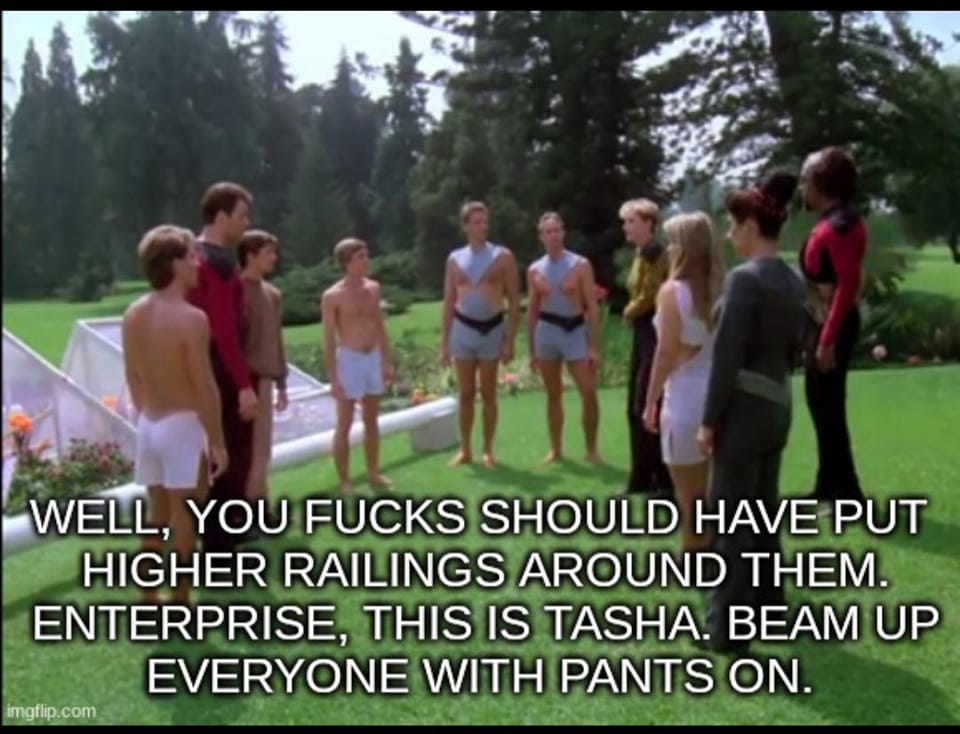
I just watched quite an interesting segment on the Laura Kuennesberg program about artificial intelligence, and how it is now being used in natural disasters. Apparently robots, combined with satellite imagery and mapping, are now increasingly being used to locate survivors of things like earthquakes. Of course this is vitally important and deadly serious, but – forgive me – as soon as they started to talk about robots scanning for life-forms, this clip popped into my head.

A Truly Nauseating Idea

Just to follow up on this entry from two days ago, it appears I’m not alone in being pessimistic about the reboot of Fawlty Towers. I just came across this Guardian article predicting the show will be an ‘anti-woke nightmare’. Broadly echoing the points I made in my entry, Stuart Heritage writes how Fawlty Towers is a ‘foundational text’ of british comedy, and to revive it is almost certainly doomed to fail. “[T]he world needs a Fawlty Towers reboot as much as it needs to be kicked down a well by a horse. Almost nothing about this news is a good idea. Where to start? There is the fact that, by Cleese’s own admission when the subject last came up in 2009, the original is held in such high regard that any attempt to follow it is almost guaranteed to be a disappointment. There is also the fact that reboots of almost everything, barring perhaps the first return of Frasier, are almost always inferior to the originals.” He goes on to explain how nothing about this idea makes sense: “Cleese won’t have the same support staff around him. Andrew Sachs is dead. Prunella Scales has long since retired on health grounds. Connie Booth – who, let’s not forget, co-created and co-wrote the whole thing – doesn’t appear to have anything to do with this new project.” I hope I’m wrong but, again, this just reeks of a right-wing zealot reviving one of his greatest hits to use as a political soapbox.

Lee Anderson Shouldn’t Be Anywhere Near Government

There probably comes a point in any country when it is forced to ask itself why the flying fuck it allowed certain people anywhere near it’s government. In America, the obvious example is Donald Trump: it still baffles me how any modern, educated society could allow such an obnoxious charlatan anywhere near it’s political system. Here in the UK, the two names which first spring to mind are Boris Johnson and Nigel Farage: both are repulsive, arrogant scumbags who just entered politics for their own puerile gratification. All three of these insults to humanity barely deserve to be allowed to sweep the streets, let alone help run a country.

After today I would add Lee Anderson to this list. To be honest I hadn’t heard much about him before, but when I heard this news that he wants to bring back the death penalty, he automatically struck me as abhorrent. Capital punishment has no place in any civilised society: that is as obvious and unarguable to me as the fact that the earth is a sphere. As soon as the state gives itself the right to kill people for whatever reason, as soon as judges are given the right to say who lives and who dies, we step back towards the dark ages. We should not have ignoramuses who support it anywhere near our government. He has also spewed a lot more obnoxious, right-wing crap which I don’t want to detail here. Yet, as Owen Jones explains quite thoroughly here, there is reason to see Anderson as nothing more than a troll, spewing more and more controversial bollocks just to provoke a reaction. Like Piers Moron, Anderson is trying to frame himself as some sort of champion of free speech, reviled by the so-called ‘left’ for daring to say what we want to ban or outlaw, pandering to the Sun-reading cretins desparate to get their baseless xenophobic views aired. Yet the truth is, any thinking person can see him for what he and those like him are: loudmouth luddites fit only to be ignored.

Basil’s Back

My jaw hit the floor when I turned on my computer a bit earlier to see this news. “Comedy series Fawlty Towers is set to be revived after more than 40 years. John Cleese, who played Basil Fawlty, will be returning to write and star alongside his daughter Camilla Cleese.” For a moment, it struck me as the bit of awesomeness I had been waiting for: the revival of a classic, legendary comedy series which will get us all rolling on the floor with laughter again. But the question is, will it? Is this really the time for the revival if such a comedy series, last in production over forty years ago, or should classics remain classics?

Of course, I felt a similar kind of skepticism when it was announced that Monty Python were reuniting in 2013. Lots of questions automatically cropped up, such as what format would the shows take, or over whether the Pythons would be sticking to their old classics or creating new material? In the end, those shows turned out to be a massive, massive success, and I will always count watching Monty Python Live in 2014 as one of the greatest events of my life. Yet a stage show based on TV sketches which most of the audience already know off by heart and a sitcom attempting to revive one of televisions seminal conic characters after a forty year absence are two very different things.

The new show will apparently be a continuation of the original: “The new series will explore how the cynical and sarcastic Basil navigates the modern world….The revival will also see Basil and his daughter, who he has just discovered is his, team up to run a boutique hotel.” To be honest that sounds a lot like an attempt to flog a horse which has been dead for forty years. It sounds as if Cleese and co. want to revive a tried and tested franchise which we all remember with great fondness simply to make a bit of money. Yet that is to forget that Fawlty Towers was very much of it’s time, reflecting and playing with attitudes which were prevalent in the seventies but aren’t popular today. More to the point, Basil Fawlty is a very energetic, physical character: much of the humour of the original series derives from him picking things up, throwing things around and running all over the place. John Cleese is now in his eighties, podgy and greying. For him to play Basil now would, arguably, totally miss the point of what made him so great and so memorable.

I don’t want to sound too negative here. After all, we have been in this position before: whenever we get news like this, whenever we hear of such a revival or reunion, there is always a tendency to be cautious. I was too young at the time, but I’m told that when Gene Roddenberry announced the creation of Star Trek The Next Generation, fans automatically dismissed it. TNG obviously turned out to be a great success, and eventually went on to give rise to several more Star Trek series. Yet the difference here is that, whereas TNG had a completely new cast, Cleese is attempting to revive the same characters from his original series. Moreover, the gap in time between The Original Series ending and TNG beginning was much shorter, especially if we remember that there were Star Trek Films in between.

I thus think I’m right to have rather large reservations about the return of Fawlty Towers. Could it be the return of a classic, or a pointless attempt to flog a long dead horse for money? Might this in fact be a case of a comedian with rather anachronistic views, trying to muscle his way back into the increasingly progressive political and cultural discourse, simply by bringing back a fondly remembered but very much of-it’s-time series? I suppose we won’t be able to tell until we actually see it.

Exploring the Quaggy

I had a lovely little trundle today to Lewisham and back over Blackheath. London seems to have a bit of a negative reputation as a huge urban sprawl, but when you get to know the city you realise that that is misplaced. It is a metropolis of parks, and even rivers. This afternoon I walked beside the river Quaggy as it meanders through several very well maintained parks between Eltham and Lewisham. To show you what I’m getting at, as well as to give you a glimpse of how peaceful and picturesque rivers like the Quaggy can be, I’d invite everyone to watch this lovely little John Rogers video. Broadly, it covers almost everywhere I visited today or have trundled previously, as well as being quite a fascinating exploration of many of my local parks.

Wondering About the Paris Metro

Life in London seems to have given me a peculiar interest in urban public transport systems. Combining it with my equally peculiar interest in the Olympic Games, earlier I was finding out about the Grand Paris Express project. And we thought Crossrail was ambitious: the Grand Paris Express seems to want to totally overhaul the Paris metro system, adding 200km of track and 68 new stations. Watching a few videos about it earlier though, a few thoughts and questions cropped up which could be worth posting here: Is it fair to say that it is an attempt to bring the Paris Metro system into line with other metropolitan tube systems? if so, what was it like before the Express project? How big was it compared to the London tube, and is it now bigger than the London underground? How wheelchair Accessible was it, and did it have a card system like London’s oyster card? How do the stations compare architecturally? I’ve never really explored Paris as I now do London. I can barely believe it has now been fifteen years since I visited the french capital with Charlie – it’s high time I went again. I’m curious to know whether I could use the metro as I now use the tube. And if this Express Project is an attempt to bring the metro up to scratch with other urban transport networks, what must it have been like before? Indeed, is this an example of the Olympics helping to spur on much needed urban redevelopment?

Can Victimhood be Inherited?

I heard in the news earlier today that the descendants of African slaves in the West Indies are now applying for compensation from the families of the people who owned their ancestors. I’m not sure about you, but that strikes me as a bit of a stretch. Of course, there is no denying that the African slave trade has a legacy, and its effects are still being felt. Yet surely people can’t be expected to pay for the crimes of their ancestors, and more to the point people can’t inherit the grievances done to their great, great great grandparents? I don’t want to say too much about this lest it becomes too contentious, but to be honest it whiffs of people assuming a victim status that they do not deserve just because they happen to have ancestors who were slaves. That strikes me as a bit like disabled people suing the descendants of Nazis, just because they are members of one of the minorities persecuted so savagely during the holocaust.