Both Have Cool Hats
Not that I want to give too much away, but when the central protagonist survives being hanged within the opening few minutes of a film, you know you’re in for two to three hours of contrived Hollywood bollocks!
Yesterday I took myself to see Indiana Jones and the Dial of Destiny at the cinema. To be honest I don’t go to the cinema very often these days, simply because it is easier to watch films here at home, but yesterday I thought I’d make an exception: This was an Indiana Jones film, after all. I don’t think I had been to the cinema since watching No Time To Die two years ago in fact, but as soon as I entered the screening room I remembered why film is so much more awesome on the big screen.
As for the film itself though, I must say I left the cinema in two minds about it. The eight year old in me was awe struck: this was a rip roaring action adventure involving Nazis, fights on trains, ancient artefacts and tons more. Given the audience it was aimed at, it hit the spot quite perfectly. There were plenty of pleasing, nostalgic nods to the previous films in the franchise, including a rendition of ‘A British Tar‘. On the other hand, again not wanting to give the game away, the extent to which this film requires you to suspend your sense of disbelief really pushes the limits. Frankly I burst into open laughter at one point, and I daresay anyone who knows anything about ancient Greece, Archimedes etc would do the same. The film critic in me is crying out this is contrived, inane bollocks which only got made to revive a forty year old franchise whose lead actor is clearly far too old to play the part.
Which is it then? A fantastic action adventure bringing back one of post-classical Hollywood’s greatest heroes one last time, or a bit of contrived rubbish flogging a horse which should have been allowed to die about two decades ago? I honestly can’t decide; but then, isn’t that part of the joy of going to the cinema?
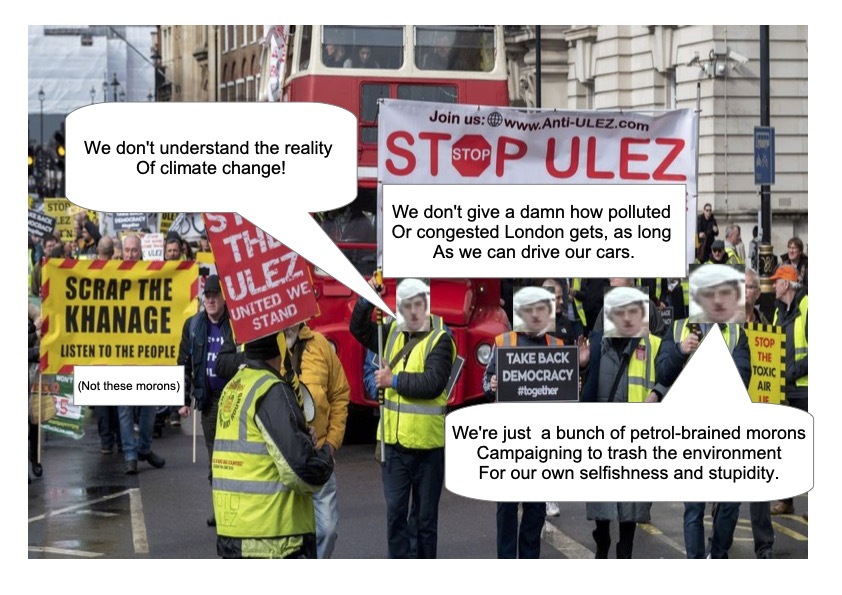
Of all Tory MPs, one of those I detest the most is Jacob Rees-Mogg. He is a loathsome, self-important little man who thinks he is inherently superior to everyone else, simply because he was born into wealth and speaks with a plummy accent. That aside, if you want to see why he is utterly unfit to be anywhere near any modern government, just watch this Owen Jones video. In it, Jones discusses Rees-Mogg’s recent comments on climate change he gave for a TV interview: in an era where any sensible, educated person can see the need to draw our energy from green, renewable sources, Rees-Mogg was arguing that wind and solar energy are too unreliable, and that we should be going back to nuclear and fossil fuel-based electricity. Has this man not bothered to read the data? Or does he just have so much personal wealth invested in coal mines and oil fields that he thinks we should continue fucking up our environment just so he can stay rich?
Such arrogance and wanton shortsightedness makes me furious. How can anyone still believe that the accumulation of wealth should take priority over the urgent need to do something about climate change, that nothing should inhibit the ability of p’tahks like him to make money, or that their opinion counts more than others because he is pseudo-aristocratic and talks with a posh accent? As I said, at a time when everyone sees the need to do something about climate change, Rees-Mogg is an anachronistic idiot utterly unfit to be anywhere near our government.
I have been fretting over this all day, and you should probably forget what I wrote here yesterday. While I still think that I shouldn’t just blog for the sake of it, something seems to compel me to keep blogging, to the extent that I start to feel rather uncomfortable if I don’t. I wouldn’t say it was a full on addiction, rather a habit built up over two decades of blogging. If I don’t blog by a certain time of day, a voice at the back of my mind keeps telling me that I might not get the opportunity the day after. Needless to say, the voice sounds remarkably like my parents. Thus I think I’ll just keep prattling on here, just as I always have; and if people can’t read every entry, or if I don’t quite manage to blog every day, nobody should get too upset. These are, after all, just the ill-informed ramblings of a cripple.
Mind you, I really need to find something more substantial to write about, rather than whether or not to blog.
A few days ago I was told by someone who reads my blog that I tend to post entries too often and that they found it difficult to keep up. That is, writing an entry every day meant they struggled to read them all. To be honest that made me think: I take pride in my blog and like keeping it updated, but perhaps it’s time for a change of tac. I think I have written some really good entries over the last two decades, but trying to blog this regularly has often lead to me posting a lot of pointless ones. Sometimes I just post an entry about the first thing I come across, just so I can get an entry online before the revelries of the evening begin. Maybe it’s time to take my foot off the pedal slightly and only blog when I have something specific or interesting to write about. This will probably still mean that I update my blog fairly frequently, just not with such relentless regularity. After all, having been at this for two decades, including two years (2017 and 2018) in which I made sure I blogged every day, I think I’m due a bit of leeway.
I’m still not sure what ‘Smoosh’ means, but whatever it is, it’s awesome. Yesterday I took myself up to Southwark, to check out an event by the Paraorchestra. I had heard it mentioned on the news the evening before and decided to check it out. It had been years since I’d had any contact with the Paraorchestra: Lyn stopped participating in it soon after 2012, and we had fallen out of touch. Yet as a disabled blogger and commentator, the Paraorchestra seems a key part of disability culture, so I thought I’d go see how they were doing.
I got up there a couple of hours early, so I milled about the Southbank Centre for a bit, checking out what was going on and avoiding the heat. Then, at three yesterday afternoon, it all began: it wasn’t so much a performance than a parade: A procession of about thirty musicians with various disabilities, marching along the south bank of the Thames, playing all kinds of funky, modern songs. I was instantly intoxicated. It felt like a carnival; a celebration of human diversity in which the participants cried out ‘this is what we can do!’ There was dancing and whooping and cheering. People were playing all sorts of instruments, including one guy with a huge sousaphone and another with a full drum kit bolted to his wheelchair.
To be honest, at one point I became rather emotional. It reminded me so much of Lyn, and I could almost feel her presence. The Paraorchestra has a lot of new musicians, and I barely saw anyone who was a member in 2012, except one: I recognised Lloyd Coleman, who is (I think) now one of the creative directors. He recognised me too, and we started to talk. It was great to see him: we spoke about Lyn, and had a brief hug.
The event lasted all afternoon, and there were two performances of roughly the same songs. I stayed for both. I really wanted to catch up with Charles Hazlewood, who created the orchestra, but was eventually told that he had had to leave early. All the same, it was a fantastic afternoon, and I really want to explore ways of somehow getting involved in the Paraorchestra myself as a filmmaker.
I’m still not sure why they called it ‘Smoosh‘ though.
I was thinking about writing one of my facetious little blog entries earlier about sometimes getting lost in my powerchair, but never causing an international search. I’m currently watching the evening news though, and it now looks like that wouldn’t have been at all appropriate. It is now looking more and more likely that the submarine Titan has been lost. Jokes are all well and good, and it’s pretty easy to make fun of things like getting lost in tiny submarines amid massive oceans, but sometimes it is better to resist the temptation.
I genuinely think Best Interests is one of the most difficult, hardest pieces of television I have ever watched. By that I mean it was difficult for me to watch, just because it brought back so many upsetting memories and thoughts. The four part drama, aired over two weeks, tells the horrific story of a dad and mum as they fight to preserve the life of one of their daughters, Marnie, who has a form of Muscular Dystrophy. They want Marnie to be kept alive, despite the fact that, over the series, we see her gradually deteriorate so that by the last episode she isn’t conscious.
This is thus hard, hard viewing for me, having lost so many friends to MD. The sight of that girl in that hospital bed last night, her family around her as the machines were turned off, raised so many gruelling, fucked up questions in my mind: is this what the families of my friends had to go through? Did they have to make choices like this? Did the Wheatleys, Foxes and Donneleys all have to watch as Andrew, Andy and Lee faded and died before them? That thought is too abhorrent for me to bear, yet last night we saw it played out on television: a family wishing their child farewell one final time.
Muscular Dystrophy is the type of thing you encounter when you grow up going to a school for physically disabled young people. I don’t think many other people will have heard of it, but it is the type of thing I learned about at school. Those were the hardest, most gruelling lessons of all. I remember first meeting a boy called Andrew Wheatley in the nursery department at school. We must both only have been five or six at the time. I remember wondering why Andy was there: at the time, he could walk, talk and feed himself, so I childishly reasoned that he was perfectly ‘normal’. As we grew up together though, I noticed Andrew’s strength slowly ebbing away: he began to use a wheelchair, and seemed less able than he once was. I didn’t understand it at the time. We went through nursery then junior school together, being joined in junior school by Lee Donnelly. Then, one day in the last year of junior school, our teacher Mrs. Tomlinson walked into the classroom one morning to tell us that Andrew had died – it was only a few months after his older brother Dan had also passed away.
I remember feeling heartbroken: it just seemed so unfair. Yet it’s the type of thing which happens in a special school; the type of thing you almost get used to when you attend one. I lost two more friends to MD: Andrew Fox passed away in 2001 aged eighteen, and most recently Lee Donnelly, whose 2018 funeral I recorded here. To a certain extent knowing about such sadness feels like something hidden and secret, as if you only know about it if you go to a special school. To watch it being portrayed on television, then, almost feels like such hidden sadness which everyone else has been allowed to ignore, has been released into the open, so that everyone else can now witness the things I encountered in my childhood.
My friends had different types of MD to the one Marnie supposedly had on the program; and to my knowledge their families did not have to go through any legal proceedings. Nonetheless, Best Interests reminded me what Muscular Dystrophy is and what it can do: it is a horrible, horrible disability, sapping away a child’s strength so they can’t even lift their hands to touch their face. A lot of the time they suffocate under the weight of their own fucking chests. MD tears the heart out of loving families, leaving mums, dads, brothers and sisters with nothing to do but mourn. It is the one disability I loathe above all others; one which has deprived so many young people I have known the chance to live long, full lives. Watching it’s devastating effects being played out in this series brought that feeling of injustice and powerlessness back to me: all we can do is watch as these once thriving, energetic, joyful kids fade and die, both on television and in harsh, cold reality.
Just as an update on this entry from a couple of years ago, the incredible news is that my schoolfriend Daniel Holt is now a fully fledged barrister who is able to accept cases. He announced it on his Facebook page yesterday afternoon. This is fantastic news of course, although it makes me reflect on a couple of things.
Most obviously, it demolishes the line that Special Schools always give kids a second or third rate education and fail them. You can go to a special school, get a decent education, go to university and lead a rich, full life. I now know quite a few people who attended my old school, Hebden Green, who have gone on to achieve wonderful things, academically or otherwise. Of course, there will always be pupils who attend such schools who won’t be able to get A-Levels, go to uni etc, due to their disabilities: I now suspect that those who campaign to close special schools lump the two groups of pupils together to deliberately distort the situation. Such ‘activists’ want to say special schools fail kids when they clearly don’t; the reality is much more complex, and some kids need to be taught in separate spaces, away from the chaos you find in most comprehensives. Obviously where it’s at all possible, all children should be taught together, but this is far from a black and white issue. While I may have received the best academic education when I attended mainstream classes, frankly, I now think my experiences in a special school really did me good: had I never been to Hebden, I would never have met my classmates – guys with far more severe disabilities than I have, from whom I learned a great deal of humility and patience. I am honoured to have known people like them, as well as guys like Dan Holt.
More personally though, Dan’s achievement makes me feel a little ashamed. He has a job: he is now a barrister, and will presumably be working to defend people in court. But what do I do? I just write blog entries and trundle around London in my powerchair. Learning about incredible achievements like this makes me feel a bit lazy, as though I’m wasting my life. Then again, I keep asking myself how I could ever have been a barrister. Dan uses a powerchair but talks clearly. As a communication aid user, I think I would struggle to keep up with the argument in a court of law, especially if I was supposed to be representing a client. I think the same goes if I had a regular nine to five job: because of my care needs and limitations, I really think I’d struggle. Yet through my blog and my other writing, I tell others what I think: I can convey to the world what life is like for a disabled man living in London, letting them know that I am just as nuanced, complex and proud as anyone else.
I don’t think I should feel too ashamed of myself, then. After all, not everyone has a Master’s, and not everyone can say they have kept a blog up for twenty years. I might not be a barrister, but I am a blogger, writer and filmmaker, and I think that that in itself is something to be proud of. And like Dan Holt I went through a special school system, coming out the other side with a will and determination to fight for what I need as well as a pride in who I am.
I’m sure most people will have heard of “The Knowledge”, the legendary system in which London taxi drivers memorise every road and route in the capital in order to get their passengers from A to B. If you ask me, I have serious doubts about whether that is actually possible. While it may have been in the past, now that London is so vast and sprawling, I cannot see how anyone could learn the entire map of London.
Out on my trundle this afternoon, I was slowly getting more and more lost: as I have said here before, I often like to just follow my nose, exploring roads and paths I have never taken before. More often than not this leads me to losing my way, but that is half the fun; the longer I live in this city and the more I explore it, the more intriguing and labyrinthine London seems. Today though, I was following more and more obscure roads, and soon began to go in circles.
Of course I eventually found my way again, but it made me think: how could anyone memorise such a maze? How could anyone possibly learn all the road in this massive place? I struggle to find my way, and even then I stick to a relatively small corner of the metropolis. There must be tens of thousands of roads and junctions in London: I find the notion that someone could remember them all, knowing by heart where each one of them leads, frankly beyond credible. How on earth could any human brain grasp the entirety of such a vast, complex, dynamic system?
One of my most chilling memories – an image which will remain scarred into my mind for the rest of my life – is of Lyn lying in a hospital bed at Queen Elisabeth hospital in early April 2020. Lyn wasn’t conscious; she was very ill with a tumour. By then I was living in Eltham, and I had gone to visit her. Of course I had been in two minds about going to see her: at that time the pandemic was just starting, and I didn’t want to make things worse. Yet I really wanted to visit my friend, a person who I owed so much to, and had shared so many memories with. I just remember the sight of her lying motionless in bed, feeling so furious that there was nothing I could do to help.
It now appears that at that time, at the time when we were all sheltering, desperate to avoid becoming infected or to infect anyone else, the very people who were supposed to be running the country, advising us to stay safe and social distance, were throwing parties. They were dancing in the offices of state, as if it didn’t matter what the rest of us were having to go through. This morning video has emerged of one of those parties, showing people dancing and cavorting together like students at a campus disco.
How is it possible that any human being so be so arrogant? How can they feel so superior and separate from the rest of us that they felt they had a right to party while so many others died? The mental juxtaposition of the memory of Lyn in that hospital bed, butting up to the footage I saw when I turned on my computer this morning, is sickening. Lyn died a few days later, and to be honest for some time part of me was worried that my visit had caused her death. Of course, many other people will have memories like mine, of friends they will never be able to speak to again, dying during the most catastrophic medical emergency in living history. Surely they too will look at this film and, remembering their friends or loved ones, feel the rage I now do.
Together with the political turmoil of this week, surely the Tories, as a group of people who feels so entitled that they give themselves the right to party while so many others die, can never be forgiven for this.
Assuming I have any, long term readers will probably have noticed that they can’t really predict what they are going to find here on any given day . I like to vary my subjects, and basically write about whatever takes my fancy. Over the years this has lead to me writing about all sorts of things, from what I did the previous evening to my political opinions to Olympic ceremonies. That is the way I like it. Yet I recently came across a phenomenon in blogging which rather puzzled me: a newly established blog, kept by a friend of mine, just about a specific subject, in this case food.
The writer of the blog is an intelligent guy with cp who I have known for a while. He is interested in all kinds of things, just like anyone else. To be honest he has never struck me as a particularly culinary kind of guy. Of course, he can do what he wants with his blog, yet it really puzzles me why anyone would limit themselves creatively like this. I don’t think I could abide having to stick to one subject, every time I wanted to blog. After all, it’s my primary way of expressing myself, and that includes questioning other bloggers creative choices.
The British political realm has of course been set ablaze today by the comittee report about Boris Johnson misleading parliament. I’m glad to see that that scumbag is now getting the disgrace he has long deserved. Watching the news earlier, most commentators were rightly condemning him. Yet what got to me, what infuriated me so much that I had to turn the tv off, was that there were Tory MPs actually trying to defend the prick. They were spouting bullshit about the comittee being biased and unfair, claiming that it was always going to find against Johnson just because of who he is.
The freedoms of speech and thought are fine things of course, but I strongly and passionately believe that such people don’t deserve to be anywhere near government. Johnson has been found to have deliberately and knowingly mislead parliament and the country, but they want us all to just let him off: They were saying things like Johnson didn’t intentionally do anything wrong, and that Starmer was somehow just as bad. But I refuse to be conned into forgiving a man who partied while tens of thousands of the people he was supposed to be governing were dying; and I refuse to bow to these arrogant, superior Tory scumbags now insisting Johnson has been unfairly wronged. Their entire ‘born to rule’ mindset is sickening, and they have no place in any democracy. Johnson has gone, but they must go too.
Today I had what felt to me like quite a dramatic realisation: in thirteen years of trundling around (east) London, I have never actually been outside of the city. Of course I have been outside Greater London when I visit my parents or go on holiday etc, but my daily trundles have always been confined within the M25. That’s not necessarily a bad thing- I still have a heck of a lot of the metropolis left to explore- yet I also remember that London is not the entire world, and as awesome and thrilling as the great maelstrom can be, surely there are other places I can get to.
I’m not yet sure how, but it’s surely time to put that right. There must be busses which go outside the city, or paths which lead under the M25. The weird thing is, that somehow feels far, far away, almost as if the rest of the UK is a totally different country from where I now live. Perhaps I have been living in this self-important place for too long, but it makes you think that all that is worth seeing or visiting exists here, so there’s no need to go beyond. Yet I remember towns and villages which are separated by dozens of fields, and which it took time to travel between. Places with their own character, which weren’t part of the same vast urban sprawl. I think I miss such places, so I now want to explore more of the area outside London in my daily trundles. Surely there must be places down in Kent or Sussex which I can get to and look around for an afternoon or so.
I was just coming home via Canary Wharf having just attended quite an important meeting in central London. The meeting had gone really well, but I nonetheless wanted to let off a little steam with a trundle. For the first time I could remember, I was wearing a shirt my friend James from the cricket team had given me to thank me for my support. I was making my way quietly, deep in thought, when I suddenly heard someone say “Hi Matt!” Totally at random, I had bumped into one of the players from the very team who’s shirt I was wearing. What are the chances? Sometimes it feels like I’m living in a village rather than a metropolis.
We didn’t talk long and it was only a fleeting interaction. Yet it reminded me how small this city seems to now be becoming, and instantly struck me as amazing enough to be recorded here.
When I’m out on my daily trundles, I’m often struck by sudden ideas about places or things to investigate. Some of these ideas turn out to be awesome , and I have blogged about many; most of the time, however, they turn out to be grave mistakes. I think today’s adventure was somewhere in the middle.
Today began sunny and very hot. I decided to wheel my way down to Woolwich, just to see what, if anything, was going on there. Of course, Woolwich was still the busy market and town centre which I last visited a few days ago, so from there I decided to go and take a look at the river, trundling through the old Arsenal: What was once a great eighteenth century munitions depot is now a chic upper class housing estate, complete with Marks and Spencers, drama studios and an Elisabeth Line Station.
The problem was, by then the sky was quickly darkening – it was obviously about to bucket it down. It was then I was struck by an idea: perhaps it would be cool to try out the Woolwich ferry. I had never crossed the Thames that way before, and I reasoned it would give me the shelter I suddenly urgently needed. From the look of the cloud, the rain would be heavy but wouldn’t last long, and this way I could cross the river and explore a part of the city I hadn’t been to before.
That is basically what happened: the ferry crossing was short, uneventful and free. Looking out towards the west, I saw the metropolis before me, a forrest of skyscrapers, cranes and building sites, cut in two by the river. By the time I was on the north shore of the Thames, the rain had stopped. From there I started to explore a bit more of East London, again nothing how much of the old nineteenth century housing is being replaced by more and more ultra modern infrastructure. What might once have been termed a juxtaposition I now think is more rightly called an outright conflict, as the very new rapidly wipes out what was here recently in that weird abutting of architecture which I have only ever encountered here in London. Here, exhibition centres sit beside nineteenth century docks, as cable cars are carried above a river once plied by sailing ships.
The Woolwich Ferry, then, struck me as a nice, pleasant way to cross the Thames. Of course, taking the Lizzie Line or DLR is faster, but given that there has been a ferry crossing at Woolwich for centuries, it seems to me that it is a cool link to London’s past. Ferries now carry cars and lorries where they once carried horses and carts. And beneath them all flows the mighty Thames: timeless, immortal, unchanging.
After this week, I believe what I wrote here more passionately than ever: the Conservative party ought to be disbanded. It’s becoming clearer and clearer that the bunch of arrogant charlatans think they are above the law, and have a right to award honours to whoever they wish. This week we saw Johnson dishing out knighthoods and peerages to his mates, and this morning we saw the worm Grant Shapps on TV defending him to the hilt, trying to persuade us that Johnson had done nothing wrong, and that he somehow deserves our respect. I really am sick to death of this group of spoiled thugs calling itself a political party, driving the country into the dirt for their own selfish ends. I honestly think it ought to be disbanded – surely we are better than this.
Sadly I didn’t create this, but I couldn’t agree more with it’s sentiment.

“Eastenders” must surely now be the most ironic name for a television show ever, and that irony keeps getting clearer and clearer. Of course, when the soap was created in the early eighties, the east end of London was a very working class, downtrodden area synonymous with grift and grime. Eastenders worked harder for very little pay, living in postwar council houses quite removed from their central London neighbours.
These days, however, east London is a completely different place: probably starting with the transformation of the Isle Of Dogs in the late eighties and continuing with the creation of national cultural destinations like the Dome and the Excel Centre, the area has been gentrified beyond recognition. Rows of terrace houses have been replaced one by one with smart blocks of flats, complete with coffee shops and bourgeois bistros. You only need to go to Stratford to see how radical the transformation has been; but the same thing is happening all over the east end of London, from North Greenwich to Woolwich to Kidbrooke. Of course, the extension of the jubilee line and then the creation of the DLR and Elizabeth Line have made a real difference in uniting the capital with its historic east end. The area is also vastly more gentrified and multicultural than it once was. Thus I no longer think the name Eastenders and the connotations it once carried really holds true, unless the soap is now set in an area of well maintained parks, enormous skyscrapers, huge shopping centres and multi billion pound transport projects.
Today I’d like to remind everyone of this 2018 blog entry, in which I declared myself a West Ham supporter. When I say ‘supporter’, of course, I don’t mean much more than keeping an eye on how they are doing, and hoping they win matches. Nonetheless, the news that they won the Europa Conference League last night, especially in such dramatic style, is great. I haven’t been out yet, but I’m sure all of east London will be buzzing; there is even talk of some kind of victory parade. The next few days could well make me relish living here once again, and if anything particularly awesome happens, you can expect a full account here.
I have quite strong memories associated with The Full Monty. In 1997 or so, when the film came out, our PE teacher Mrs Jones suggested using the main song from the film, ‘You Sexy Thing‘ by Hot Chocolate, as the basis for the dance module we had to do. At the time I was in a class of nine or so profoundly disabled young men (plus one girl) all bar two using wheelchairs or powerchairs. If memory serves, we were in two minds about it at the time, but in the end we were able to put together a fairly solid, well choreographed dance routine set to the famous song, and tick the box for the class.
We thought little of it at the time, but as it turned out it was just a prelude: A couple of years later, our new PE teacher Mrs Stallberg had the idea of entering us into a national wheelchair display competition. I don’t know how much she knew about what we had done before, but she nonetheless had the confidence to enter us into the regional competition in Manchester, then the national one up in Glasgow. We performed that routine to different music though, so that’s another story.
I came to think about this this morning when I heard on breakfast TV that Disney now plan to release a sequel to The Full Monty. Needless to say this strikes me as utterly bizarre: The Full Monty was a classic of 1990s British Independent film – what is a massive American studio going anywhere near it? More to the point, why does anyone need to do anything with this nice little film, set in North England, confronting many social and political concerns of the time? Surely the wisest thing to do would be to let it stand and allow it to retain it’s status as a classic. But No! Like The Lord Of The Rings, Star Wars and so many other franchises these days, the massive American corporations now want to go back to it, presumably because it was so successful at the time, to see if they can make yet more money out of it. And of course, the risk now is that they’ll just create a mess, turning The Full Monty into commercialised pap with little resemblance to the original film. It would seem that, to Hollywood these days, very little is sacred.
Yet I still have my memory: I still remember performing with my friends to Hot Chocolate. Strangely, I still think I remember some of the moves we had to do, and how Rich had to whip Andy’s shirt off as they wheeled past one another. Yet Andy, Rich and so many of those guys aren’t here any more, so these memories have a really bittersweet feeling for me. That probably includes the memories I associate with the Full Monty, another reason why I’m not convinced by this reboot.
I spent most of this morning going in circles, and I don’t mean wasting time in my powerchair. I wasted about two hours looking for one of my early university essays, so I couldn’t find it anywhere: not in my documents, my external hard drive, or my old emails. I wanted to find a review of The Lord Of The Rings films I wrote in my first year at university. It was the first thing I wrote for my Film Studies course and I remember feeling quite proud of it, but I have no clue where it went.
This came about when, earlier today, I came across a Facebook post about Ralph Bakshi’s earlier animated adaptation of Lord Of The Rings. I remember watching that adaptation once or twice as a child, but I don’t know much about it. However, it struck me that it might be interesting to compare the Bakshi version with the later, live action Peter Jackson adaptation. That was the version my uni review was about of course, so I reasoned that a good starting point might be to refresh my memory with what I had already written all those years ago, before proceeding any further and rewatching both films. Naturally I still have my 2012 blog entry on the trilogy to go back to, but my review was far longer and more detailed.
My inability to find the document I want aside, it still strikes me as a very interesting idea: how might the two adaptations of Tolkien’s epic novel compare? They are obviously very different works: Jackson’s ten hour, three film version was a smash hit, famously winning about twenty Oscars; whereas Bakshi’s was – or is now – relatively unknown. Obviously, one is animation and one is live action, and they seem to have had vastly different budgets. Even so, being based on the same book(s), there might be a few correlations which it may be interesting to analyse. I wonder how much has already been written about this, and whether anyone has already tried to contrast the two adaptations. Time, then, to stop going in circles trying to find long lost documents and get down to some actual research.
Something else which pricked my attention on the breakfast news this morning was a short piece about fly tipping in Stoke on Trent. I grew up in a town not far from Stoke, so it got my interest: fly tipping and littering is apparently becoming a real problem there, with rubbish blocking many streets. However, I didn’t think much more about it, until a few hours later. My trundle today took me over to Canary Wharf. I’m currently quite interested in that area, and in how such a heavily industrialised area of docks and mills has been transformed into a region of sparkling skyscrapers and high-end shopping malls.
Today, though, what caught my attention the most was how clean it all was: the roads and paths around the Isle Of Dogs were almost totally litter free, and I think the same can be said of London in general. A huge amount of money has obviously been spent on gentrifying east London especially, and it’s striking how well maintained everywhere is. Of course, you still see the odd beer bottle or crisp packet here and there, but it’s nothing like as bad as what was being reported about Stoke.
I haven’t visited Stoke on Trent in about fifteen years. I know the city has quite a negative reputation, but I can’t say whether that reputation is still deserved. However, what I saw this morning, contrasted against what I encounter these days in London, gives me cause for concern: has the chasm between the capital and the rest of the country now grown so hideously, unjustifiably wide?
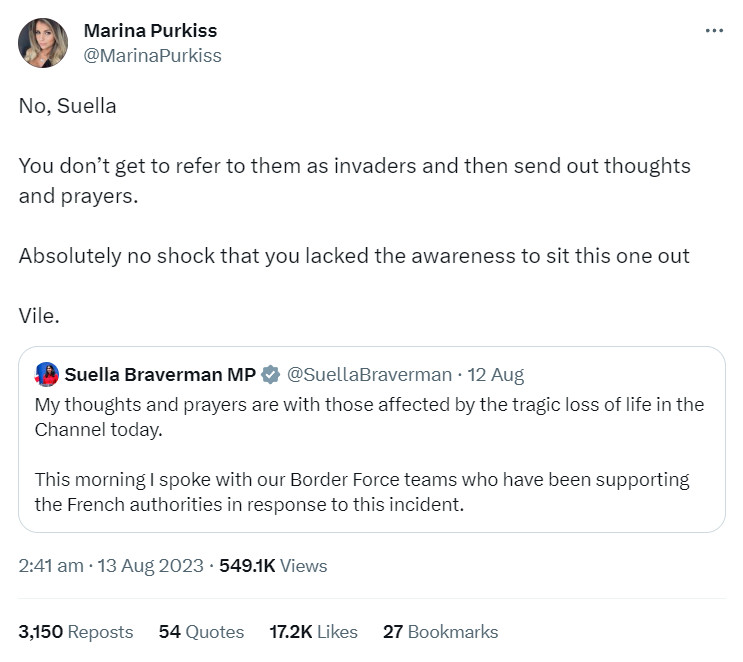
You know you have reached a shameful, abhorrent point as a society when your government announces plans to spend £6bn it can barely spare trying to deport people coming here looking for refuge. When I turned on the news this morning, that was the first thing I was greeted with. “The cost of detaining and deporting people arriving in the UK in small boats under planned new legislation could hit £6bn over the next two years, internal government projections say….The BBC understands the Home Office estimates it will have to spend between £3bn and £6bn on detention facilities, and ongoing accommodation and removals.” Are the Tories really so vapid, so eager to please the Mail and Express reading xenophobes, that they would waste so much money trying to detain and deport these poor people? Of course, I know it wouldn’t be cheap to welcome and house them here instead, but surely that would be a far more humane and civilised thing to do. And given that it would mean putting money into supporting people to live here in the UK, it would essentially be investing in our society, rather than wasting it on barbaric, inhumane schemes intended to appease bigots. I really am appalled by what the Tories are turning this country into.
I honestly don’t think I’ve watched a television program with Philip Schofield since I was a child and he was presenting after school kid’s TV. I don’t give two hoots who he had an affair with, especially given there are so many far more worrying things going on in the world right now. Why, then, when I turned on the TV this morning in the hope of catching up with what’s going on in the world, Schofield was all they were talking about. If he had an affair with a younger man, surely it’s his business. At the very most, it’s worthy of a thirty second mention at the end of a news bulletin, but this morning it seemed to take up the entire hour. Have we all become so shallow that such irrelevant celebrity trivia is all we care about? And more to the point, why am I even blogging about this?
I wasn’t sure whether I wanted to note this when it was announced a few days ago, but I have to raise an eyebrow at the fact that John Cleese is now working on a stage adaptation of The Life Of Brian. On the face of it, it’s a wonderful idea: Life Of Brian is one of my favourite films, and one of the funniest films of all time. The problem is Cleese himself. As I wrote about his rebooting of Fawlty Towers, Cleese has lately become a bit of a spokesperson for the reactionary right, appearing on channels like GB News and railing against so-called woke culture. What concerns me is that Cleese will now try to hijack Brian and use it as a mouthpiece for his inane, increasingly vile politics.
People seem to be forgetting that Monty Python was the creation of five highly educated, extremely talented men rather than just John Cleese. They want to give all the credit for the classic comedy program to Cleese alone, and he seems more then happy to accept it in the pretence that the show was a pure reflection of his increasingly judgmental, intolerant views. But that is to forget that Monty Python’s Flying Circus was a manifestly left Wing, liberal creation involving transvestic lumberjacks and exposing the stupidity of religion. As I wrote here, it was about exposing the hypocrisies of postwar, conservative Britain. In a way Python was itself manifestly woke.
Thus for Cleese and others on the right to try to argue that much of Python would have been cancelled as too offensive if it was being made today is to distort matters entirely. Monty Python wasn’t about articulating or reinforcing prejudices or stereotypes, but exposing their inherent ridiculousness. To think it was about making fun of people like cross dressers or trans people is to miss the point of Python completely. I just hope that that remains clear in the upcoming Life Of Brian adaptation, and that John Cleese does not turn it into something hideously reactionary which runs counter to the very ethos which made it so awesome in the first place.
I’m really starting to regret not studying psychology seriously now. Turning on the TV earlier, all the talk was about mental health. It is, of course, mental health awareness week, but even so it staggers me to hear that one in five people in the country now has a mental health issue. It’s becoming a real issue, and I find myself wishing I understood more about it.
I have written here before about the difficulty I had studying psychology at A-level. Part of that was down to the problems I had getting my head around all the various, competing academic approaches which make up the subject; but I also think part of the problems I had arose from the fact that, as someone with a physical disability, I could never really understand how people could have such severe issues which could not be seen. That is, it perplexed me why anyone would act so abnormally or feel so depressed without having a real physical reason to do so. To a certain extent it still puzzles me. Over the years I have come across many people with physical conditions who have very positive mental outlooks and who just get on with their (often significantly shortened) lives; so why would anyone with no such problems apparently pity their selves so desperately? Another example may be the increasing number of people now hearing ‘voices’ in their head: what is the difference between such a voice and your normal, everyday internal monologue? How can a person tell they are separate, and if they are where does this second or third voice come from? Is it possible that people are paying attention to such voices in order to placate their desire to feel different? After all, we all have internal debates with ourselves.
Naturally, this only betrays my ignorance and lack of understanding. I wish I knew more about these issues. So many people now have mental health issues it’s apparently an epidemic; the same goes for neurological conditions like Autism. However, part of me says people are craving the type of social outsidership I’ve endured all my life: that is, it’s no longer politically or socially fashionable to be straight, white and able-bodied, so people are grouping themselves into whatever minority they can. This goes back to what I wrote here about a type of ‘cultural intrusion’. Could people now be claiming to be mentally ill or have mental health problems without fully understanding what that entails, but simply doing so to claim a form of sociopolitical outsidership? Another example: Is so-called high functioning autism really a neurological disorder, or simply a set of behaviours which were once considered perfectly normal, but which people have now pathologised for sociopolitical reasons? A person then internalises and conforms to such behaviours, consciously or not, so the prophecy fulfils itself. As far as I can tell, high-functioning autism is not debilitating; it does not disable or impair anyone. Yet more and more people seem to be labelling themselves (‘self-diagnosing’) as autistic, and then emphasising their habits which may loosely be considered autistic traits, in order to distance themselves from being perceived as normal.
Yet I know that that cannot be the whole story. People obviously aren’t just claiming to be depressed, hear voices or be otherwise mentally ill just because it’s not politically fashionable to be perceived as ‘normal’ any more. How else do you explain it though? Physical disabilities usually have clear physical causes: in my case it was a lack of oxygen getting to my brain at my birth; in the case of my friends with muscular dystrophy, it was a fault in their DNA. What, then is causing the current staggering influx of mental health issues? Without a tangible physical origin, how else can you explain it without it being, partially at least, the conscious or unconscious desire to be seen as abnormal?
I’m not writing this to offend anyone or to accuse anyone of lying; it just perplexes me how conditions with such ambiguous, intangible origins can be so profound and prevalent. There can be no doubt that mental health issues are very real and that they can be profoundly debilitating; I’m just arguing that part of the reason for their rise may be more social than medical. If you had been around people with severe physical disabilities, wouldn’t you come to the same conclusion too?
If anyone would like to read about life from the perspective of (seemingly rather hungry) disabled stand-up comic Ted Shiress in Cardiff, I would advise you to check this blog out. I came across Ted Gets Fed earlier this morning: it’s fairly newly-established and I’ve only read a couple of entries, but it seems like a witty, intelligent blog which articulates some of the issues disabled people encounter when it comes to eating out. Ted’s comments about straws seem especially resonant, and it will be interesting to see if he starts to articulate some of the issues I come across fairly often in restaurants as someone who uses a powerchair, drinks alcohol through a straw and needs to be manually fed by a personal assistant.
I just came across this and found I couldn’t agree more. When you think about it, writing is one of the greatest human inventions of all, letting us communicate not just with the people immediately around us, but across vast geographical and temporal distances. It frees us to express ourselves with the rest of humanity.

This Sagan quote may refer specifically to books, but I would add that, today, the internet has given writing an even greater power. On the web writing can reach unimaginable numbers of people in an instant, so we can convey to others what we think and feel like never before.
One of the things I love most about London is it’s rivers, canals and waterways. I don’t just mean the mighty Thames, although as I said here ten years or so ago, the Thames gives the metropolis a geographical core in a way I never realised before moving here. Rather, I’m talking about the dozens of canals and small rivers which intertwine the city, especially it’s northern half. Quaint little tributaries to the Thames which many people who don’t live here barely realise exist: rivers like the Lea, winding through the Olympic park down into the Thames; or the regents canal, dug long before the metropolis existed, yet serenely cruising its north from east to west, behind houses and buildings,, barely visible from the main roads.
I love how they both have wide, flat, well maintained towpaths so I can drive my powerchair beside them for mile upon mile as they take me on a tour of the city, the troubles of the past few days being instantly banished from my mind. Fascinating cultures and communities have sprung up beside them in places like Camden, where stall holders sell goods in the same way that they have for centuries. People drink in happy little riverside or canalside pubs, built in medieval brickwork and no doubt once backing onto fields yet now increasingly surrounded by shining silver skyscrapers.
Someone who didn’t live here probably wouldn’t realise this watery London existed: canals aren’t something that the city is noted for. Yet once you start to explore London, once you get to know it’s secret little corners, you find it to be a place of quiet, charming little waterways meandering through the metropolis, all the wonderful variety of human life in a modern, twenty-first century metropolis on either bank. As I wrote here, it’s an incredible way to explore London, drawing you in metre after metre as you trundle along towpaths created centuries ago.
I really thought the issue I had with the pub in Lewisham had been resolved. Last Sunday, when I spoke to the manager, she seemed quite apologetic and understanding, and seemed to imply that now we had talked matters through I would be welcome back. However, when I decided to put this to the test yesterday afternoon, things weren’t so positive by any means: I was again refused service, and again the staff insisted that I had to have a ‘carer’ with me to have a drink there. This seemed absurd to me. I felt discriminated against, and lost my temper. There was a different manager on duty there yesterday, who didn’t seem anywhere near as considerate. I’m embarrassed to say that I lost control and did some things I should not have, but settled things in the end.
The bottom line is I won’t be going back to that pub. I still feel very hurt by the way they treated me. I’ve written here before about how much I relish my independence, and how much I cherish my ability to go into places like pubs on my own. It helps me feel just like any other, normal guy. To have that ability refused me; to be told that I need someone looking after me, or that the staff can’t ‘do table service’, or that they don’t want to have to do small but helpful things like rinse my straws, really is insulting. I never have such issues anywhere else. To be honest, combined with the contempt I encountered yesterday in Tesco, I can’t help feeling more than a little rejected. Frankly, days like the one I had yesterday make me feel like a worthless cripple who nobody wants to have to help.
As I say, I won’t be going back to that pub. They sold my favourite beer, Leffe, on tap, which is why I kept returning, but now I’ll find somewhere else. Yet it just feels so hurtful: I thought issues had been settled there, so to be treated like I was yesterday evening, to be told that staff were too busy to give me the little bits of help I need, feels like a real punch in the stomach. I can’t help thinking if I was anyone else, if I was a member of any other minority being denied service due to factors innately liked to being a member of that minority, this would be seen as a blatant act of discrimination and everyone would rightly be up in arms.
You know that you aren’t really welcome at your local Tesco if, upon rolling into the shop and into the spot you usually do to wait for assistance, you see one of the members of staff notice you’ve arrived and exclaim, with a hurtful mixture of resignation and contempt, “Oh, the wheelchair guy!” You then spend around ten minutes sat in that spot while you overhear the staff argue between themselves over who should help you get your shopping. I know I shouldn’t really complain as I got helped in the end, and the staff need to interrupt their other tasks to help me; but it really is draining to know I’m perceived as that much of a burden by some.
It would probably be a bit hypocritical of me to suddenly start to claim to be a Tina Turner fan, never having mentioned her on here before, but the truth is I really liked her music and, like everyone else was saddened to hear about her death yesterday. At the same time, everyone knows what a great big Bond fan I am, and music is of course a huge part of the James Bond film series. One of my favourite Bond themes is Tina Turner’s Goldeneye: I feel it really goes to the core of the franchise, at thee same time recalling the classic Bond themes by people like Shirley Bassey while still possessing a modern edge. Goldeneye was the film which revived the Bond franchise after a long absence in 1995, so producers had to strike the right balance between wanting to seem up-to-date while waning to evoke past Bond films. I think Turners’s theme hits that balance perfectly, and in many respects it is a classic Bond theme, delivered to perfection in her incredible voice. More personally, I like it because when I was little I worked out how to play the opening notes to the song on the family piano, and still have fond memories of playing them over and over again. Thus like most people I had a real liking for Tina Turner’s music, and know that she will be missed.
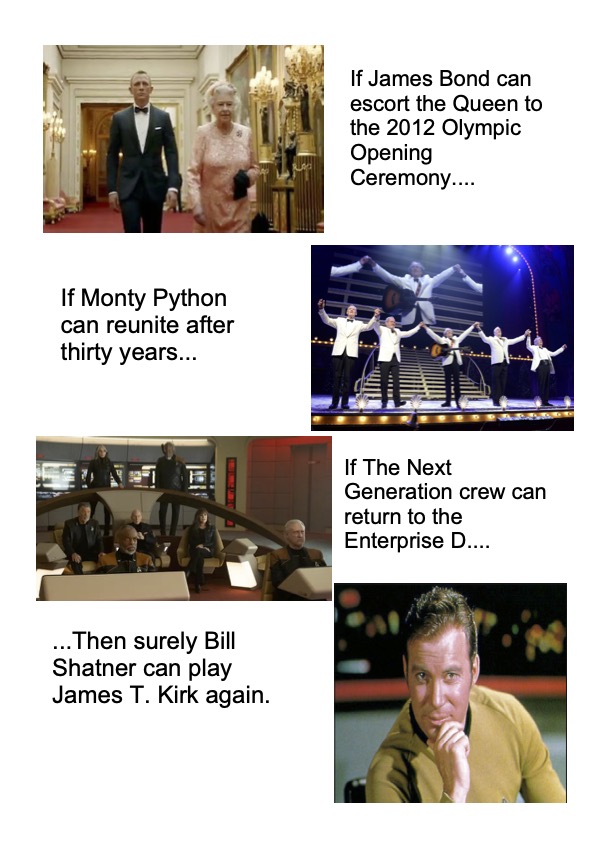
I was up a bit early again today, and one of the first things I came across when I logged into Facebook was this review of the third season of Star Trek Picard by Steve Shives. I’ve been watching Shives’ videos for a while now, and really enjoy the detail he goes into, particularly how he explains why he liked or disliked the various pieces of media he responds to. In this video he excels himself: it’s essentially a degree-level essay in video form, albeit with the occasional swear word thrown in. Detailed, thorough, yet amusing, this is a very impressive analysis. As much as part of me loved seeing the old Next Generation crew reunited, I must agree with his central point that what we watched in Picard Season Three boils down to essentially meaningless fan service. That is, we constantly got nods and references to past incarnations of Star Trek thrown at us, without anything new really being developed. It was as if the writers didn’t want to make the effort, so simply rehashed things we had seen previously in Trek, as well as overplaying the nostalgia card and bringing back things and characters which had previously been written out (how many times has Data ‘died’ now?).
At 52 minutes, it’s quite a long watch, but I think it’s worth it. Shives makes some very good, fairly sophisticated points, most of which I had to agree with. He says he doesn’t want to seem too negative, but I don’t think he is; rather, Shives makes some good, well informed points about where the final season of Picard falls down creatively. To be honest I think Shives’ review is broadly on the same intellectual level as the film analysis I was reading back at uni: videos like this really demonstrate just how advanced the online fan discourse around programs like Star Trek is becoming.
Today I just have a bit of a strange confession. I like to think of myself as quite a technologically-aware, up-to-date kind of guy. I’ve always used computers, and like to keep in touch with the current trends. However I just realised something which struck me as very weird: watching breakfast TV just now, the presenters said that viewers could get in touch with Whatsapp, and it struck me that I don’t have a clue what Whatsapp is. Of course, I have heard it referred to quite a bit, and I think my brother mentioned using it, but I’ve never been anywhere near it.
I know it’s a way to communicate over the web, but for that I stick to Facebook messenger or good old email. It strikes me as weird that I’ve never used it and don’t know anything about it, but it’s now so popular. Perhaps the fact that you apparently need a mobile phone to use it, which I don’t own, means that this trend has left me behind. There also seems to be a lot of QR code scanning involved, which I can’t do. I wouldn’t mind, but given the Beeb are now referring to it as one of the main ways of getting in touch with them suggests this is a huge trend which I have somehow been totally oblivious of.
I think long term readers will know what a big Star Trek fan I am. I especially like the Klingons. It interests me how intricate and detailed the fictional alien species is: over the years we trekkies have watched it develop an interesting culture based on the notion of ‘honour’, complete with it’s own religion (‘Glory to Kah’less!”) and language. Thus, while I don’t actually speak Klingon or Klingonese as some Trek fans apparently do, I like to regularly use a couple of words I’ve picked up, just to show what a geek I am.
A while ago I began to wonder about something. These days, when I head out of my flat in my powerchair of a morning, I often leave my PA Serkan here, giving him space to, say, tidy up or mop the floor. As I head out, it has become like our tradition to exclaim the word “Qa’pla!” (success!) at one another, simply as a farewell or good luck expression. I have also taken to using the (never defined) insult “P’Tahk” when I’m confronted with people I object to, usually Tories or Brexiteers, and I’ve noticed Serkan now occasionally using the term too. This has made me wonder: Can Serkan be the only person who regularly uses Klingon words, but who, to my knowledge, has never watched an episode of of Star Trek and has never heard of Klingons?
Joking aside, it goes to show how such geeky, niche things can sometimes take on a dimension of their own. To be honest I find it very endearing that Serkan would choose to use words which he doesn’t know the meaning or origin of, which come from a TV program he has never watched, just to strike a chord with me. Qa’pla!
Who else is in the mood for some gratuitous Monday morning violence? I just came across a reference to a film called Sisu of Facebook and, never having heard of it, looked it up. I found this trailer, and instantly burst out laughing. It looks awesome in a slapstick, nazi-beating way. I obviously don’t know much about it yet, but it seems to be set during the German invasion of Finland. According to the trailer, it looks like they single-handedly – and quite violently – get beaten back by a lone, rather angry miner. The film comes out in a couple of days, and I definitely want to check it out.