I went up to Stratford again this afternoon. As usual I encountered a group of street preachers just outside the station there. They were very loud, shouting all kinds of absurd things through a speaker, threatening people with being sent to hell unless they listened. Some of what they were saying strayed into homophobia, and at one point I was accused of being possessed by daemons. People there were trying to go about their business in peace, but the noise being made was inescapable. Surely I can’t be the only person who finds this not just intrusive and annoying, but actively offensive?
Month: January 2024
If I Don’t Need A Guide, Why Should They?
I suppose this entry is a bit of a confession. I was out and about as usual again today, over near Canada Water. It was getting on a bit, so I thought I’d hop onto a bus to make my way home. A couple of stops after I got on, Twitter guys also got on through the front door. One had Down’s syndrome and I think the other also had learning difficulties. They were both wearing lanyards, obviously having just left a nearby college or something. To my shame I caught myself looking around and wondering whether they had some kind of carer or chaperone with them. It surprised me to see two guys with LD out on their own. Of course, it then immediately occurred to me that a lot of other people probably think the same when they see me out and about; and that if I don’t need anyone following me around, why should these guys? It seems certain stereotypes are hard to outgrow, no matter how enlightened and open minded we try to be.
Warehousing Must Be Resisted
I just came across this Guardian article and I’m suddenly very concerned indeed. With more and more local authorities increasingly strapped for cash, it appears the so-called ‘warehousing’ of disabled people is starting to make an ugly reappearance. That is, rather than being supported to live in our own homes independently with the help of Personal Assistants, we’re increasingly being sent back to live in institutions or care homes like we were thirty or forty years ago. Frankly, I find that absolutely chilling.
Luckily I have been relatively independent all my life: I grew up as part of a loving, supportive family. Going to university gave me my first real taste of living on my own, choosing what to eat and when, and what I wanted to do. Then, when I moved in with Lyn here in London fourteen years ago, it became impossible for me to imagine a life without absolute agency: surely I have the rights and liberties of any other person. However, I have heard what life is like in such institutions for disabled people, without such liberties: being told when to get up and when to go to bed; having no choice over what you eat; not being allowed to leave the institution without permission or without a ‘carer’ with you. I think Lyn herself lived in such a prison for a time before I met her. She told me how she was perpetually treated like an infant.
To be honest I think I would rather die than be institutionalised like that, I value the freedoms I have so much. Yet because of the cuts the government is now inflicting on local authorities, it is becoming a very real prospect for many disabled people; people who are now used to living on their own and are perfectly capable of doing so. As the Guardian article notes, many people are now trying to find ways to resist being warehoused, but as government money gets tighter and tighter, I fear it will be an uphill struggle. More and more people with less and less severe disabilities are probably going to be ‘encouraged’ to relinquish their independence. I know that social services are unlikely to set their sights on me in my flat, at least for a while; but as a disabled man I nonetheless find that a very worrying, troubling prospect.
Unexpected Landings
Something quite awesome happened out on my trundle this afternoon. The skies above London are notoriously busy, with planes and helicopters flying around almost constantly. Well, I was near Lewisham trying to follow the Thames west for a bit, when I started to hear a helicopter overhead. I thought little of it at first, but it persisted, so I looked up to see it was a London Air Ambulance. As I continued my walk I noticed it getting lower and lower, seeming to circle the area I was in. Pretty soon it grew very loud indeed: it was obviously landing very close by. Remarkably, I came upon a park just in time to watch the huge red helicopter touch down on the grass and the crew get out. It made my jaw drop. I knew they were attending an emergency and that someone nearby obviously needed help, but to see such an awesome, spectacular sight so suddenly and unexpectedly felt like a real treat. This city will always have the potential to surprise me.
A Buffoon Aspiring to be a Dictator
It has been a while since I posted anything about American politics or Donald Trump, but I really think this video is worth checking out. It’s quite a thorough analysis of trump: the man clearly has no idea what he is talking about, but aspires to be some kind of dictator. Any intelligent person can see him for the buffoon he is, but as the video explains, trumps own lack of comprehension actually makes him quite dangerous.
Already Wondering About LA
Watching the breakfast news earlier I noticed a short item about the Paris Olympics: it still isn’t for six months and they’re already talking about it. Obviously they were focusing on the sport side of things, but what I’m most interested in are the ceremonies. To be honest I’m expecting nothing less than spectacular from Paris this summer; anything else would be a disappointment.
Mind you, I’ve already started to wonder about the LA Olympics in four years. I’d be curious to know whether they have already started to plan their ceremonies: Los Angeles is supposedly the entertainment capital of the world, after all. I wonder if they would try to do something similar to having James Bond escort the Queen, a la London 2012.
Strangely, the prospect that they might do so interests me. We know how competitive American culture can get, so I reckon that there will already be several film studios vying to have their characters and franchises foregrounded like James Bond was. What producer wouldn’t be dying to have their lead character be shown to escort the President from Washington to LA? It would obviously give that character a status in American culture like no other. After all, Happy and Glorious was arguably the stand out moment of the 2012 Olympic opening ceremony – the bit everyone still remembers, a moment of incomparable national pride. Then again, do any American fictional characters resonate with America culturally in the same way that James Bond resonates with Britain? I don’t think any character holds the same cultural significance. Nonetheless, the execs of every film studio in the States must be jumping over one another to get their franchise used in such a moment of national glory. The question is, what could the ceremony planners do? What character could be linked to the American state like 007 was linked with the UK twelve years ago? Jason Bourne? Agent Jay from Men in Black? Captain Jack Sparrow? I suppose we’ll have to just wait and see.
A Cure For CP?
I was just watching the local BBC London news, when this story pricked my attention. “A teenage boy from London has become one of the first in the world to be treated with a new brain device. Surgeons at the Evelina Children’s Hospital hope it will help Sean Igbokwe deal with the uncontrolled movements caused by his cerebral palsy.” The device apparently works like a car gearbox, helping to filter unneeded brain signals. Not that I think CP necessarily needs a ‘cure’ – I’m perfectly happy as I am, thankyou very much – but I can’t help thinking this is very exciting news. No doubt it will improve the lives of many people with severe CP. Mind you, I can’t help thinking that cybernetic devices like this are just another step closer to humanity becoming the Borg.
Concerning Signs?
You can probably tell from my last couple of entries that I haven’t been having the best week. To cheer myself up, this afternoon I took myself on one of my favourite walks along the regents canal. It’s a long, quiet walk across the north of London, through fascinating suburbs like Camden, towards the city centre. It was exactly what I needed. One of the things I noticed, though, was the number of Palestinian flags which have appeared: I saw them all over the place, stuck to lamp posts and fences. I also saw things like “Free Palestine” and “Free Gaza” scrawled everywhere. I don’t know how significant this is: obviously it’s a response to what is happening in the Middle East, but I really hope it’s not a symptom of something more ominous and intolerant.
Mountains and Molehills

Having calmed down and cheered up a bit since yesterday, I was inspired to make this.
I really should just chill out sometimes. Everything turned out to be perfectly all right in the end!
Not A Good Day
I really don’t want to go into detail about this, but I have a knack of screwing things up and making things worse when I’m trying to help people. From time to time, I get these big, bold ideas about how to make a situation better, so I set off with resolve. But in the end it turns out that I misunderstood things, got the wrong end of the stick and should just have stayed at home. I’m afraid today was such a day: we don’t need to go into detail, but I set off thinking I could do something to resolve a situation, but came home feeling dejected and useless, and afraid I’ve made things even worse.
Does anyone else have such days, or is it just me?
Steve Shives on Star Ratings
I think I really need to flag this Steve Shives video up today, as it’s one of the most articulate and interesting pieces of analysis I’ve found on Youtube in a while. In it, Shives starts to explore star ratings and how, in reacting to anything both online and off, we’re now encourage to give five star ratings to anything we encounter. Such ratings have become a kind of currency: particularly in America, people now feel socially obliged to give the highest rating to everything whether they liked it or not, rather like tipping. As Shives says, such ratings have thus become meaningless in assessing how good something is.
This can be applied to anything, including film of course. These days, films are often assessed and compared via the number of stars they have, especially online. Numerous film review websites use such ratings to rank films currently in cinemas. The problem is, such stars are usually not awarded using any objective criteria. Shives has an issue with the principal that someone can actively dislike a film, but still award it five stars for various other reasons – perhaps to keep a particular actor or director high in the rankings. Yet that reminds me of my work on cinephilia: should we try to judge films based on some form of objective criteria, or should we go with our subjective opinions, or try to use both? If we rank films based on a set of externally mandated criteria, then in theory it would be possible to award a film a maximum rating, even though a reviewer may dislike the film overall. Yet would that not still make a nonsense of such ratings? Doesn’t a reviewer, by definition, have to like a film to award it a maximum score?
I’m still intrigued by all this. Shives goes into far more detail in his film, and it’s well worth watching. It’s a great example of how articulate and nuanced this form of online video discourse is becoming, seemingly picking up upon debates found in film journals, and taking them in fascinating new directions
Cheerful Road Crossings
Something rather odd happened earlier. It was only a fleeting event, but it struck me as so strange that it was worth noting here. I was out and about again, crossing Shooters Hill road. When I cross roads in my powerchair, I use zebra crossings where I can. When I do, I have a habit of waving to the waiting drivers in thanks as I cross. I know they are legally supposed to stop when they see people waiting at zebra crossings, but it just seems friendly to recognise their gesture. I just raise my left hand and nod towards the waiting drivers. Mind you, I usually have the cloth I wipe away my dribble with in that hand, so it probably looks like I’m waving it at them.
Crossing Shooters Hill earlier, everything had gone as it usually does: two cars had stopped, I’d crossed and waved. I was about to continue my journey, though, when all of a sudden a strange man came up to me and cried “Wow! That was the most cheerful crossing I’ve ever seen!” before continuing on his way. I don’t know whether it was cheerful or not, but it certainly struck me as an odd thing to hear when you’re crossing the road.
What The World Does Not Need
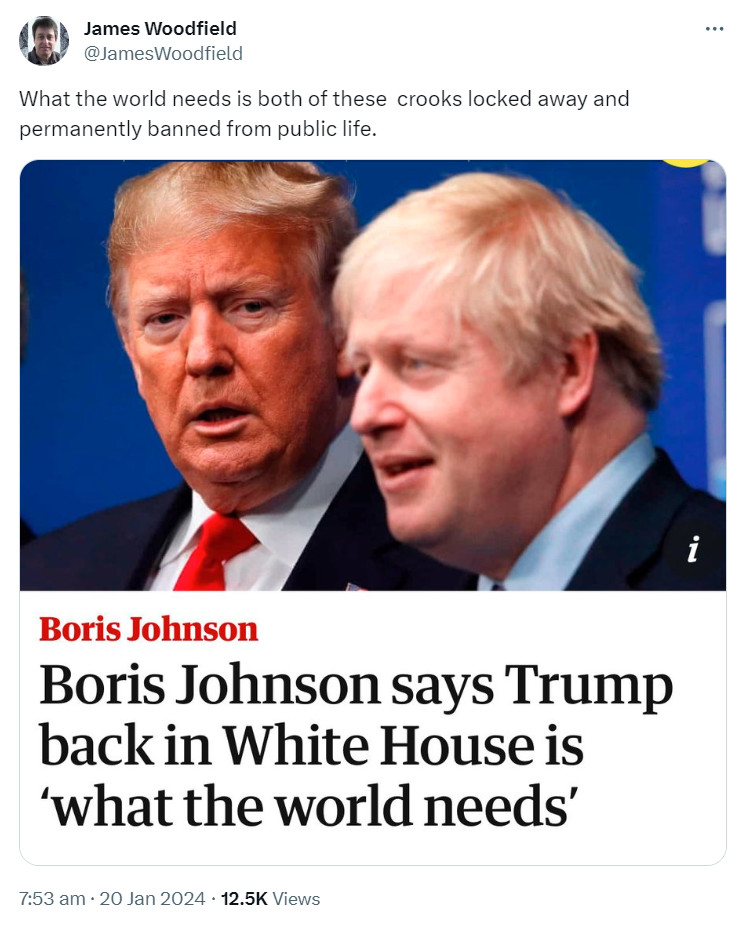
I just came across this on my Facebook feed. I find it staggering I must say, not only because Johnson spouted such utter rubbish - Trump belongs in jail, and the fact that America could even consider electing the charlatan again is frankly bewildering – but also because he has the gall and temerity to assume anyone still takes his opinions seriously. The world could really do without either of these jumped up, arrogant fraudsters.
Kids Are Getting Worse
These days just the sight of two or three school age kids when I’m out and about makes me worry. I think I’ve described here before how, when I’m out and about in my powerchair, I now become tense whenever I see kids, bracing myself for them to say something. It’s happening more and more: they shout things like ‘Spazz’ or ‘Timmy!’ as I roll past them, trying to provoke me into reacting. Then, when I confront them about it, they suddenly become defensive, acting hurt, as if I’m the one who wronged them by making false accusations. It happened a couple of days ago, and again as I was coming home this afternoon.
I have had enough of it. How is such behaviour in any way acceptable? If these kids mocked and teased a member of any other social or ethnic minority, they would quickly find themselves in deep trouble – and rightly so. Why, then, should I put up with it? Why should I tolerate being the butt of some little squirt’s joke? I’m proud of who I am and what I have achieved; so to have a schoolchild laugh at me, as though they somehow have the authority to lord it over me just because I have CP, makes my blood boil with rage.
Yet I don’t know what to do. I’m pretty sure they just do it to guys like me, as if we are ‘easy targets’. When I try to confront them about it, either they try to deny they ever said anything, or attempt me to provoke me even further. And on the rare occasions when I’ve managed to report this behaviour to an authority figure such as a teacher, the kids have denied it and said I was making it up, as if I didn’t know what I was talking about.
It is incredibly frustrating. As I say, it appears to be getting worse. I suspect these kids have been emboldened by what they’ve seen on social media, and think it looks big, cool or whatever to mock people like me. Thus the fact that I can’t do anything about it or tell them to stop, together with the fact that it doesn’t happen to anyone else, also makes me feel very alienated.
We Should Help These People, Not Deport Them
I want the UK to be an open, tolerant, culturally diverse country: I passionately believe we should be welcoming people here from across the world. I relish the fact that, here in London, I can trundle up to Woolwich market and find people from all kinds of exotic, wonderful places, interacting with one another. More personally, I am the grandson of Greek immigrants who came to the UK from Cyprus around eighty years ago. Immigration is a country’s lifeblood, without which it would culturally stagnate.
However, there is no denying that people should come here safely. Irrespective of how you feel about migration, people should not be forced to cross the English Channel in small boats. It is simply too dangerous. As others are pointing out, they are often trafficked by gangs, forced to take the risky crossing out of sheer desperation. Surely we, as a civilised, compassionate country, should not allow that to continue.
Yet the answer is obviously not just to threaten to deport these people to Rwanda. These immigrants are desperate; they want to come here as a place of safety. If we really were a civilised nation, we would be trying to ensure they have a safe, secure way to get here, before ensuring that they all have safe, secure homes. We would also be breaking up the vile gangs who trafficked them in the first place.
Instead, the heartless, brainless charlatans currently governing the country just want to send these immigrants elsewhere. The Tories don’t care about these desperate people: they just want to make a show of turning them away, in an effort to appease the knuckle-dragging xenophobes whose votes they want. They can’t honestly think that people who will do anything to reach the UK would have second thoughts about crossing the channel, simply because they might be sent to Rwanda. The government doesn’t care about international law, cultural diversity, tolerance, or even human compassion; they just want to look tough and strong by turning their back on people looking for help. I find it gut-wretchingly abominable: how can we, as a civilised, tolerant, enlightened society, continue to allow these charlatans to speak for us.
Poor Things
I just got home from the cinema, and for the second time in a week I find myself wondering what on earth I just saw. John and I went to see Poor Things. From the trailers I had kind of assumed that it may be about mental illness or learning difficulties, which is why I wanted to watch it. Yet what J and I just saw was far more complex and interesting than a simple allegory: by turns it was hilarious and horrific; as shocking as it was charming. It was bizarre and surreal, even fairly obscene, but also humane and very lovable. It owes as much to Mary Shelly as it does to Monty Python. I’ll not try to write a complete review of it yet because I wouldn’t know where to begin; but I can only say I was absolutely fascinated, and that Poor Things is the best film I’ve seen in a very long time.
A Perfectly Normal but Very Special Lunch
In a way I don’t have anything to note here today. It has just been a normal day, in which I didn’t do anything most people would consider unusual. After breakfast I took myself up to Stratford to have lunch with my parents. There is a lovely Greek restaurant we like to go to there.
For most adults, meeting your mum and dad for lunch isn’t really something to write about: it’s a nice family event, but nothing special enough to blog about. At the same time, to me, in a way it was very special indeed. When I was growing up, I could never have imagined that I would be living by myself in the east of London: if someone had told my fourteen year old self that I would one day be trundling around the capital and meeting my parents for lunch, I would never have believed them. The idea that I could be so independent, so free, so normal would have seemed absurd. I always assumed that I would just keep living with my parents, relying on them, perpetuating my childhood for as long as possible.
That was a comforting thought: back then, the idea of ever living on my own made me feel so insecure. Yet I now find myself wishing that I could go back and tell myself that everything would be fine: that one day I would be living in my own flat, just like everyone else; that I would be travelling around London, just like everyone else. That rather than living with my parents, depending upon them, I would one day be meeting them for lunch, just like every other independent, middle-aged adult eager to catch up with the mother and father he loves so dearly. Because ultimately, I am just like everyone else.
There was a time, when I was growing up, when the thought of ever leaving the security of my family home seemed so absurd and frightening: things like riding busses, going shopping on my own, even communicating with people and telling them what I wanted, was something other people – normal people – did. Yet now, largely thanks to my communication aid and powerchair, they are as normal to me as they are to everyone else. Thus I live in this beguiling, labyrinthine, amazing world city, something I would never have once thought possible. The thought that I have come so far from the insecure child I once was, dreading the idea of even staying a single night away from home, fills me with an unimaginable pride and strength. That’s why meeting my parents for lunch today was so special, even if it was perfectly normal at the same time.
This Is Obvious, Really
Two Exhibitions In One Day
Yesterday was a very cool day, although, if I’m honest, there isn’t too much for me to note on here. Watching TV yesterday morning, I got wind that there was a big drag queen convention somewhere in London. Naturally that made me curious, so I thought I’d look it up to see where it was. It turned out it was at the Excel Centre, just over the river, so after breakfast I headed over there.
I didn’t know what to expect, or even whether I’d be let in given I didn’t have a ticket. However, getting there I found there were two conventions happening simultaneously at the Excel: Rupaul’s drag con and MegaCon Live, a huge exhibition of popular culture. Both interested me so I decided to check both out. Without going into detail, I’m getting rather good at blagging my way into events which I don’t have a ticket for.
The rest of my afternoon was spent switching between two of the massive exhibition halls of the Excel Centre. There was so much to see in both: I’ve never seen so many guys wearing ridiculously high heels, or so much manga. It struck me as an incredible celebration of two subcultures, both rather different, but both incredibly vibrant. There was so much to see; so many stalls, all packed with weird, wonderful things, from both the worlds of pop culture and crossdressing. Once again I was reminded why I love London: where else can you find people in Bo Peep costumes sharing coffee with guys dressed as Batman? The highlight of my day, though, was catching up with Davina De Campo. She’s now a famous drag queen, but I know her from uni. When she was just called Owen, she was a year above me at MMU, and I remember her wearing all kinds of crazy things at the Wednesday night discos – rather like me. It was good to catch up with her and reminisce, however briefly.
I love this city. It is a place where you never know what is going to happen. I woke up yesterday thinking it would be just a humdrum Saturday, but it turned out to be deliciously vibrant and packed with culture. While it might not quite have involved one of my big, primary obsessions - I will always cherish the memory of going to Destination Star Trek at the Excel Centre in 2014 – nonetheless I got to see some truly awesome things and meet some incredible people. Surely that is what life in this great world city is about.
Wonka – WTF?
I just got back from the cinema. I had initially headed there to watch Poor Things, having seen Mark Kermode’s review of it this morning and grown intrigued. However, it wasn’t going to begin for a couple of hours, so I thought I would check out Wonka instead. I had heard a lot about it, and it is a film I had been intending to watch for weeks. The simple fact that it purported to be a contemporary retelling of a classic children’s film from the sixties pricked my curiosity. However, now that I have seen it, I must say I find myself totally bemused: it is utterly bizarre, as if film as an artform has at last lost it’s mind completely and thrown any sense of reality out the window.
I know that, as a kid’s film, you shouldn’t try to read too much into it; yet I’m at a complete loss to say what Wonka is actually about. By turns it can be read as a tribute to the original Charlie And The Chocolate Factory; an absurd psychedelic children’s romp involving policemen who were dressed as French gendarmes but spoke with thick New York accents; or an allegory for the mafia and illegal drugs cartels. Indeed, the film itself could even probably be read as some kind of drug trip, it was so full of bizarre iconography. Above all, as I trundled home for the cinema, the question bugging me the most was, how the zark did Hugh Grant get cast as an Oompa Loompa?!
It was an inane, absurd piece of post-classical American film attempting to cash in on the sixty year old original; yet, forgive me, but I couldn’t help liking it.
Data, What is This?
As both a Star Trek and Red Dwarf fan, I couldn’t help chuckling when I saw this nifty crossover earlier.
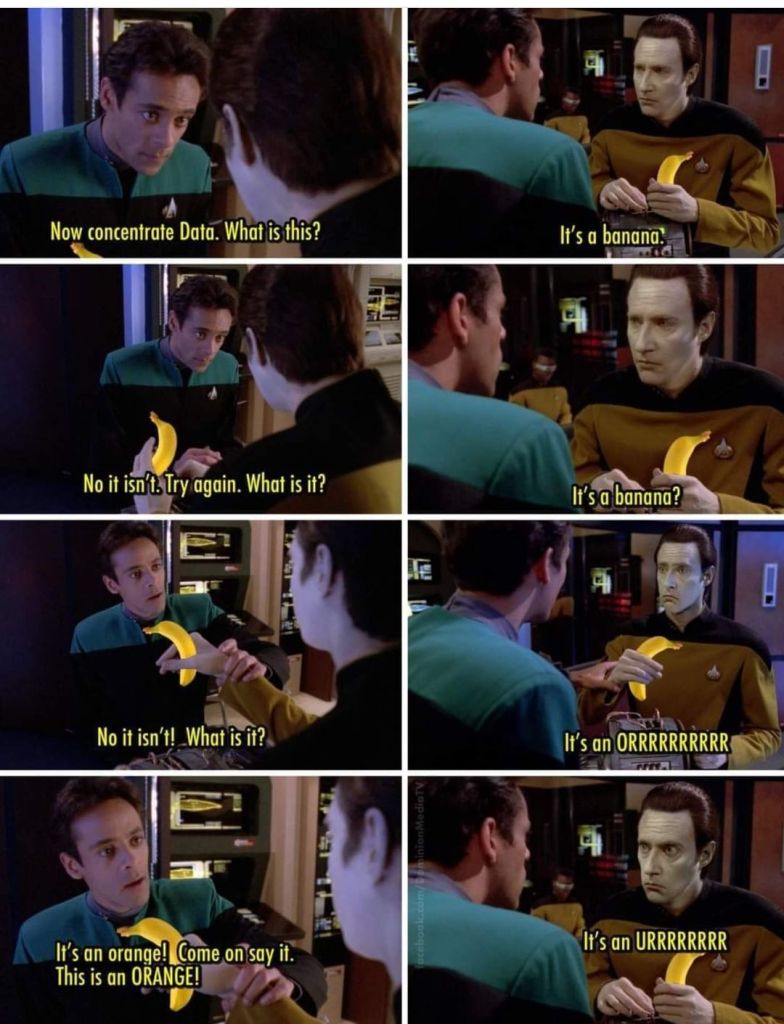
Just for reference, you might want to check this out.
Socks Are Now Easier Than MAs
It’s getting easier and easier to put my socks on. I think I’ve mentioned here before how Serkan currently takes Wednesday mornings off, so I don’t have my usual morning support. It’s not an issue: I just slowly get myself dressed and take myself up to Costa in Eltham. I’ve been able to put my own clothes on since I was little, but I’ve always struggled with my socks. They are so awkward and fiddly. I’ve developed a technique of sitting in my armchair, leaning forward and trying to hook them over my toes, but it’s kind of like a cowboy trying to lasso a rabid cow! I often grumble to myself that writing my Masters thesis was easier. However, it must be said that I now don’t find it anywhere near as difficult as I once did: it just needs me to relax and open the hole of the sock nice and wide. I have now got the whole process down to under ten minutes, which, believe me, is quite an achievement. What once took me about seven or eight attempts for each foot now only needs two or three. And I suppose that’s an attitude which you can apply to anything: you can do anything you put your mind to, from putting your socks on to getting a Masters, if you just keep going.
Is ITV Playing Into Tory Hands?
It’s looking more and more likely that I’ll check out Mr Bates vs the Post Office soon. On the whole I tend to avoid ITV in favour of the Beeb, mostly because I don’t like sitting through adverts. Yet so much is now being said about the Post Office scandal that I probably better see what all the fuss is about. I’d assumed it was just a pretty average TV drama about some sort of historic social scandal, and nothing very interesting; yet now the government has got involved, maybe it’s worth a look.
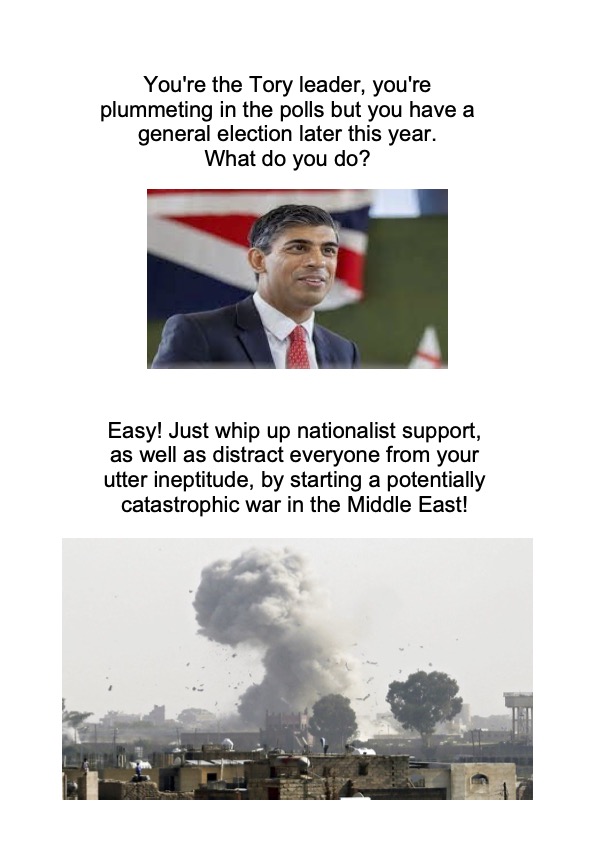
Mind you, you have to raise an eyebrow at the timing of all of this: the Tories were plummeting in the polls, but all of a sudden ITV has gifted them this scandal which they can be seen to sort out. The drama is said to highlight a huge travesty of justice, one which would be bound to play on the national consciousness, just in time for the Tories to step in and be seen to bring those responsible to justice. Forgive my cynicism, but have ITV just played right into Tory hands?
Anyway, before I can comment any more, I better go watch the program.
Rainman – Where Do I Even Begin?
The truth is I’ve been putting this entry off for a couple of days, trying to summon the intellectual energy to give the subject the weight it deserves. Unfortunately, I’m not sure that energy is going to arrive, so I think I better just bite the bullet and start writing. Four or five days ago, Rainman aired on BBC2. I watched it on Iplayer the next day, and it instantly struck me that it necessitated a fulsome analysis from someone familiar with the contemporary disability rights discourse. The problem was, I wasn’t sure I was the right cripple for the job: as familiar with concepts like the Social Model as I am, I’m not convinced that I’m up to the task of applying them to Rainman to the extent that a proper review/analysis/reading would require. And rather than confining my thoughts to a blog entry, such an analysis would need to be far longer and more substantial.
When you begin to look at it, Rainman is a very problematic film. It is a depiction of a man with severe Autism (played, it must be noted, by a nondisabled actor) being kidnapped from the institution where he lived and then exploited by his estranged able-bodied brother. Much of this interaction and exploitation is played for comic effect: the ‘quirks’ caused by Raymond’s disability are depicted as humorous; the way his brother Charlie uses him to get an advantage at gambling is not frowned upon or criticised in the film but are portrayed as a highlight. And at the end of the film, in spite of this exploitation, the two are seen to come together in fraternal love, as if Charles hadn’t spent most of the film trying to con Raymond out of half of his inheritance or using him to gamble, but had treated his brother respectfully.
Of course, I know Rainman is forty years old, and was made before disability rights was really a thing. But I nonetheless don’t know where to begin unpacking this film. How can depicting autism, or any disability, in this way be seen as acceptable? As audience members we’re meant to laugh at how one character treats his disabled brother; then, at the end of the film, we’re supposed to find pathos in the way the one brother learns to accept the other, as if he hadn’t just been a complete bastard to his autistic sibling.
The film left a very nasty taste in my mouth, it must be said. It struck me as very uncritical, as the exploitation of disabled people was just water off a duck’s back. I know I ought to go far, far deeper in analysing Rainman, but first I want to see whether anyone else has written anything about it from a contemporary disability rights perspective. What was humorous or lighthearted forty years ago is far more problematic today. Yet if that is the case, why are films like this still being aired on TV today?
A Star Trek Picard Film Is In The Works
I’m suddenly rather excited, having just come across the best bit of news I’ve seen in a while. Last year, when the third season of Star Trek Picard ended, like many I assumed that that would be the last we’d see of Picard and the old Next Generation crew. However, I just got wind that a Picard film is in the works: Patrick Stewart himself has said that a script is ‘being written’. Of course, at this stage there are no details, and as usual there is already a lot of online speculation about what shape this film might take, which I’m not going to get into. Yet, as a Star Trek fan, this is very exciting: we haven’t seen Picard and crew on the big screen since Nemesis in 2002, so if they could have one last big cinematic outing, perhaps even returning to the glorious heights of First Contact, it could well be awesome.
A Must Watch
I know I said I’d try to avoid blogging about what is currently happening in Israel, for fear of getting embroiled in a political minefield, but I really think this video is an important watch. It’s an interview between Owen Jones and Andrew Feinstein, a Jewish journalist from South Africa, in which they explore the parallels between how Israel treats Palestinians and South African Apartheid. They go into quite extensive detail, but I think it helps to put what we are currently watching in the Middle East into context, as well as making the issues at hand absolutely clear for anyone even remotely concerned about social justice. I’m not going to try to summarise what they say here, other than to say that it is thorough, qualified, balanced and absolutely chilling.
Margaret Hathaway
I just turned on my computer to see some very sad news. The Ex Pupils and Staff Facebook page for my old special school is reporting that Margaret Hathaway sadly passed away over Christmas. Mrs. Hathaway was one of my very first teachers at Hebden Green. I must only have been four or five when I started going to the nursery department there. I still remember her class quite vividly, and how every day started with drawing pictures. Above all, Margaret Hathaway was an extremely dedicated teacher who must have worked at Hebden Green for well over thirty years, educating hundreds of children with special needs. She will be greatly missed.
The Elephant In Starmer’s Room
I watched Sir Kier Starmer’s speech earlier, and I must admit I found it refreshingly honest. Unlike most politicians these days, particularly Tories, Starmer seemed approachable and trustable. Yet it must be said, Brexit was notable in it’s absence: Starmer didn’t mention the crime of 2016 once, like some colossal elephant in the room. The damage our withdrawal from the EU is doing is becoming clearer and clearer, so much so that any honest opposition MP should surely be talking about reversing it.
Indeed, John flagged this Reuters article up for me earlier: it was little noted in the mainstream press, but the country has now scrapped the cap on banker’s bonuses which the EU put in place. So while the rest of us are struggling to get by in the cost of living crisis, these super-rich, arrogant bankers are now free to award their selves obscene pay rises, despite doing essentially nothing for the wider community. I find that utterly perverse, although it was what Brexit was about all along: a right wing ploy to unleash the most sickening form of capitalism loose on the country.
If the Labour leader really cared about social justice as much as he says he does, surely such things are what he would be drawing our attention to.
Spot On, Frank
I’ve been saying something similar all my life.

…Well, at least since I first pulled on a pink tutu.
When Bus Ramps Fail
After today I now firmly believe that all London busses should have auxiliary manual wheelchair ramps, of the kind dad used to use to load my powerchair into the back of our MPV. Of course, automatic bus ramps are wonderful, and I love being able to get on and off busses sleekly and quickly. Most of the time they work without a problem. However, when they don’t work there ought to be a backup system.
I went up to North Greenwich earlier today. Ironically enough I was heading for the TFL offices there to ask about a completely unrelated issue. The trip had started ordinarily enough: as usual I had caught the bus there. But when the time came for me to get off the bus, after the driver had let everyone else off first, the ramp stopped working. It would go out as normal, but then automatically shoot back in as though it had encountered something unexpected. Of course, this was not the first time I had seen this happen; the driver usually just has to reposition the bus slightly to get the ramp to stay out. But when he tried that, it still wouldn’t work. He tried over and over, but the ramp kept darting back in.
I must have been there for at least twenty minutes or half an hour, unable to get off the bus. In the end, the staff had to break the glass of a special compartment, in order to get to the emergency ramp tool. Yet it struck me that it would have just been been so much easier if somewhere on the bus, behind the driver’s cabin perhaps, there was an emergency manual ramp which the driver could get out, unfold and let me off the bus. Luckily busses terminate at North Greenwich, so nobody else was on the bus when this happened, and there were other TFL staff around. Yet I dread to think what things would have been like if the bus was on it’s way to somewhere, and a bus full of commuters was waiting for me to get off. As I say, automatic bus ramps are great, but experiences like this clearly demonstrate that there needs to be a back up.
Shut Up Welby, Again
I just saw in the morning news that Justin Welby has been making pronouncements about british politics: in a new year’s address, he called on politicians to treat one another humanely and to “treat political opponents as human beings”. I’m sorry, but I have to say things like this really, really piss me off. As I wrote here, Welby is a man who nobody voted for, whose only authority stems from an ancient, anachronistic belief system; yet he claims a right to speak on national TV and radio, and to tell politicians how to act like some sage old wizard who we should all venerate. That strikes me as obscene. After all, if everyone saw the set of myths which Welby and religious figures like him derive their authority from as the baseless hogwash they are, he would just be ignored like every other lunatic spouting nonsense about their imaginary friends.
Instead, because religion, and christianity in particular, still has so much of a hold over our culture, primarily because the church won’t allow us to call it out as the nonsense it is, such men can tell others what to think and how to act, including our politicians. That strikes me as both extremely arrogant and undemocratic: surely in any modern democracy, political authority should stem from the population, not religion. Welby and preachers like him (note that I refuse to use their self-proclaimed religious titles) have no right to make judgements and pronouncements about politics, and such pronouncements certainly shouldn’t be aired on the morning news.
Blimey, barely a morning into the year and I’m already ranting about politics.
 The Ill-Informed Ramblings of a Cripple