Rowling Should Never Have Been Published

I am now rather ashamed to admit that I have fairly warm memories of listening to Stephen Fry reading the Harry Potter audio books. We listened to them as a family, as my parents, brothers and I drove through various parts of Europe. I remember being quite captivated by them at the time: they might not have been on a par with Tolkien, Melville or Hemingway, but as stories they were certainly  entertaining, especially when delivered through Fry’s rich, maple syrup and Lord Melchett voice. Now, however, I never want a single word written by the hateful bitch Rowling to pass my eyes or ears again; and the same goes for the film adaptations of the fourth rate, pisspoor shyte she made her fortune from.

Accuse me of cancel culture all you want, but Rowling should never have been published in the first place. Now that she has revealed herself to be nothing but a rabid, vile transphobe, it’s time we recognised her work for what it is: a collection of stolen ideas delivered with all the talent and wit of a pile of horse shit. It is an insult to english literature, with it’s two-dimensional characters and simplistic, infantile themes and plots. Frankly, it should be taken out of print immediately: young people deserve better than to be subjected to such derivative, talentless crap. I’m glad to see that Fry now feels the same way, and I would personally urge him to get the audiobooks he recorded taken out of circulation: if I was him, I’d be sickened by the thought that this bigot was making money from my voice. The fact of the matter is, Rowling is now using her undeserved success as a platform to spread hate, and that platform should therefore be destroyed.

Shut Up Yanks!

I made this before yesterday’s appalling news broke, but mean it now more than ever.

The US is now dangerous and can no longer be allowed or trusted to dominate global affairs.

Absolute Folly

You know that, if the first words you utter when you turn on your computer and read the headlines in the morning are ‘oh shit!’, things aren’t as they should be. Like any other sane, thinking person, I am appalled by what is currently happening in the Middle East: what the US started today will have major, major repercussions. I went for a trundle this afternoon to try to collect my thoughts on the matter, stopping for an orange juice in Charlton Park. I thought going back to that little cafe where I have so many wonderful memories might help me think, without much luck. At the end of the day, there is not much anyone can say about the fact that one sovereign country has unilaterally attacked another entirely without provocation, and in doing so has ripped the international rule book to shreds. There is nothing any of us can do now but watch and see how things unfold, as if it was all some sort of strange, perverse film directed in equal parts by Alfred Hitchcock, Francis Ford Capella and Monty Python.

A Dark Door

To be honest I can’t decide what I think about yesterday and the assisted dying debate. I thought briefly about going up to Westminster to check out the campaigners, but decided not to as it was too hot and I didn’t want to get worked up. It’s a complex, highly emotional issue: like many disabled people, I worry that legalising assisted suicide opens the door to many dark consequences, such as people being coerced into ending their lives too early. On the other hand, if people have a right to get help to do things they want to do, surely that includes committing suicide: logically we can’t only give people help if we approve of what they are doing.

It’s a dark, thorny issue. I love life: I love living, having fun, going travelling, doing all kinds of crazy things. The idea of ending that, throwing it all away, is noxious to me, particularly after having lost so many good friends, including Lyn, far, far too early. I know full well how dark life can get, but that also teaches me to relish it, and live it as fully and enthusiastically as possible. The notion that someone would choose to end their lives when the world is full of so much potential frankly sickens me. Thus I must admit that part of me was appalled by the sight of the ‘Dignity in Dying’ campaigners cheering on Parliament Square yesterday afternoon – why cheer for death when you should be putting your energy into helping people to live?

But again, this is something I don’t want to get too worked up about. It’s a fraught, emotional issue which people on both sides feel extremely strongly about. I might pop up to Westminster later, just to check what’s going on; then again, it might be a better idea just to go watch the cricket.

Queuing for Pretentiousness

Oasis and the fact that tickets for their upcoming tour have gone on sale was on the news this morning. Inspired to blog about it, I just checked my archive, and my opinion of the band hasn’t changed since I wrote this entry: Liam and Noel Gallagher are still two talentless, arrogant wankers. What gets to me (in a mildly annoying way) is the obviously fake adoration they’re currently receiving. The beeb’s breakfast show I was just watching showed fans queuing outside ticket offices, as if it was somehow equivalent to a Beatles or Queen reunion. The thing is, many of the people there were obviously too young to have been alive when Oasis were actually together; either that or just wanted to tap into the band’s Northern chique, faux-anti-establishment brand. In other words, this didn’t have anything to do with wanting to listen to music, but was entirely pretentious.

Then again, I suppose the same accusation could be levelled at me when I was so enthusiastic to get tickets for Monty Python Live in 2014. Given that I wasn’t alive when Python first aired in the Seventies, was I just going with the Python-are-great vibe? Was I being pretentious, claiming to tap into a culture which I thought was trendy and fashionable? I don’t think so: although I was born post-Python, I had grown up in a household full of Monty Python References. I remember my dad singing The Lumberjack Song when I was little, not understanding why he would work all night and sleep all day. I remember being told about spam, and the song Jesus sang when he was on the cross. Most fondly of all, I remember watching Michael Palin’s travel programs on Sunday evenings. Thus when they reunited eleven years ago, my enthusiasm was entirely heartfelt and genuine. Those guys were and are legends and cultural icons; watching them live will always be one of the highlights of my life. My only regret looking back is that I didn’t get tickets for my parents to see the show too, as they were even bigger Python fans than I was.

Now, however, Oasis are trying to tap into the same kind of nostalgic vibe Python exhibited, but the difference now is that it is entirely superficial. These ‘fans’ don’t actually like Oasis, as much as they want to be seen to like Oasis. They seem to be under the gross misapprehension that being an Oasis fan makes you an anti-mainstream rebel, when the irony is that you can barely get more mainstream than these two generic, nauseating, unoriginal twits. Anyone genuinely into rock music would be queuing for tickets for the plethora of other actual rock concerts happening across the country this summer. But instead they put on their stupid hats and sunglasses, and try to imitate the mannerisms of two Mancunian wankers who never had a shred of musical talent in the first place.

America Is The Problem

Like everyone else, I’m waking up to the increasingly concerning news from the Middle East. It’s looking more and more likely that the US will become involved in the current conflict between Iran and Israel; and if that happens, there’s no telling what will happen. Without being hyperbolic, Russia could get involved, leading to a potential third world war. What makes me angry, though, is the fact that Iran had signed a deal on it’s nuclear capabilities and was being contained, until Donald Trump ripped it up solely because his predecessor Barack Obama got the credit for it. This crisis wouldn’t be happening were it not for Trump and his sickening ego.

I’m sorry to say this, but I think the case could be made that America/the US is the problem. Had it not been for their president, Iran would still be contained, Israel would not have felt it had the right to act so aggressively, and perhaps the United Nations could have calmed everything down. But because this group of self-important fuckwits across the Atlantic is currently the world’s preeminent superpower, we’re now hurtling towards armageddon! If you ask me – not that anyone is – it’s time for the era of American dominance to end, just as the era of British dominance did. With the election of Trump they have destabilised the world; the US can no longer be trusted to act logically or do the right things. America is the problem, and needs to be taken off it’s throne before the idiot leading it makes matters even worse.

Different Pictures Of The Same Parade

I’m not sure how much everyone else has heard about it, but I want to say something about the big military parade Trump apparently held for himself at the weekend. The thing is, I don’t have anything to base it on. There was absolutely nothing about it on the Beeb, so all I have to go on comes from Youtube. These days, I trust Youtube channels, especially American ones, less and less: they all seem to be biased this way or that. Things seem to have become especially questionable since the advent of CGI and AI – we can’t even trust things purporting to be photographs. Thus while one channel might show a huge glittering parade lined with adoring spectators, others might show long rows of empty seats. It’s extremely difficult to know who to go by, so I think I better just stay out of it.

Oh, what a mess we’ve got ourselves into.

One From Shives’ Heart

I think I really need to flag this Steve Shives video up today. As you may know, I’ve been watching Shives’ videos for a while: I think he’s one of the best film and TV analysts on Youtube, especially when it comes to franchises like Star Trek. In this vid, however, he discusses his adoration for Superman, particularly he earlier Superman films when he was played by Christopher Reeve. What interests me about this video is how, as Shives himself admits, he forgoes any in-depth discussion and instead just tries to convey his love and fascination with what he sees on screen. He knows that what he is watching is silly, campy and far fetched, but that somehow does not matter: Shives feels intrigued and compelled to watch. He does not use the term, but to me that is instantly recognisable as cinephilia, the discourse of filmic love I spent seven years analysing and writing about.

In a way this is cinephilia in it’s purest form. The way Shives picks out films, actors or just moments of film and speaks about them so adoringly is quintessentially cinephiliac. I was particularly struck by the moment when, two and a half to three minutes into the piece, Shives deviates slightly and starts talking about the moment he first saw Atticus Finch appear on screen. He had apparently been studying Harper Lee’s To Kill A Mockingbird at school, but this was the first time Shives had seen the film adaptation. Shives describes how he was struck by how Gregory Peck’s portrayal of Finch looked uncannily like he had imagined the character; how he had to stop himself ‘audibly gasping’; how amazed he felt at the sight of a character he had previously only imagined brought to life on screen. Shives might not use the term – or even know it – but what he is describing is a cinephiliac moment: a moment in a film when the viewer is absolutely taken by what they are seeing, although they can’t quite articulate why. It touches them on a deep, personal level; they feel compelled to explain and talk about it, even though it somehow seems to go beyond words.

To be honest I find it incredible to see one being expressed so clearly and obviously. Shives probably hasn’t read the literature surrounding cinephilia, let alone my zarking thesis, but this is a primary example of it’s development, and how it is emerging online more and more. The thing is, until Shives and commenters like him recognise what they produce as such, and start to talk about their love of film in and of itself, what they produce will always remain a form of fandom.

We Need To Speak Up For Hannah

I’m sorry to have to say this, but Becky Cheetham is still a nauseating, patronising bitch. I just came across this Youtube short from them, and instantly felt I needed to say something. In it, it seems that Becky’s disabled sister, Hannah, is celebrating her thirty-fifth birthday; but from the way her sister was treating her and talking to her you would think that she was only about five. As I explain at some length here this is a Youtube channel I have had major issues with for some time: at the end of the day, Hannah is being used essentially as a puppet to attract attention while her sister foregrounds herself to take all the credit. You don’t need to be an expert in film analysis to see how it’s shot like a human exhibiting her pet or a mother showing off her newborn baby. Quite frankly I find it sickening.

You can probably tell that I like blogging: I see it as my way of conveying my opinions to the world, and over the years I have blogged about all kinds of things. I relish the freedom and ability to do so. Yet it seems to me that Hannah Cheetham is being overtly denied such freedom, and instead is being used as a puppet, cued only to say things at her sister’s command. Perhaps she doesn’t feel entitled to speak out against her sister; perhaps she has been told that things have to be this way; perhaps this is some fucked up kind of Stockholm Syndrome. If so, then perhaps it is up to those of us with the ability to speak out against such things to do so. We have to say what we see, and what I see is a woman with just as much ability, potential and intelligence as I or anyone else has being used, patronised and silenced by her sister. I would love to hear what Hannah Cheetham thinks about things, but until her sickeningly condescending sister gets the fuck out of the way, I fear that won’t be possible.

The Crucible

Something cool happened yesterday, which I felt a tad guilty about at the same time. Unlike last Saturday the sun was shining, so yesterday morning I had what I assumed was a brilliant idea and emailed the Globe theatre. I explained what happened, about my powerchair, the rain, and why we missed half the play, asking if we could perhaps go to another performance. A couple of hours later I got a reply asking for our booking details, which of course I gave. I soon got another email back, informing me that we could go to the performance that afternoon. For a moment I was over the moon, until John, who was by then in the room, told me that he couldn’t go because he had things he needed to do here. I instantly felt extremely guilty: going to see The Crucible had been his idea in the first place, and I should have checked with him before I sent the email.

By that time, however, there was no time to get into that: it was almost one and the performance would apparently start at two. I hopped onto a bus and set off for the South Bank, feeling rather guilty but looking forward to what I was about to see.

Arthur Miller’s Crucible is a fascinating play. As I said last week, it was a text I studied at A Level, but I had never seen it performed live. The spectacle I was witness to yesterday afternoon was incredible. It’s a play where tension slowly builds and builds until, in the third act, it’s almost tangible, with all the characters accusing one another of witchcraft. Their denial only results in more suspicion, escalating to a riveting, heart-breaking, almost unbearable denouement. The way it was performed yesterday was jaw-dropping, and I really felt for the lead character, John Proctor, trapped in a position he had no way of escaping. This was theatre at it’s greatest.

Of course, Miller’s play is famously an allegory for the McCarthy witch hunts of the 1950s, so that’s what I kept thinking about throughout yesterday’s performance: what are we actually watching, and what might it mean? You only need to turn on the evening news to see that there is a crucible now burning in America far more dangerous, more insidious than either Proctor or Miller could ever have imagined; and I think that may have been among the reasons why this play is being performed at the Globe this summer. The timing cannot be ignored. A play illustrating the first time people in America descended into embittered, suspicious anarchy is actually about the second; but what might it now say about the third? What worries me is that this time, there won’t be any rapturous applause at the end.

As the play ended and I started to leave the theatre, of course I felt deeply satisfied: it had been a fascinating afternoon. But I needed to make sure I did two things: first I got a copy of Arthur Miller’s play so I could reread it and study it more deeply; but I also asked if John could go, perhaps in a few weeks, since he couldn’t come with me yesterday, and I’m glad to say he can.

Visiting Cambridge

I don’t really have much to report here today. Yesterday was a lovely day: I went to Cambridge with John, and then came back. He had some business to do at the university, and invited me to go with him, just so I could explore the city. It was a short, hour-long train trip from Liverpool Street, before I spent an afternoon in a beautiful little city. I enjoyed looking at all the book shops and cafes, but that’s about it. highlights included glimpsing the tree Newton apparently was sitting under when he came up with gravity, and (best of all) walking around the park where this was filmed.

No DLR Extension (This Time)

For some reason I seem to be becoming a London public transport geek. That is to say, London public transport is now one of the subjects I keep an eye on and am excited to hear news about. I want to know if there are any awesome new infrastructure projects like the Elisabeth Line in the works. I was disappointed, then, to hear yesterday that the DLR extension to Thamesmead hadn’t got the go-ahead: there was nothing about it in the Spending Review. I use the Docklands Light Railway quite regularly these days, and if you ask me it’s one of the coolest pieces of London Public Transport, as it winds it’s way over and under the east end. Best of all, all it’s stations are fully wheelchair accessible. Extending it beyond Woolwich into quite a neglected, undeveloped area of the capital could have breathed new life into it.

Then again, as many others are pointing out, that area already has a brand new Elisabeth Line station; and the fact that the DLR extension wasn’t announced this time doesn’t mean it won’t be announced in the autumn or next year. The same goes for the Bakerloo line extension to Lewisham. Such things have a funny way of getting built eventually in the capital. What I suppose I should be even more concerned about is infrastructure projects outside of the capital. The metropolis just got Crossrail, the biggest most expensive transport project in Europe; it can’t really complain. Are other areas of the UK seeing such investment? Around here I can just wheel onto a bus or into a DLR or tube station and get to wherever I want to go across the capital: I fear that that isn’t the case outside the metropolis. What about the more neglected areas of the country? I’ve heard that Manchester is getting an extension to it’s tram network, but what about Stoke-On-Trent, for instance? What about it’s infrastructure? I haven’t been there in quite some time, but from what I hear it has barely had any attention or investment in the last forty years. Such areas weren’t even mentioned yesterday. Surely places like Stoke should get the investment they need before we even start talking about yet another multi-billion pound project for the capital.

But You Don’t

Do you know what Muscular Dystrophy is, you stupid bitch? Do you know what MD does to young boys, slowly sapping their strength away? Do you know what it feels like to go in to school, day after day, and have to watch your classmates, boys you grew up with, fading away? Do you know what it’s like to wonder which of your friends will die next, until there are only two of you left by the time you’ve reached forty? Boys who all deserved long, happy lives, but the sight of whose grieving, distraught parents is now seared into your memory like molten iron pressed into flesh. I don’t think you do, because if you did, you wouldn’t have stood up on that bus back from Bexleyheath earlier and started to hand out leaflets about a god which can’t possibly exist. You wouldn’t have started to talk shit about how everyone should love Jesus, trying to indoctrinate your fellow passengers into believing in a god who, if he actually existed, did nothing to prevent the suffering of so many of your friends. A god you demand everyone should love, while being nothing but an entity of contempt, rage and malice.

You would understand why I reacted with such anger, disgust and horror, demanding that you either shut the fuck up or got off the bus, while you arrogantly went on spouting bullshit. You would understand why I for a moment wanted with every fibre of my being to put my hand out and break your neck for thinking you had a right to force everyone on the bus to believe the baseless nonsense you do, as if you were the purveyor of all knowledge. You would realise why I find you an arrogant, vile, brainwashed bitch, deserving nothing but my white hot fury. But you don’t, so in the end you went on your way thinking you have a right to come onto busses and try to spread your bullshit.

Finding Fields

I had a lovely long trundle yesterday. When I go out in my powerchair, I usually head up towards central London to check out the vibrant cultural hubs of Greenwich, Canary Wharf or Stratford. Getting into the metropolis proper is now easier than ever thanks to the Elisabeth Line. Yesterday, though, I headed in the opposite direction, south across Eltham towards Sidcup and Bexley. I seldom head that way, but yesterday I fancied a change. It wasn’t long until I noticed the traffic beginning to get quieter and the birdsong more noticeable; the landscape was also getting greener. An hour or so after setting out, I was fairly astonished to see I had found myself among fields! When I was young, I used to adore fields and the countryside of Cheshire: it seemed so pretty and wholesome. Now that I live in London, I have grown used to the vast urban labyrinth of tarmac and concrete. London’s parks are awesome, of course, but they are no replacement for the quiet, melancholic lanes of my childhood.

Yesterday, however, I had a taste of them once again. In fact I even passed a sign saying I had reached Kent! Of course I was still well within the M25, but at that point I decided that I would head that way a bit more. London feels smaller and smaller these days: no longer the vast urban expanse I once took it to be, but an easily navigated, walkable city. If the countryside is not in fact that far away, perhaps I’ll head that way again. Perhaps it’s time for me to get out of the city a bit more, daring to cross it’s orbital motorway which often feels so much like an impenetrable boundary.

Another Reason to Avoid Wetherspoons

Not that I go in to pubs much now that I have stopped drinking altogether, but I certainly think this Youtube documentary about the cultural impact of Wetherspoons is worth a watch. At an hour and a half it is a tad long, but I think it’s a shining example of just how advanced and sophisticated online video journalism is becoming. The guy who made it, Tom Nicolas, presents it as a travelogue from Cornwall to Scotland, visiting various Wetherspoons pubs on his way. But he intercuts this with information about the history of the franchise, it’s position in British culture, and his interview with it’s owner, Tim Martin. This gives rise to an extremely insightful film about an aspect of social life which on one level we might be fairly dismissive of (a pub is a pub, after all), but which is actually pretty revealing about UK culture and politics.

We hear how many people view Wetherspoons pubs as the pub equivalent of Macdonalds or Walmart, and to be honest I agree. Martin is revealed in this film to be a shallow, vapid, Outist piece of shit, who thought nothing of using the magazine associated with his pub chain to fool the larger-swilling morons who drink there into voting to Leave the EU. My need to avoid alcohol aside, having just watched this film my determination to avoid Wetherspoons pubs is now even stronger. Pubs should be welcoming, social, friendly places; hubs of social life. By taking them over one by one, however, Martin has reduced them to cesspits of right-wing politics no person of any class, style or education would be seen dead in.

Rain Stopped Play

I’m sorry to say that I don’t have the entry I thought I would write here this morning. I was really, really looking forward to last night. A couple of weeks ago, John suggested going to the Globe Theatre to watch The Crucible, and of course I was up for it. It is a play I studied for A-Level English, and seeing it at the awesome Shakespeare’s Globe would be a treat. I was extremely keen to see how it would be performed, and how it might be used to make a comment on contemporary American politics. I knew, of course, that it was a play about the Salem Witch Hunts, but that Arthur Miller used that history to make a statement about the Mccarthy Witch Hunts of the 1950s. Could performing the play now mean it was being used to say something about what is happening in America at the moment?

We got to the Globe about 45 minutes early, and killed the time on our Ipads (who knew seventeenth century playhouses have Wifi?). To be honest, the sky had been grey all day, so I was a bit concerned about the weather. In due course we were lead out, and I was allowed onto a wheelchair viewing platform among the groundlings right in front of the stage. It wasn’t raining, the play soon began, and we were quickly absorbed into Miller’s intriguing historic narrative. However, about half an hour into the play, the skies began to open, gently at first, then gradually heavier and heavier. I was obviously in my powerchair – allowing it’s control to get too wet would be a disaster.

Unfortunately, as the weather grew worse and John and I became increasingly soaked, we had no choice but to call it a day and head home. It was a great, great shame. I had been really looking forward to the performance, but we only got about a quarter of the way through it. I was extremely disappointed to say the least: it was a great play in an incredible venue. Oh well, I suppose seventeenth century groundlings obviously didn’t have powerchairs they had to keep dry!

Even The Most Vibrant Metropolises

You know, it’s weird: the more I explore London, the more captivating I find it, the more fascinated I am by it and the more deeply I fall in love with it as a city. That has been the case for the last fifteen years. These days, though, this fascination seems to give automatic rise to an even more intense curiosity about what lies beyond London. If London is this cool, what might other cities be like? Surely there must be even more awesome cities out there, just waiting for me to explore them. I suppose such an evolution of feeling was inevitable: the paths I regularly take in my powerchair, once so intriguing, are beginning to get tiresome. It just goes to show that even the most vibrant, captivating metropolises can start to feel dull after a while. Yet, it isn’t that I have started to dislike London; more like my fascination with it has spawned a growing desire to know what might lie beyond it, in the world’s other great cities.

Time For American Exceptionalism To End

When you think about the United States of America, by and large three of the most prominent things which probably pop into your mind are film, spaceflight and the internet. These are the three things the USA is most famous for; the three things Americans like to brag about inventing or leading the world on. The thing is, when you look at it, America doesn’t deserve the credit for any of them. Film, and especially filmic grammar, is essentially a french invention of the first half of the twentieth century. NASA would never have got into space without the progress made by German scientists among others. And we have a Brit, Sir Tim Berners-Lee, to thank for the World Wide Web. Thus, for all their bravado and bragging, I think it’s time we recognised that America and Americans aren’t as special as they claim, especially as their country edges closer and closer towards fascism. If we are ever going to break the USA off it’s current, dangerous path, surely we must let our American friends know that what they are doing is unacceptable, and that their country is nowhere near as exceptional or special as they think. They can’t take the credit for everything they like to claim the credit for, and the wider world would get on perfectly well without them.

Of course I take no pleasure in expressing this much animosity toward an entire nation, but the way the US is now behaving through it’s current president means it does not deserve the respect it had until recently. We must collectively show Americans our displeasure at the path that they have chosen. That means recognising that their healthcare system is abhorrent and their education system woeful, among many other things. America is not great and frankly never was, and it’s time the rest of us made that clear to them.

Trouble With Teenagers

I’m afraid to say that I’m really, really starting to dislike kids. By kids I mean teenagers, aged between about thirteen and seventeen. It might just be my perspective, but they all seem to have developed an arrogant, cocksure, undeserved worldliness that is completely misplaced: they are still essentially children, but they seem to think they’re adults. For instance, I was in Starbucks in Kidbrooke earlier enjoying a  cuppaccino, when three youngsters from the nearby school came and sat at the table next to me. At first I thought little of it, but when they began to talk about American history I began to become interested. They were discussing the origins of Thanksgiving, so I thought I would intercede by pointing out that it was just part of the American self-justifying, self-aggandising mythos.

As usual I tapped what I wanted to say into my Ipad and then tried to play it to them. However, to my horror and frustration, they ignored me completely, acting as if I didn’t exist. I tried again and got the same response. Now, I know I was a stranger and that perhaps I should have just let them be, but I find that introducing myself in this way is a good way of helping young people get to know people like myself, and showing them that, at the end of the day, we’re just like anyone else. The way they ignored me, however, struck me as downright rude: they seemed to have a sneering, contemptuous attitude, as if they thought themselves better than me and everyone else in the room. The least they could have done was note my presence and show me some respect.

Perhaps I’m just getting old; perhaps I’m just turning into a cranky old man who thinks young people should know how to behave. Yet the attitude those kids seemed to have this morning stunned me, and it seems to be becoming more and more widespread. I was just trying to introduce myself, but all I got in return was arrogance.

Religious Ipad Word Prediction

I have noted here before quite a few times that I use an Ipad as my communication aid. On the whole I must say I think it’s pretty cool: it’s just as good as any standard, bespoke VOCA, and when I’m not using it to talk to people I can also use it for things like blogging or checking my email. However, the Ipad has one major, nagging issue which I’m not at all happy about. For some reason, the word prediction on it has some kind of religious, christian bias. That is to say, the words it suggests, no matter which app I’m using, seem to nearly always be religious. For example, if I use a capital C it will suggest ‘Christ’, or if I type ‘I’m going to’ it will suggest ‘Church’. As an atheist this is very annoying, even infuriating. Apple is a respectable, international company of course, so I wouldn’t expect this from them. I wonder whether anyone else has come across this stupid bias, and what is behind it.

Brief Breakfasts Are Sometimes Best

Breakfast was quite brief this morning: my PA Abdul arrived at about half seven, made my coffee and toast, helped me with my shoes and socks, did another couple of things and got on his way. Obviously, things usually take a bit longer, but today Abdul had somewhere else to get to so it was quick and efficient. Frankly, that’s fine by me: I’m now fed, caffeinated and ready for the day; after writing this I’ll get in my powerchair and set off to continue exploring the world’s greatest city. Then, this evening, I’ll get back home and wait for Abdul to arrive again to cook dinner. That’s just the way I like it.

The thing is, there was a time when this would have been unimaginable. Growing up, I tended to assume that I would always need constant help; either that or I would always live at home with my parents like a perpetual adolescent. The notion that I would one day have my own flat in South London, the ability to go in and out and roam around as I pleased, choosing what I wanted to eat and where I want to go, would have seemed absurd – even scary. The assumption was that I’d be unable to do anything without the help of my parents or an able-bodied person. Fortunately, my experience living on campus at university, then moving down to live with Lyn in 2010, put an end to that.

However, many disabled people still seem to think that way. There seems to be a residual assumption, especially among people with CP, that they need a personal assistant constantly with them, and that they wouldn’t be able to function without twelve or even twenty-four hour help. Although there is an element of ‘to each their own’ to this, frankly I fail to see how anyone can live like that. These days, I enjoy being by myself and doing my own thing: in my chair I can go where I want; if I fancy a coffee I’ll pop into Costa or Starbuck’s; when I feel like lunch I’ll grab a wrap; if I need to communicate with anyone I’ll just tap it into my Ipad. Inaccessible shops and tube stations aside, I have more or less the same abilities as any other citizen. Then, in the evenings I return home and wait for my PA to arrive to cook dinner.

I think this is a healthy way to go about things. Obviously, there will be periods when I need far more assistance: when I go abroad I naturally go with someone like John. Whereas at home I can quite easily feed myself using my Neater Eater, it would be hard to carry such equipment across places like India or Morocco. The same goes for my powerchair, which is why when I go abroad I take my manual chair, and therefore require far more support. Besides, it’s always far nicer to travel with a friend.

Here at home though, living in my own flat which I can go in and out of at will, I don’t see why I would need anyone here with me more than they currently are. If I had someone with me for eight or twelve hours a day, following me around on my trundles across the metropolis, I daresay things would soon become untenable. Thus this is the way I like things; and I know that, when I need more help, it is only a message over Facebook away. I firmly believe that is the healthiest attitude to have, and that thinking you need constant support and a personal assistant 24/7 ultimately traps people with conditions like Cerebral Palsy in a form of perpetual childhood.

I find myself wishing that I could somehow go back and tell my younger self how things would turn out: how, while mum’s dinners might be both delicious and dependable, it would one day be far cooler to do my own shopping before asking my PA to cook what I fancy. That, rather than being the hostile, frightening place I once assumed it to be, the world was crammed with more wonder and excitement than I could ever have imagined. That is one of the reasons why I blog: if there are any young disabled people out there as timid as I once was, I want to tell them that, once all the basics are in order, they are ultimately just as able as anyone else.

The World Must Save America

I just came across this video about Donald Trump on the Occupy Democrats Youtube channel. I think it’s a reputable source, so we can probably trust it. It picks up on a theme which I’ve come across quite a bit recently: Trump’s mental health. It’s becoming clearer and clearer that the guy has significant psychological problems. I don’t just mean his intelligence, which is obviously lacking, but his very grip on reality. Apparently, rather than through normal daily briefings, the only way White House staff can supply Trump with the information that he needs is through Fox-style news bulletins. He seems to have the attention span if not the entire demeanour of a four year old.

As much as I like to champion human diversity, and as much as I know that it is wrong for countries to interfere in the democratic affairs of others, it’s becoming clearer and clearer that the wider world cannot sit back and watch as it’s foremost superpower descends into a form of fascistic chaos. Putting aside the fact that I think the era of US primacy should now be ending, it is still the worlds biggest economy and most powerful military: if we sit back and watch this mentally ill man drive it over a cliff, the chances are it will drag the rest of the world down with it. There is no telling what chaos will then unfold, but I daresay we’re just seeing the start of it. Surely we must take some kind of action as soon as we can to avert the US and the wider world from it’s present horrifying course.

Trump is obviously unfit for office: if US civil structures prohibit them from relieving him of power on medical grounds, at the end of the day the wider world has no choice but to act. The consequences of not doing so – of sitting back and watching as our foremost superpower drops into a deranged kind of fascism – are simply too hideous to contemplate.

STFU You Shambling Spoiled Oaf

Begrudging contributing to society through tax so it can be used to sustain a society is the mark of a spoiled, arrogant brat whose arsehole parents never taught him to share. That Johnson has the audacity to try to liken the government to addicts, when they are trying to sort out the catastrophic mess he and his friends left the country in, is utterly sickening.

Analysing Loretta

New project idea. Extended essay. Close textual analysis of the Loretta scene in Life Of Brian. Does it mock or support transgender people and politics? Given that the scene was created in 1978, I would be interested to see how it holds up in the context of contemporary attitudes. Trans politics was still in it’s relative infancy in the late seventies of course, so how have the attitudes depicted in the scene aged? I was on one of the Monty Python Facebook fan groups yesterday, and many of the commenters seemed to think it was transphobic. However, they meant it in a good way, which of course didn’t really sit well with me. I therefore think it’s now worth me going back to the scene and doing a bit of proper analysis, just to try to work out what the Pythons actually meant with it. I’d be interested to hear what everyone else thinks of it too.

Scumbags Don’t Deserve Salutes

I still wouldn’t call myself a royalist, nor am I a big supporter of the military, but I think I ought to flag this video up as essential viewing. The incident it details is almost beyond belief: Donald Trump’s son Eric apparently recently tried to make one of the Coldstream Guards at Buckingham Palace break with protocol and salute him, simply for being the son of the current US president. What followed was a truly repugnant diplomatic incident in which Trump Jr showed himself to be the entitled, arrogant piece of shit he is. It is detailed really well in the video, so I’ll let it speak for itself; yet it tells us all we know about what a pathetic scumbag Trump is. What kind of vermin demands to be saluted by Palace guards, simply because they are the offspring of the criminal who the Americans currently call their president? All I have to say is, huge respect for the guard in question for holding his cool; although it strikes me as a bit odd that so little is being said about this despicable event elsewhere.

ADDENDUM Many people are now pointing out to me that the video I linked to is a fake and the incident never happened. To be honest I feel quite embarrassed to have fallen for it. I should have spotted it, although you must admit it’s the type of thing you would expect from Eric Trump.

Are Powerchairs Suddenly In Fashion?

Is it just my imagination, or are many more people using powerchairs all of a sudden? I don’t mean mobility scooters – I’m used to seeing elderly people going around on scooters with handlebars at the front. But suddenly many more people seem to have started using the kind of powerchair I use, and which I think of as mobility aids of people with serious physical disabilities. Not that I want to make any assumptions or generalisations, but the people I saw using powerchairs today weren’t that old, and didn’t seem to have any physical disabilities I recognised. I saw at least four or five on my trundle today, whereas it would previously be rare for me to spot any. I can’t help finding this very odd indeed: if my perception is correct and more people have started using powerchairs, I have to wonder why. It isn’t as if those things are cheap! Might powerchairs somehow be becoming fashionable?

DVDs Still Rule

By rights I should love streaming: it makes films and television programs so easy to watch. All you need to do is sit down at your computer, and you can now watch virtually anything you can think of, no matter how obscure. There is no need to muck around hunting down rare videos or DVDs, and no need to store them on shelves and put them into drives whenever you want to watch them. From my perspective, streaming should be awesome.

The thing is, I still don’t think it actually is. Of course, as I wrote here, streaming has many advantages, especially if like me you can’t physically use things like DVDs. Yet it seems to me that the rise of streaming has brought about an entirely new paradigm in how we consume film. Before now, if you wanted to watch a specific film, you just either went to the cinema or bought a video or DVD from a shop. It would then be yours to keep. It wouldn’t matter which shop you bought it from or the chain of cinemas you went to; the same films were available anywhere.

What bothers me these days, however, is the way in which certain streaming services are effectively the gatekeepers of certain films or programs. Instead of owning a film on disk which I could then watch whenever I wanted, Ad Infinitum, these days to watch certain films you have to subscribe to certain streaming services. The only way you can maintain access to that film is to keep up your subscription to the streaming service it is hosted by, of which there are now several.

I can’t help thinking that this is a fundamental change in how we consume and access film. Whereas we might previously have had a shelf of videos or DVDs alongside our shelves of books, to watch certain films we now need to be subscribed to certain streaming services. They are now no longer texts which we can get off the shelf whenever we want, but the products of streaming platforms without which we cannot access certain films. In a way this renders them products, like forcing people to keep buying bottles of water when previously it had been always available through taps.

A couple of days ago I bought all three seasons of Picard on DVD. I have seen all the episodes before of course, and it was little more than an impulse buy. Yet I think the purchase is something I will now cherish. Obviously, to watch the episodes I will need to ask someone to put them in my DVD drive. Yet simply to own them as a physical artefact, just as I own box sets of James Bond and The Lord of the Rings, is something I find very satisfying: simply to know the episodes are there, ready for me to access and indulge in whenever I want, without having to update a membership or keep paying a subscription, gives me a sense of contentment.

I love film, of course: I love how it really ignites the imagination, taking us to a plethora of different places. I love how different directors use it to express their selves and say different things. Yet instead of being the expression of directors, film now seems to be the product of online platforms, without which we cannot watch certain films. This renders them commercial products rather than works of art; pieces of entertainment to pay for rather than meaningful expression of thought. 

Just Exchanging A Book

It amazes me what a numpty I can be sometimes. A couple of weeks ago, I was watching a James Bond-related video on Youtube, which concerned a biography of Ian Fleming which I thought sounded interesting. I have read a couple of good bios of Fleming in the past but not this one, so I determined to try to look it up. A day or so later, I set off for Waterstones in Lewisham, and put in an order for the book I was interested in. A few days after that, of course I went back to Lewisham, payed for the text and brought it home.

Truth be told I don’t read that much these days as I get too distracted by the internet, but I told myself to make the effort to read the book I had gone to that much effort to buy. It wasn’t until that point, however, that I glanced at my book shelf to see that a copy of the very same book had been there all along! At that moment I felt so infantile and stupid – I would have died of embarrassment, if anyone else had known what I had done.

Fortunately for me they didn’t, so today I was able to pop back to Lewisham and exchange the book for one I don’t have, on Hitchcock and Truffault. It’s not that I think this is particularly noteworthy or blogworthy – many people probably do similar things every day. Yet, on another level, in a way it’s pretty amazing: if I had been told as a ten or even fifteen year old that I would one day be trundling around South-East London, living independently, doing my own shopping, talking to strangers and even buying books I already had, I probably wouldn’t have believed you. Every once in a while, it stuns me how differently my life has turned out to the way I always assumed it would growing up, even down to the ability to go out on my own and buy my own things. That is why I think it’s so important that I help to encourage young people in similar positions to mine. When you have a disability which effects how you communicate, you often don’t realise that you can interact with society just like anyone else.

Not A Very Uplifting Experience

Something bloody stupid happened this afternoon. It’s one of those slow, cloudy Sundays, so I thought I would pop up to Stratford for a trundle around the Olympic park. Up there, to get from the station to the park you either have to go up a flight of stairs or use a lift, as I do. This leads to a large foot bridge over the railway station, which is the only way between the older and newer areas of Stratford. The two lifts are really over used, and over the years I have had quite a lot of trouble with them.

Today, however, really took the biscuit: One of the two lifts was clearly completely out of order, and I must have had to wait at least ten minutes for the second to arrive. When it did, though, it was already full of people who were obviously perfectly able to use the nearby stairs. What followed was quite a furore over who should be using the lift and who should not. Things become rather heated, and to cut a long, stupid story short it was around another five more minutes before I was eventually able to get into the lift. They seemed to think they had as much right to use the lift as I did, if not even more. I’m not sure what happened then: as I was entering the lift I might have knocked the door with my powerchair or something, because it then completely refused to go up to the floor I needed to get to. No matter how many times the button was pressed, the lift wouldn’t move.

After a few minutes two other wheelchair users got in. By then the ambulant people had got out to use the stairs, but those of us who had no choice gradually began to panic. For a while the zarking lift seemed broken. Fortunately things ended well, the lift started working again and finally went up to the bridge without the engineer having to be called out. As I trundled towards the Olympic park though, I found myself reflecting once again that such things would happen far less often if lifts in places like that were only used by people who need to use them; and that the episode would probably be good material for a blog entry.

Pulp Fans And Outsidership

I was just watching BBC Breakfast News as usual, and came across something which really, really got on my nerves. They were running an item on Pulp, Jarvis Cocker and Britpop, about how it was so influential and the legacy it left, especially on places like Sheffield. Towards the end of the piece, they quite predictably interviewed a few fans: what I found so annoying was how such fans saw themselves as outsiders. They were saying how, to be into a band like Pulp, you had to be a bit weird, strange or unusual, gleefully emphasising how different and abnormal they thought they were. The thing is, the people saying this were white, male, able-bodied and (I assume) straight. Sorry, but I couldn’t help getting rather wound up by that. They obviously belong to the most mainstream, advantaged cohort of people there is; one which faces the least discrimination of all. Liking a certain band or genre of music does not make you an outsider, yet they seemed to regard theirselves as oddities swimming against the mainstream current.

As someone who faces various kinds of discrimination every day, down to being unable to get where I want to go due to places being inaccessible for wheelchair users, to hear such a person trumpet how ‘different’ he felt he was, really felt like a piss-take. He would know nothing of the kind of persecution a member of any real minority faces. But then, these days it seems to be culturally fashionable to be a member of a minority: nobody wants to be seen as a member of the advantaged, privileged few, so rather like Monty Python’s Four Yorkshiremen will jump at anything that makes them seem hard done by, persecuted or different. The thing is, liking the music of a certain band, and being educated in a special school alongside seven or eight quite disabled young people, are hardly the same thing.

AI Could Soon Become Dangerous

I know I don’t post about it much on here, but I am of course very interested in technology, innovation and computers. I just came across this CNBC interview with an American entrepreneur called Paul Tudor Jones, and what he says is frankly alarming. He was apparently recently at a conference in the States where the future of Artificial Intelligence was discussed, and it seems to now pose quite an imminent threat: AI is now becoming so advanced and powerful that it poses an ‘imminent threat’ to humanity. The technology is becoming so advanced, and developing so quickly due to the competition between Russia, China and America, that it is thought that within twenty years it will put us all at risk. Of course, we should always treat such predictions with caution, but nonetheless I think what he says is quite an eye-opener. These days, we treat apps and websites etc which use AI as just a part of daily life; to think that it could soon become so problematic is alarming.

Communication Works 2025

I’m very pleased to report that today was the most interesting day I’ve had in a long while. A couple of weeks ago I emailed Kathryn,the lady I used to volunteer with at Charlton Park Academy, to ask whether I could do anything for her. I initially got no reply, so I slightly forgot about it; but a couple of days ago I got an email back from her inviting me to this year’s Communication Works event. I have been to a couple of these before: they are yearly conferences, organised by the school, about Augmentative and Assistive Communication technology. They are always very interesting, so naturally I jumped at the suggestion.

The event seems to be getting bigger and bigger every year. Today it was at The Valley, Charlton Athletic’s football ground. I wasn’t quite sure what to expect as I headed that there this morning, but I was treated to a fascinating day of exhibitions and seminars related to communication technology and education. As a communication aid user, I find things like that extremely interesting. I found it incredible to see how advanced such technology is becoming, and especially how it is being used to help young people with extremely complex needs. My eyes were opened up to a plethora of new devices and apps which I was totally unaware of. The area around artificial intelligence seems to be especially flourishing. It really was a great day, and perhaps even better I have got back in touch with the guys from school, so perhaps I can start going in and helping out there again.

Time To Do Something For Lyn

Once again, today would have been Lyn’s birthday. I still miss her, and think of her fairly often: I usually start to imagine what she would have said when I get into certain situations. She had the kind of guiding personality which you could always look to for support. Dom, John and myself were discussing recently that she was never given a funeral or any kind of celebration. I checked at the cemetery again yesterday, and like last year they told me that they never heard from Lyn’s brother Paul. I now think it’s high time we put things right, and did something to honour this remarkable person.

Billboard Update

Just a quick entry to note that I passed the political billboard I was so taken with last week on a bus yesterday, to see that all five of the faces had been daubed with white paint. I suppose not everyone must have been as appreciative of it as I was.

Could Tarantino Direct The LA28 Opening Ceremony?

I watched From Dusk till Dawn last night with Dom. I don’t think I had seen it before, but it proved to be a complete joy. It’s written by Quentin Tarantino, and was a clear demonstration that he is truly one of the all time great film makers. I don’t want to give anything away, but I loved how half way through the plot, the film you think you’re watching completely changes it’s tone and even genre, in a way totally different to any other mainstream film. What begins as one type of film essentially suddenly morphs into another in a way I found very cool indeed.

Going back to this entry from a few days ago though, it predictably made me wonder: if a well established director like Danny Boyle can direct the London 2012 Opening Ceremony, what’s to stop Tarantino directing the one of LA28? Just think about it! How awesome would it be to watch a magnificent world ceremony involving thousands of people, performing before us all, directed by the man who gave us Kill Bill and Reservoir Dogs? Just imagine what he could do on such an enormous stage. It’s obviously only a vague dream right now, but the prospect that he could – that it could even be possible – strikes me as just to exciting not too note here. Mind you, more to the point, you have to wonder what he might do in relation to the current political state of affairs there.

European Breakfast Politics

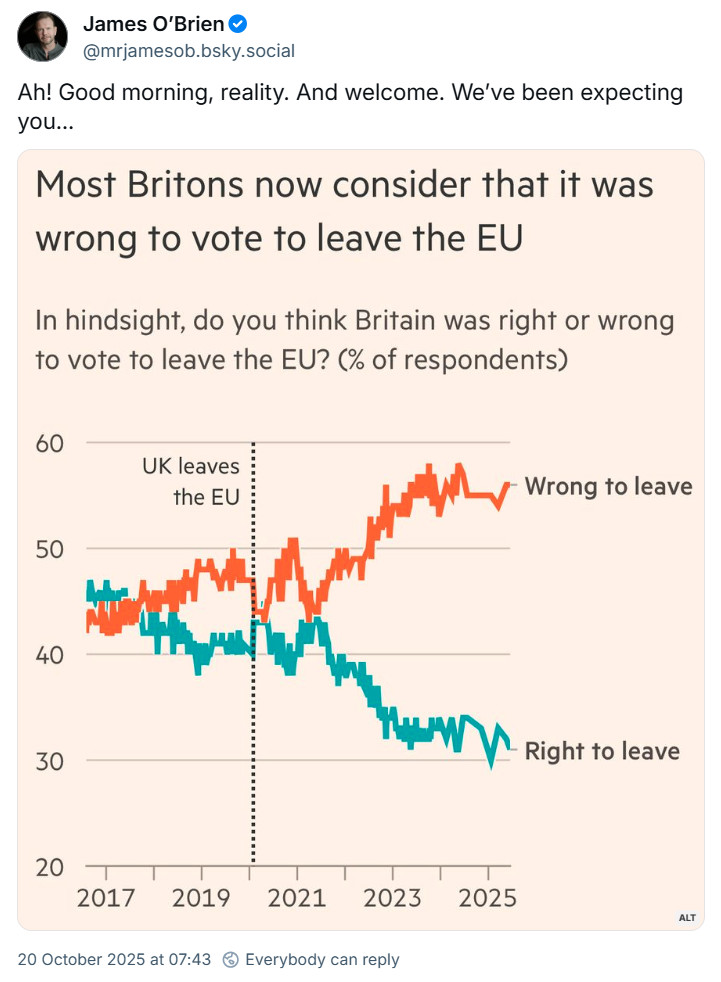
A lot is being said on the breakfast news this morning about how the trade deal the Labour government has struck with the EU effectively mean UK businesses will now have to abide by European rules which we now have no say in setting. I’m sorry, but I just feel compelled to post an entry to state the blindingly, stupidly obvious: we would still be participating in making such regulations if we had remained a member of the EU. This is exactly what the Remain campaign warned would happen! Everyone knew that UK businesses would still have to abide by EU rules, but have no say in setting them. Thus for Pritti Patel to just come on the Beeb breakfast program just now, and for the right wing tabloids to accuse the government of ‘betraying brexit’, when brexit is what caused these issues in the first place, really is too stupid to ignore! If these Outist idiots really cared that we had control over such trade guidelines, they would not have advocated breaking away from the body which sets them. The government is thus undoing the ongoing mess the outists made; for them to complain about it, calling it a betrayal or relinquishment of sovereignty when it was brexit which caused these issues, really is an insult to our intelligence.

The Attenborough Equation

This equasion occurred to me while I was watching Ocean yesterday. It seems quite a good way to sum the great man up.

If you think about it, Sir David possesses features of all three of my biggest fictional heroes: the wisdom of the ancient wizard Mithrandir; the curiosity and fascination of Captain Picard; and the tenacity and resilience of 007. Is there any wonder why I think he’s so incredible?

Ocean with David Attenborough

It was turning into quite a dull day so this afternoon I decided to take myself up to the cinema to watch Ocean with David Attenborough. I was, of course, extremely eager to watch it, although a (small) part of me was hesitant as I tend to associate Attenborough with the BBC, and he didn’t work with them on this film. However, what I found myself watching a couple of hours ago was truly, truly remarkable. First of all, Ocean is a beautifully shot piece of non-fiction cinema: some of the scenes we are treated to as an audience are jaw-dropping. More to the point, it is a highly compelling film. As many others are noting, unlike Sir David’s TV work, this film has a clear agenda: in large part it is about the damage we are doing to the oceans, mostly through over-fishing. We glimpse the ruin trawlers inflict on the seas, which it would be hard not to find compelling. In this sense it was clear to see why this film could not have been made by the beeb as it couldn’t have had such an overt agenda. At the same time it does not go too far or slip into dogma: it is not anti-fishing, but emphasises how balanced, sustainable methods could benefit everyone.

However, the aspect of the film I was most drawn by was how it highlighted Attenborough’s own incredible career. We are treated to clips of him diving as a young man fifty or sixty years ago. This allows the film to highlight how much the oceans have changed over that time, and how they also have a remarkable capacity to recover if we allow them to. Thus we are treated to a view of the oceans very much through Attenborough’s own wise, compelling eyes, and the film is all the richer for it.

The vast majority of us have spent our entire lives with David Attenborough on our television screens, treating us to insights into the natural world nobody else comes close to. I think I have said here before that I regard him as the greatest broadcaster ever. To my knowledge this is his first foray into cinema, and the result is an absolute pleasure. If I had a single criticism of the film, however, it is that it does not touch upon how the damage we are currently doing to the seas has it’s underlying roots in economics, or what causes it socio-economically. The issue is essentially one of capitalism. After all, people are compelled to catch fish to make a living; if this motivation was got rid of, surely over-fishing would be far less of a problem. The only way the issue of over-fishing can be dealt with is if we address our appetite for seafood. The film does not focus on this broader aspect of the issue though, but seems to shy away from the underlying economics. That aside, we are treated to a wonderful piece of natural history cinema – one which I would passionately encourage everyone to go and watch on the big screen as soon as you can. David Attenborough has treated us to yet another delightful insight into the world around us; but then, we expect nothing less from this great, great man.

The Life Of Python

One of the first things I came across on Youtube this morning was this rather fascinating 1989 BBC2 Omnibus documentary on Monty Python. I think it’s well worth a watch, especially if like me you’re into Python. It’s rather dated by now of course, but what I find interesting about it is that it gives us a snapshot of the group just past their heyday: It opens with Graham Chapman’s funeral, and we really get a sense that these men had, until fairly recently, been the comedy equivalent of rockstars. More to the point, what I’m also interested in is how much things went on to change since then. Quite a lot happened since this documentary was first broadcast, and the various members of the group went on to pursue their individual careers. They speak as though the Python phenomenon was well and truly over; they could barely have imagined that they would get back together twenty-five years later. Watching this thus makes going to watch their reunion in 2014 feel even more special.