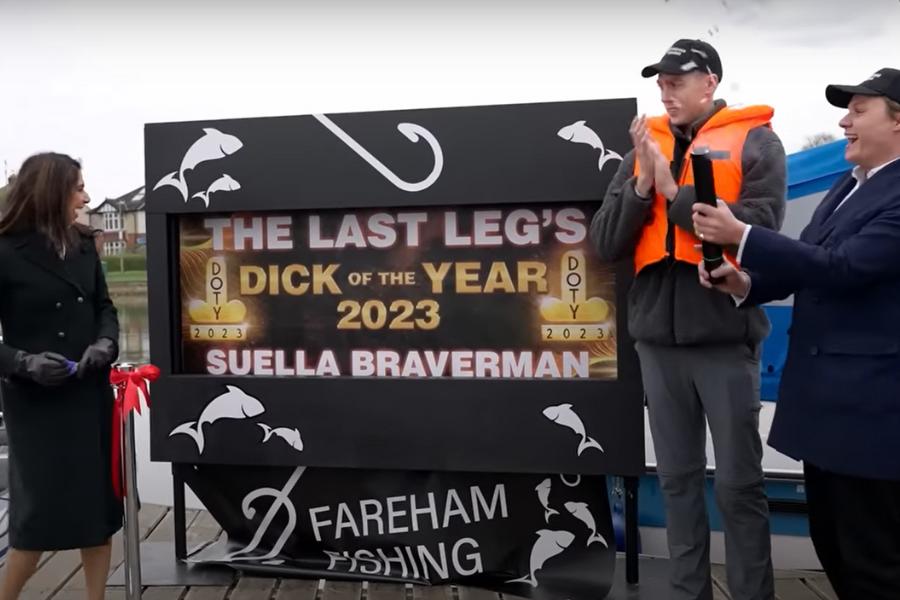
I must admit that I didn’t actually watch Rishi Sunak’s speech yesterday – the headlines were enough for me to go on. I knew that if I stayed in and watched it, it would just enflame me, and I’d probably end up shouting at my screen. Thus it wasn’t until I watched the late evening news that I caught up with anything else he spouted, and it immediately made my blood boil with rage. How that scumbag has the gall to stand there and spout discriminatory, transphobic bile is beyond me. Of course, he was obviously trying to appeal to the Mail and Express reading halfwits who are the only way he’ll ever get reelected; but they are too dim and narrow-minded to understand the modern world. In 2023, any educated person understands that humanity is a diverse rich tapestry, in which former gender boundaries can be overcome and anyone is free to identify as any gender they feel closest to. It now seems we are being governed by a vile, anachronistic group of charlatans which refuses to understand that, and which demands that everyone else conforms to their narrow-minded values. Surely we, as a community, are better than this; surely we deserve leaders with more foresight and understanding, not a group of intolerant bigots totally out of touch with contemporary society.
So Much for Levelling Up
Long term readers will know how much I love London. The metropolis fascinates me: I adore exploring the city, going to events, finding out more about it’s history. It is far from perfect, of course, but part of the reason why I like London so much is because I can get around it. As a powerchair user, I can get on and off busses with ease; the tube network, though not without flaws, is fast, reliable, and is gradually becoming more and more accessible. As far as I’m concerned, London is one of the greatest cities in the world.
A hell of a lot of money goes into London and it’s infrastructure, obviously. Just a year or so ago, it opened a brand new, multi-billion pound tube line. Despite being obscenely late and over budget, we got Crossrail eventually, and the Elisabeth Line is now up and running. That’s why I can’t help feeling indignant that the rest of the country is not getting the same sort of treatment. I may now live in London, but I come from cheshire, and I’m becoming more and more acutely aware of the imbalance between London and the rest of the country, especially the north.
The announcement of the cancellation of the northern part of HS2 today will surely only widen that imbalance; it will also widen the social division and animosity which is opening up between north and south. How can anyone see it as anything other than grossly unfair that London gets so much investment and all the swanky new tube lines, but when it comes to updating the connections between the rest of the country, it is suddenly deemed too expensive? If I still lived in cheshire, or if I were to one day move to Manchester or Liverpool, I would expect to see the same standard of infrastructure I’m now used to here in London. But I know I wouldn’t find it: to my knowledge, public transport up in cheshire is in the same dilapidated, creaking state as it was fifteen years ago, manual bus ramps and all.
Perhaps I’m biassed, but I think I’m very lucky to live where I do, with the ability to trundle around this city with increasing ease. London is an outward looking, forward thinking world city which recognises how vital it is to invest in infrastructure which benefits all its citizens, from accessible tube lines to automatic bus ramps. If I was living anywhere else, life probably wouldn’t be so easy, largely thanks to the Tories and their reluctance to invest in anything which might make life better for anyone other than themselves and their rich friends. For all their talk of ‘alternative projects’, at the end of the day, the Tories don’t care who suffers or goes without as long as they can reduce tax for their rich friends: After all they don’t live in the North-West so why should they care what they cancel? Surely that has to stop; surely the notion of ‘Levelling Up’ has to be given some substance, and not allowed to remain the sickening joke it was turned into this morning.
Totally Incapable of Decency
This just about mirrors my feelings towards the gathering of spoiled scumbags up in Manchester exactly.

International AAC Awareness Month
Slightly embarrassingly perhaps for someone who ought to keep on top of such things, but today I gathered that October is International Augmentative and Alternative Communication (AAC) awareness month. It’s a month to celebrate and raise the profile of those of us who use communication aids. Of course I think this is a great idea. I use a communication aid pretty much daily, mostly when I’m out and about, and you would be surprised how many people still don’t really know how to interact with someone like me. However, perhaps the best thing I can do here today is to point out how vital my communication aid was on the incredible trip I just got back from. As often happens, John became used to how I speak and the strange patterns of my natural voice; yet I nonetheless needed to use the communication app on my iPad quite regularly, from suggesting where I thought we should head to, to selecting what I wanted to eat. In fact, I would go as far as to say that trips like the one I just had, and indeed my whole life as a man living independently in London, would not be possible if I didn’t have my communication aid. I think that is very much worth highlighting and celebrating, and I really hope documenting my travels here might encourage people in similar positions to me to try similar things.
Moonrise Over Tangier
A couple of days ago I witnessed one of the most stunningly beautiful things I think I’ll ever see. John and I were heading home through Tangier. It had been a long day: we had taken the train up from Casablanca, and were aiming to get the ferry back to Spain that evening. John had already pushed me from the train station, and we were heading along the seafront. Evening was falling, and there was a warm, brilliant glow in the sky. Nearing the end of our walk, John suddenly pointed out the moon to me, and my jaw dropped. It was a stunning sight: the moon seemed bigger and brighter than usual, and appeared to be rising faster in the sky. I’m not sure whether it was because of where we were geographically, or the time of year, but the moon was getting higher and higher in the sky as we watched. I had never seen anything like it; it was phenomenal. John looked it up using his phone and said it could be a supermoon, but whatever it’s cause it was a sight I will never forget.

Returning From A Wonderful Trip
We flew back into London late last night. It had been a long, tiring day: from Tangier we got the ferry up to Tarrifa, the southernmost point of continental Europe. After a night there, it was a long, fairly slow bus ride to Seville. A couple of hours’ there yesterday gave me and John the chance to walk around the beautiful city in the stifling heat, and we determined that we would return there soon for a proper visit. Then it was a bus to the airport, and a flight, delayed by an hour, back to the UK.
How can I sum up a trip like the one we just had? How can I write any kind of conclusion or ending to such an incredible two weeks, so full of culture, variety and contrasts. I don’t think I can, but I’m sure my memories of our trip to Spain and Morocco will last far longer than the suntan it gave me.
A Taste of Trips To Come
It always makes me feel sad to leave somewhere. We are currently on the train heading north back to Tangier. A single day was hardly enough time to get to know a city like Casablanca. I have never been anywhere so beguiling and full of contrast. Nor did I ever think I would have a chance to visit such a wonderful, historic place so different to anywhere I’m used to. But then, I somehow doubt this will be my last taste of North Africa.
Casablanca: Where Two Worlds Meet
John and I initially planned this trip to be a visit to Morocco and North Africa. After our trip to India four years ago, it seemed to me that the Sahara would be next on the list. Then, of course, the pandemic got in the way of our plans so it wasn’t until this year that John and I began to think about going anywhere again.
A few weeks ago our plans were taking shape. When an earthquake hit Morocco, however, our plans had to change once again and we decided to visit southern Spain instead. Yet North Africa was still so near and so tempting.
Thus yesterday afternoon saw John and I on a ferry crossing the straits of Gibraltar. To be honest it was a really long day, one which started in Europe and ended in Africa. We landed in tangier, before catching a train to Casablanca. Here I have a confession to make: I was probably clinging to an outdated stereotype, but part of me was expecting to board a train made of wood and pulled by a diesel or even steam engine. Instead, as night fell I found myself hurtling south at over two hundred kph by a perfectly modern, comfortable bullet train.
Today I woke with a completely new city and continent to explore. It soon became very apparent that we were not in London any more: everything seemed so different, so much more exotic, and to be honest so dangerous. For one, walking out to explore the city, nobody appeared to be obeying the traffic laws. Truth be told I was soon quite glad I was in my manual wheelchair being pushed by John, as there was no way I could ever navigate this maelstrom of maniacs on my own.
That being said, as we explored Casablanca this afternoon I fell deeper and deeper into a fascination like no other. Here two utterly different worlds, European and Arabic, collide like tectonic plates. Being pushed through the medina by John a couple of hours ago felt like I had been transported to another time or even another world. Tiny, timeless streets full of people, with Moroccans selling things from the hundreds of small shops as they have done far countless centuries. Meanwhile men on mopeds and small motorbikes zoomed between the shoppers in a way that made me wonder how the place was not lined with corpses.
My astonishment was redoubled, however, when we left the medina to find a huge modern shopping centre just outside of it. The contrast between the two areas was almost unsettling; it frankly felt like a sort of geographical and cultural jump cut, as though we had leaped suddenly and unexpectedly from the past back into the ultra modern twenty first century.
Yet that is what you find in places like Casablanca. Cities like this straddle two or more worlds. Ancient Arabic medinas are surrounded by the metallic and neon structures of modern capitalism; tourists are taken there from their hotels on a tram system worthy of any European city. I think such clashes are only to become more common as fascinating, timeless places like this rise into modernity.
A Stupid Little Place
Gibraltar. Behold the dying embers of a long faded, defunct empire trying to cling desperately to past glories. An anachronistic overpriced tax haven, insisting that the flag it still so passionately waves does not now belong to an irrelevant laughing stock. Red phone boxes which nobody use still line the streets as if in a deliberate attempt to make the place look more British, even though the buildings around them are irrefutably Spanish and even Moorish. Poorly maintained, barely accessible for wheelchair users, after touring the small town yesterday I must admit that I found the place as vile as it is comic. I doubt we’ll be going there again.
Another Beautiful Balcony
This entry finds me again sitting on the balcony of yet another hotel room, just outside Gibraltar. This one is slightly higher and wider, and instead of a narrow Spanish street I’m looking out over a large marina with the straits of Gibraltar beyond. Further beyond that I can see the majestic mountains of North Africa. The sun is beating down and wind shakes the palm trees in the street three floors below me. When he returns from doing our laundry, John and I will head out to explore the landscape now stretched out before me. It’s a wonderful scene to behold, but once again I find myself wondering how on earth I can be so lucky.
The Picasso Museum
Having returned to Malaga yesterday evening, this morning we visited the Picasso museum. Five minutes walk from the hostel where John and I stayed last night, I must say I found the museum very interesting indeed. I knew a little about Picasso from Writers Contexts at university, but I really think today helped put some meat on those bones. I really got an idea of who Pablo Picasso was and what his art is about. He was making comments about the world around him, just as I do on my blog. What I was struck by the most, though, was how his use of different perspectives could be perceived as a comment on the essential subjectivity of the world: After all, we all see things from slightly different angles.
Moreover the exhibition itself is housed in an extraordinary building built over ancient Roman and Phonecian ruins, beautifully preserved in the basement. If you ever visit Malaga, I would thoroughly recommend a visit to the Picasso museum.
Granada’s Awesome Bus Train
I think I mentioned yesterday how narrow the streets are here in Spain. Back in the UK I’m used to fairly wide urban streets with room for cars going both ways and reasonably wide pavements. Here, however, the streets are far narrower, particularly in older parts of cities like Granada. They are barely wide enough for cars to go down, and are usually just used by pedestrians.
As enthralling and evocative as such narrow streets are, the only problem crops up when it comes to public transport: There is no way you could get a bus of any size down such roads. Yet cities like Granada are so spread out that not everyone can get around them easily on foot.
The solution the Spanish have found must be one of the coolest pieces of public transport I have been come across. An amazing combination of a train and a bus, it is a vehicle which goes along the roads, but is formed of three short carriages. Two have seats for ten or so passengers, which are pulled along by a kind of van at the front. The entire vehicle can thus snake its way through the streets, bending around the tight corners, climbing the steep slopes.
The best part though, and the thing which surprised me to be honest, was that it was wheelchair accessible. The last carriage had a wheelchair lift at the back, so I was able to get on and off easily. That instantly impressed me, and as John and I rode the incredible bus train up through Granada, I wondered whether we could ever see anything like it in London.
Spanish Town Squares
I suppose London has two or three squares of note: Trafalgar Square, Parliament Square, Leicester Square and of course General Gordon Square in Woolwich. Yet as a city I wouldn’t say squares were an integral part of London’s geography. On the whole I find them large, impersonal public spaces. Here in Spain, on the other hand, town squares seem fair more intimate and full of character. We are currently in Granada, an absolutely fascinating city un in the mountains. Here there are a great many urban squares all separated by ancient streets far too narrow to drive cars down. I find it intriguing and intoxicating: John pushes me along the ancient streets, tall buildings hundreds of years old earth side, for us to suddenly come out onto a majestic square. Most aren’t very big, but they all thrive with local culture: many have cafes where people eat outside, as well as music in the afternoons. It seems to be a defining characteristic of Spanish towns and cities, and one which I already find spellbinding.
Ronda: Life In The Afternoon
We visited Ronda yesterday, a small town a couple of hours outside Malaga. To be honest I had never heard of it, but John was keen to go there. He said he had visited Spain many times, but had never been to Ronda.
Stepping out of my wheelchair and onto the bus, I didn’t know what to expect. We had soon left Malaga and were driving up into the hills and mountains. It was beautiful. It was then that John told me a bit about the place we were heading to: an ancient fortified town once held by the Moores. Of course I was instantly intrigued.
What really caught my attention, though, was when I heard that Ronda was the birthplace of bullfighting. Now, I am not a bullfight aficionado, and like most people these days think that it’s fairly barbaric; but as a fan of Earnest Hemingway that information couldn’t fail to catch my attention. It had been a while since I had looked into much about Hemingway, so I didn’t know whether there were any links, but the possible tie between my two interests made me eager to find out more.
Ronda is a stunning place. It’s steep cobbled streets meant John had a bit of difficulty pushing me around, but we had an amazing afternoon exploring the small town. It’s architecture is an interesting mixture of medieval and moorish; stone bridges swoop elegantly over ravines; promenades look over wide beautiful valleys. We spent the afternoon walking around the town, stopping for drinks and visiting the museums.
It was in one of the cafes that I managed to get online to finally upload yesterdays blog entry. It was there too that I had chance to tap a couple of words into google, and to my absolute wonder found that Ronda was, in fact, one of Hemingways favourite places. The great American writer spent many summers there watching the bullfighting. It was there too that he met Orson Welles: after a famous fistfight during the creation of one of Welles’ films about the Spanish civil war, the two struck up a firm friendship. I find the fact that two of the greats of twentieth century art had such a close link to the place we visited yesterday absolutely thrilling.
We got back to Malaga fairly late and tired. Days like yesterday give me a buzz which I cannot really describe. Coincidence had once again brought me into the presence of one of my heroes: I had been pushed across the very bull ring where, so many summers ago, Hemingway used to go to watch animals being ritually tortured and killed. Of course that was a different era with totally different values; yet as abhorrent as I might find the custom, I relish discovering such links to histories and people I find so intriguing.
Flamenco
Any writer would want to describe what we saw last night. Any wordsmith worth their salt would feel an urgent need to try to convey in prose what John and I were witness to: the mournful lament of the woman singing; the swish of the girl’s skirt as she strutted across the stage; the sheer power and emotion of the male dancer, dressed in black, as he rounded off the evening’s performance. Yet I doubt that any writer could recapture what we saw, at least not in a short blog entry.
I honestly think the flamenco performance John and I went to last night, in a small venue off one of Malaga’s beautiful squares, was one of the powerful and emotive pieces of art I have ever been witness to. Knowing very little Spanish, of course, I couldn’t tell what the songs being sung were about. Yet the tone of voice and rhythm of the dancing were enough for everyone in the audience to tell that a great loss was being expressed; and that someone or something was being mourned to a degree more tragic, profound and devastating than I had ever come across. It was as heart rending as it was stunning: raw, visceral emotion expressed through dance. Above all it was mesmerisingly beautiful, and I will never forget it.
Such wonderful spectacles are surely what journeys like this are for.
The Thrill of the New and Exotic
Today began fairly quietly. John and I got to bed quite late last night, and after a while of tossing and turning I slept pretty well. John woke up just before I did and left the room to investigate breakfast, leaving me to get up a few minutes later and walk over to the window of the small hostel room we currently share.
Stepping onto the small balcony, I looked out over a narrow Spanish street. I was instantly struck by how different it felt: the architecture, the narrow street below, the people walking along it, felt so evocative of something I had never experienced but had only seen in films. It was as if I could feel bulls, matadors and sombreros in the air.
Things had suddenly become far more interesting than my little corner of south London. The thrill of the new and exotic that I already felt, standing on that little balcony this morning was almost overwhelming. This trip is going to rule.
The Quiet Before The Adventure
I am, of course, currently sat at my desk in my comfortable little flat in Eltham. As much as I like it, it is where I have gone to bed, woken up and spent most of my time for the last three and a half years or so. Largely due to the pandemic, my recent world has been confined to London and it’s South-Eastern quarter; and as great as I find the metropolis, a growing part of me is now yearning to go out into the world beyond it.
However, at last today that yearning ends. In a couple of hours, John and I will be heading to the airport en route to Spain. Our bags are around me, packed and ready to go: this is now the calm and quiet before the adventure begins, and I feel a wonderful buzz of energetic anticipation. What will we see? Who will we meet? I can’t help remembering all the incredible places I have already been to – India, Crete, Paris, Australia – and wondering what we’ll experience this time which will add to such fabulous journeys.
To travel, in my opinion, is to live. The very act of going out into the world, exploring it, seeing new places, brings with it a joy like no other. Staying in one place, waking up in the same bed every day, gets so monotonous that the only way to wake yourself up is to set off to somewhere new, somewhere exotic. I intend to record my adventures here if I can, although it might not always be possible to get online. Nonetheless, I’m sure I’ll soon have plenty of exciting new things to write about.
Gollum Meets Schrodinger
As someone who loves Tolkien and who has an interest in physics and quantum mechanics, this really made me chuckle.

Not Being Stared At
Perhaps I can be a little too self-conscious at times. Dominik and I had dinner in Whetherspoons in Lewisham last night. We were at the table in the corner, and I was sat with my back to the wall furthest from the main entrance. A few minutes into our meal, I began to notice a man sat at a table not far away, seeming to look directly at me. I tried to ignore it at first, but he continued to stare with such fixation and intent that I began to get unnerved. I told Dom about it, who of course said I should ignore it. Yet it began to really irritate me: did this guy have a problem with me, my dribble, or how I ate. I was about to take it up with him or report it to the staff, however, when I realised something. On the wall, just over my left shoulder, was a wide-screen TV showing the evening news. The poor guy wasn’t looking at me at all but simply watching TV.
Needless to say I instantly told myself to shut up and not to be so paranoid.
Lessons in Crossing Roads
I still keep an eye on my old special school’s Facebook page. I like to keep track of what’s going on there, and to see how the old place is changing. Of course, a lot seems to have changed in the twenty years since I left: from the look of it, they now support a lot more students with learning difficulties, whereas when I was there, there was a much higher proportion of kids with just physical disabilities. Just now, for example, I came across pictures the school had posted of students being taught the safest way to cross a road. They were stood at a replica pedestrian crossing painted onto what looked like the old playground. I couldn’t help letting out a cynical little chuckle: I can’t remember having such lessons. Indeed, if only those teachers could see me now.
Of course, I cross roads every day in my powerchair, many times a day. What amused me was, like most urbanites, I find that the rules soon go out of the window. It isn’t so much a case of ‘stop, look and listen’ here in London, as much as a situation of ‘cross when you get the chance, and don’t worry about the consequences!’ Of course, pedestrian/zebra crossings are certainly good places to get across a road, but that assumes all the drivers stop for you like the law says they should!
I find myself wondering whether the students in the pictures I saw will ever get a chance to lead an independent, urban life like mine; or whether, when I was their age, I could ever have imagined that I would one day be living on my own in one of the world’s greatest cities, crossing roads, getting on and off busses, living life just like everyone else in this amazing place. To be honest as a youngster I couldn’t imagine ever leaving our old family house, so ultimately the kids now at my old school have just as much potential as I had. If that is the case, though, they will probably need much more advanced lessons in how to cross roads. They may be being taught the basics – things which every child needs to learn – yet I really hope that one day they feel the thrill of life that I now do, a feeling which no school lesson can imbue.
Do You Trust Pythagoras?
I just came across this on a science-related Facebook group, and can’t help noting how salient and telling it is of current culture. We live in strange times.

A Necessary but Disturbing Watch
If anyone reading this is as concerned as I am with how sickeningly racist and downright xenophobic the Tory party is becoming, I would really recommend you watch this newly-released Owen Jones video. I don’t want to paraphrase Jones because he explores the issue perfectly well, but the details he talks about really are shocking. For one, he says the Home Secretary Suella Braverman is now championing the views of Douglass Murray, an out and out bigot and islamophobe who apparently thinks that immigration has turned London into a ‘foreign country.’ It’s a disturbing, unsettling watch, especially for those who value living in an outward-looking, welcoming country which deserves better than to be governed by populist, xenophobic slime.
East Bank Is Almost Open
I’ve mentioned here before how often I go up to the Olympic park. I like it there, and it has become the default destination for my daily trundles. There is a lot of building work going on there, so I have got to watch the area slowly change over the past few months and years. There usually isn’t that much to note, but today I was in for a bit of a treat: the development called the East Bank has now started to open up. Five years or so ago, it was just a bit of waste ground used, I think, for temporary buildings during the Olympics. Since then, though, the park elected to build three large arts venues there, including a new base for BBC Music.
Whenever I have visited the park I have caught snippets of the three buildings being constructed. Before today, of course, the area has been a building site which I couldn’t go into; even yesterday it was still fenced off. When I went up there this afternoon though, I noticed that some of the hoardings had been removed so I could go up to the buildings.
While you still can’t go into them, I couldn’t help feeling impressed: that area, opposite the Olympic stadium, promises to be a wonderful new cultural hub for London. To be honest finding somewhere new to explore and new paths to go down today thrilled me like a new toy thrills a five year old. The whole complex felt so dynamic and new: A hell of a lot of money has obviously been put into constructing it, totally from scratch. When it is fully open the East Bank promises to be incredible. As I have said on here before, the thought that that entire area was pretty much totally derelict and forgotten until so recently staggers me, but between the shopping malls, velodromes, stadiums and now theatres, it’s hard not to be in awe of what this city can do. I have never known anywhere which is capable of such epic creation, or which can regenerate itself so rapidly.
Sir David Attenborough will present Planet Earth III
I just had my first moment of complete astonishment of the day. A couple of days ago, I began to wonder about Sir David Attenborough again. I was curious to know whether he was up to anything. To be honest I’d kind of assumed he had retired: he’s 97 after all, and after such an incredible career who could blame him? However, I just tapped his name into Google, and came across this utterly amazing news. Far from retiring, the great man is currently filming a third series of Planet Earth. “BBC Studios Natural History Unit has confirmed that Sir David Attenborough will present Planet Earth III, the third instalment of the landmark award-winning series.”
Quite frankly I find this news jaw-dropping; it thrills me. Attenborough has done more than any other person to make us aware of the natural world, of how it works and it’s sheer beauty. As far as I am concerned, he is the greatest television presenter ever, of any subject and of any nationality. He started working at the Beeb in 1952; the fact he is still making the fascinating, beautiful programs he is known for, still educating us all about the natural world, is absolutely wonderful. Surely no other cultural personality can even come close to his legacy.
There’s no word on when the new series will hit our screens, but I can’t wait.
Take That Outists!
I can’t say I watched The Last Night Of The Proms last night, although I wish I did now. The Outists are apparently exceedingly pissed off that there were so many EU flags being waved by audience members there. I just saw a copy of a page from the Daily Fail which I was thinking about reposting here, but I don’t want to befoul my blog with anything from that rag. You should see the moronic comments though: They accuse the flag-wavers of ‘hijacking’ the night, calling it ‘utterly vulgar and disgusting’. Yet I think it’s a clear sign that most people now see Brexit as the stupid mistake it was, and want it undone as quickly as possible. Let’s hope we see more and more of this kind of thing; and if it pisses the Outist idiots who read the Daily Fail off, surely that’s a good sign.
We Might Not Have Seen The Last Of Picard
One of the first things I came across when I turned on my computer this morning was this exciting piece of Star Trek news. It seems that I was wrong to assume that we had seen the last of Captain Picard a few months ago. Patrick Stewart has recently expressed interest in doing one final, triumphant round off to his Star Trek career. He wants to do one last film involving all remaining/surviving characters. I think this is incredible news: as awesome as the final season of Picard was, I feel one final act on the big screen would be more fitting. After all, Captain Picard is my favourite Star Trek character; like many contemporary Star Trek fans, I grew up watching Star Trek The Next Generation, so to see that crew get back together for one last adventure would be awesome. Whereas I couldn’t help being rather cautious and skeptical when it was first announced that Patrick Stewart would be stepping back into the role four years ago, especially after such a long break, the three seasons of Picard we have seen already are, I think, good grounds for optimism.
Whether anything will come of this news of course remains to be seen, but I’ll obviously be keeping a very close eye on it.
A New Band To Get Into
I think I have suddenly found a new band to get into. I had never heard of Ezra Collective before last night. Catching snippets of them on the Mercury Prize awards though, they sounded a lot like the Cat Empire, probably due to their heavy use of trumpets and jazzy overtones. That sort of pricked my attention, and I decided to do a quick blog entry on the similarity. Before starting to write though, I thought I had better listen to some of their music, and within a few minutes I began to feel myself getting into it. While there are a few similarities with my favourite Australian band, there are of course significant differences too. Similar styles perhaps, but different themes. While Cat Empire are all about throwing beach parties and drinking lots of rum, Ezra Collective seem more urban and all about life in London. I wonder what my friend Charlotte will say about them: it was C who introduced me to The Cat Empire in the first place, so it would be interesting to see whether she likes their new British counterparts.
Why Costa Coffee is Cool
I’m fast becoming a fan of Costa Coffee shops. I don’t just mean because of their coffee, although I am partial to a large cuppaccino, but mostly due to a combination of their free WiFi and ubiquity. I don’t have a SIM card in my iPad so I have to rely on WiFi when I’m out and about. Like most people these days, I don’t like being out of touch with the online world for too long, so sooner or later I start to look for a WiFi network to connect to. I get nervous about whether guys like Serkan, John or my parents have messaged me.
Luckily, you can now find costa coffee shops in almost every cluster of shops across London; they also have the advantage that, once you have connected to one of their WiFi networks, you can quickly and easily hook up to them all. That means that I don’t even have to go into the shop if I don’t have to, but often just park outside the front window to get the few minutes of web access I sometimes need. Slightly cheeky perhaps, but I promise I buy plenty of coffee in their shops when I need to.
Sequoias in South London
I have just got back from my daily trundle with John today, and I must say we came across something I find utterly, jaw-droppingly remarkable.
I still have very fond memories of my family trip to America, back in 1994: we visited New York City, before going on to tour California and the west coast. Our trip included going up to Yosemite and seeing the giant Sequoias: I’ll never forget how huge and majestic the tallest trees on earth were.
That,, of course, was almost thirty years ago and I must admit I hadn’t thought about the Redwoods in a while. Today, though, John and I took a walk through a few of the parks and woods near Eltham. It was a lovely, lovely stroll: to be honest I don’t tend to go that way on my own because the paths can get a bit rough and dodgy. Paths through parks are usually fine, but heading into Oxleas or Sheperdleas wood they are unpaved and root-strewn. Today, though, following John, my eyes once again tightly fixed to his arse as he lead me through such peaceful, beautiful woodland, I felt confident that I wouldn’t come to any harm.
We were there for two or three lovely hours, exploring the woodland: I had no idea that the woods in this area were so vast. At one point we found a cafe overlooking Oxleas meadows where we had a brief snack. It was astonishing how far you could see across south London and beyond. Pressing on from there though, we went back into the woods, where we found something incredible. I didn’t notice them at first, but John pointed out two tall, majestic Sequoia trees, there in Oxleas Wood. I was astonished – I thought Redwoods only grew in California. My mind instantly went back to my eleven year old self, looking up at those trees in Yosemite. They weren’t as tall of course, but they were still recognisably Sequoias. What the zark were they doing in South-East London though?
I was amazed by what we had found, seemingly purely by chance. It just goes to show what you can find if you just go out and look, apparently even including fragments of California. We now intend to head that way again soon. London will never stop amazing me.
An Encouraging Sign in a Pretty Little Park
Apart from lunch at the Tudor Barn with my parents a couple of weeks ago, I hadn’t been into Well Hall Pleasaunce for quite a while. Of course, being on the main road into Eltham, I go passed it fairly regularly, but before this afternoon I hadn’t had occasion to go into or through the pretty little park for months. It used to be that, being about four hundred years old, the paths around the park were flagged, uneven and broken up with steps. Thus, as pleasant as it is, I tended to avoid it. Today, though, on my way home with John after buying a new manual wheelchair, we chose to break up our walk by going through the Pleasaunce. At first I wasn’t sure about the idea because of all the steps, but to my amazement as soon as we went in I saw it had been entirely flattened: the steps had either been converted into ramps, or nice new paths lead around them so that I could easily go from one level to another. I was very impressed: a lot of work had obviously recently been done to make sure a wheelchair user like myself could access all of the park. I must admit that I find the fact that the council would carry out such a renovation on such a little place very encouraging.
Scorchio!
I got the inspiration for this from the Indian Summer we’re currently experiencing.

It’s Called The Northern Powerhouse, Matt
Just a brief note to say that, chatting with my parents online last night, they told me that something very similar to the ‘idea‘ I was waffling on about on Saturday had already been tried: The Northern Powerhouse was proposed/created over ten years ago, essentially by the Tories. It was designed to boost the economy in Northern England by improving rail links etc. I don’t know how successful it was, particularly regarding issues like public transport accessibility, but I must admit it sounds a tad more realistic than creating a giant Northern Metropolis.
Freedom Passes are Fiddly
I must admit that I can be a bit lax sometimes when it comes to things like post. Unless I’m expecting something specific, I tend to let letters go unopened for two or three days. I just kind of assume they are yet another bank statement which can be filed away and ignored. That’s how, this morning, Serkan told me that the letter containing my new freedom pass had arrived a couple of days ago and I hadn’t realised.
That minor error aside, today was the first day I went out with a freedom pass. Serkan inserted it into the lanyard my parents sent, which was then secured to my bumbag and put into it’s front pocket. Truth be told I still wasn’t sure whether I would need it, but I resolved to try to use it anyway, just to see if it worked and how practical it was.
I just got back from a nice long trundle up to Stratford. I took one of my usual routes, but one of my favourites. It was a good way to use a nice, sunny afternoon. Of course I took the tube back as usual, but today instead of asking the guard to open the gate, I was determined to try to do it myself using my new card.
I realise that, to most people, the simple act of getting a card out of your bumbag and tapping it on a sensor won’t sound too taxing. This afternoon, however, a queue growing behind me, I found it the most stressful, irritating thing I ever had to do: nothing, from my fingers to the bumbag zip, seemed to want to cooperate. It took ages for me to get the card out of the bag; then, manoeuvring it in my hand so the sensor could read it seemed about ten times more difficult than it should have been. Then, after about five attempts at getting the card read, once I was through the gate getting the zarking thing back into it’s pocket, including the lanyard chord, seemed all but impossible, especially when I was rushing to catch a waiting tube train.
In short, I can’t say I was impressed by the whole experience: I think I’ll stick to asking the station staff to open gates for me. But at least I have it now, so I can sort myself out on the odd occasion when there is no staff available. I just hope that doesn’t happen very often.
A North-West Rural Metropolis
I have been thinking about the North-West quite a bit recently. While I wouldn’t say I was homesick, I’m becoming more and more concerned about the economic disparity between London and the rest of the country. From what I can see, the north west of England still doesn’t have anything resembling the infrastructure, in terms of public transport etc, which I’m now used to in the capital. To my knowledge bus wheelchair ramps are still manual there, so drivers have to grudgingly get out of their cabs to unfold them whenever someone like me wants to get on a bus.
Out on my trundle earlier, however, I had another of my crazy ideas: what if the north west of England started functioning as one big metropolis, akin to Greater London? It’s a massive area of course, encompassing five or six large, fairly rural counties. I’m not taking about concreting over all the countryside between the towns of course, even if that was possible. Rather, perhaps the region should act under a single authority and develop things like a comprehensive transport network. If a rail system like the DLR or even the tube was created, linking towns and cities like Manchester, Liverpool, Stoke and Crewe with a fast, efficient, accessible network, surely it would help to integrate the entire region in one big economy. Such a region could possibly be on a par with London as resources could more easily be focussed where they are needed, and much more help could be given to rejuvenate notoriously deprived cities like Stoke-on-Trent.
Of course I could be taking nonsense here. I know full well that the north west has a perfectly functional rail system. Yet one of the things I relish most about life in London is my ability to travel from area to area so easily; and one of the things I remember hindering me the most when I was living in Cheshire was the slow, unreliable bus service. The only way any area can improve things like public transport is by working as one, so it seems to me that if the entire north west united into one political entity, forming a sort of rural metropolis, then it could begin to punch with far more weight.
Barbie
John and I went to watch Barbie yesterday, but I’m still not sure what to make of it. I had been looking forward to seeing it for a couple of weeks: I’d heard a bit about it, and got the impression that, despite outwardly being a kids film about a doll, the film was actually quite satirical and subversive. That made me fairly eager to go and see what the fuss was about, but now that I have, I can’t make my mind up about what the film was trying to say. It was clearly only about dolls to the extent that Animal Farm is only about farm animals. There is a lot of commentary about patriarchy, capitalism and the role of women in contemporary society. Yet beyond that, if we try to read anything deeper into it, the messages seem to get more confused. The film was clearly trying to say something about sexism, but what?
In the film, all the dolls live happily in Barbieland, having parties and going to the beach. Then, at one point, one of the Barbies and one of the Ken dolls have to travel to the supposed real world to find out why the girl playing with the barbie is becoming so sad. There, the Ken doll learns about contemporary patriarchal society, and realises that it is the Kens rather than the Barbies who should be running things. When they return home the Ken (of which there are a great many nauseating wankers) insists that they take control of Barbieland and that the Barbies should be housewives. The normal power structure is only restored when all the Barbies are told about the cognitive dissonance they have to endure as women in contemporary society, thus breaking the spell of patriarchy.
Thus there are a lot of confused and confusing messages in this film. At one and the same time, it purports to be a critique of modern, capitalist patriarchy; yet it also upholds it by saying women should enjoy being fun loving and glamorous. There is also a lot of weird, weird shit about the executives from Barbie manufacturer Mattel charging around the place which didn’t make much sense: was that a lampoon of capitalism, a defence of it, or did the filmmakers just want Mattel to appear just because they were funding the friggin’ film?
I left the cinema yesterday afternoon feeling like I had just been on some sort of acid trip. I didn’t know what the film I had just watched was about, and still don’t. It was as though the film was trying to say too much, do too much, and as a result essentially said nothing. Mind you, at least it was an improvement on the lobotomy of a film we saw last week. Of course, I now want to read up on what other critics are saying about it, particularly guys like Kermode. Perhaps I’m missing something; perhaps I need to rewatch it. Yet, while being a children’s film, Barbie truly is a puzzling film: It’s obviously trying to say a lot, but the question is, what?
Trains Might Be Out Of Bounds Again
The Beeb is currently going on about the closure of manned ticket offices at railway stations, and I suppose that, as a disability access issue, I should probably say something about it. Truth be told, I don’t use national rail much these days, and haven’t had to buy a rail ticket in years. I use London transport and the tube quite a bit of course, and wrote about my issues with oyster cards etc a couple of weeks ago (Incidentally, the Freedom Pass I ordered still hasn’t arrived for some reason). Yet when it comes to national rail, I haven’t had that much experience recently. When I was first going out with Lyn and coming to visit her from Crewe, however, I used to buy tickets from the offices: I used to talk to a member of staff there using my communication aid, where I could buy my ticket and arrange the wheelchair access ramps I needed. My concern is, without manned stations, these days that would be much harder. There is no way I could use a ticket machine, so I would need to bring a personal assistant with me to do it for me, or just order the ticket online. But then, how would I arrange ramps and make sure someone is there to put them in place when I need to get on and off the train?
To be honest the whole idea puts me off using national rail. That’s a shame, because the whole system used to be great: I remember how exuberant I felt when I first found I could use trains without having anyone with me – it was a huge step forward towards my independence. Now, though, trains might once again be out of bounds, not just for me but for many people with disabilities.
My Irrational Fear of Kids
I seem to have developed a fear of the sight of kids, at least in my local area. Well, perhaps it’s not quite fear; more a mixture of concern and animosity. Whenever I see a group of school-age young people in the street when I’m out and about these days, my adrenaline and heart rate begin to rise and I automatically brace for trouble. School kids, particularly teenage boys in groups trying to impress one another, shout abuse at me or take the piss so often that I can’t help starting to worry. Almost unconsciously I prepare myself to shout something back at them.
It happened just now: coming back from quite an early coffee, I saw two young boys across the street from me coming in the opposite direction. I instantly felt my mood change as if I assumed they were about to shout something nasty and try to provoke me. Of course, this time nothing happened and everyone passed quietly; but I just hate the way I now react. I hate the fact that I’ve had so much trouble from these chavvy little shits, I now assume that all children will cause trouble. I don’t see why I have to put up with young people taunting or abusing me just because I use a chair, but at the same time I know it’s wrong for me to assume that they are all just as vile.
Notting Hill Carnival
Bank holidays are usually quiet, soporific affairs for me, spent at home on my computer or watching TV. Yesterday, however, was another matter altogether. John stayed here overnight on Sunday, and it was he who came up with the fascinating idea of going to the Notting Hill carnival on Monday. Of course, me being me, I had already considered going up there on my own on Sunday, just to check it out, but both my parents and Serkan had put me off the idea as far too risky. Going there with someone, seemed another matter.
As I’ve said here before, getting into central London is now easier than ever thanks to the Elisabeth Line, so at about midday yesterday J and I headed to Woolwich, getting off at Paddington. We were there in about twenty minutes, and almost immediately were hit by a wall of sound and human energy unlike anything I had ever encountered. It was like that part of London had lost it’s mind! The streets were closed to traffic. and thousands upon thousands of people were walking about in all sorts of extravagant costumes, banging drums, singing and hooting horns. I was automatically mesmerised: I loved it – London had done it again, and showed itself to be the wonderful, vibrant, intoxicating place I know it to be.
If I’m honest, though, I must admit there were times yesterday when I grew quite scared. John and I walked through the crowds for a couple of hours, and I was scared to death of loosing him. I don’t know that part of London very well, and loosing contact with my friend amid all those people would have meant I would be in a lot of trouble. Thus I spent most of yesterday afternoon piloting my powerchair, concentrating rigidly on Johns arse as he lead me through the streets of Notting Hill. Mind you, it wasn’t that bad a view: there were many, many more arses to look at, sat at arse-hight in my powerchair, most far rounder and far more exposed than John’s!
One way or another I managed to stay with John all afternoon, and together we had a good tour of Carnival. I was struck most by how loud it was: some of the music was so loud, so throbbing, I could barely hear myself think. Yet that was the point. It was a party – a celebration of Caribbean culture, and indeed wider, human culture too. There were so many happy, charming people there that I couldn’t help being blown away, in spite of the noise.
After two or three hours up there (I quickly lost track of time) John and I went to meet Mitch, who we had planned to hook up with earlier, but he got delayed. The rest of the afternoon was spent in a far quieter spot, talking over some beer. As the evening drew in, I realised what a wonderful day it had been. I had never seen London like that before, closed to traffic and transformed into an intoxicating maelstrom of humanity. I resolved to go back next year, possibly in costume. I also couldn’t help wondering whether Lyn had ever been to carnival; I don’t think she did and she never mentioned it, but L would have loved it.
Due to a slight delay on the tube we got back here quite late but all in one piece. I had somehow survived the day! More to the point, the metropolis had once again made my jaw drop at all it’s richness and diversity; it had once again given me an experience which I can never possibly forget. Notting Hill carnival is about migration, about welcoming people coming here not just from the Caribbean but all over the world. It is a celebration of the spirit of diversity and inclusion which London is founded upon. For all the crowds and noise, for all the stress of keeping sight of John’s arse, I loved it, and now can’t wait until next year’s.

Surely It’s Possible

The only question is, how. I know Shatner’s Kirk was shown to have died in Star Trek Generations (1994), but all it would take is a little clever writing to put Starfleet’s most iconic captain back in his chair.
Surely India Should Have Other Priorities
One of the bits of news which has puzzled me the most this week, although I have been slightly wary of writing anything about it for fear of saying anything out of line, was the news that India has now landed a spacecraft on the moon. Of course I think it’s wonderful that humanity as a whole is exploring space; any country surely has a right to have interstellar aspirations. Yet, not that I want to tell any country how to run itself, or think that we in the ‘developed west’ have a right to dictate to those in the ‘undeveloped east’, but I must say that countries like India have huge infrastructure and poverty issues which surely need sorting out before they spend billions of pounds/dollars/rupees launching anything into space.
When John and I visited India five years ago, I remember seeing gigantic undeveloped, dirty, poverty-stricken areas crying out for investment: people were living as they had done a century ago, in dilapidated housing, walking along unpaved roads. Yet between such areas, there were pockets of sleek, modern buildings: they were the areas which the Indian government obviously wanted us to see. To be honest it struck me as quite perverse that any government could spend so much developing such small places while leaving the rest of the country and millions of people to rot. This space program is obviously a vile continuation of that attitude: the Indian government want the country to look like a modern superpower so they start firing probes at the moon, hoping nobody notices the huge social and infrastructure problems which surely should have been it’s priority.