Something very odd is going on with regard to the news. I think I’ve said here before that I begin every morning by watching the BBBC Breakfast program. After that, before either heading out or starting something more sensible, I usually watch a few Youtube videos. One of the Channels I often watch is Owen Jones – I like his take on current affairs, although I can see how some may call it a bit extreme. The weird thing is, the contrast between the two with respect to the war in Iran is becoming more and more noticeable. This morning for instance, the war barely registered on the beeb, appearing fifth or even sixth down their hourly list of headlines; but to listen to Jones on his latest video, the war is an absolutely cataclysmic event as big as or bigger than the pandemic. To listen to him the conflict is of the utmost concern and will only get bigger and bigger. The question is, who should we listen to? is the BBC playing things down to keep us all calm; or might Youtubers like Jones be over dramatising things in order to attract views? Is this conflict nothing to worry about, or the beginning of a third world war?
Author: tiiroac
Catching Myself Being Racist
I have just got in from my usual daily trundle. I don’t want to reveal too much, but I’ve had a bit of an idea, so I was looking for something unusual. The problem was, I didn’t know which shops would sell them. First I checked in the big shops on Greenwich Peninsula without any luck, before heading east through Charlton Riverside and eventually to Woolwich high street. Rather than newer, big chain stores, there are quite a few small bric-a-brac shops in Woolwich where I might find what I was looking for. Heading along the road towards Woolwich, though, I caught myself doing something which I’m not proud of: whereas I had no problem going into the larger shops, I seemed to feel slightly concerned that I wouldn’t be understood in Woolwich. Shops there are predominantly run by immigrants from southern Asia or Eastern Europe. Because I was looking for something rather obscure, I knew I would need to use my communication aid to ask for it, and seemed to feel ever so slightly concerned that they wouldn’t know how to interact with a communication aid user. I knew the staff in the larger shops were more likely to have done some kind of customer service training, but was worried that I would have a bit more of a struggle in the smaller stores.
Of course I know that’s utter crap, and in the end I had no problem. Yet I just wanted to note that odd feeling of concern: what if they had never met a communication aid user before? What if the shopkeepers just ignored me? Was I being racist?
Missing An Important Protest
It annoys me how much of a dumbass I can be sometimes. Yesterday was turning out to be a pretty ordinary Saturday: I went out at about eleven, had a nice long trundle through Charlton (no cricket in the park yet) down to Woolwich and then back to North Greenwich along the river. Nothing too unusual. I got back at about four, had lunch and checked my computer, only to see that there was a massive anti right-wing protest in central London taking place, which I had been intending to go to but completely forgotten about.
I was in too minds at that point: was it still worth going, or was it too late? From the pictures I saw, something was still going on in Trafalgar Square, and getting to Westminster on the Jubilee Line isn’t that hard, so I headed off again (keeping a close eye on my powerchair battery level). It would obviously have been easier just to stay home and settle down for the evening, but this was important: right-wing reactionary politics is gaining more and more traction, and we must show our opposition to it whenever we have the opportunity. The gradual swerve towards right-wing vitriol, happening not just here but in America and elsewhere too, is becoming so concerning that we have no choice but to stand up to it. Mind you, given that the event was called Stand Up To Racism, I feel I ought to point out that some of the most broad minded, tolerant people I’ve ever known could not stand up.
Such gripes aside, unfortunately I got up there just as everyone was heading home: people carrying placards were heading in to Westminster tube station just as I was heading out of it; police on Whitehall were packing things up. From the look of it, it had been huge. I got to Trafalgar square but nothing was happening, so there was nothing for me to do but turn around and head home.
I may have missed it, but really hope there will be many more protests like yesterday’s. It is vital that we show our opposition to people like Farage and Yaxley-Lenon, and the puerile, repugnant politics they espouse. If we don’t it will just gain more and more traction. I’m glad to say that the action yesterday was huge: 150,000 people apparently turned out, far more than the 20,000 or so morons who came in support of Tommy Ten-Names. It just frustrates me that I wasn’t among them, although I’m pissed off at myself more than anything. The weirdest thing of all, though, was there wasn’t a word about it on the evening news, which was surprising given it was so big.
Bait – WTF?
I obviously like to keep my blog ticking over, but yesterday was one of those days when I struggled to come up with an entry. It wasn’t as if I didn’t have anything to blog about, though. The evening before I had watched all six episodes of Bait, Amazon’s new comedy series, and it had given me plenty to think about. The problem was, I didn’t know where on Earth to begin.
Let me keep this brief. Bait, if you ask me, is a total mess. Huge James Bond fan that I still am, of course I’m going to be interested in anything to do with the character. But as Calvin Dyson explains quite well here, Bait is related to Bond tangentially at most. It’s essentially a short comedy series about an actor of Indian heritage who somehow auditions for / gets cast as 007. It obviously came about now that Amazon have the rights to the Bond franchise, and it’s a clear statement of intent that they’re going to mine it for all it’s worth. The narrative plays out over the six half hour episodes as a tangled, confused, not very amusing hodgepodge of conflicting messages: the series clearly wants to position itself as some sort of commentary on multicultural Britain, but did so with such broad, unsubtle brushstrokes that I frankly found it tiresome. The whole thing played out as a lecture on inclusion coming from yet another person who assumes they know what they’re talking about but in fact hasn’t got a clue.
However, the thing which for me pushed the whole thing over the cliff into the abyss of derangement was having Sir Patrick Stewart voice a pig’s head. I’m naturally going to be interested in anything to do with Sir Patrick, but here he just voices a pig’s head which the central character schizophrenically hears talking to him. We never actually see the great actor appear on screen, which to be honest struck me as somewhat cheap; although what made matters worse was that the lines he was given were so crass and vulgar, the actor was so misused, that the whole thing felt like it was written by a moron for morons. I don’t know whether it was an attempt to be some kind of comment on mental health, but if so it was made by someone who had never attended a single psychology lecture. I came away from the last episode wondering what the zark I’d just watched, whether I had missed something, and wondering whether it was one of those things I needed to watch again in order to understand.
How Long Till He Snaps?
The only question is, how long until he goes ‘snap’?

Not that long, I reckon. The problem is, the mess will be hideous.
A Step In The Wrong Online Direction
As a blogger and someone who spends so much of his life online, I suppose I will be expected to say something about the proposed social media ban for under sixteens. To be honest though, I honestly can’t decide where I stand on it. We all know that the internet is becoming more and more of a hellhole of extreme ideas and repugnant content: certainly no place for kids. But I also feel that there’s a lot of weight in the notion that the web is just an efficient, convenient means of exchanging ideas and content, and it should be up to parents to control what their children are accessing. After all, if someone commits a crime after reading a book detailing that crime, would you ban the publisher? Or perhaps prevent everyone else in the same ethnic or social group as the criminal from reading books? I know they’re not trying to prevent kids from using the web altogether, so the analogy doesn’t quite work; but this whole affair just reeks of parents trying to absolve themselves of responsibility. I know how useful and powerful the internet can be, including social media. The contention that it is somehow addictive is total nonsense. Trying to put limits on it in any way is a step in totally the wrong direction. Thus while I have definite reservations about sprogs using Facebook, thinking they’re older than they are, I have even greater reservations about parents trying to put the blame onto such companies for their failings.
A Tom Bombadil Film
I honestly don’t know what to think about this. The Tolkien fan in me obviously went into overdrive just now, as soon as I got wind of a rumour that a new film is being made about Tom Bombadil. But then of course my more cautious side kicked in, and I calmed down. The film is apparently being written by Stephen Colbert – of all people – and will take place alongside the events depicted in Fellowship Of The Ring. It will be set as some kind of flashback focussing on Sam, Merry and Pippin, many years after they return to the Shire. That obviously raises questions about how it will work in terms of narrative continuity: while I’m glad to see they are going back to the books, I still can’t help thinking that the production companies are mining them for all they’re worth. Alongside The Hunt For Gollum, this will be another big Lord Of The Rings spin off. As intrigued as I am to see how this film will turn out, I can’t help detecting a whiff of commercial exploitation.
A Very Dangerous Point In Time
I just listened to the most recent episode of The Rest Is Politics. It’s rather long and in-depth, so I won’t try to summarise it, but I just want to say that the hosts, Rory Stewart and Alastair Campbell, are now talking seriously and earnestly about events in the middle east now escalating and spiralling into a third world war. They weren’t being hyperbolic and their analysis seemed sound. I have to say that I find that truly, truly frightening. As things stand, we seem to be heading somewhere nobody wants to go, in large part due to Donald Trump’s vanity, ignorance and ego. Surely something must be done to avert this catastrophe.
Smooth Pavements and Privilege
I freely admit that the following will probably be one of the stupidest sentences that I have ever written: I think I want to visit more places where I can’t use my powerchair. I realise how ridiculous that must sound, but it’s a feeling I have had for a while. When it comes to accessibility, of course, London is a long way from perfect, but at the end of the day it’s one of the richest, most privileged cities in the world. It is safe and secure, and I can get around the city pretty much on a whim. This morning, for example, I decided to continue to try out the overground by taking the train from Kidbrooke up to Victoria. Dom and I had taken the route on Friday to get to the theatre, but I wanted to see if I could use it alone. It turned out to be a pretty uneventful trip, and, aside from a short wait for the ramp, I was in central London probably more quickly than ever.
If you haven’t been into London recently, it really is jaw dropping just how quickly it’s developing. Colossal amounts of money are clearly being spent in and on the city; not just in central London but in the so called east end too. The area around Victoria station, however, took my breath away: it was like a 3d labyrinth of concrete, metal and glass, with walkways, arcades and paths leading around coffee houses and expensive boutiques. The wealth was so apparent that it didn’t seem quite real.
The thing is, I’m almost used to it: I’m used to trundling along wide, smooth pavements; I’m used to being able to get on and off buses with automatic ramps; I’ve come to expect stately, well maintained parks which I can explore just as easily as anyone else. Of course I have a right to expect such things, but I can’t escape the cynical voice in the back of my mind crying out that they are all simply facets of extreme privilege. There is no denying that London is an extremely rich, bourgeois city: take a walk around Mayfair or Pimlico and you can almost smell the entitlement. It is a great world city which can fund any infrastructure project it wants. As fascinated as I still am by it, part of me now craves grittier, grimier places.
Of course I’m not talking about living London altogether. London is obviously an incredible base, full of culture and life , where I can go and buy fresh doughnuts five minutes from my front door. It’s just that the pull of grittier, grimier parts of the world is growing. Towns and cities which have not been so pumped full of money; smaller, more down to earth places, not so used to being developed and redeveloped beyond recognition. More earnest, less privileged places, not so accustomed to being the centre of attention or being granted permission for every project it likes. Perhaps it would be harder to get around such places, and I might not be able to use my powerchair. The people there might not even speak English. Yet I really think that it would somehow seem more real.
Am I That Rare?
I was out and about once again earlier when quite an uncanny thought occurred to me. In fact I found it rather surprising that it had never noticed it before. I think I’ve mentioned that I’m encountering a lot more people using powerchairs these days, particularly cheap ones. There has obviously been a sharp rise in people identifying as disabled. The odd thing is, I’m yet to come across anyone like myself: that is to say, out on my trundles, I don’t think I’ve ever come across another powerchair user with fairly significant CP who uses a communication aid. If I have, they’ve always had a personal assistant with them or been part of some sort of disability group; they also often have learning difficulties. I kind of think going out exploring the city on my own isn’t that novel, but this realisation may suggest otherwise. Can anyone help me out with this: are there other Matts out there? Just how rare is it for someone with my level of Cerebral Palsy to be living in their own flat, going out and trundling on their own, like everyone else?
Doctors or Dumbasses
To be honest it really, really pisses me off when clergy style themselves Drs and claim to have PhDs. Surely anyone stupid enough to be convinced of the existence of an omnipotent, omnipresent creator being has no right to any such qualification. I’m sorry if I sound grumpy, but this really does offend me. I was watching the BBC breakfast programme again this morning, and they suddenly had an item about the so-called Arch bishop of Canterbury making some kind of pilgrimage. It was obviously just a stunt to get press attention, but the Beeb had fallen for it. What wound me up, though, was the fact they then had the bishop of Manchester appear on the premises spouting all kinds of nonsense about God. He seemed to think he had the authority of an elected politician or academic.
I’m afraid to say it made me fly into a rage and I had to turn it off; but the guy seemed so arrogant, so up his own religious arse, that it was insufferable. In any other context, trying to convince people of something as manifestly absurd as the existence of a god would just get someone mocked and ridiculed, so it baffles me that such people are awarded such reverence. I have no idea whether the guy has a PhD or not, but he deserved one as much as Trump deserves the Nobel prize. He just spoke so condescendingly and with such crass superiority, as though he should be treated like some great paternal authority figure simply because he cited a book of Bronze Age myths, that it made my blood instantly boil.
I surely can’t be alone in finding this kind of thing so abhorrent. At the end of the day, such people are trying to tell us what to think and how to act, demanding we believe a set of baseless myths which start to seem ridiculous the moment you actually think about them. If nobody listened to them, if everyone saw this anachronistic cult as the outdated form of social control it is, such authority would instantly evaporate and perhaps they would have to find something more productive to do. Yet they seem to think they have the right to speak down to the rest of us, demanding we remain chained to their belief system; allowing them to talk on TV alongside professionals, politicians and people who have actually earned their authority just plays into their game and reinforces their undeserved status. That’s why I find letting such people appear on news shows so appalling: as a society we really need to outgrow such divisive, oppressive forces, but letting such people appear on the morning news and referring to them as doctors simply allows this perverse, outdated form of social and intellectual domination to continue.
There Is Far Too Much To Take In Here
As soon as you try to unravel it, what we were witness to last night was very complicated indeed. The fact that it was absolutely beautiful goes almost without saying, but it was nonetheless a melting pot of cultural influences which almost demands decoding. I went with Dom to see the stage adaptation of The Lion King. To be honest it was his idea, as I don’t think it would ever have occurred to me to go to such a show; but I’m always up for such experiences and nights out. I had of course watched the original film, although not since childhood.
Only, The Lion King is not quite original. It’s pretty well established that The Lion King is essentially a retelling of Hamlet, the tale of a Danish prince whose nefarious uncle murders his father and usurps the throne. Thus a Shakespearean play was translated into Disney animation and told as a story about animals on a Pride in Africa. Only, the translation has now been taken a step further and the text has morphed into a live action west end stage show.
Needless to say, the production is absolutely spectacular. The effort which must have been taken to create the performance we watched last night was jaw-dropping: people performed intricate dances dressed as Lions and Hyenas; incredible puppets walked across the stage and throughout the theatre; staggeringly beautiful light shows evoked the stars. This was theatre at it’s greatest.
The thing is, I couldn’t help but be baffled by what I was watching: Shakespeare had apparently returned to the London stage via American children’s animation. More to the point, the production was a plethora of different cultural influences. East African art mixed with Brooklyn humour, English was used almost interchangeably with Swahili. It was such a cultural maelstrom that even beginning to decode it seemed a daunting task: yet there I was, sat in a theatre in central London, watching this fascinating cacophony unfold before me. On one level, it was just a show aimed at children, adapted from a 1990s animated film; yet on another, it was an intriguing retelling of one of the greatest tragedies of all time, involving not just duplicity and betrayal but the transposition of rich African culture, art and language into central London.
It was incredible, and I absolutely loved it, although it must be said that, amid this mixture, I couldn’t silence the thought in the back of my mind was faintly imperialist, or even racist. For one, the character Rafiki in the original film was represented as a mandril, but last night was transposed into a faintly stereotypical east African tribal woman. I may be over-reading, but such details feel fairly distasteful. Such reservations aside, what we watched last night was a treat, and I woke up this morning hungry for more.
Look At Our Great Big Moon Rocket!
It was just announced on BBC Breakfast that the latest Artemis rocket is now being rolled to it’s launch pad. I’m now quite sure that I won’t be alone in finding the entire project an American PR stunt or face-saving exercise. I know I’ve touched on this before, but it really gets to me: American authority and respect must be at an all-time low; they have slipped from world leaders to a bunch of neo-fascist warmongers lead by a deranged, egotistical madman. What better way to recapture the prestige and esteem they once held than to repeat their greatest achievement? After all, the entire world remembers the incredible images of Neil Armstrong walking on the moon sixty years ago.
Of course, I’m not disputing the scientific benefits of going back to the moon. There is still a great deal we, as a species and civilisation, can learn from venturing into space; and I still firmly believe that exploring the cosmos is our collective destiny. But is Artemis really about that? Of course there will be people at NASA who are genuinely curious, and who want to return to the moon to expand human knowledge. Yet I can’t help thinking that the vehicle currently being rolled to it’s launch pad in Florida is little more than a national phallus: a huge, expensive display of American bravado, and a way to distract everyone from all the other sickening catastrophes happening in their country and across the world. A superficial way to reclaim their prestige while their nation crumbles.
That isn’t what science should be about. That isn’t what rockets are for. As things stand though, and with the US behaving as it is, I can’t help thinking this is nothing but a face saving sham. After all, these rockets are far from cheap, and there are so many other things the Americans can spend such money on – a decent healthcare system for one. Yet instead they spend it on returning to the moon in a vain attempt to regain the respect they’re loosing with every explosion over Tehran. At the very least, there is a stark mismatch between how Americans so desperately want to be seen – as enlightened scientists and explorers – and the thuggish, arrogant way their nation is currently behaving.
Sudden Family Links
Something I think is rather remarkable happened this afternoon. I was, once again, out on my usual trundle: it’s a lovely day, so I was heading along the Thames between Woolwich and North Greenwich when I suddenly caught sight of two vans parked outside a block of flats. Nothing that unusual, but what gained my attention was the name on them. Now, I think I have a pretty rare name, and in fact I don’t remember ever coming across anybody who shares my surname ‘Goodsell’ on my travels. What made me do a bit of a double-take this afternoon, though, was the fact the vans were from ‘H. Goodsell and Son Ltd’, a company established in 1924. It immediately stopped me in my tracks, and I started to look around for whoever owned the vehicles – there was potentially interesting family history to discover, and even a long-lost relative.
It turned out, however, that the builders were working on the nearby ecology park, and that nobody from the family was there. But a little googling has revealed to me that H Goodsell and Son Ltd is a builders company based in Maidstone, Kent. I know I’m just blogging about seeing my own name on a couple of vans, but it was just one of those nice little surprises which keep me on my toes.
A Quiet Birthday
I just checked what I wrote here on this day a year ago, and it’s safe to say my birthday this year was nowhere near as eventful as my last one: a nice, pleasant trundle in the spring sun, including popping to theatreland to ask about seeing Lion King. I would, however, just like to thank everyone for their kind birthday wishes. Needless to say, I didn’t loose my credit card this year.
The King Should Not Go
It’s fair to say that I no longer respect the United States of America. In the light of recent events, I can’t see how anyone can still respect America or Americans. As I said a couple of days ago, I know they don’t all support Trump, but if you ask me the reputation of their country is now in the gutter, and it will take some time to get out. I heard earlier that the King is going to go over there to help them celebrate the 250th anniversary of the establishment of their country. No doubt it will involve a lot of self-congratulatory hijinx about how wonderful and special America is, and how amazing it was for them to break free of British oppression.
Frankly, I really don’t think he should go: the US is now acting so reprehensibly that surely the rest of the world has no choice but to make our disapproval explicit. I’m apparently far from alone in that opinion, with many now worrying it will cause great embarrassment to the monarchy. If you ask me, though, we brits should now be deeply regretting ever letting the Yanks try to govern themselves in the first place; but as things stand I seriously think we should do what we can to make our objection to what Trump is doing known. That includes the King staying home and refusing to participate in the American self-congratulatory festival. Perhaps above all, going would award the orange p’tahk a gravitas and respect which he does not in any way deserve.
Project Hail Mary
I’m still very partial to science fiction of course, and I’m happy to report I went to see Project Hail Mary with Dominik yesterday afternoon. It is a very interesting film which I couldn’t resist thinking owed quite a bit to Red Dwarf. It was essentially about a lone man lost in space whose crew had all died. I would even go so far that some of the robots even recalled scutters, leaving me wondering whether the reference was deliberate or not. To be honest I couldn’t quite work out whether the film wanted to be taken seriously, or wanted to be seen as a lighthearted comedy. At times it seemed like a children’s film, but also touched on deep philosophical themes such as communication. Even so, it is a film which is certainly worth going to see: the photography is truly spectacular, the acting by Ryan Gosling is heartfelt and earnest. While I left the cinema with a few questions on my mind, searching for an underlying moral to the story, it is nonetheless a film which reassured me that the cinematic arts are alive and well.
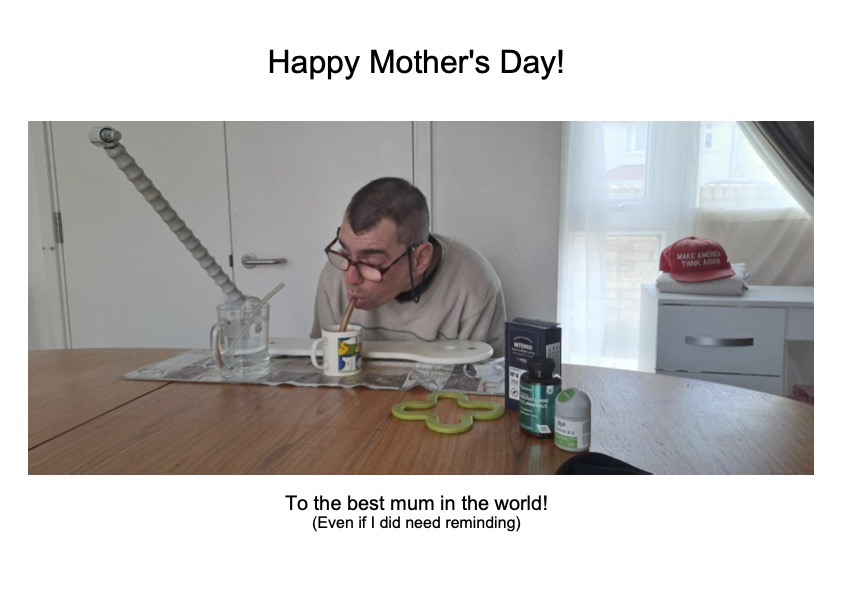
Happy Mother’s Day 2026
These Cowboy Hats Don’t Fit
Fascism is one of those things which is notoriously difficult for define. The term is bandied about all too easily, often used as an insult, to the extent that it loses any real meaning. I think, though, that in the broadest terms, fascism is a form of ultra right wing, discriminatory culture; a form of reactionary intolerance where you are right and everyone else is wrong, and one’s culture is inherently superior to all others. Under those terms, however, that is precisely the culture we now see emanating from the United States.
Since the second election of Donald Trump, America has become ever more brash and arrogant: its attack on Iran was unprovoked and criminal. To be honest such actions give American culture in its entirety a far darker, more reactionary feel. Americans now have the aspect of those who feel they have the right to do whatever they want, no matter what suffering it causes. Of course, I know not all Americans approve of what their government is doing, but you could have said the same about Germans under the Nazis. For me at least, American culture now has a vile, repugnant undercurrent to it.
That makes what I am experiencing today far more disquieting than it would have been not long ago. I am writing this sat in the corner of the O2. The Country To Country festival is on this weekend: country music is being played through the speaker system; thousands of people are walking around in cowboy hats and jeans. I frankly doubt many of them would ever have actually been to the Midwest, and I thus can’t help feeling a deep sense of charade to what I’m watching. More to the point, the fact remains that this event is essentially a celebration of a culture which is slipping further and further to the right. Like it or not, American culture is now a fascistic, intolerant one; a culture which is becoming increasingly violent and discriminatory; a country now lead by a vainglorious megalomaniac who thinks he can do anything he pleases. A culture underpinned not by freedom and liberty, but by guns, fury and gut-wrenching arrogance. To see that culture being celebrated here in London today, however lightheartedly, feels profoundly disconcerting. At any previous point in time I would not have had any issue, but here and now, with a needless catastrophe unfolding in the Middle East, I cannot divorce this event from the culture and nation it supposedly celebrates.
Busses, Children and Stairs
It’s fair to say that I have fairly little experience with children. I am obviously not a parent, and don’t see my young nephews or niece nearly as much as I would like. However, I have to say something happened earlier today that I found appalling. I was on a bus again, heading out to Dartford. A young woman got on pushing a pram and leading a young boy by his hand. She can’t have been more than 25, and the boy was about three. To my absolute horror though, she let the boy wander off while she spoke on her phone. My parents always kept a close eye on me and my brothers whenever we rode a bus, but this stupid young woman was just the opposite. I was appalled. But then she let the kid climb the stairs by himself.
Of course, as difficult as it was, I knew I better not say anything. But then the inevitable happened: there was a series of loud thuds as the little boy fell down the stairs. I’m not sure how , but luckily the kid was unhurt. Frankly I found it remarkable that it didn’t send the three of them straight to hospital. I couldn’t resist letting out a loud exclamation; it shocked me enough to instantly decide that it warranted blogging about. Again, I know I’m not a parent and have very little experience of looking after children; but, with so many more inexperienced parents around all of a sudden, I really wish such young parents knew how to look after their children a bit more.
Time To Go Beyond The City
Would stating that I would like to get out of London a bit more imply that I no longer like it or don’t appreciate living here? To be honest that’s a dilemma I’ve been caught in for a while. I’ve been living in London for sixteen years, and as incredible as I think the metropolis is, I’m sure there are other places to explore. I think I’ve written here before how I can go months without getting beyond the M25. As I began to reflect a couple of days ago, perhaps the fact I’ve now lived here for so long means it is also starting to seem dull: the well-maintained paths I trundle along so often in my chair, through the parks and by the river, have now lost their novelty.
The thing is, I don’t mean one of my trips with John or Dominik. As awesome as such escapades are, I now feel the need to get out of the city by myself. If I’ve been trundling around London for all these years, surely I can get myself beyond the city. After all, it isn’t that huge a metropolis really. The thing is, that might not be quite as simple as it might sound: I obviously need to use public transport, so given the tube system doesn’t extend beyond London buses would be my best option. That basically means that I would need to take a bus to somewhere near the perimeter of the city and get another bus from there, since London and the surrounding counties have two different public transportation systems.
That is essentially what I began to investigate today, catching a bus to Bexleyheath and then one to Dartford. It was just a preliminary journey, and I didn’t go any farther because I was already feeling the need to head home for lunch. Yet nonetheless I noticed that there were buses I could take from Dartford down into Kent on a future trip.
It’s very, very peculiar how London now almost feels like my entire world, to the extent that the idea of going outside of it feels pointless, or almost dangerous. That is, if I do somehow manage to get somewhere outside the M25, how can I be sure I’d be able to get myself home again? I know that isn’t the case, but my day to day life has been centred around the city for so long that I seem like have forgotten that there is anything outside of it. However, I now feel it’s time to put that right, and to start trying to go beyond the sprawling urban labyrinth. Frankly, as much as I love living in one of the greatest cities on earth, as someone born and brought up in Cheshire, I’m really starting to crave the fields. It isn’t that I am growing tired of London, just increasingly conscious that there is a world outside of it full of different places to explore.
Misplaced Monologues
As I think I’ve mentioned before, every morning as I drink my first coffee, I’ve fallen into the habit of watching clips of Stephen Colbert on The Daily Show from the night before. It seems like a good way of catching up with what’s going on from an American perspective. The thing is, watching it for the last few days has really started to jar. Colbert’s nightly monologues are full of the usual mixture of political satire and wit, but to be honest that now seems gravely misplaced. It’s as if Americans are behaving like everything is normal: that the problem lies with Donald Trump rather than with their country, and that once the current crisis is over everything will return to normal. Thus guys like Colbert make jokes at Trump’s expense, seemingly not realising that their country no longer occupies the position it did. Americans are no longer the good guys; they are no longer the arbiters of right and wrong – insofar as they ever were. They are no longer in a position to make fun of the nightmare which is currently unfolding, because they are the ones who caused it. Americans elected Trump as their president, so the whole country bears responsibility for the turmoil he has caused. I’m afraid that means they no longer have a right to joke about it, mock it or attempt to give some kind of third person commentary on it, as if they are distanced from it and will regain the world’s respect once this is all over.
An Incredible, Dull City
I seem to now be caught in quite a curious paradox with regard to the city around me. At one and the same time, London still seems to have an endless capacity to intrigue and inspire me: this afternoon, for instance, I decided to head up to Farringdon to explore a bit more of the area around the Barbican. There is an incredible raised path there called the Highwalk which you can walk along. I had never checked it out properly before, and thought it would be a cool destination for the afternoon. The whole area had a new, novel feel to it, and it was amazing to see the sheer amount of building work going on in that area.
At the same time, however, London is also starting to feel strangely tiresome. I have of course been to the Barbican before, quite a few times, to check out various shows and films. It is not that new to me. The paradox is, as inspiring as London still feels, it also seems mundane or even dull, for precisely the same reason. Take the Elizabeth Line as another example: nobody can possibly deny that it is an amazing feat of urban design and engineering; but by the same token it is quiet, clean and well maintained, lacking any kind of spark which might make it anything more than just an expensive tube line. What it has in efficiency it lacks in character, and thus could be any new tube line in any wealthy metropolis on Earth.
It is obvious that a huge amount of money is being spent on developing the city and building it up: as amazed as part of me is by that, it also feels like the city is just being transformed into a generic modern metropolis full of wealthy urban elites. Part of me is starting to crave getting out and exploring smaller, more authentic places. Thus, strangely, London feels both amazing and dull at exactly the same time.
A Waste Of Jet Fuel
How could anyone expect me not to gloat about this? Nigel Fartage flew all the way to Florida, only for Trump to refuse to meet him. “Nigel Farage failed to meet with Donald Trump despite flying all the way to Florida to dine at the US president’s Mar-a-Lago resort….But in a humiliating development, he flew around 4,500 miles – and never actually met Mr Trump during his visit.” For one, just how self-important can the wanker be? He’s only a back bencher of a not that popular party, yet he seems to want to be treated like a high ranking minister. He obviously isn’t that close to Trump as he thought, and it’s pleasing to see him being put in his place. Leaving aside my conviction that he should be rotting in jail anyway for knowingly misleading the country in 2016, I’m just glad to see Farage being taken down a peg or two.
London and the Lion’s Share
I was just watching Politics London on the Beeb. To be honest I’d just had a much needed shower, so my glasses were still off and it didn’t have my full attention, but nonetheless one thing stuck in my ear. One of the politicians on the programme was saying how London is effectively the financial powerhouse of the country, and as such should get more money devolved to it to use how the Mayor chooses. It could then use it to fund all sorts of new infrastructure projects. I must admit that struck me as fairly bizarre: the contribution the capital makes to the UK economy is obviously beyond parallel, not just through tourism but also the financial sector and all kinds of things. But to argue that London isn’t getting it’s fair dues really takes the biscuit: I only have to take a short trundle out of my flat to come across all kinds of lavish, expensive building projects. More to the point, just four years ago the Elisabeth Line opened, the biggest, most expensive infrastructure project in Europe.
Contrast that with the neglect I see being reported from places outside of the capital, especially in the North-West of the country, and it really seems like the guy was taking the piss. Now, I haven’t personally been there in some time, but the reports of degradation and neglect I see coming from places like Stoke on Trent really are becoming alarming. Empty shops are being left to rot; high streets are barren and deserted. There is no transport infrastructure to speak of. In reality, London is still getting the lion’s share of investment, and the notion of levelling up is looking more and more like a perverse joke. Thus for any politician to moan that London doesn’t get enough money really strikes me as a piss-take.
Martyn Ashton’s Bowhead Trike
I was just in a Zoom meeting with a few of my AAC-using friends, and a Youtube channel was mentioned which I now just have to flag up. Martyn Ashton is a wheelchair user who has converted a mountain bike into a hyper-powered off-road trike. I may not ordinarily be into such things, but what he has created beggars belief. Check it out here. Needless to say, I want one.
Still Fiddling
I suppose I can only repeat what I wrote a couple of weeks ago about the opening ceremony of the winter olympics this evening. If my attitude towards that was rather naive and romanticised, then it is even worse for the Paralympics. As pretty much the only mega-event foregrounding people with disabilities, of course it will always have my wholehearted support. But as they just said on the evening news, Russian athletes will be allowed to compete in these games; it’s also the first such event since the beginning of the situation in Iran. As much as I love such celebrations of global unity, I’m afraid this evening it feels more out of place than ever.
Meridian Memories
One of my earliest memories is being photographed standing astride the meridian line in Greenwich. I don’t remember much else about the day, but I think I was about seven or eight, and it was one of the weekends when I was down in London with my family visiting my grandparents. I recall we had had to make quite a journey across the metropolis from their house in Harlesden, and that Dad had got me out of my wheelchair and was holding me up while the photo was taken.
Greenwich Park and observatory would have seemed such a wondrous, distant place back then: the destination for a family day trip, before returning for dinner made by my Yaiya. I don’t remember much else about the day, other than that crossing the city took quite some time. The strange thing is, though, these days I go through Greenwich Park fairly often. I love the view from the hill there, and I often think of that childhood memory as I pass the Observatory, usually on my way down to Greenwich.
Of course I could never have known back then how the next thirty years would unfold, or that that place would one day become so familiar; but I suppose that is the uncanny nature of time. Once distant destinations are now just around the corner, the intriguing has become familiar, and a city which once seemed so vast is starting to feel small. Yet I remember that photo being taken, dad helping me stand with one foot either side of the meridian line, whenever I go through Greenwich Park. If this is a future I could once never have imagined, then such memories anchor me to the past in a way I find both pleasing and inspiring.
Real Voices through AI
Having used a communication aid for pretty much all my life, I’m fairly used to having a synthetic, robot-like voice. However, this report on the local news just caught my interest. A woman with Motor-Neurone Disease has had her old voice recreated from recordings. “Yvonne Johnson, 58, from north London was diagnosed with motor neurone disease (MND) almost six years ago. A bubbly, charismatic personality, she found losing her ability to speak the most difficult to process. But now Yvonne has regained the ability to communicate in her own voice through artificial intelligence (AI) technology.” I must admit it struck me as very cool, particularly amid all the other doom and gloom, although it did get me wondering: if her voice could be reconstructed like this, what might mine sound like? Could other AAC users soon be able to select which voice they want, perhaps choosing from an array of life-like voices? Might I even one day have the opportunity to sound like James Bond or Captain Picard?
Powerchairs and Youtubers
I don’t think I should go into too much detail for fear of sounding like I’m bragging or gloating, but I’m very pleased to say that I took receipt of my new powerchair this morning. My old one was fast wearing out and fast needed replacing. As I think I’ve said here before, while I might not need my powerchairs in the quite same way that my friends at school did – ie they aren’t absolutely essential for my day-to-day living – I would nonetheless be pretty screwed without one. They are more or less essential for my life here in London.
I think it was going to a special school which taught me every disabled person is different, and that we all have slightly different requirements. My classmates all needed their chairs for different things: about half of them used powerchairs, the other half manual. They often switched over the years as their conditions worsened. Either way, their chairs were part of who my friends were; it was just how they got around.
Coincidentally enough, a little earlier I came across a short Youtube video by a fairly young woman seeking to explain who should use powerchairs and who should use manual ones. To be honest as soon as I began to watch it, it struck me as a perverse, sickening insult, but I would just like to explain why. It was frankly obvious that the woman was one of the growing numbers of people who have only recently started identifying as disabled: it was clear she had never been to a special school, and had probably met very few other disabled people. However, she had somehow taken it upon herself to be the arbiter of who should use what type of chair, or to advise people on which chair they should be using like some sort of self-appointed expert. To be honest I found it sickeningly arrogant, as if she had hijacked part of my identity which she knew nothing about in order to attract Youtube views. She seemed to be treating wheelchairs as mere accessories which people can choose between, like they choose between shoes or bikes. Anyone with an actual disability will know what kind of chair they need and what they can best use. We don’t need some airheaded Youtuber giving us advise like some self-appointed expert, reducing something as essential as mobility to the level of any other bit of tech or fashion accessory.
Again, I know I shouldn’t get so wound up about things like this, but I hope it’s clear why it is so insulting. It’s as though these people are trying to make videos about things they know nothing about, arrogantly assuming they are experts, spouting all kinds of nonsense on the internet while drowning out those of us with actual experience of such things. It’s as if part of who I am is being hijacked, or people are thinking they can speak for guys like me, reducing my life experience to a mere internet gimmick, even though they know nothing of what our lives our like. It is really starting to make my blood boil.
Now if you’ll excuse me, I have a new powerchair to try out.
You Can Take My Horror As Read
I suppose as a blogger I’m now in a bit of a tight spot. I see it as part of my role to give some kind of commentary on what is going on in the world, particularly from the perspective of a disabled man. The thing is, we can all see what is going on; I’m sure everyone else will be just as appalled as I am. Thus, yesterday’s entry aside, I currently find myself torn between the urge to carry on my blogging as usual, writing about whatever takes my fancy on a given day, or to focus wholeheartedly on what is currently unfolding in the wider world. To be honest I see both as just as important. Thus, if over the next few days/entries you start to wonder why I’m not saying anything about what is unfolding in the Middle East, it isn’t because I don’t care. It isn’t that I’m not utterly horrified by what is going on or apoplectic that the USA could sink so low: I just suspect my focus might be better kept elsewhere. You can just take my horror as read.
Bullies Deserve To Be Treated As Such
When you look at it, it’s fairly unnerving just how much our culture – especially popular culture – is dominated by America: from fast food restraints on our high streets, to crappy sit coms on TV, to the websites we use daily on the web, American culture is everywhere. Of course, no cinephile can possibly ignore the fact that the vast majority of the films we go to watch are American. Here in the UK I suppose we tend to think of Americans as our jovial friends across the Atlantic, and there’s no denying that we now have a long history together. Yet there’s also no denying that, this week, America launched an entirely unprovoked attack on Iran. I’m obviously no fan of autocratic theocracies, but surely there is no justification for what the US is currently doing or for what is now happening in the Middle East.
The actions of America this week have made the situation there far worse. In attacking Iran out of the blue, America has set a very nasty, dangerous precedent. There is no denying that these are the actions of a bully, and frankly bullies deserve to be treated as such. To be honest over the last couple of days I’ve began to notice just how ubiquitous American culture is, and whereas that may previously have been met with jocular acceptance, it is now tinged with revulsion. Naturally I know that not all Americans will approve of what their government is doing, but I’m afraid what has unfolded this week has given the facets of their culture I encounter so regularly a jarring taint which I can no longer ignore. Due to their President, Americans no longer seem like amicable burger eaters, but arrogant loud mouths who think their opinions outweigh all others, and who think they have a right to do whatever they like simply because they are American. Their entire culture has now been tinged with an unnerving, unsettling darkness. Even Star Trek, a television program which I’ve always loved, now seems like a brash, arrogant vision of an Americanised future: a future not of a united humanity exploring space, but one where the yanks simply got to dominate and bully over everyone else.
I really, really hope this doesn’t last. Americans should be our friends, and their culture should be as welcome and as entertaining as any other.After all, where would we be without The Simpsons or the occasional Cheeseburger? Yet because of what Donald Trump embarked upon this week, the US no longer seems like the friendly, outward looking place it once did. A nation which recently seemed like a benign fraternal superpower welcome to sit at the world’s head, now looks more like an arrogant upstart too used to getting it’s own way and imposing it’s will, economy and culture onto everyone else’s. What the United States is now doing is totally unacceptable, and a dark blight on their nation’s history. I suppose we can only hope that they soon come to their senses; but I’m afraid for now their entire culture has been tinged with an unnerving darkness I cannot ignore. It has lost my respect, and I can’t see it being restored any time soon.
Sir David Attenborough’s 100th Birthday celebrations announced
Just when the world seems to have finally gone absolutely crazy, it appears I now have something incredible to look forward to in May. The BBC have announced how they plan to celebrate Sir David Attenborough’s 100th birthday in two month’s time, including a range of documentaries and a live concert at the Royal Albert Hall. I’m still a big Attenborough fan of course, so if you ask me, absolutely nobody deserves it more. When you look at it, Attenborough’s cultural footprint is incredible; he has done infinitely more than anyone to open our eyes to the beauty and sophistication of the natural world. If anyone deserves such a national celebration, it’s Sir David, and frankly I’m now really looking forward to it. It’ll be a great way to express our thanks to the greatest broadcaster who has ever lived.
Plan to Pedestrianise Oxford Street Gets Go-Ahead
The obvious big political news aside, I saw in the local London news this morning that the plan to pedestrianise Oxford Street have now got the green light. Of course I know this idea won’t be popular with everyone: London is still an extremely car-centric city, and I would hate to hear all the cab drivers who will now be endlessly moaning about it. As a powerchair user though, I must admit this seems fairly exciting. Thanks to the Elisabeth Line, I can now get up to the centre of town more easily than ever: Bond Street is less than twenty minutes from Woolwich, so it’s very likely that this new pedestrianised street will be a fascinating place for me to go check out. Who knows, it may turn out to be one of my regular destinations for my daily trundles. Frankly, it’s also good to see that the centre of political gravity is moving away from the motorist and onto the pedestrian in London. It has always been such a car-dominated city, so it’s fantastic to see that there will soon be a place in the centre of town where guys like me can head and wonder and while away an afternoon. I can now see Oxford Street becoming a thriving cultural hub. How it will turn out of course remains to be seen, but for now I think this is very welcome news.
HBD Luke 2026
I still don’t see my little brother Luke half as much as I’d like. I’d once again just like to wish him a very happy birthday. He’s a very busy, important guy these days, and probably won’t have too much time to read my ramblings. But I hope he knows that I often think of him, Yan and Elias, and really hope they’re getting along well. Have a great day bro.
Pondering Public Screens
I would just like to pose a question here today: one about something I’ve been wondering about for a while. I think I’ve said here before that I don’t get out of London much these days, and that my trundles are confined to the great metropolis. That is pretty much fine by me, although I would like to now get out of the capital a bit more. Wheeling around London, I notice how many screens I come across. Public screens seem to be everywhere, particularly in the centre of town but also notably in places like Woolwich. In General Gordon Square there, there is a large public screen where people can sit and watch television together. I think it was built for the 2012 Olympics, but these days it’s usually screening BBC news whenever I pass it. What I’m curious about now, however, is whether any similar screens have been built outside of London. Can you come across similar large public viewing spaces in places outside of the capital, or is this just a London thing? I’d be really interested to learn whether any other such community viewing areas have been created in cities like Liverpool, Birmingham or Manchester.
Involuntary Racism?
Needless to say that I didn’t watch last night’s BAFTA Awards ceremony, but I have of course got wind of the news about an actor with Tourette’s Syndrome using a nasty racist term. I can only point out that he couldn’t help it, any more than I can’t help dribbling. At the end of the day, his vocal tics are part of his disability. That fact should surely outweigh any offence caused. Indeed, I’ve met people who seem to find my dribbling just as offensive. Then again, this gives rise to the unseemly situation where one value must be weighed against the other.
SEND Is Becoming Political
I suppose the subject of my blog entry today is pretty obvious: the government’s overhaul of SEND provision as a result of the dramatic rise in the number of students with special needs. The thing is, I honestly have no idea what to make of this spike. As I touched upon here, I grew up in a class of young people with fairly severe physical disabilities: they all had conditions like Muscular Dystrophy and Spina Bifida, which have well established causes and effects. I must thus admit to being rather puzzled by this sudden dramatic rise in kids with special needs: many apparently have far more ambiguous conditions, such as anxiety.
I will obviously know about as much as any other layperson about what caused this increase, yet I must admit it seems very perplexing. It just suddenly feels as if a core aspect of my identity, which I have always had to overcome and which has always set me apart, is now being opened up and politicised. The status of having a disability, of whatever kind, is being claimed by people who never used to; it is being ascribed to kids for more and more tenuous or political reasons. More to the point, the education system is now having to deal with this rapid change. Children are increasingly being othered; their behaviour – which may well have previously been seen as normal – is now being perceived in the same manner as a physical disability. I worry it gives young people pseudo-medical labels which they might not ultimately need, but which they then unconsciously internalise and conform to in a way which may not necessarily be healthy. It sort of seems to me that having a disability of whatever kind has become almost fashionable, and having a kid with special educational needs possibly even more so. I suppose that if it means that young people get the support they need, then it’s fair enough: yet I can’t help feeling that a large aspect of my identity and life experience is being opened up, watered down, and rendered in terms of just another sociopolitical identity without people having any real understanding of what having a physical disability really means.
Torture In Camden
Ask anyone for a torture scene in a film, and many people would probably point to the scene in Casino Royale where Le Chiffre interrogates Bond by flicking him in the balls. Trust me, that’s nothing compared with what I had in endure this afternoon. I was having a lovely trundle along the Regents Canal. That’s still one of my favourite routes, but I hadn’t been that way in a while so I was feeling quite cheerful, when I came to the Camden Market. It was predictably quite busy there, being a Sunday afternoon; but you should have smelled all the food! I came across a stall selling American pancakes with real maple syrup, and I suddenly felt absolutely starving. I could tell they would be so warm and sweet and tasty The problem was, being out alone I had nobody around to feed me, and trying to eat such things myself would just result in a great big mess. That meant I had to beat down the temptation, but needless to say it needed all the determination I could muster. Trust me, Bond had it easy! Oh, the things I go through sometimes.
Another Massive New Skyscraper
One of the first things I came across on Youtube earlier was this video about JP Morgan’s massive new skyscraper, recently approved to be built at Canary Wharf. It’s apparently set to be one of the biggest buildings in Europe. Naturally this put me in mind for one of my usual trundles over to the Isle of Dogs. I go over there fairly often. To think that, forty years or so ago, all that was there was a bunch of crumbling, deserted docks always strikes me as incredible. The area feels more and more like Manhattan each time I go over there.
Today, though, a couple of questions occurred to me: If so much investment and regeneration can be ploughed into that curve in the Thames, could other areas of London be lined up for similar treatment? Obviously the area around Stratford had a similar overhaul, but I wonder where could be next? More to the point, I have to wonder, with so much investment now going into London, with all the shiny new buildings and huge transport projects being built, what about elsewhere in the country? New buildings are going up pretty much everywhere I look here in London; I still can’t help worrying that other parts of the country, particularly towns in the north, are being neglected and left behind.
 The Ill-Informed Ramblings of a Cripple