Free Dinners And Double Standards

I know I’m probably a great big hypocrite for accepting it, but at the end of the day a free meal is a free meal. I just got back from my daily trundle: today I thought I would check out how the Olympic park was coming along, before exploring a bit more of that area of East London. I was going along one of the fascinating, labrynthine streets of Tower Hamlets when I passed a man stood at a table wearing Islamic clothes. At first I assumed i would just cruise past him, but he asked me if I fancied something to eat. He was obviously participating in the kind of religious almsgiving event which I usually loathe. Yet it struck me as such a kind offer that I stopped and, out of curtesy, started to explain that I wouldn’t be able to feed it to myself.

He, however, wouldn’t take no for an answer and insisted that I accept the box of tasty-smelling food he was offering me, explaining that it could be easily reheated this evening when my Personal Assistant arrived. That, of course, eventually lead to me asking him to put the box in my bag. I know it was something to do with Islam, and that I staunchly oppose anything to do with religion and street preaching; but wouldn’t just flatly refusing his offer have just been rude? It was just a five minute interaction, and as I trundled on wondering what was actually in the box, I couldn’t help asking myself whether it would have had the same outcome had he been an Evangelical Christian.

London and Languages

I have something rather embarrassing to complain about here today. When I was in Paris, I was impressed to see that all the signs, notices and explanations in all the museums and photo galleries we went to were in at least three languages. This meant that, despite not knowing French, I had no problem understanding what was being displayed. It firmly contributed to the feeling that the front capital is a welcoming, open, international city.

With that in mind, I became curious about whether the same could be said of London. To find out, this morning I trundled down to the National Maritime Museum in Greenwich. It’s not that I hadn’t been there before, but I wanted to be certain about the writing. Unfortunately, I’m sad to say that I found the signage only in english, and was told by the lady I spoke to there that it was the same case in other museums across London.

I must admit that I find that very regrettable and problematic. If London wants to claim to be a world city, it can’t be so anglocentric. For a city which welcomes so many visitors from across the globe and whose economy is so reliant on tourism, it is surely baffling that we seem to expect everyone to be able to understand English. Of course, I can’t be completely sure whether it is the same case in places like The British Museum or Natural History Museum, but that just gives me an excuse to go and check. Even so, from what I saw today, compared with Paris, linguistically London is not up to standard.

What Do You See

Tell me, what do you see, young man? You probably see a guy in a wheelchair, drool cascading from his chin. You see someone who can’t control his body properly, whose arms and legs move in a funny way. A man who tries to speak, but when he does he just makes incomprehensible noises. A man who clearly gets angrier and angrier whenever you or your friends mock him, making the situation funnier and funnier. So you carry on winding him up, until it reaches the point that the man is almost in tears the situation is so unbearable for him; yet you know he can’t do anything to hurt you in response, so you carry on, seeking to amplify the perverse thrill and feeling of power it gives you.

You do not see a middle-aged man just trying to get on with his life. A man living alone in his South-London flat – something many once assumed to be impossible for him. A man who has blogged almost daily for over twenty years. A man with a Master’s in Film Studies. A Filmmaker. Someone still grieving the loss of his former partner. A man proud of what he has achieved. A ‘survivor’ of the special school system, who has, over the last twenty years, watched most of his classmates die one by one. A man desperate to stop your taunts, and would now do anything to live in peace; someone who finds your perverse game so hurtful that it drives him to absolute despair. But you obviously don’t see any of these things, because if you did, perhaps you wouldn’t take so much pleasure in mocking him.

Undeserved Attention

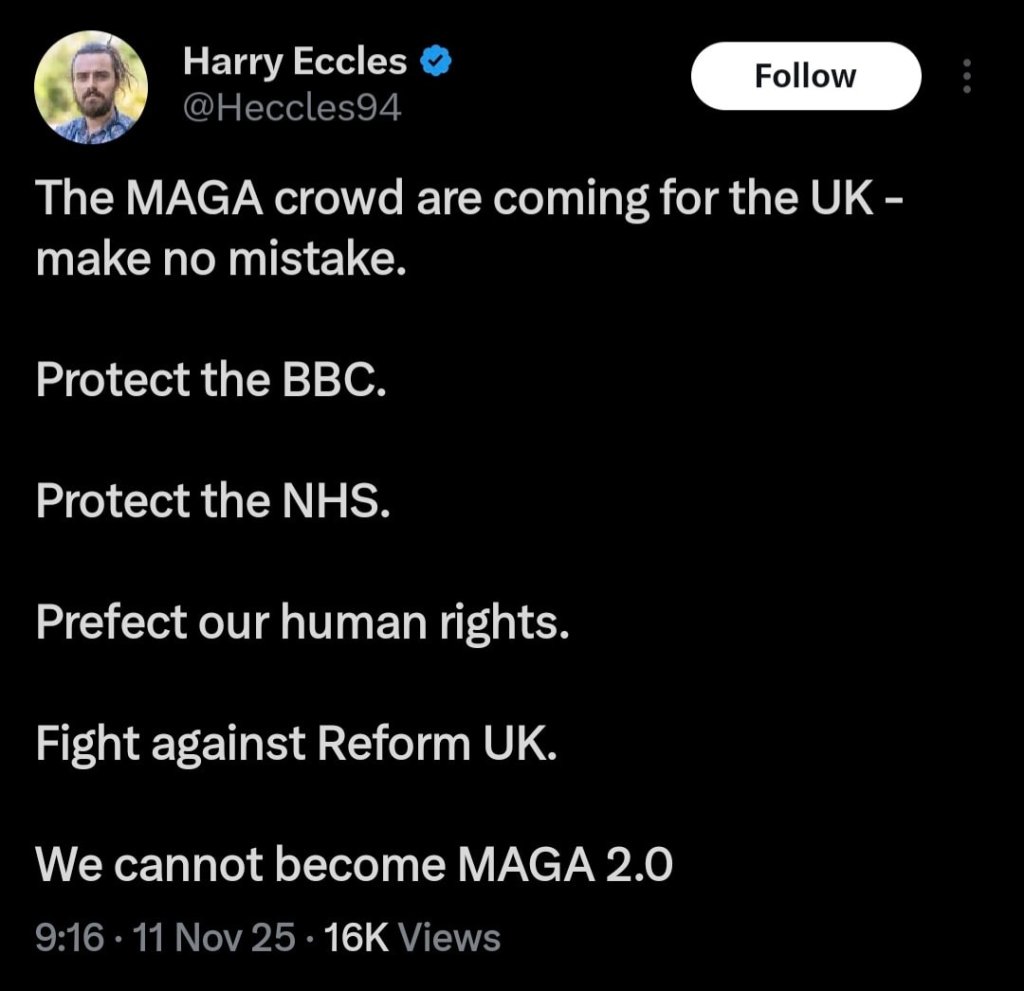
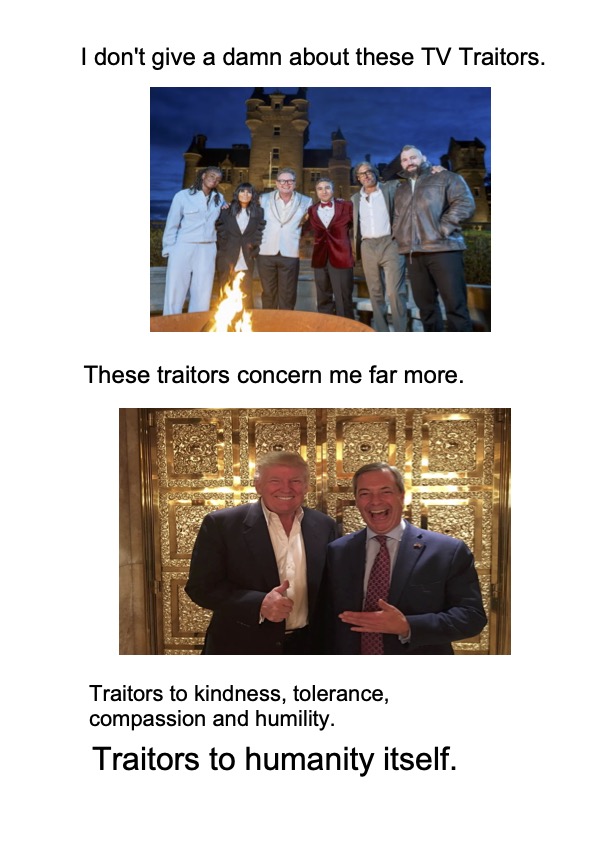
Freedom of Speech is a great cultural asset which of course ought to be defended: people should have the right to say whatever they want, no matter how much others may disagree. I usually hold that to be quite obvious. However, I think problems crop up when it comes to airtime on national Television. I was at my local building society earlier, where they had a TV playing the BBC News channel. Fortunately it was on mute, but I could see Nigel Farage yapping his puss-filled head off. I instantly felt appalled, as I always do whenever I see the face of that utter disgrace to human civilisation. Not only was I appalled by what I knew he would be saying, which from what I had read would be abhorrent enough; but also at the fact that the Beeb were giving the charlatan airtime he did not deserve. This is a man whose lies conned the country into voting to leave the EU, something manifestly against our best interests; he knowingly ferments division and hate, and stirs up xenophobia.

I firmly believe Farage should be rotting in a jail cell for what he has done; but there he was, yapping his head off on national TV as if it was his own Nuremberg Rally, or as if he was some kind of great statesman rather than the lying, hate-spewing scumbag he is. After all, had this arrogant bigot not been awarded so much attention a decade ago we would all still be enjoying our rights as European citizens, and everything he spewed during the 2016 Referendum was proven to be complete bullshit, so why do we still have to listen to him? Reform is still only a fringe, minority party which no sensible, educated, intelligent person pays attention to, yet the Beeb somehow sees it as a valid opposition. If we are ever to escape the quagmire of division and animosity society currently finds itself in, we need to stop giving such people airtime they do not deserve.

Can We Still Visit America?

The trouble with travel is that it’s addictive: as soon as you come back from anywhere in the world, life at home seems so dull that you start planning your next trip. The wider world seems so exciting and exotic that you start wondering where to go next. I say goodbye to John for a couple of months today, but we have already started to throw around ideas for our next adventure. I still want to explore Paris a bit more, but one city John mentioned was New York.

On the face of it, New York would be a great idea: it is one of the world’s greatest, most cinematic cities. Yet these days, the thought of going near the USA is tinged with trepidation. On social media especially, I’ve been hearing all kinds of frightening things about the military being deployed on the streets of Washington and other big cities and the rights of minorities being removed. The puzzling thing is, you hear distinctly less about such things on mainstream news platforms; so the question becomes what is the actual situation? Watch organisations like the Beeb and everything seems relatively fine; watch Youtubers like this one and America is now a despotic neofascist hellhole far too dangerous to go near. It’s becoming harder and harder to discern the actual situation there, as in these days of information overload it becomes harder and harder to know who to trust.

What, then, is the actual situation in America? Is it still a safe place to visit?

Bare Bums And Blue Powder

This is resoundingly not the entry I thought I would be writing this afternoon. I thought I’d be writing a short, jolly entry about London still clearly knowing how to party, and about never having seen so many bare women’s arse cheeks, having taken myself up to the Notting Hill Carnival. My parents had warned me against going, but as usual my curiosity had got the better of me. After all, having gone to last year’s carnival and the one before it, I was thirsty for more.

It had started well enough: a nice, easy journey up to Paddington followed by a short roll. When I found the carnival itself everything seemed fine, and I was once again fascinated by all the people in all kinds of weird costumes. After watching things for a while, though, I decided to follow the parade. That was a mistake: things become more and more crowded, and less and less pleasant. It became harder and harder to move my chair. It soon stopped being fun, and the music being played around me was far too loud.

When sticky, coloured powder started being thrown around, I decided I had had enough: I went into Red Alert, getting out of the situation as quickly as possible, battling my way through the thousands of people who had gathered by then. That certainly wasn’t the predicament I had expected to find myself in.

By the time I had got back to the station I had had chance to reflect a little. To be honest it was quite incredible to see such a large area of London, usually swarming with traffic, given over to such an enormous cultural event. On the other hand, given that the carnival was supposedly a celebration of Caribbean culture, I couldn’t help wondering how much of a role imperialism or cultural appropriation had had to play in its origins. After all, Notting Hill is a white, very affluent area of London.

Such questions, however, would need to wait, as at that moment I was far more concerned about whether I could get all the blue powder off my clothes. Having returned from Paris just two days ago, it has been quite a week; but I suppose today goes to show that I really need to listen to my parents more.

A Tube System For Manchester?

Going back to my odd interest in public transport and urban infrastructure, I just came across something I find really rather interesting. I’ve been living in London for fifteen years, but come from a town in Cheshire where the nearest large city was Manchester. I have always found the disparity between London and other UK cities rather unsettling, frankly: the capital seems to get all the money spent on it while other parts of the country get left behind. However, I just got wind of this intriguing bit of news: Manchester may finally be getting it’s own underground rail system. Of course Manchester already has it’s trams, but Mayor Andy Burnham is now talking about constructing a tube system.

I suppose what interests me most about this is the cultural side of things. London’s tube network is over 150 years old and is more or less part of the city’s very identity. The same could be said about Paris’s metro or New York’s subway. Both are integrally tied to the metropolis’s they serve – part of their very mise-en-scene. If you watch films about or set in any of these great world cities, sooner or later their underground rail systems appear. I thus wonder, in promising to give Manchester a tube system, might he be, albeit unconsciously, trying to put his city on a par with the likes of London or New York? If tube systems are synonymous with great, sprawling, global powerhouses, could Burnham be trying to garner the same acclaim for Manchester? Obviously, such a system will surely be a huge boost to the city and give rise to massive amounts of growth; yet I can’t help thinking there might be an element of metropolis-envy in this.

Humanity Reached The Moon, Not America

This is something I thought up a couple of days ago. My disdain for America and Americans now grows with almost every news bulletin, due to the conduct of their president. Frankly, as a people I now see them as a collection of arrogant, self-important arseholes all too eager to claim the credit for other people’s achievements.

Now it’s clear that their president is owned by Russia, I honestly think that it is time for the era of American cultural, political and economic preeminence to end. They are bullies whom the world needs to stand up to.

Of Departures and Returns

London. The place of departures and returns.
Of tubes and domes.
Of skyscrapers and two storey terraces.
And not much else.
Where adventures might begin and end,
But seldom happen.
I’m back in London. 
A place of warm beds and good breakfasts:
A place of the mundane and normal 
When you yearn for the exotic.
A place of safety when you somehow yearn for danger.

Line Fourteen Issues

So much for Line Fourteen of the Paris metro system being accessible. John and I are just:making our way home, but before catching our rather late Eurostar train back to London, we thought we would do one last bit of sightseeing in the centre of the city. We could then get the metro up to Gard du Nord, finally giving me a chance to try out the Parisian answer to the tube. I had heard that Line Fourteen was fully wheelchair friendly, and I was kind of curious.

My high hopes, however, were quickly dashed: Leaving aside the half an hour or so we spent trying to find the entrance with a lift, when we eventually get down into the station and found where we needed to head, we weren’t allowed past the barrier and were told that the line wasn’t accessible after all. I’m not sure whether it was some sort of misunderstanding, but we then had no option but to go back to the street and catch a bus. As peculiarly interested in such things as I am, I must admit it was a bit of a let down.

It has been quite a week. Paris is an incredible city: beautiful, stylish, captivating. Getting to explore the city under my own steam in my powerchair for the first time has been a real joy. To that end, the various problems we have come across aside, now that I know I can get around Paris in my powerchair relatively easily, my appetite has been whetted for future trips. Paris intrigues me, but my exploration of this City Of Light has only just begun.

The Beguiling City

I really, really wish I knew more French. I think I’ve written about this before: the fact that I don’t know any language other than english feels hugely embarrassing to me, like a mark of extreme ignorance. I suppose you could just pin it down to the fact that special schools have other priorities- why bother teaching kids a language they’re never going to actually use? Here in Paris though, as I roll around this magnificently beautiful city, I find myself wishing I could understand what the people around me are saying or what the street signs mean.

I realise that I might have seemed a bit negative in my last few entries: too eager to criticise, as though I didn’t really want to be here. Let me assure you, noting can be further from reality. While I may have seemed somewhat eager to point out the problems or drawbacks we have come across, this was simply a case of my instincts as a blogger coming to the fore. The fact is I like that Paris: it is an exceedingly beautiful city, far more aesthetically charming than London. It’s narrow, picturesque streets draw you in, so that, in spite of its woefully inaccessible metro system and thousands of cafes with steps into them, it’s impossible not to fall under its spell. 

The longer I am here, the more immersed I feel, the more intrigued I am by the city and it’s fascinating history. I  love the little book shops, the streets named after writers, the thousands upon thousands of sculptures and statues; I feel so beguiled that John and I are already starting to plan our next trip here. The very streets and buildings captivate me like nowhere else. That is why I feel so sad about my lack of French, as it will always be a barrier between myself and truly getting to know Paris.

It Seems I Can’t Escape This

I’m not sure but I think it just happened again: it’s happening more and more. John and I were in a park not far from our hotel, where he could use the small outside gym presumably built for the events of last year. While he was doing so, I decided to take a short trundle to have a look around. As I was going along a nearby road though, a guy on a bike started to take the piss. That is to say, he started to make the kind of repetitive,  non-verbal sounds which you sometimes hear people with severe learning difficulties making, before shouting something at me in French. I don’t know why people do this, whether they find it funny or what they are trying to imply, but I nonetheless find it deeply hurtful. It feels like they are saying that I have learning difficulties and they therefore have a right to mock me. As I say,  it is happening more and more, and it seems that even here in France I can’t escape it.

Museum Or Tube Station?

Is it just me, or does the main entrance hall of the Louvre museum feel uncannily like a tube station? When I first visited it seventeen years ago, I remember feeling utterly awestruck by the architecture of the place, with its great glass pyramid. Having visited it a second time this afternoon though, I must say that that very architecture left me distinctly unimpressed.  To be fair it was just a brief visit, as it had already been a busy day and we had left it slightly too late; but what I expected to dazzle me fell far short of the mark. Having now been using the London Underground so regularly for the last fifteen years, it genuinely reminded me of a tube station. The way you enter the museum by going down into a large chasm in the ground surrounded by doorways leading into various tunnels, honestly put me in mind of the tube stations I now use so regularly. That, together with the fact that the lifts were an absolute mess, I’m sorry to say left me feeling distinctly underwhelmed.

Not A Lift In Sight

London is obviously a long, long way from being beyond criticism when it comes to public transport and the accessibility of the tube system: although things have improved phenomenally in the last few decades or so, particularly with the advent of things like the Jubilee Line extension, DLR and the Elizabeth line, the city still has a very long way to go before all of its rail network is completely step free. Having been exploring Paris for the last few days though, I must admit that I am astonished at how inaccessible the metro system is: I still am yet to come across a station which isn’t just an opening in the pavement with stairs down into it and not a lift in sight! It really does strike me as woeful.

On the other hand it must be said that busses here are far better. Not only do they have automatic wheelchair ramps, as in London, but two wheelchair spaces. That means that there will be far fewer confrontations between wheelchair users and mums with prams, as there will be space for both. Clearly there is plenty both cities can learn from one another.

Fever All Through The Night

Human memory is such a strange thing: details of the past, long discarded or buried in time, can suddenly resurface and come flooding back at the slightest cue.

Something truly wonderful happened last night. Something incredible, and so significant to me that it is almost beyond words. John and I were heading back to our hotel after quite a long, interesting day visiting museums and photography galleries. I was quite tired, and frankly looking forward to bed. We were almost there, when suddenly I heard a few notes of a song coming out of a bar we were passing. It was a song I hadn’t heard in years, but which I instantly recognised.

“You give me fever!”

When I visited Paris with Charlottte in 2008,  an occasion now so long ago that it now seems a distant memory, we ended each day by visiting bars. Charlie, of course, is a great musician and singer. One night we were listening to some live music and, towards the end of the evening, C got up and asked if she could sing a song. The lady doing the music said it was okay, so my friend got up and took to the stage.

What happened then was incredible. Charlie sprang into a rendition of Fever like no other, the bass notes on the backing track seemingly synchronising with my heart beat. Thus when I head those very notes coming from that bar last night, my memory shot instantly back to charlottte standing on that stage, microphone in hand. It was an awesome, eerie coincidence, but one I found striking. For a moment these two trips were united by a few notes.

You give me fever!

How Is This a Good Idea?!

Having been exploring Paris for the last 48 hours and now having visited several shops for refreshments, I have just one nagging question: how the smeg is 9% or even 11% beer a good idea in any way shape or from? I’m just glad I stopped drinking, because just a mouthful of that would have knocked me out cold!

Back In The Beautiful City

This entry finds me and John in Paris, having got here last night on Eurostar. We are only here for a week, but it’s already turning into quite a phenomenal trip. For the first time, I am here in my powerchair, meaning I have chance to explore the city under my own steam. Before now, every time I have visited Paris I have been using my manual chair, so I haven’t been able to decide what direction to take. Having said that, today I’ve found myself making every effort to keep up with John for fear of loosing him and getting lost. Even so, it feels incredible to be back in this beautiful, fascinating city after so long, and I’m really looking forward to the adventures to come in the next few days.

Actress With Downs Selected For Strictly

I’m not about to start claiming to be a Strictly Come Dancing fan – in fact, I’ve never watched it – but I think this news is at least worth a raised eyebrow: “Model, actress and disability campaigner Ellie Goldstein has joined the line-up for this year’s Strictly Come Dancing, making her the first star with Down’s syndrome to take part in a regular series of the dance show.” I think this is obviously a step in the right direction in terms of disability representation – after all, you can’t get much more primetime than Strictly – although I can’t help wondering whether there is an element of pity porn to this.

Three Contemporaries

This is a question which I started to puzzle over while out on my trundle yesterday.

Three great, hyper-masculine writers of the twentieth century, all privileged, yet all, in his own way, highly traumatised by war. Just imagine what would have happened had they ever met one another!

I Can’t Just Ignore This

I stopped going to pubs a while ago of course, but one of the pubs I used to go to quite regularly was the Banker’s Draft in Eltham. It was a friendly Whetherspoon’s, and I came to know the staff and clientele there fairly well. Having stopped drinking though, I hadn’t been in there in ages. However, something happened this afternoon which I think I ought to record here: I was just going past the pub when two fairly young men standing outside of it holding pints thought it would be funny to try to take the piss by shouting ‘Timmah!’ I’d barely noticed them, but their insult made me immediately furious. I’m sorry, but I refuse to be the butt of some uneducated chav’s joke.

I stopped and told them to shut up, which they seemed to find funny. They started insulting me more, so I decided to go into the pub and ask the bar staff not to serve them. What else could I do? I absolutely refuse to just let such things slide. Ignoring it would simply allow it to continue; and I am too proud of what I have achieved to tolerate being the object of some imbecile’s ridicule.

Inside the pub, however, I was just told to calm down – it quickly became obvious that the staff had no intention of doing anything, and the two men would carry on being served. I left still feeling quite furious. Here’s the thing, though: if I had been a member of any other minority, say a black guy, and those two men had started spouting racial slurs, would it have been similarly tolerated? Would the black guy have just been told to ignore it? Would the two racist thugs have been allowed to continue to drink? Probably not, so why is it acceptable when they do it to me?

The problem is, this is happening more and more. A few days ago I wrote about schoolchildren thinking it was funny to take the piss, but I’m not just getting it from children. To be honest, I suspect it is a consequence of the rise of right-wing politics: as such reactionary stupidity has become more popular, people think they no longer have to abide by the social rules of tolerance and decency. Taking their cue from morons like Farage and Yaxley-Lennon, they think it a sign of masculinity and bravado to start hurling insults at those they assume can’t shout back. That is why it is essential that I don’t just let things like what happened this afternoon slide.

Another Example of Cultural Intrusion

Just to go back to what I was talking about a few days ago about this apparent new sort of disabled person, yesterday I came across this short film from Eliza Rain. I’ve been puzzling over Rain for a while now: a manual wheelchair user, she says she became disabled / started identifying as disabled in the last two or three years, but refuses to state what her disability is. However, she now seems to be quite a prolific Youtuber, uploading a video every couple of weeks. As she puts it, “I make content all about living in London with a disability including travel advice, tourist advice and just general disability good things along with a bit of fashion and fun sprinkled in there.”

In the video I’ve linked to, though, she is talking about prams taking up the wheelchair space on busses. Of course, that is a problem I encounter quite frequently. The trouble is, in this very short video, Rain goes way, way over the top, to the point where she becomes antagonistic and misleading. That is to say, her representation of mums with prams as bolshy bitches refusing to move goes way too far. They may often be reluctant and sigh loudly, and it may sometimes take the intervention of the driver, but in my experience they have always followed the rules and moved their pram to allow me onto the bus. I have never encountered the overt argumentative refusal Rain tries to depict.

It therefore seems to me that she is attempting to over-dramatise things to get attention. If she actually used busses as a wheelchair user, she would know that the vast, vast majority of times it isn’t a problem, leading me to strongly suspect that this is an experience she does not in fact have. Once again, someone is attempting to take ownership of the experiences of others for their own gain. No mums blatantly refuse to move their prams as depicted here; nor have they ever been so argumentative and insulting. Yet the way she presents it, it seems like Rain is the victim of overt intolerance and persecution.

Thus what troubles me about online content like this is, as someone with a congenital physical disability who had to go through things like special school, people who know nothing about experiences like mine are increasingly taking it upon themselves to speak for all disabled people. Miss Rain says she only became disabled a year or so ago, yet she brands herself as ‘Disabled Eliza’ and seeks to inform the entire online world about what it is like to have a disability. Forgive me, but I can’t help feeling offended, as if my sociopolitical voice and experiences are being increasingly hijacked or stolen by people who become disabled, or claim they do, then exploit their disabilities to become self-styled online influencers, despite knowing almost nothing of what me and my friends went and continue to go through.

Having spent over twenty years attempting to chronicle my experiences and thoughts for the online world, I bet anyone would be just as upset by this as I am. I am not trying to suggest Rain or anyone else is ‘faking’ their disability, but rather seising upon their impairment for cultural and political gain, and in so doing effectively usurping voices like my own. Yet I don’t want anybody to speak on my behalf: Surely it is up to guys like me to relate to the world what having a disability is like, including using the wheelchair space on busses; not someone for whom having a disability is seemingly just a means to attract hits on Youtube.

A EUO Day

I’m sure I don’t need to tell anyone how useful Ipads can be: Not only do I use mine as my communication aid, but also to browse the web, check my email and keep in touch with my PAs when I’m out and about. I also often use it to draft blog entries, ready to put online when I get home. The problem is, that all uses quite a bit of battery power, so it is fairly essential that my Ipad is put on charge every night. When it isn’t, it can be rather problematic.

Today, for instance, I was out on my usual trundle when I noticed my Ipad hadn’t been charged. I’d got as far as Lewisham when I noticed it was down to 52%. Now, that wasn’t catastrophic, and no reason to abandon my outing and return home, but I knew it would limit me. Today would have to be an Essential Utterances Only (EUO) day: in order to preserve my Ipad battery, I would need to talk to people only when I really had to. There would be no chatting to strangers or telling street preachers to shut up. Otherwise, if I got into an emergency and needed to ask for help or give people instructions but my battery had died, I would be totally stuck.

It’s rather strange when you think about it: this situation effectively rendered me dumb or voiceless. I had to go all day trying to avoid talking to people, just because my Ipad hadn’t been charged. In a way it put a barrier up between me and the rest of society. If I met someone new I would be unable to introduce myself and tell them who I am or what I do. If I bumped into someone I knew I wouldn’t be able to update them with my news. In the end it wasn’t that much of a problem; yet I find it odd to reflect upon how such seemingly insignificant things can have such large social and psychological consequences.

Another Way To Camden

I have just made a discovery which I am rather happy about. I’ve described here before how fond I am of trundling along the Regents Canal. One of the areas the canal passes through, Camden, looked essentially interesting. The thing was, I never had a chance to explore it properly as, by the time I got there, I would already have been wheeling, along the canal for a couple of hours and would need to press on to get home a sensible time.

A couple of days ago though, I noticed that Camden Town had a stop on the Northern Line, and was struck by the idea that if I just got the tube there, exploring the area would become much more straightforward. This morning, then, I headed to North Greenwich tube station, intending to get the jubilee line to London Bridge and then the northern line up to Camden. The problem was, the staff at Greenwich told me that Camden Town station was not wheelchair accessible.

However, the lady helping me then started to look for an alternative route I could use, and soon found that a could take the Mildmay overground line from Stratford to Camden Road. While ramps would need to be arraigned, it would be just as straightforward as my original route. This seemed quite an innovative idea to me though, as the overground is still something I have to get the knack of.

As it turned out, it was a complete non-issue, and I was in Camden within an hour ready to explore. It’s one of those thriving, fascinating areas of the metropolis, the air full of music and delicious smells. Some of the architecture by the canal is intriguing. As soon as I got there I was enthralled; and now I know how easy it is to go back there I certainly intend to.

London, it seems to me, is constantly opening up and becoming more accessible. I’ve been living here for fifteen years, but even during that time things have improved considerably. Using the overground was once totally off limits to wheelchair users; but although I’d still personally prefer it – and indeed the entire tube network – to be completely step free, experiences like today’s demonstrate how far it has gone in the right direction. Thanks to the overground, as well as the Elisabeth Line, which I used to get home, Central London is more accessible than it ever has been. It almost feels like the city is shrinking: what once felt like a vast, unwelcoming urban sprawl now feels more and more like home.

Not Just Americans Use The Web, Yanks!

Does anyone else get the impression that Americans think they created the internet, that it is American and that only they use it? I keep coming across content on the web made by Americans which uses phrases like ‘the country’, ‘the government’ and ‘us’ which seems to assume that it will be consumed by other Americans. Before now, of course, I’ve just let it slide; but for the last few months it has really began to get on my nerves. It seems extraordinarily arrogant for them to just assume that the internet is American, or an American invention. After all, the web was created by Sir Tim Berners-Lee, a Brit. It had very little to do with America, and far, far more people across the world use the web than just Americans, so why do they speak as though they are only talking to other Americans? I suppose it goes back to what I was saying here a few weeks ago about Star Trek and American exceptionalism: now that the USA is no longer the mighty democratic utopia it always took itself to be, for Americans to stick so stubbornly to the attitude that their country is greater and more important than all others, looks increasingly arrogant and out of place.

Let’s Hope

As things stand, the USA is descending into fascism. That isn’t hyperbole – Donald Trump seems intent on clinging to power at all costs. Given the damage he is causing, that would be catastrophic, not just for America but the wider world too. If you still need evidence of that damage, just check out one of the growing number of videos like this one; Trump’s idiotic tariffs are ransacking the American economy. We can only hope Americans wake up and do the right thing before it’s too late.

Fantasising About Filmmaking

You know, the problem with filmmaking is the filming. Writing is a comparatively straightforward task: in my case at least, I can just bash out a few words, post it online, and anyone can read what I have to say. Its probably why I have kept my blog going for so long. Making a film, on the other hand, is far more complex: cameras need to be set up and actors organised; even the act of using a film camera requires a dexterity which I physically do not have. This is probably why, despite calling myself a filmmaker, I have made so few films.

The thing is, this is now becoming increasingly frustrating. Film, especially short online film, is becoming ever more popular. As a means of communication, films on the web have become almost a default. As I began to explore a few months ago in this entry, where fifteen years ago blogs and blogging were at the cutting edge, these days so-called influencers just talk into their camera phones and upload their ramblings to YouTube. Whatever they say is delivered far more directly than any piece of writing.

The thing is, where does that leave guys like me? I long to make films, but making films is not just a matter of sitting down and bashing a few words out. Yet I know film can be used to say things often far more effectively and convincingly than writing. This afternoon, for example, I had an idea for a piece which, presented through film, would probably be quite compelling and revelatory; but if confined to writing might well just come across as gossip, mud-slinging or worse. What, then, should I do with this idea? I could obviously write it out as a script in the hope that It could one day be made into a film; but as always happens, that would ultimately mean it gets saved on my computer and read by no one.

I thus find myself longing for some way to make film: some means of manipulating pictures, shots and sound into a coherent argument or narrative using only my computer. I fear animation would be too cumbersome and appear too frivolous for what I want to make. Yet these days there must surely be some solution to this problem; otherwise, as online communication moves more and more in the direction of the moving image, those of us who still need to use the written word risk being left behind.

Patrick Willems on Why Craig’s Bond Was So Weird

If anyone is up for a bit of a long watch, but is also in the mood for some 007-related film analysis, you really should check this out. It’s the best bit of online analysis I’ve come across in quite some time, exploring Daniel Craig’s five Bond films, where they succeed, where they fail, and how they relate to the wider series. Broadly, the argument is, after the great success of Casino Royale in 2006, the problem was moving on from there and developing this exciting, newly-rebooted, deeper character. As usual I’m not going to try to give any kind of summary but let the guy talk for himself, as he clearly knows what he’s talking about; although there are a couple of weird bits involving a puppet which you might want to skip.

Cultural Intruder Alert

When I got up and turned the news on earlier, I came across something which I found fairly problematic. At about quarter to eight, BBC Breakfast ran an interview with a man called Dave Steele, the self-named ‘Blind Poet’. Steele had apparently become blind (or, more accurately, partially sighted) ten or eleven years ago, and was now writing poetry and publishing books about his experiences. What irked me about this wasn’t so much the fact that he was articulating his experiences, which of course he had a right to do, but that he now seemed to be presuming to speak for all disabled people. That is to say, since he began to loose his sight, he had taken it upon himself to become some sort of disabled people’s champion, as if it was now up to him to inform the rest of the world what it is like to have a disability.

I know I shouldn’t get so worked up about this, but I am coming across it more and more these days: otherwise fairly socially privileged people who happen to get a relatively minor disability, but then framing being disabled as a core aspect of their identity and presuming they are a leader of the disabled community. From his description, it sounded like Steele’s eyesight was only marginally worse than mine; but whereas I just put my glasses on and get on with life, he opted to churn out books of poetry about it and appear on breakfast TV as some kind of disabled people’s champion. More to the point, as a (presumably) straight, white, otherwise able bodied man who only started to become disabled a decade or so ago, Steele will frankly know very little of what life is like for someone with a significant congenital disability, from being bussed away to special school, to being constantly spoken to like you’re a five year old, to being mocked and laughed at on an almost daily basis by schoolchildren.

Thus for people like him to adopt such sociocultural positions, even taking their disability as their pen name along with the prefix ‘the’, as though they are the only one, feels like an imposition or encroachment of the worst kind. I don’t want to sound melodramatic or over the top, but it is like a white person finding out they have black great-great-grandparents, and assuming that they can speak on behalf of all Afro-Caribbean people and claiming to have endured racial discrimination all their life. As I say, this cultural intrusion is something I’m coming across more and more these days, not just with respect to disability: the voices of the most marginalised people in society are increasingly being usurped and stolen by people who know nothing of their experience. Being straight, white and able-bodied is now no longer politically cool, so people will do anything to emphasise things that render them members of marginalised groups. The problem is, in doing so they usurp the voices and steel the often brutal experiences of the actual members of such groups.

Time To Get Into Peaky Blinders

Following the news that Stephen Knight has now been selected to write the next Bond film, my project for the next few days is to catch up with Peaky Blinders. I know it’s now quite a well established BBC franchise, but until now I’ve never got into it. I know absolutely nothing about it, other than that it involves guys wearing flat caps. However, having just watched this clip of some nuns being told what for, I suddenly suspect it is something I could really get into. Who knows – it might even be that new obsession I’ve spent so long looking for.

As for James Bond itself, as I’ve said before, after Daniel Craig, the expectation and eagerness for the next film will be greater than ever. Craig’s Bond films were such a critical success that they left a vacuum which will only get deeper the longer we have to wait. Whoever is selected to write it, direct it or act in it, I really don’t envy them their task.

Watching The Meaning Of Live – Cheers Uncle!

Just to follow up on this entry from a few weeks ago, last night I watched The Meaning of Live for a second time. I’m pleased to say that my wonderful uncle Aki managed to find me a copy, and gave it to me at a family meet-up a couple of weeks ago. Of course I watched it as soon as I got back here, but the truth is I wasn’t feeling that great, so it didn’t really get my full attention or enthusiasm. Yesterday evening’s rewatch, however, did the trick: I was able to grasp the full background of the 2014 Monty Python reunion, why it was culturally so important, and how it came about. Monty Python Live was essentially a review show, so it was devoted to re-performing the old classic sketches, intercut with dance sequences etc. While it is true that it came about in order to get those guys out of financial bother, it was also about nostalgia and celebrating arguably the greatest television comedy show ever. This documentary very much established that cultural context. More to the point, it reminded me how ridiculously lucky I am to have been there watching it! It was like The Beatles, Rolling Stones or Queen getting back together to perform, virtually on my doorstep, and documentaries like this really reinforce that absolutely incredible context. I know I’ve said this here before – repeatedly – but to get to see the greatest, most influential comedy group ever reunite and perform after over thirty years, really is mind-blowing.

Foray Into Flowcharts

By and large I think it’s fair to say that I like prose and that I’m a fairly prose kind of guy. That is to say, whenever I have an idea, I write about it in nice, formal, clear-cut sentences, more often than not posting it on here. Once or twice recently however, I’ve found myself craving for the ability to create flowcharts, ie putting single words or phrases onto a page and drawing lines between them, connecting the ideas. When I was studying psychology over twenty years ago, I remember our tutor Pat using them on the whiteboard: it seemed to allow him to link concepts far more freely, quickly and easily.

I can’t write with a pen, so I never took to them. Obviously, to make a flowchart you need to be physically able to jot down words onto a sheet of paper and draw lines between them. That isn’t easy for me, which is probably why I usually prefer to write things out in prose. Recently however, usually when I’ve been out in my powerchair, I’ve had interesting ideas which I wanted to note down as flowcharts or notes rather than pieces of writing. They were connections between concepts rather than fully formed, articulable pieces of information. Of course, they could then be developed into something I could write about, but first I wanted to jot down the interesting connections between the ideas. This afternoon, for instance, I started to play with the connections between cinemas as physical spaces and ideas concerning ‘the urban’, and the metropolis. That way I could unify my interest in cinephilia, my fascination with metropolitan life, as well as my work with the local Free Film Festival. It’s only a rough idea at the moment, but I certainly think it’s worth exploring more.

I’m very pleased to report quite a bit of success. When I got back here, I had a quick Google for a piece of software I could use to make flowcharts, and found Flowchart Designer. It’s fairly simple, but it was free and easy to start using – certainly far easier and less fiddly than trying to make them long-hand using a bog-standard word processor or drawing program. I have already made the flowchart I had been thinking about, and I suspect it could be the start of an interesting new project. Now that I have found a way to make flowcharts, I also suspect my ideas will flow far more fluidly.

The Taunting Kids Must Stop

Something surely needs to be done about this. I’m getting trouble from kids more and more these days, and I’ve had enough. It’s now happening at least every two or three days: I’m trundling peacefully along in my chair when, completely out of the blue, a teenager makes an abusive or insulting remark. I know I’ve moaned about this on here before, but I honestly think it’s getting worse. The vile little shits are getting more arrogant and cocky, acting as though they are twice their actual age and have some inherent right to belittle people like me. Well, I’ve had enough! Nobody else would be expected to put up with this, so why should I just accept being the butt of a child’s insults? While I’m not yet sure what I can actually do, as trying to shout back just encourages them, it seems to me that, if I have any real respect for myself, not to mention my disabled friends, I cannot let this continue.

Is This Just Happening In London?

I was once again out on my daily trundle earlier, today just along the Thames east of Woolwich. As often happens these days, I was amazed to see the amount of redevelopment going on in that area: I head that way fairly often, but even so I was astonished to see the number of swanky new blocks of flats which seem to have shot up between Woolwich and Abbey Wood. Obviously it’s happening in that area because of the new Elisabeth Line stations, but such overt, hyper-gentrification is happening all over London. However, the obvious resulting question which struck me is: are we seeing the same thing happening outside of London? Is the whole UK being similarly gentrified, or just the capital? I don’t get out of the metropolis that much, so I’m genuinely curious. Please fill me in if you can.

Coming Home To A Much Darker World

Something is very, very wrong at the moment.

I just got back from central London. I thought I would go up to watch the Lioness’ victory parade: well, you know how captivated I am by such big cultural occasions, and it wasn’t as though I had anything better to do. To be honest, though, I didn’t find it that inspiring, and I was struggling to decide what, if anything, to say about it on here. I lined the Mall with thousands of other people, just to get a brief glimpse of an open top bus going past. That’s about it, really. I couldn’t actually see much because there were so many other people standing in front of me.

Mind you, after the parade itself I treated myself to a lovely trundle through St. James’ Park and eventually to Bond Street Station, during which I once again reflected to myself how lucky I was to live in such an awesome city, where such marvellous events take place, and which has such a wonderful, ever-improving public transport system. Where else could someone like me live a life like mine? By then though I was getting rather hungry, so I headed home on the Elisabeth Line for some lunch.

Once in, I put the news on while I ate, as I often do. I was greeted with images which instantly chilled my blood: pictures of children in Gaza, starving to death; vast scenes of deprivation and destruction. The contrast with what I had just experienced could not have been more horrific. Here I am, in this cosmopolitan world city, arsing around going to all these parades and cultural events; at a time when elsewhere in the world we are watching a conflict unfold, the horror of which we haven’t seen in decades. I know I touched on this a couple of entries ago, but I honestly find this disturbing. We seem to be acting like nothing’s going on, or collectively ignoring the unignorable. I was happily eating my lunch while, on the screen in front of me, emaciated babies were crying out for food. I had just ridden a brand new subterranean railway which cost billions of pounds while elsewhere in the world entire cities are being laid to waste. Children are starving, people are suffering, war crimes of the worst kind are being committed; yet still we parade our footballers around in busses and cheer their victories as if sport is more important, or as if the wider, darker world can be put to one side while we sing songs and drink champagne. Something here is very wrong indeed.

Well Done England!

Given what I wrote a couple of weeks ago, I realise it would be awfully hypocritical for me to suddenly start claiming to be a huge women’s football fan, but probably like most of the nation I was glued to my TV last night, biting my nails as the match dragged on and went to penalties. Of course, huge congratulations must go to the women’s England football team: they have achieved what our men’s team has failed to (twice). I certainly think this will mean women’s football will continue to rise in status. The thing is, I just hope that it doesn’t start to mimic the male version of the game and become self-important and awash with obscene amounts of money.

Of Football and Famine

I’m pretty certain that I won’t be the only person to notice this haunting contrast or juxtaposition, but I think I need to flag up something I realised while I was watching this morning’s news. The difference between the two top stories could barely be more stark or unnerving. On the one hand, we have the news of this afternoon’s football match between England and Spain: it’s set to be a great game, and a roaring celebration of women’s football and it’s rise in stature. On the other hand, we have the appalling news of what is currently happening in Gaza, where thousands of people are deliberately being allowed to starve. We surely haven’t seen anything so horrific in decades. Indeed, as a whole, I doubt the world has been this divided or adversarial since the 1940s; peace hangs on a thread. Thus, at a time when tragedy and conflict grow ever more imminent, we continue to play international sport as though everything is still safe and normal. Frankly, that contrast is beginning to feel rather galling.

Batter Goes On Fish

I don’t usually have anything against political correctness. In fact, most of the time I think I’m quite a strong advocate for it: I think, for example, that we should all use language which is inoffensive and accommodating to all people, regardless of gender, ethnicity or whatever. As a cricket fan, however, I have to say that the recent switch from referring to the person currently batting as ‘the batsman’ to ‘the batter’ kind of irritates me. Obviously the change was made in order to reflect the fact that cricket can be played by women as well as men; and I would have nothing against it, were it not for the fact that, as a word, ‘batter’ is something I think goes on fish. Whenever I hear it used on the sports bulletins, I automatically think of fish and chips – it sounds so odd and unnatural. I’m sure I’m not alone in thinking this. I suppose it’s just something I’ll have to get used to, but I suspect the fish association will stick for quite some time.

Can The US Stoop Any Lower?

When I caught sight of this tweet earlier, I honestly assumed it was some kind of spoof. Even Trump couldn’t be this shallow. Not even he would attempt to hit back at a satirical cartoon mocking him by bragging about the size of his cock.

However, I just got in from my daily trundle, and among other things came across this summary by the Beeb. It’s all true: Trump was apparently so upset by a recent South Park episode poking fun at him that it’s creators have now issued a mock apology. I haven’t watched the episode in question yet so I can’t comment on it, but I find it utterly bewildering how shallow and juvenile American political discourse is becoming. While part of me is laughing, when you remember that we’re now watching the president of the world’s most powerful nation attempting to lash out at his critics by bragging about the size and shape of his cock, another part of me is genuinely worried.

Let’s (Not) Ride A Trike

I rode a tricycle today: a big three wheeled bike like the ones the physios used to make me ride at school. Well…perhaps not. I was up at the Olympic park as I frequently am, when, outside the famous velodrome, I saw a man showing a variety of three wheeled bikes to the general public. Naturally I thought back to school, and how, when I was about seven or eight, I used to get strapped onto very similar contraptions and told to ride around until,  almost inevitably, I tipped the zarking thing over.

Slightly to my surprise, the man came up to me and asked whether I wanted a go; in fact he seemed rather insistent. It wasn’t that it didn’t look like fun, but I immediately judged that it would mean getting out of my powerchair, putting my things in a safe place, before having to put in quite a lot of effort not to fall off the thing and crack my head open, only for a ride lasting twenty minutes or so at most. Thus, then and there, as enthusiastic and eager as the guy seemed that I should give his trikes a try, I decided it would definitely be a case of “Let’s not and say I did.”

Going Off Star Trek

I am, of course, a huge Star Trek fan. I’ve loved Star Trek since my family and I used to watch it every Wednesday evening when I was growing up. I especially liked it’s reassuring, optimistic vision of the future, in which humanity has overcome our petty differences and come together to explore space as one united civilisation. Recently, though – ie in the last few months – something about that vision hasn’t been sitting so well with me: perhaps I’m just getting old and cynical, but what once looked like a united, cooperative humanity, to be honest now just feels like America and American culture writ large. By that I mean, where Star Trek claims to present us with a united Earth culture, if you actually look at it, it’s pretty obvious that the characters and cultural structures we’re presented with are fundamentally American. It is an American film and television franchise after all. The future Star Trek presents us with is one where American culture and the American mindset has somehow risen to dominate the entire globe.

Until now, that has sat comfortably with me, or at least I’ve let it slide. Recently, however, the vision of such an Americanised future has felt more and more insulting. Since their second election of Trump especially, the inherent arrogance of it has become more and more apparent: what gives Americans the right to assume they will dominate humanity’s future? Why will First Contact take place in North America, and why is Starfleet Headquarters in San Francisco? Why are these starships crewed mostly by Americans? Indeed, how conceited do Americans have to be to presume that the supposed warp barrier will be broken by a lone maverick from Montana, particularly given that many Americans currently seem convinced that the world is flat and/or was summoned into existence by an imaginary creator being?

Obviously, Gene Roddenberry intended his future to be global and united, famously putting a Russian at the helm of the first Starship Enterprise at the height of the Cold War. Yet these days such things feel more and more like shallow, hollow gestures, varnishing over an America-centric future where their culture is the only one that matters. And at a time where distain for America is growing and it no longer has any claim to the respect it once had, frankly what once felt so optimistic now feels like gut-wrenching arrogance.