Jackass: I’d rather have a labotomy

I am, more or less, a cinephile: I think film is a phenomenally powerful artform which can be used to say things about the human condition that no other can. It has tremendous beauty and resonance. How should I feel, then, when this supreme mode of expression is dragged into the gutter and reduced to something unspeakably childish and infantile? I just came across Mark Kermode’s review of the latest Jackass film, and quite frankly I’m appalled that such films are still being made, let alone watched and enjoyed. Call me a prude, highbrow or whatever all you like, but I don’t see how anyone can find amusement or joy in watching someone get hurt or hurt one another. The entire premise of the film and it’s predecessors seems to be someone exclaiming “Look at me! I’m going to do something idiotic!” like a badly behaved child in a playground. They then somehow expect plaudits for it, when they should just be stripped of their filming equipment and told to get jobs. To see film as a medium intentionally being reduced to something so degenerate is frankly insulting; although I suppose you could argue that it’s just symptomatic of contemporary America.

And before anyone moans at me for blogging about a film without having actually watched it, frankly, I’d rather have a labotomy.

Matthew Elliott Deserves No Respect

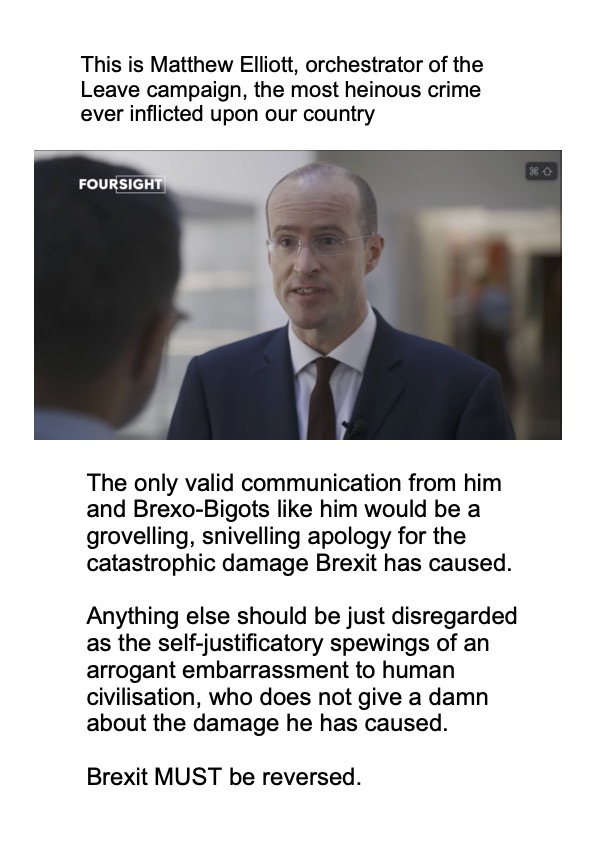
Shortly after posting yesterday’s entry, I came across this extremely interesting Channel Four video assessing whether Brexit has been a success or a failure. Somewhat predictably of course, it doesn’t really come down on one side or the other, although the evidence of the economic and political damage which it puts on display is so colossal that you would have to be a simpering idiot not to conclude that Brexit is one of the most idiotic mistakes any country has ever made. Towards the end of the film, though, there is an interview with Matthew Elliot: I’d never heard of him, but he was apparently one of the chief architects of the Leave campaign – presumably anyone more well known on the Outist side is too cowardly and tired of being shown to be a lying scumbag to appear on such programmes. However, Elliot came across as so arrogant and slimy, refusing to accept any form of responsibility for the damage Brexit has so clearly dome to the country, that I instantly felt compelled to make this.

I’m not being hyperbolic when I say such people are criminals. Thanks to their lies, our ties to our European neighbours were severed; our links to an international community were cut and we became nothing but a pack of inward-looking xenophobes in an unregulated, ultra-capitalist dystopia where the privileged few are free to bully and persecute anyone they like. And all p’tahks like Elliott can do is insult us even more, and claim to have been right all along. I know I shouldn’t get so wound up, but such shortsighted disgraces to humankind really do make my blood boil with rage.

Ten Years On From A Sickening Crime

I hardly need to point out that today marks ten years since I wrote this entry: ten years since I woke up to the worst (political) news of my life; ten years since the country took a sharp turn towards somewhere very, very dark. Ten years on since fifty-two percent of the voting population were fooled into stripping us all of our right to work, live and politically participate across an entire continent through a campaign of lies. Needless to say, I’m still bloody angry about it. I don’t want to go on about it, other than to point out that the mainstream media doesn’t seem to be making that much of the occasion. I think that’s rather telling: if Brexit had been an enormous success, surely they would be making a huge song and dance about it. Instead, as the consequences of the crime of 2016 get clearer and clearer, there seems to be a tendency to shove it into the sidelines and play it down, like the huge national embarrassment it still is. There wasn’t a word about it on this morning’s news bulletins; although, if anything, much more should be being made to rejoin the international body we were so idiotic to leave.

Farewell Sir Kier

I actually have to feel quite sorry for Kier Starmer. He is, fundamentally, a good man: unlike most politicians, he was actually interested in improving people’s lives, as opposed to just being motivated by self promotion or preserving an unfair, unjust socioeconomic status quo. The problem is, the political atmosphere he was elected into not that long ago is becoming more disturbing by the day: people are steadily losing their minds and becoming more reactionary and draconian; mislead by charlatans like Farage and Trump, people are turning their backs on the voices of reason and logic and are being given permission to listen to hate-ridden instincts and uneducated gut reactions we should have outgrown long ago. Guys like Starmer don’t have the communication skills to counter this narrative, and, depicted as dull career politicians and “liberal elites”, inevitably get cast aside. Thus I fear what we saw happen this morning is just a sign of these worrying, dark times.

One Bus Wheelchair Space Is Not Enough

Wheelchair use is obviously rising rapidly: these days I see more and more people going around in wheelchairs and powerchairs. I have no idea why this might be, but the problem is when it comes to busses. Buggies aside, there was a time not long ago when I could pretty much assume that I could get on to any bus I wanted. My fellow wheelchair users were so rare that finding a bus wheelchair space already occupied was quite unusual. These days, however, it’s happening more and more often, and I have been left waiting at a bus stop more than once recently. Just having one wheelchair space on a bus is obviously no longer sufficient, making me wonder how long it will be before buses need to be redesigned.

Tubes, Ramps and Glasses

I suppose it’s another of those half full or half empty glass conundrums, but I’ve recently been trying to make up my mind where to stand, at least metaphorically, on ramp request tube stations, ie stations on the London Underground network which aren’t step free but have a lift, so wheelchair users can use them but only if they request help with a ramp. A couple of days ago I came across this quite excellent video illustrating how much longer it still takes going from A to B across London if you use a chair, and a large part of that is having to rely on ramps and step free stations. I have said here before how enamoured I still am with London public transport, but the fact remains that it is still nowhere near fully wheelchair accessible. On the other hand I also know just how dire it could be, and how much progress has been made towards accessibility has been made over the last twenty to thirty years. I can go pretty much anywhere I want across this sprawling, fascinating metropolis; I just have to be careful about the route I take, and make sure I request the ramps I need.

The question is, how should I feel about this? Should I welcome the progress which has been made, or feel blighted that there is so much further still to go? I remember how impossible it was to get around London on our family visits as a child; equally, it would be wonderful to just be able to roll into and out of every tube station in London, like everyone else. Should I therefore see the progress which has been made in a negative or positive light? Is the glass half full or half empty?

Obviously both positions are equally valid; but the problem comes when people try to make political hay from such issues. That is to say, they use the fact that not all stations are accessible as a sign of the overt opposition of disabled people, and a way to get people angry. Telling people that they are oppressed is a very effective way to politicise and manipulate them. While there is no denying that the only way to improve any situation like this is to take political action, it is also true that such issues are open to abuse or distortion. It has happened to me more than once, when I was told that things like the special school system or inaccessible public transport were part of a scheme to intentionally oppress people with disabilities. Thus, as I wrote here, I was told that I was a “victim” or “survivor” of “segregated education”, often by people who actually had very little experience of what they were talking about. The reality of such issues, as any actual disabled person will be able to tell you, is much more complex and nuanced. More to the point, by focusing only upon the negative aspects of a given situation it becomes all too easy to adopt a mentality of victimhood and oppression all too prevalent these days. Surely it is far healthier and more useful to appreciate that there might be valid, practical reasons why not all stations are accessible, just as there are very good reasons why not every child can attend a mainstream school, and work from there.

Water and Contortion

I have some pretty good news to report here today. It has been another absolutely boiling day, so water was pretty much essential again. Having seen my last entry on the issue of course, my parents ordered me a special water bottle with an attached straw. The problem was, it wasn’t clear how we could fix it to my powerchair, ready for me to suck out of.

The issue had been shelved for a couple of weeks before it became really hot again. This morning, however, going out without a supply of water was obviously out of the question, so Dom did his best to find a remedy: he secured the bottle to my powerchair arm, ensuring that it wouldn’t spill or go anywhere. The problem is, it’s next to the backrest, so the only way I can drink from it is if I halt the chair and twist my  body round like a contortionist.

Refreshing but slightly painful.

A Vile Image

I just came across a picture which made me want to vomit. I won’t give it the dignity of reposting it on here, but it was on one of the Facebook political pages I keep an eye on. Someone had obviously used CGI to create an image of Donald Trump as though he had Down’s Syndrome. It was obviously based on trump, but was smiling gleefully as guys with Down’s often do. As opposed as I am to the disgrace to human civilisation who Americans currently call their president, this was utterly, utterly repugnant. Someone had obviously thought it funny to insinuate that Trump has a learning difficulty, as if it was appropriate to point and laugh at people with LD. The image was as foul and discriminatory as one of Trump with Cerebral Palsy or as a black person, and whatever moron made it is just as vile as Trump himself. Frankly, if this is the direction online political discourse is heading in, these are dark times indeed.

Faraday Doesn’t Work

Just as an update on this entry from quite some time ago, the old warehouses by the river at lower Charlton are still as dilapidated as they have been since I first moved to London. I go through that area quite often, as I still enjoy the path along the Thames between Woolwich and North Greenwich; but those buildings are still in the same crumbling state. I thought there were plans to renovate the area, called Faraday Works but they seem to have got nowhere. It’s strange because all the land around it seems to be being redeveloped into oblivion, especially as you get closer to Woolwich, but those buildings have apparently been left behind, creating quite an uncanny juxtaposition: they feel like some fragment of a fast fading past. As privileged as I know east London now is, especially in comparison to the rest of the country, I can’t help finding it rather odd.

Outists Don’t Deserve Pity

I watched the second episode of the Beeb’s documentary on Brexit last night, and towards the end of the programme there was a section on how, just after the referendum had been held, the advocates of the Leave campaign suddenly came in for all kinds of criticism and abuse they didn’t expect. Guys like Boris Johnson and Michael Gove were complaining that people were suddenly absolutely furious, making them very uncomfortable. Well, if you ask me, they had absolutely no right to complain and still don’t: they are the ones who lead the campaign to cut the country off from our neighbours; they’ve the ones who made the UK an abject irrelevance. They were knowingly at the forefront of the most divisive, corrosive, abject political campaigns in our nation’s history. People had every right to vilify them, and obviously still do given both the corrupt way the referendum was won and the abject hole it has now put the country in.

The consequences of Brexit are becoming clearer and clearer. Thus to listen to those Outist p’tahks complaining and claiming some sort of victimhood really was sickening, almost Trumpian. They brought it upon themselves, and I honestly hope that it increases and gets more intense as the ramifications of the crime committed upon this country ten years ago become more and more undeniable.

New Forms Of Storytelling?

Going back to what I was saying here a week or so ago about the relationship between film and video games, I just came across this Calvin Dyson review of the new James Bond game First Light. I usually have a lot of respect for Dyson, but I must admit that my initial reaction was to make a comment such as “Video games are what children play while their parents go to watch films at the cinema!” However, when I actually started to listen to what he was saying, a few very interesting questions began to crop up: it’s quite clear that Dyson is just as interested in these games as he is in the Bond films; he speaks of them on equal levels with the same enthusiasm. Interestingly, he employs the same analytical criteria, such as character and plot – and even dialogue. To be honest that is what caught my attention: it may be because I don’t play computer games, but I can’t see how they can have plots. I can’t see how a game can tell a story in the way films and books do, with one scene following another? Would it not be completely different structurally? The same goes for characterisation: Dyson speaks of characters being acted or portrayed in the game, but I’m at a genuine loss to see how that might function. In film, of course, scenes are acted out, with actors saying dialogue and conveying emotion. Shots are selected by the director in order to convey the meaning he wants. To my knowledge games work completely differently, with the player controlling the character with a limited set of options, viewed from one angle in order to carry out a series of in-game tasks.

The two therefore function completely differently, but to hear guys like Dyson speak, they seem almost identical. At one point he even compares the portrayal of Bond in this game to his portrayal by specific Bond actors, as well as discussing things such as tone. To be honest I don’t see how that might function in a video game, and I mean that as a genuine admission of ignorance. I’d be honestly interested to see whether anyone has started to look into this, and if any academic work has been done. Such fields are obviously constantly evolving, and areas keep merging. There is a giant crossover between literature and film – might it be time to start looking at video games in the same light? How can a game tell a story, and how does this compare, structurally, to other forms of storytelling?

Hashtag Fascinating

I know I shouldn’t just direct everyone to the first video I come across of a morning, but I really think this one is worth watching. It’s Robword’s fascinating account of how all the symbols on our keyboard, such as the pound sign and hashtag came about. I’ve always been interested in things like etymology, and to be honest I was engrossed: did you know that ‘hash’ as in ‘hashtag’ comes from the french word for chopping things up? He also goes into the surprisingly long history of the ‘@’ sign. It’s one of those videos which is full of lovely little pieces of information which you’ve probably never really thought about, but once you hear them they seem great to know.

Awesome News I Better Not Blog About

As a blogger I find myself in quite a weird predicament today. A couple of days ago on a Facebook fan page I came across news of something absolutely astonishing: word of a reunion in the works which I would have assumed far from possible. The thing is, I’m not sure how credible this news is given the reports I saw seemed rather sketchy and the guys concerned – think very funny guys now in their eighties, who last worked together twelve years ago – had previously discounted the prospect, so I’m not sure how much I can speculate or say about it here. There’s also no word about it on the BBC website, which is surprising as it would be quite a high interest culture story, if it were true. Thus I’m not even sure what I can say about it here, as it might all prove bogus; I might not even be able to say what it is, given it frankly seems so far fetched. I can only say something similar happened thirteen years ago, causing quite a few jaws to drop, which is why I’m so intrigued by this rumour. The prospect of something which would be so phenomenal if it actually happened that I feel compelled to blog about it, while the details and very possibility of it seem so scant that even naming it seems premature. Nonetheless it’s a news story which I’ll be keeping a very close eye on, and I look forward to blogging about it properly soon.

Reflecting Upon Race

Today I would just like to dig into what I wrote here a couple of days ago with regard to the notion of race. We’re probably all familiar with the idea of course, but when you start to think about it, race – as in a biological, cultural or social subdivision of humanity – isn’t as straightforward as it might at first seem. Of course, I’m a blogger, not a biologist, so I’m no expert in this, but I can’t help recalling A Level Film Studies and the debates around genre. That is to say, there was a lot of academic writing about how each genre was defined and how a film could be classified as belonging to a genre. Broadly speaking, it boiled down to the iconography of a film and to what extent it fitted in with each category. A film featuring starships flying through space probably isn’t going to be a high fantasy film – but then, how does Star Wars fit in with that?

Obviously living beings aren’t films, and categorising people isn’t going to be that straightforward. We are all essentially one species with the same biology and genetics; there is some variety in terms of skin colour, complexion and bone structure in people from across the globe, but such differences are ultimately minor. We are all ultimately human: the last non-human branch of our species, the neanderthals, died out about a hundred thousand years ago. There is nothing to prevent people from across the globe mating and mingling.

That is why I find the entire idea of race so problematic: like genres, when you begin to dig into it, it becomes a bit of a trap. Where does one group of people begin and another end? That is why I think we should abandon the concept entirely, and just see ourselves as one human civilisation. This is also why I dislike the fact that certain people or groups of people seem to want to position themselves as members of a different race, seemingly just to set themselves socioculturally apart. It means clinging to a form of sociobiological stratification which should be redundant. But then, of course, the issue of culture crops up: There are certainly cultural differences between groups of people, and such variety obviously needs to be relished and preserved. What relationship does that have on the notion of race? Does it mean the concept needs to be safeguarded?

Again, I find that extremely problematic, given that dividing humanity up along racial grounds has proven so harmful. Thus we need to weigh the necessity of outgrowing essentially arbitrary dividing lines against the need to preserve cultural diversity. The whole point of traveling is to experience other cultures; but we must never forget that, wherever we go, the people we meet and cultures we discover are just as valid and human as we are. And needless to say the same applies to being open to and embracing the cultures and traditions of the people who come to live with us. The danger is when we put up false social barriers and start to needlessly stratify groups of people, placing them in artificial hierarchies which do far more harm than good.

The New American Era is About to Begin

A couple of months ago I wrote that “the prospect of the Americans, Trump foremost among them, soon boasting about walking on the moon again and hosting the ‘greatest olympics ever’, as though only they could do such things, really is unedifying.” That is to say, with the world’s attention on their country this summer and indeed for the foreseeable future, the spectacle of the yanks basking in the global limelight wasn’t one I was looking forward to. However, I now think that ‘unedifying’ was far, far too mild a world. It’s already becoming clear that the world cup kicking off this evening is a total train-wreck; it’s already mired in xenophobia and corruption, before even a single match has been played.

Frankly, what the world now has before it is truly, truly hideous: A despotic, far-right nation headed by a vainglorious megalomaniac, being given the right to boast about itself before the globe, celebrating it’s 250th birthday, preparing to launch rockets to the moon and to host the Olympic games in two years time. All while it bombs the shit out of the middle-east, bans the citizens of several muslim countries from entering it, and targets it’s own people with a racist gestapo. Just ten years ago this would have been unthinkable, but this is what the United States has become: the nation which likes to boast that it is the greatest in the world and a shining light of democracy has become a corrupt, fascist cesspit; and at a moment when the rest of the world should be telling America that the direction they are heading in is unacceptable, we are sending athletes to participate.

It would seem that what I once called “the new American era” is about to begin. The global limelight is on the yanks, as they always want it to be. Yet a sequence of events which may once have been enjoyable, interesting and fun have now been replaced with the prospect of something dark, arrogant and frankly horrifyingly ugly. I don’t think I’m being hyperbolic or exaggerating: as a nation the USA becomes more frightening every day. With so much of our attention now upon it, surely it is up to the rest of us to stop it going too far.

Graffiti Suspicions

I just got in from my usual daily trundle. Today’s was quite a long one, over to Canary Wharf and then along the canal to Stratford. It was going well until it started bucketing down. I just noticed one thing, though, which I think I’ll draw your attention to: at one point, going along an underpass, I spotted some graffiti. It was quite well done, as graffiti often is these days, but it was about the gentrification of the area. A fat, snobby looking man in a top hat was depicted evicting other working class people.

Of course, there is no denying that East London is being hugely gentrified at quite an astonishing rate. I hardly have to leave my flat to find blocks of high end expensive apartments being built. The entire feel of this half of the metropolis changed beyond all recognition over the last twenty years or so. The thing is, to be honest I’m not absolutely sure that was really what the street art I came across was really getting at. While there is certainly a sense that “traditional east Londoners” are being pushed out of the area, such sentiments often go hand in hand with a staunch rejection of multiculturalism. That is to say, there is an equally strong feeling in some east Londoners that the area is being overrun by immigrants: the culture they grew up with is steadily being drowned out by influences from all over the world. Frankly, I can’t help suspecting that was what the picture I saw was really getting at, but the painter had just tried to give it a less reactionary, more left-wing veneer. Obviously, this isn’t based on much more than a hunch, but if I’m right it would reflect quite an alarming growing cultural tension – one which people still seem to be hiding, but is nonetheless definitely there.

Making Space For Me

Whoever said that it’s the small things in life which make it worth living clearly knew what they were talking about. I was sat at a bus stop this afternoon: to be honest I had got a bit lost and had been waiting ages for a bus back to Woolwich. It didn’t help that I was already in a pretty foul mood, but when the bus eventually came it had two prams in the wheelchair space. When the driver started to spout the usual guff about having to wait for the next bus, needless to say I lost it and began to demand they make space.

A small standoff ensued, but I was determined to stick to my guns: I knew my rights, and wanted to get home. Just when I was getting quite furious though, something reassuring happened. The mums in charge of the prams told the driver to put the ramp out, saying they would move their babies. Upon hearing that, of course my anger turned instantly into gratitude. I was able to get on the bus, and we were soon on our way.

In the end it wasn’t a problem, but the fact is I could easily have been left sitting at that bus stop. Sometimes I know I need to stand up for myself, albeit metaphorically. A wheelchair space is a wheelchair space, not a pram space; and I had fully expected, with the driver on their side, for those mothers to stubbornly refuse to make way, as has happened before. At the same time, the kindness of those women filled me with gratitude, enough to make the world suddenly seem a lot brighter. Small though they may be, such fleeting acts of kindness and understanding can often have the most profound effects.

Different Just Because They Want To Be

We all know that antisemitism is worryingly on the rise, but I feel slightly nervous to confess that there is something about the whole issue which I simply do not understand. Earlier today I came across this video of Miriam Margolyes, Michael Rosen & Alexei Sayle discussing being jewish and their experiences of antisemitism. They talk about being picked on as children and othered. The thing is, it seems to me that to all intents and purposes, there is nothing to differentiate them from anyone else: to look at them they look like any other European or Anglo-saxon. They are white, able-bodied and straight; there is ultimately nothing to other them from any other ‘normal’ member of society; no physical or practical barrier to prevent them functioning like any other member of the wider community. What puzzles me is, why talk of yourself as other, unless you want to be other? Why rhetorically split yourself off from the norm unless you want to derive a form of political capital from it?

I have written fairly often here about my experiences as a disabled man and going to a special school: being educated separately from other kids will inevitably make you feel different or separate from most other people. The same goes for things like needing to use lifts when people use stairs, or having to use special entrances. Yet ultimately the reasons behind such differences are physical ones: my body simply works differently. Look at me and I look different. I am, whether I like it or not, ‘other.’ So why would these three comedians want to emphasise there supposed other-hood, especially given it has historically caused so much suffering? Why go out of their way to split themselves off from the norm, if not simply because being normal is culturally too boring, and it’s far more interesting to identify as a member of an oppressed minority these days? The problem is, in doing so they reinforce the artificial cultural divisions which have brought about so much turmoil. I have even heard being jewish referred to as a ‘race’, when the notion of race – as in a biological subcategory of humanity – is one of the most problematic and harmful notions ever. Certain people seem to want to actively reinforce it though, if just in order to say some people are inherently ‘different’. If everyone simply forgot about being ‘gay’ or ‘black’ or ‘jewish’, and just saw ourselves as ‘human’, it seems to me that there would be a lot less animosity in the world. Thus clinging to such identities, particularly those with such non-physical basises, seems totally illogical to me.

I’m not writing this to cause offence; I don’t want to sound antisemitic or anything. As I wrote here a couple of weeks ago, this is something I genuinely don’t understand. Why reinforce the very divisions we need to be outgrowing?

Platforming the Agents of Division

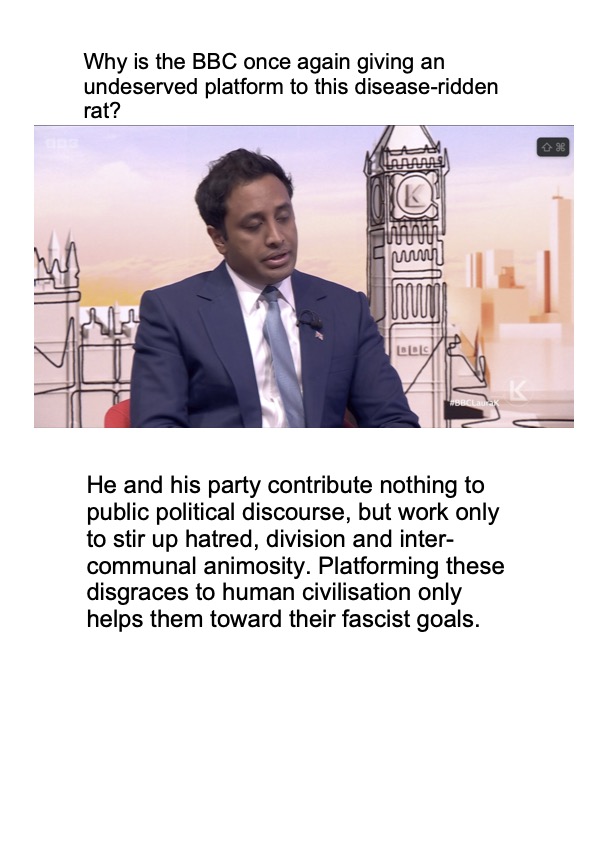
While I admit that the ‘disease-ridden rat’ part may have been over-egging the Sunday morning omelette, I felt inspired to make this after watching Zia Yusuf on the Laura Kuenssberg show this morning. How he had the audacity to sit there and say that his pimp Farage had nothing to answer for, and in fact had somehow acted ‘bravely’, in the light of his utterly disgraceful behaviour this week, was truly an insult to us all. Such abject spectacles always work me up. Mind you, having posted it on a few Facebook pages a couple of hours ago, you should see the reaction it’s getting.

Addendum. If you want to watch Femi’s thorough debunking of the toxic nonsense Yusuf spouted earlier, and his explanation of why it was so foul, please go here.

How Is America Putting Up With This?

I go up to Westminster quite a bit. Not every day or every week, but regularly enough. Thanks to the Jubilee Line, I can get up there very easily; and I think I’ve written here before about my reverence for the statues in Parliament Square. Crowded with tourists though it often is, I think it’s fair to say that that is an area of national pride and solemnity, with police officers on patrol and MPs going in and out of parliament. Now, imagine if one day we somehow elected a complete idiot as Prime Minister. Even more imbecilic than Boris Johnson or Liz Truss put together, they decide that, to mark the occasion of a great national celebration, it would be a fantastic idea to erect a boxing arena in the midst of the Square and to have crowds of people come to watch men fight. In between the statues of great historic figures like Churchill, Gandhi and Mandella, crowds of people would be invited to come, drink beer, shout and scream while watching people pretend to beat eachother up. How degrading would that be and and how collectively insulted would we feel?

It appears that that is exactly what is going to happen in Washington this summer. To mark the 250th anniversary of the establishment of the United States, Donald Trump now plans to create a UFC ring in front of the White House. I just read about it, and I’m slightly ashamed to admit that I burst out laughing. Trump’s ball room was bad enough – he seems to think the seat of his nation’s government is little more than a hotel or holiday resort – but this is frankly so crass it is frankly beyond words. Americans are usually quite renowned for their patriotism, and surely that will extend to a certain reverence for their national infrastructure; so how the flying fuck can they let Trump trample all over it and use it as his own egotistical plaything? Reducing it into the stage for something so infantile and vulgar? The spectacle of that hoard of fascist morons in Parliament Square two weeks ago was bad enough, but this is so abject it is frankly horrifying.

…Or would be if it wasn’t so hilarious. In all honesty I don’t see how America or Americans can currently be taken seriously, given that they continue to allow Trump to treat their country with such abject disrespect.

Not All Tiers Are An Evil

While I can’t say I’m absolutely cool with it, I think I need to flag this very interesting little piece by my friend James Cullis up. The notion of social tiers has cropped up in the national discourse, and James argues that adapting to everyones need is an essential result of human diversity, so to a certain extent social stratification is inevitable. As he puts it, “We prioritise, we triage, we judge. Society works because we discriminate — not in the moral sense, but in the literal one: we distinguish between cases.This is why the Novak scandal was so disturbing. It was a grotesque parody of justice, and yes, anyone who manipulates religion to game the system should be condemned. But here is where I part ways with Starmer: tiered policing exists because society itself is tiered. It is not a glitch in the system; it is part of the system.If we truly wanted “one tier,” then let’s be honest about what that would mean. Remove the ramps from buses. Rip out the lifts. Tell disabled people and the elderly to climb the stairs. Abolish sign language. Scrap subtitles. Eliminate every accommodation that acknowledges human difference.”

I think that, on the face of it, this is quite incontestable, and very well put. The thing is problems arise when such ideas are taken too far and this stratification is used to justify inequality and injustice. We are indeed all different, everyone has different needs, and society should accommodate those needs; but that should not be allowed to give rise to some kind of social hierarchy. Accepting that everyone is different should not then be twisted into the idea that some people are inherently worth more than others. If anything, the fact that there is no such thing as a “normal human being” means precisely the opposite: we all have equal potential and equal worth, so society/the environment needs to adapt to help everyone fulfil that potential, whatever their needs may be. Somewhat paradoxically, treating everyone equally does not automatically mean treating everyone the same. If some people are more capable than others, then surely those with more ability should assist those with less, be that help practical, physical, financial or whatever. Diversity should thus not be used to underpin notions around socioeconomic class. That is why, in spite of his otherwise solid argument, I find Cullis’ use of the term tier in the quazi-positive sense he does seems to leaves a slightly nasty taste in my my mouth, as it carries with it overtones of the very social stratification that we need to be breaking free from. Yet Cullis seems to imply that such tiering, in this context, is a good thing.

The notion of tiers can therefore be taken either way: used as the basis for equality and acceptance, or abused to justify discrimination and hierarchies. We are currently watching it being taken both ways. The scandal around Henry Novak is now being hijacked: such stratification is being sold to people in the name of tiers, and used as evidence for the perverse notion of “two tier policing”. The fact that some people’s needs differ from other’s should not be used to argue that some people deserve more than others simply because of who they are, or to stir up animosity between groups of people. That’s what makes what we saw yesterday in parliament so sickening, and this cultural impasse so dangerous.

A Disgrace To Parliament

I have just watched Prime Minister’s Questions for the first time in a while. I rarely watch PMQs these days because it winds me up too much, but my parents were visiting and they asked me to put it on. Rather inevitably, of course, I soon started to shout at the screen: The issues around the death of Henry Nowak of course were one of the main topics for discussion, and I have to say I was utterly disgusted by the abject spectacle of Nigel Farage trying to exploit the tragedy for his own ends. To see him trying to warp the story to suit his baseless bullshit about two tier policing was sickening.

I will obviously know as much about this story as anyone else: I’ll have only seen what everyone else has. The footage is of course horrifying. Yet I don’t think it can be used as the basis for a highly political, right wing argument that members of ethnic minorities are treated differently or preferentially to white people. I don’t know anything about police training, but I think it is reasonable to assume that, like all members of the social services, they are rightly taught to respect the diversity of contemporary culture, and that, as such, members of different ethnic or religious minorities might need treating slightly differently. That is just a product of the complexity of modern culture, and as such ought to be valued and welcomed. What might be acceptable to a member of one minority might not be acceptable to another: I would be quite comfortable to take my cap off if I was asked to by a policeman, whereas a Sikh man might not want to remove his turban.

To see this being exploited to fit a sickening, reactionary agenda in parliament earlier was appalling. It wasn’t just Farage – many Tories seemed just as eager to warp and bend it for their own xenophobic gain, arguing it means that white men are treated worse by the police than members of ethnic minorities. Doing so not only panders to the pathetic sense of victimhood increasingly felt by straight white poorly educated men being fermented by the likes of Tommy The Ten Named P’Tahk; it also ferments inter-communal division and tension. Nowak’s family had explicitly asked that the murder of the son not be exploited, but today we saw Farage doing precisely that, using a horrifying murder to stir up hatred and to suit his own petulant, abhorrent ends. I honestly think he is a disgrace to parliament and should be expelled from it immediately: we shouldn’t have such divisive, reactionary charlatans. anywhere near our government.

Mind Your Own Toes, You Snooty Cow!

Tell me, would you not feel highly insulted if, wheeling into the lift at the Woolwich Elisabeth Line station last night, an elderly couple gets in with you, and you hear the woman exclaim haughtily to her husband “Mind your toes!” Given that you haven’t driven your powerchair anywhere near anyone’s feet, upon hearing this you instantly feel extremely insulted. But then, when you try to confront the couple about it, they both completely ignore you and, upon reaching the ground floor, make straight for the station exit as though you didn’t exist. You pursue the couple for a few metres, until they head into the M&S next to the station, obviously thinking it was the only place people like them should do their evening shopping, at which point you give up and head for the bus stop. So, what would you do? Would you not feel indignant at being so patronised and spoken over? Would you not want to call them out on it and explain that such language and attitudes were not acceptable? Or would you just ignore it, accepting it as just part of the background discrimination which you know you’re going to have to put up with all your life?

Or would you mentally chalk it up as material for your next blog entry….

Video Games are Not Films

Everyone probably knows I’m a bit of a James Bond fan, but if you were expecting me to say anything about the new Bond video game which apparently came out, I’m afraid you’ll be disappointed. It isn’t only that I see such games as an infantile waste of time and would probably have no interest in playing them even if I had the dexterity to; more that I don’t see how such games can have any kind of relationship to the character or narratives that they claim to be based upon.

As much as certain teenage doofuses might want to pretend otherwise, video games are not films. Films, like the novels that they are often based on, are pieces of narrative art: they are the creation of a director, and, our personal reception notwithstanding, do not change each time they are watched. Like any other form of art, film has a definite, discernible meaning. Video games operate on an entirely different basis. They are basically distractions which players enter into to achieve a goal, changing every time they are played. To see the two as somehow on a par is thus meaningless: playing a video game is not effectively acting out a movie. That is why it really irritates me when all these numpties on YouTube, who have previously often posted some excellent James Bond film reviews, start playing games and talking as though they’re of the same order.

Of course I know that a lot more could be said about the relationship between films and games, and I realise I have plenty more to explore. When you start to think about it, the relationship between the two is not that straightforward, and could actually be quite intriguing. Yet I simply cannot deny that the cinephile in me finds the notion of 007 being turned into a computer graphic in a game and used to do little more than shoot his way through labyrinths, an absolute insult to the intriguing enigmatic figure I know Bond to be. The character Ian Fleming created was so much more than a man with a gun: to see him commercialised and rendered into an adolescent plaything in this way really does bug me.