Going Off Star Trek

I am, of course, a huge Star Trek fan. I’ve loved Star Trek since my family and I used to watch it every Wednesday evening when I was growing up. I especially liked it’s reassuring, optimistic vision of the future, in which humanity has overcome our petty differences and come together to explore space as one united civilisation. Recently, though – ie in the last few months – something about that vision hasn’t been sitting so well with me: perhaps I’m just getting old and cynical, but what once looked like a united, cooperative humanity, to be honest now just feels like America and American culture writ large. By that I mean, where Star Trek claims to present us with a united Earth culture, if you actually look at it, it’s pretty obvious that the characters and cultural structures we’re presented with are fundamentally American. It is an American film and television franchise after all. The future Star Trek presents us with is one where American culture and the American mindset has somehow risen to dominate the entire globe.

Until now, that has sat comfortably with me, or at least I’ve let it slide. Recently, however, the vision of such an Americanised future has felt more and more insulting. Since their second election of Trump especially, the inherent arrogance of it has become more and more apparent: what gives Americans the right to assume they will dominate humanity’s future? Why will First Contact take place in North America, and why is Starfleet Headquarters in San Francisco? Why are these starships crewed mostly by Americans? Indeed, how conceited do Americans have to be to presume that the supposed warp barrier will be broken by a lone maverick from Montana, particularly given that many Americans currently seem convinced that the world is flat and/or was summoned into existence by an imaginary creator being?

Obviously, Gene Roddenberry intended his future to be global and united, famously putting a Russian at the helm of the first Starship Enterprise at the height of the Cold War. Yet these days such things feel more and more like shallow, hollow gestures, varnishing over an America-centric future where their culture is the only one that matters. And at a time where distain for America is growing and it no longer has any claim to the respect it once had, frankly what once felt so optimistic now feels like gut-wrenching arrogance.

A Revealing Tweet

I don’t think I’ll pollute my blog by reposting it here, but earlier I came across a Tweet, apparently by a MAGA supporter, asking us Brits not to protest when Donald Trump visits, and would be “very rude and disrespectful” and “not very English like”. Needless to say, I was staggered that anyone could have the audacity to make such a demand, but now that I come to reflect on it, in a way I think it goes to the heart of the problem. Americans know how unpopular their current president is; deep down, they know trump has turned their country into little more than a global laughingstock. The problem is, those in the cult of trump hate when it is demonstrated explicitly: they know full well that there will be huge protests when Trump visits the UK, but will do anything to avoid them for fear that the spectacle would dash away their fantasy that their hero is a university respected statesman. Hence we see tweets like the one in question appearing, demanding that we all behave ourselves, simultaneously clinging to the delusion that their country still holds the authority to make such demands while betraying an underlying knowledge that the display of revulsion will be unambiguous and un-ignorable when Trump tries to parade himself before the wider world.

Nicholas McCarthy at the Proms

This morning I would just like to record a nice little coincidence which I know won’t resonate much with anyone, but which I think is worth noting anyway. I saw my family over the weekend at our old family house up near Kilburn, visiting London from various parts of the world. On Saturday my cousin Alex told me that the next day – yesterday – they were going to the Royal Albert Hall to watch one-handed pianist Nicholas McCarthy play at the proms. Of course, that automatically struck me as very cool because I know Nick having met him in 2012 when Lyn was performing with the British Paraorchestra. I didn’t know he was performing, so hearing my cousin mention him was a lovely surprise, and I had an awesome little “Oh I know him!” moment.

They would have gone to the prom last night, and I certainly hope they had a good time. Naturally I watched the concert at home on TV. It is great to see McCarthy so clearly flourishing, and I really hope it is a sign of a boom for musicians with disabilities in general. I’m not sure to what extent you can say things like this are connected to the legacy of 2012, but it’s certainly a sign things are going in the right direction.

The 2012 Legacy Lives On

Extreme oddity that I am, I just had my first squeal of spasticated excitement, joy and contentment of the day. I was just watching the morning news, and we were told that yesterday saw a massive athletics event at London Stadium. Not that I’m particularly into athletics, but I frankly find it very satisfying to see London’s former Olympic stadium used for such huge events. All too often, we hear about cities building such stadia to show off to the world for two weeks, before allowing them to fall into disrepair and collect dust. It’s good to see the legacy of the London 2012 Olympics and Paralympics still flourishing. I still head up to that area of the metropolis fairly often, and virtually every time I go it seems like some wonderful new building is being built on or around the Olympic Park – not just focussing on sport but artistic venues too. Naturally, London Stadium isn’t without it’s critics, and football fans say some of their views aren’t that great; yet I find the fact that the 2012 legacy is clearly living on, and a formerly neglected, disused corner of the city has now become such a hotbed for sport, art and culture, remarkable.

An Unexpected Trip To Canary Wharf

It can be pretty weird being me sometimes. Today was another rather hot day, so I just thought I would head to Woolwich and then take one of my regular trundles along the Thames, perhaps as far as Greenwich. However, I’m still very conscious of the need to drink water regularly, so at Woolwich I was struck by the idea of just popping into the Elizabeth Line station and asking one of the staff there to help me have a sip. They know me there now, so I doubted it would be a problem. As soon as I got into my station and rolled up to the staff though, I was met by the customary question about where I wanted to get off, the people obviously having presumed quite naturally that I had come to ride London’s newest railway.

What could or should I have done? Should I have come clean and confessed that I was only there for a sip of water, or changed my afternoon’s plan on the spur of the moment? When you need to ask for such kinds of aid regularly, I suppose you develop an aversion to looking like you’re taking advantage of people. That’s why I have just come home from a completely unexpected afternoon rolling around Canary Wharf – the first Elisabeth Line station to come to mind. Although it must be said that the Isle of Dogs is one of those exciting, dynamic, fast-changing areas of the city I enjoy going to and looking around quite regularly, it is surely rather strange how my plans have such a tendency to change at such short notice and for such weird reasons.

At least I got my drink of water.

Help With My Water Flask

I’m quite sure everyone will be having issues in the current warm, stuffy weather. Long story short, it was probably the reason for my hospital visit a couple of days ago. I obviously got extremely dehydrated. The thing is, when I’m going out and about in my powerchair, I don’t get much of an opportunity to drink much water, and frankly it usually slips my mind. When I’m trundling around the metropolis, the fact that I need to take on water gets rather forgotten about.

To help with this, a couple of days ago my friend and PA dom bought me a great flask which we can fill with water (or ‘fake’ mojito made with alcohol free rum!) which we can put in my bag and I can take around with me. It was the obvious remedy, you must admit. The thing is, the flask now goes in my the bag which hangs on the back of my powerchair: to get to it, I now need to stop my chair, take my Ipad off my lap, get out of my chair, walk around to it’s bag, open it, and so on. For someone like me, that isn’t a straightforward task. Rather than going thirsty, then, what I’ve been doing is going up to people and asking them to help me with the bottle.

Obviously I try to stick to guys I know I can trust, such as policemen or security staff; yet what I’ve been finding is that most people seem happy to help when I explain the issue to them. They are okay with going to my bag, getting out my bottle, opening it’s suckable spout up and holding it to my lips. A lot of times their fingers get rather wet or sticky, but they usually just ignore it. I must say that I find this enormously reassuring to the extent that I thought it needed noting here. We keep hearing how we live in such fractured, ostracised times, but the spirit of human kindliness and friendliness is clearly still there if you look.

Could Airlines Finally Become More Accessible?

As a wheelchair user who loves to travel, especially by air, it will probably come as no surprise that I want to flag this news up this morning. Tanni Grey-Thompson is heading a new campaign to make airlines more accessible for wheelchair users. “Airline and airport staff should have mandatory training in disability and accessibility awareness, a government taskforce has urged, to ease the stress, confusion and harm experienced by the growing numbers of passengers requiring assistance to travel.” The report was by a cross bench parliamentary group lead by Grey-Thompson. It’s high-time, if you ask me. I’m semi-ambulant, so I usually walk from my chair to my plane seat whenever I’m going anywhere; yet when I used to go abroad with Lyn, what she was often put through in terms of being hauled around airports and onto aircraft was deplorable. That’s not to mention the foul looks we both often got from our fellow passengers when putting our chairs into luggage delayed flights. It’s good to see someone in a position of authority finally getting their finger out and doing something about this issue

Why Don’t Doctors Just Use Email?

I don’t want to go into too much detail right now, but it has been a tough couple of days for me on the medical front, the upshot of which is that I now have a hospital appointment to go to in a couple of weeks. Hospital visits are usually something I try to avoid, but long story short, this one has the potential to deal with a few problems. What I find myself reflecting on, though, is how everything could be so much more easily dealt with if it was all done over email. As both a communication aid user and a technophile, it seems to me that dealing with issues like my current one would be far easier if I could simply email the doctor and explain my situation. Whenever I have to meet doctors in person, I always find myself at a significant disadvantage, having to type my answers to their questions out long hand into my communication aid, whereas email would let me sum everything up in prose. It would also be far quicker, and a more efficient use of the doctor’s time. If I could simply email the doctor I need to, just as I email my parents, support workers or anyone else, matters would be resolved far more efficiently and I probably wouldn’t find myself fretting for the next couple of weeks. Naturally I know there are probably a few reasons why email would not be practical for matters like this, and that face-to-face appointments are still useful. It’s just that, since virtually everything else has moved online, the thought of actually having to go out to meet someone feels a bit daunting.

An Open Mega-Event

You may have noticed all the stuff on the Beeb at the moment about the fortieth anniversary of Live Aid. I was only two in 1985, so I don’t really remember it. The commemorations make me wonder, though: could a similarly enormous event happen these days, and what could it look like? Obviously we still get the periodic global mass media event, and of course I’m thinking about olympic opening and closing ceremonies etc; yet in these online, social media days, could anyone still organise a huge, international fundraising pop-concert, watched by virtually everyone in possession of a television?

As I know from my incredible experience a couple of weeks ago watching Guns And Roses, Wembley Stadium is still a mind-blowing, awesome place for a rock concert. I wonder though, could someone like Bob Geldoff still be able to get everyone together, like he did in 1985? And what might that event look like in these days of Iphones and social mass media? Thus, my open question for everyone today is, if you were somehow asked to organise a gigantic concert like Live Aid, who would you ask to perform? As for me, I think I would definitely start with Greenday and The Cat Empire!

Come On England!

I can really be a bit of a prat sometimes. You may have noticed the criticism I’ve got from my old University friend steve about this entry from a couple of days ago. Rereading the entry, there’s no denying that I made myself look like a right idiot, to be so hostile towards women’s football. I honestly did not mean that I thought women shouldn’t play professional football, or that nobody should be watching it: I suppose that I was trying to articulate that I thought it was an example of the increasing trend in trying to hold two political, social or cultural positions at once – and I failed miserably. As you can see from this video my friend sent me to watch, women’s football has a rich, dark, rather shameful history, and I was utterly wrong to be so dismissive of it.

Having said that, regarding this evenings England Vs Wales match, I hope it’s all right for me to exclaim, ‘Come on England!’

Is The Rise In Powerchair Use A Good Sign?

Just to follow up on this entry from a few weeks ago about the apparent increase in the number of people using powerchairs, I was down in Greenwich this afternoon and I’m pretty certain that I saw more people using powerchairs than I used to. Most were elderly people, but there were quite a few younger ones too. It struck me, though, that rather than try to feel cynical about it and work out some underlying pseudo political motive, perhaps it should be taken as a positive, even encouraging sign. If increasing numbers of people are becoming happy to be powerchair users, surely that is a sign that society is becoming more accessible and accommodating of people with disabilities. Perhaps people are becoming more open about disabilities, especially physical disabilities, which they might previously have sought to hide. Perhaps even more encouragingly, it could also mean more people who need to use powerchairs are now confident enough to get out and about, when previously they may have felt they needed to stay at home, or away from public sight. Thus I think it’s fair to say that what I’m increasingly seeing, in the rise in powerchair use, could well be a pretty encouraging sign.

Women, Football and Cake

I must admit that I haven’t been watching the Woman’s Euros currently being played, and in fact have actively avoided it. To be honest I find it rather unseemly. I know it shouldn’t, and that we should all now embrace that kind of thing; yet somehow the sight of twenty-two women running around a football pitch as though they were men is somehow unedifying.

However, it seems to me that that brings about a paradox which needs to be unpacked: These women want to play football; they do so because they like playing the sport. Women play in their own leagues separately from men because women are biologically different from men, with different speeds and abilities. If women played against men, there would be very little competition. Yet if that is so, why is there an increasing eagerness for the woman’s sport to be perceived on a par with the men’s, with the same high wages etc; and if the two manifestations of the sport are so different that they need to be kept separate, why do women seem to be playing increasingly masculinely, almost imitating men? Frankly, it seems to me that the women’s sport wants to hold two positions at once: the same but different. The women want to attract spectators so they play more and more like men, but in doing so they erode what makes their sport different from the men’s, and frankly the more unseemly I personally find it.

Mind you, this is a paradox or contradiction we’re seeing more and more of these days. People try to hold two conflicting rhetorical positions, seemingly without understanding either. We find it in concepts like ‘high functioning autism’, where apparently fully self-aware people claim to be autistic, apparently without grasping the fact that autism is a profoundly debilitating neurological condition. It is an example of what could be called ‘cakeism’ – of wanting to have a cake, and to eat it. In turn it’s also rather like Joseph Heller’s famous Catch 22, where to be grounded for insanity, a fighter pilot must apply to be grounded for insanity, the act of which is taken as a sign of his sanity. In other words, increasing numbers of people seem to want to hold two or more mutually exclusive cultural or social identities, but in so doing strip those identities of any real meaning. To attract the acclaim of men’s football, women must play more and more like men; but in doing so their sport looses it’s identity…and point.

“You were stronger with the European Union.”

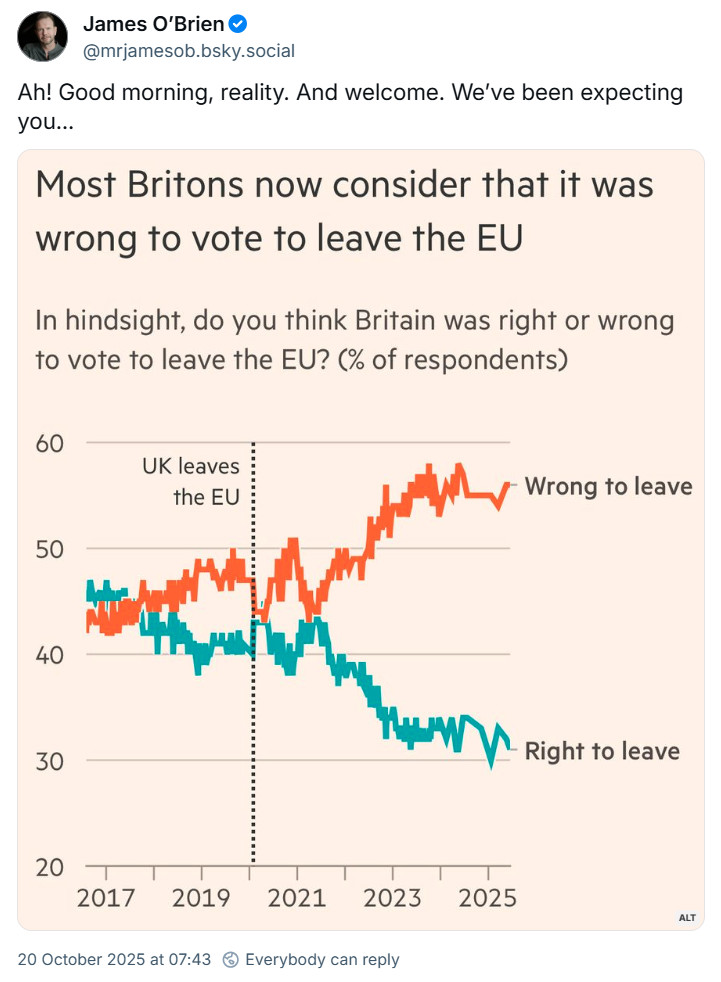
I usually try to avoid linking to sites like the Huffington Post, but today I certainly think this is flagging up. French president Emanuel Macron has openly criticised Brexit, and told the UK we were stronger as members of the EU. Of course, that won’t go down well with a lot of Outists, still clinging to the myth of British exceptionalism and wondering why we’re not being treated like some great superpower; but it’s a clear sign that reality is beginning to bite concerning the idiocy of 2016. All our allies know Brexit was a catastrophically stupid thing to do. It left us isolated, alone and vulnerable. It’s just good to see our friends are beginning to speak out about it.

Bigots like Olubanjo Must Not Get Their Way

I saw something which appalled me on the BBC local news last night, so much so that I’m still extremely pissed off about it. In fact it has been making my blood boil each time I have thought about it all day. I’m sure everyone living in London has come across pedestrian crossings which have been painted in various colours in support of various minorities, such as in the colours of the gay pride or trans pride flags. It’s surely a wonderful way of recognising the city’s diversity and inclusivity. However, as you can read here, a vile bitch in Camden is objecting to one such crossing because she claims it somehow infringes on her rights as a Christian. Suffice to say, I find that so contemptible and arrogant that it makes me want to vomit. How can anyone have the gut-churning audacity to claim that their religious delusions are somehow more important than someone else’s right to express their sexuality or gender identity? It’s like someone starting a campaign to stop Pride taking place every year because they claimed their faith did not tolerate gay people. Frankly I wouldn’t put it past them, and what clearer sign could there be that it was time for society to outgrow such anachronistic, repressive nonsense. If we truly aspire to be an open, tolerant, inclusive society, we cannot allow religious bigots like this to get in the way.

The Thames Kept Flowing

I was just going through my blog archive, as I often do, and realised that it is now more or less twenty years to the day since I wrote this entry in reaction to the terrible bombings of 7/7. I opened it by saying how, at the time, I lived in the North of England, so all I knew was the peace and quiet of rural Cheshire, far removed from the hubbub and chaos of the metropolis. The thing is, London is now my home and has been for the last fifteen years. In fact I feel more comfortable and settled here than anywhere else.

I just got in from a lovely long trundle along the Thames near Woolwich, the river looking majestic in the afternoon sun. Thus, when I think about what happened to this city two decades ago, I remember too everything else this place has been through over two millennia: the bombings, blitzes, plagues and riots. The Thames kept flowing through them, just as it always has, and just as it flowed on after the horror of twenty years ago. And sure enough, London bounced back into what turned out to be some of her greatest, most triumphant years. I may have grown up in Cheshire, and I might have been shielded from what happened here; but over the last fifteen years I have got to know London, and I know now that this city is far, far greater than anything any lunatic can throw at it.

GB News Should Apologise Immediately

If you are still under any naive illusion that anti-disabled vitriol is not rising, just read this. GB News now claims it has nothing to apologise for after a so-called commentator and comedian came onto one of it’s shows and started spouting off that disabled people should be starved or even shot as a way to cut the benefits bill. The unfunny, untalented wanker, who I won’t even dignify by naming, was obviously trying to attract attention by being controversial; but I don’t think there’s anything even vaguely amusing about denying any minority their right to live. What troubles me is that this is a symptom of a fast-growing undercurrent of anti-disability vitriol: what is currently construed as just joking or having a laugh can quickly become outright prejudice and discrimination if we’re not careful.

Spot Of Physics, Anyone?

Just in case you’re getting a bit bored of me prattling on about this and that, today I’d just like to flag this blog entry by my brother Mark up. It’s his review of a book called The Ant Mill, which is apparently about ‘How theoretical high-energy physics descended into groupthink, tribalism and mass production of research’. Mark seems to blog a lot less frequently than I do, but when he does it’s usually about intriguing stuff to do with physics. I won’t pretend I understand everything he’s talking about, but I’m sure it’ll sound far more intelligent than the nonsense I usually spew on here.

Pride 2025

It has been an afternoon which has simply reinforced my now deep conviction that London is the greatest, most awesome city on earth. A couple of days ago, I of course heard that the annual pride march was this weekend, so I thought I would head up there to check it out. You know how fascinated I am by such big cultural events. To be honest, as I headed into central London this morning, I had my political head on, wondering how much evidence I might find of the kind of cultural intrusion or usurpation I often get so wound up about. However, as soon as I got to the pavement of Piccadilly, it became clear that such concerns were totally and utterly irrelevant. If what I saw today was about anything, it was about inclusion and the celebration of diversity; politics had nothing to do with it.

Having said that, the march started slightly late apparently due to some sort of protest, but when it got going I was almost instantly overwhelmed by the energy and vibrancy of what I was watching. Thousands of people, all cheering and whooping, but above all expressing love for one another. The procession was formed of groups of people representing organisations around London. There was a vast array, but they all had an LGBT aspect, giving the afternoon a feeling of variety and diversity, but also solidarity and unity. What better metaphor could there be for London as a whole?

Apart from the last time I went to Pride, I have never seen anything like it: the feelings of warmth, compassion and friendliness were palpable. As usual I got chatting with a few people and made a few friends. One man even gave me a fabulous rainbow cowboy hat, completely at random! At about four I headed home, but as I rode the Elizabeth line back, covered in rainbows and stickers, I decided that today certainly wouldn’t be my last Pride.

Are They Filmmakers?

Film is such a strange, beguiling artform when you think about it: to a unique extent, it is at the same time supremely democratic and eye-wateringly exclusive. Unlike any other art form or mode of expression, it is something just about anyone can ‘do’, simply by holding up a camera and pressing ‘record’; yet on the other hand the film industry is notoriously difficult to get into, and making a proper, professional film for cinematic release takes years of work, dizzying amounts of networking (and luck), and obscene amounts of money. Thus in these days of camera-phones and Youtube, we find ourselves at a point where anyone can make a film by pointing a camera at something and recording it, before uploading it to make it available to the entire online world.

The question is, does that mean that they are filmmakers? At university I learned what an extremely sophisticated artform film is: Contemporary cinema is an amalgamation of techniques and styles, all of them having evolved over the last century or so, to form a rich, intriguing filmic language. You only have to read guys like Andre Bazin or Christian Metz to get an idea of just how beautiful and complex it is. Now, however, all that is being bypassed: online, film in the broader sense is becoming simply the recording of moving images, devoid of any art, style, technique or appreciation of film in any philosophical sense. It is as if what came before has been bypassed and ignored, akin to someone throwing paint haphazardly onto a canvas in roughly the shape of a woman, and proclaiming themself the next da Vinci. The result might express someone’s thoughts and feelings clearly enough, but can you call it art?

I suppose I shouldn’t complain. Film, like any other artform, is constantly evolving. The way it is accessible to anyone makes it hugely democratic. Yet, as a cinephile, part of me worries that the door has been opened to luddites with no idea what they are doing or any real appreciation of the artistry of film, resulting in the slow yet gradual wilting of the quality of films as a whole. To put it another way, it is not that difficult to write a few sentences to convey a message; but to write something with any deeper meaning or nuance, to say something meaningful about life, the universe and everything, it helps to have a knowledge of literature more broadly. That is the point at which writing, film or any other art gains true intellectual weight; without such context, it is just a few pictures or words, void of any real meaning.

How Can I Watch The Meaning Of Live?

Just a quick question today guys: does anyone know where/how I can watch a documentary called The Meaning Of Live from 2014? I just heard that Black Sabbath are reuniting for one last show in Birmingham, so with so many of these ‘reunions’ coming up, I thought I would watch the documentary exploring the Monty Python reunion eleven years ago. The thing is, it’s no longer on Netflix, and disappointingly it isn’t among the DVD extras for the recording of the show, so can anyone point me in the right direction?

An Afternoon In Westminster

It must be said that yesterday was quite an interesting day for me. I really don’t want to get too bogged down in the politics of it today, as to be honest I have quite complex, ambivalent feelings on the subject; but yesterday afternoon I thought I would pop up to Westminster to check out what was going on with regard to the disability rights/PIP protests. I got up there at about four, and it took me a while to find the protest itself: it wasn’t in Parliament Square as I’d expected, but in a smaller area just off it. Broadly speaking, I went up there mostly to observe rather than protest: while I certainly want to show solidarity to my fellow disabled people, the fact is the welfare budget has grown exponentially with far more people claiming disability-related benefits now than twenty or even ten years ago. That is surely unsustainable, and I think it’s a problem which needs to be dealt with, not just on an economic level but a social one too.

Even so, I wanted to go up there to try to get a better grip of the situation. The bottom line is the welfare state needs protecting. By the time I arrived I think the protest was winding down slightly, but there was still a good number of people there, with a wide range of disabilities. I got talking to a few, and as usual got complemented on my anti-Trump baseball cap. Pretty soon, though, people started to move: it seemed that they were actually going to go into the Houses of Parliament.

That would obviously be too interesting to miss, so of course I followed along and went in with them. I was quite surprised at how simple a process it was, as after a bit of queuing and bag checking, I found myself in the Palace of Westminster, being lead along the corridors to the main lobby. I found the place fascinating, with it’s ornate medieval decorations. Believe it or not I had never been in there before, and I was in awe.

However, it wasn’t long before I began to think about going home. It wasn’t just that it was getting late and I was getting hungry, but I was nervous that if a politician I recognised and disagreed with showed up, I would end up causing a scene. If, for example, Nigel Farage somehow showed up (extremely rare as his appearances in parliament actually are), there was a distinct possibility that I would start shouting or even try to attack the p’tahk. I would then probably be arrested, and the whole evening would have been spoiled. In all, then, I decided it was a good idea for me to head home, and watch how things played out on the evening news.

Villeneuve is a Good Director, But…

You might be wondering why I haven’t said anything about the selection of Denis Villeneuve as the director of the next Bond film. It’s not that I haven’t noticed it, or that I’m not interested: I am of course intently interested in the future of one of my favourite film franchises. The thing is, it seems to me that whoever they choose faces an almost impossible task.

No Time To Die left the Bond franchise on a high. Daniel Craig had taken 007 to another level: at least four of his five films had been outstanding successes. Prior to the opening of Casino Royale in 2006, expectations for him had been wretchedly low, but as the Americans say, Craig hit it out of the park. The problem now is, his departure has now left a gaping chasm which it will be almost impossible for anyone to fill. What Craig gave us was phenomenal, so we now expect nothing less.

Many people are now saying that the only solution would be a complete change in tone for the franchise. That is, where Craig gave us a gritty, realistic Bond, the new era of Bond films should be lighter and more jovial, along the lines of what Roger Moore gave us. That way, any uncomfortable comparisons can be avoided. I certainly think this is a good idea, although I think that that will in turn give rise to it’s own questions, issues and problems: too serious and you’ll risk comparisons with what went before; too comic and you risk turning people away for being too different to what we’re used to. The balance will therefore need to be absolutely right.

The thing is, it seems to me that the chances of anyone striking that pinpoint balance are now more unlikely than ever. Were the 007 franchise still owned by EON, with Michael Wilson and Barbara Broccoli still producing, I would not have ruled it out. Wilson and Broccoli had weight and experience behind them, with over thirty years’ experience dealing with this cultural behemoth. With Amazon now in control, promising the complete reinvention of the franchise, no doubt opening it up to the same American hyper-commercial forces which have already been the bane of so many wonderful fictions, I frankly can’t see anything other than the Bond series becoming just another piece of derivative mass-market fluff. The executives at Amazon don’t know the first thing about James Bond, the Bond Phenomenon or it’s unique cultural position; they just see it as a set of big action films which will make them money.

Thus, as much as I respect Villeneuve, I think he’s in an impossible situation which I don’t see how any director could get out of. Bond films will always intrigue me, but I can’t help thinking that it may be wiser to call time on the phenomenon, and let them end on the high of Daniel Craig, than see it become subjected to the commercial, Amazonian pressures I now fear it will become opened up to.

Of Morris Dancing, Cricket And Zombie Apocalypses

In a way, yesterday was one of those pleasant days which I just spent trundling around the Borough of Greenwich, but it resulted in three quite interesting things to record here this morning. I set out at about eleven, after a good breakfast and plenty of coffee. It was already quite warm, so I was keen to get some fresh air, heading through Kidbrooke, over Blackheath and then down into Greenwich. Greenwich Market is always bustling on Saturday mornings, but yesterday it was heaving, and I could barely move for all the people as I navigated my way through it towards the river.

Once by the Thames, though, I found something which struck me as very peculiar: a Morris Dancing festival! Morris Dancing is something I associate with rural England and small towns and villages, so to suddenly happen upon such an event there, in the shade of the masts of the Cutty Sark, was quite a surprise. There were several groups of performers dancing, so I stayed to watch a few of their rather impressive routines, reflecting to myself that it was probably worth blogging about, before continuing my walk.

From Greenwich I continued along the River up to the O2, and then decided to head up to Charlton to see if there was a cricket match being played in the park. I still have extremely warm, happy memories of watching cricket in Charlton Park: it is a fantastic spot for the sport, with it’s wide green fields and friendly little cafe, all overlooked by the majestic Charlton House. I was very pleased to find a match already in play yesterday afternoon, with none other than the Mighty Eights, a team I have grown to know and love over the years, batting. From there, it became clear that the afternoon would just be a matter of sitting there, chatting to my friends, watching the cricket, and sipping non-alcoholic beer. If you ask me you can’t get a better Saturday afternoon than that.

However, the day was far from over. Unfortunately I had to miss the end of the match as I was eager to get home ahead of what promised to be an interesting evening: John and I had plans to go to a zombie apocalypse! That is to say, we were going to go watch 28 Years Later, Danny Boyle’s new film. I’m not usually a fan of zombie horror films, but John seemed keen to go, and I still think Boyle is a demi-god for what he did in 2012, so I thought I’d give it a go.

What I found myself watching, though, was far from pleasant: the film was scary, unnerving and grotesque, set in a post-apocalyptic Britain where people have to stave off ‘the infected’ with bows and arrows. I’d like to review it properly, but to do that I’d need to give it at least a second viewing. It’s a frightening, disorienting film full of unnecessary gore. What I will say, though, is that it is chock-a-block with iconography and references: religious references, references to films like Kes, and even – although I’m not completely sure – a few references to Tolkien. For example, there is one shot if a group of people walking in file, silhouetted, over a brow of a hill, recalling the similar, famous shot in Peter Jackson’s adaptation of Fellowship Of The Ring. Also, the main protagonist of the piece, a young boy called Jimmy, is always shot wearing a pendant on a necklace around his neck, recalling Frodo wearing the Ring.

Going deeper will, however, have to wait for another time. The day is starting, and the coffee is brewing. Yesterday was a great day at the end of an awesome week. It can only make me wonder what next week will bring.

An Even Better View

There is a detail about the awesome events of Thursday which I didn’t include in yesterday’s entry because I didn’t think it would fit in with the enthusiasm I was trying to convey, and because I think it warrants it’s own entry. When my mum first bought the tickets for the show, she was told that the wheelchair spaces had all sold out, meaning when we got to the stadium I would have to park my powerchair somewhere and walk to an ordinary seat. That initially sounded fine, as I can walk short distances (although I may have needed help going up or down steps). However, when we reached our designated seats, we saw that everyone was standing up, so I wouldn’t have been able to see anything. When we realised that, John hurried back to the ticket office, me in tow. I don’t know how we managed it, but, jammy bastard that I am, we were then given the tickets for the very last wheelchair space in the entire stadium! I wouldn’t have to get out of my powerchair after all. And, because it was round a bit further, we had an even better view than the people in the other (full) wheelchair viewing area. My luck really is uncanny sometimes.

Paradise City Indeed

There are times, every now and then, when my jaw drops in astonishment of how truly lucky I am: moments when one of my dreams has come true, or a crazy far-fetched fantasy has been somehow brought to life. Last night saw another of those amazing moments.

When I got wind that Guns and Roses were going to play Wembley Stadium this summer a few months ago, of course I automatically thought that watching them would be great, and contacted mum to get tickets. These days, it seems that my mum is still the best person to ask when I want to arrange such things. Mum duly obliged, and I was soon counting down the months to last night. I have been into Guns and Roses since school: aged about ten or eleven, a couple of my classmates were into them, and I was struck by their mixture of rebelliousness and jaw-dropping electric guitar riffs. In the thirty years since, whenever I wanted to let off a bit of steam or the world got too frustrating, I always put on a Guns and Roses song: the music seemed to be able to do the screaming and shouting for me.

To have at last watched them perform live, then, at London’s greatest stadium alongside a crowd of tens of thousands, was utterly incredible. The atmosphere there last night was phenomenal, like nothing I had ever experienced before. Of course, I can compare it to things like going to watch Greenday or The Cat Empire, but in a way this was on another level. The volume was almost deafening, so much so that I could barely make out the lyrics being sung. I couldn’t even make out what John was saying, sat right next to me. Yet as the sun went down and the sky grew darker, and the lights in the stadium came on, there seemed to be a wonderful aura about the place: the audience in front of me all turned small lights on, so it looked like a reflection of the night’s sky above us. As the band went through their back catalogue*, often getting up and dancing to my favourite songs, it struck me how truly lucky I was. And when they finished the evening with Paradise City, probably one of my favourite pieces of music ever, I was absolutely euphoric.

*Mind you, I was slightly disappointed that we must have arrived slightly too late to hear them play Live And Let Die.

Tonight’s Gonna Rule!

I’m not going to say much now for fear of jinxing things or giving anything away, but once in a blue moon I’m lucky enough to have experiences which are so phenomenal, so awesome, that it goes beyond words. All being well, tonight should see another of those incredible experiences. It is something I’ve been looking forward to for months and I’m hugely excited about. Of course, I’ll fill you all in tomorrow, but for now think huge American rock bands at huge stadiums the other side of London.

TONIGHT! IS! GOING! TO! RULE!!!!!!

Avatar, Then and Now

Dom suggested we watch Avatar last night. Believe it or not, I don’t think I had ever seen it before – I think it had crept under my radar somehow. Now that I have though, I think James Cameron’s 2009 film is certainly worth saying something about, especially in the light of all that has happened since it was released. At it’s heart, Avatar is a narrative of imperialism, especially American imperialism: it is a story about humans colonising another planet to exploit it for it’s resources, and in doing so decimating the homes of the indigenous people. Obviously, this could be taken as an allegory for the invasion of Iraq being invaded for oil, the colonisation of North America, or many other real-life situations. Yet what I was most struck by, watching the film last night, wasn’t so much the combination of live action or CGI the film was famous for; nor the weird intellectual issues rising from having humans control these avatars, seemingly entering into a completely different CGI space which was nonetheless supposed to be the same planet. What I was struck by was the sheer brashness with which the colonisers were acting: they seemed to think they had a god-given right to the planet’s resources, that the natives were inherently inferior to them and were just getting in their way.

Of course, as you would expect from a Hollywood blockbuster, the ending of the film has the native people’s all joining together and showing the invaders what for; but that is only a great deal of semi-covert imperial justification. Indeed, the central love story of the film has a disabled human in his able-bodied avatar fall in love with one of the native people, whose community he has infiltrated. Even leaving aside the fairly sickening anti-disabled, ‘able-bodied is better’ nonsense, at the end of the day humans had no right to be exploiting the planet in the first place, so having the two characters fall in love, like some saccharin romantic justification for the entire premise of the film was just nauseating. No amount of romance can make imperialism right; such love stories are simply attempts to distract us from the fact that one group of people is invading another in order to exploit their country’s resources. The fact that the guy is shown to switch sides in the end and ‘become a native’, does nothing to change that.

Obviously, Avatar has clear parallels with stories about Pocahontas and early American colonists falling in love with Native Americans. On this level, Avatar can be read as an allegory for the European colonisation of North America. Thus, no matter how much James Cameron may have attempted to depict the invading humans as brazen, arrogant and ignorant, the fact remains the film does not question their right to be there, even depicting a love story between members of the two communities. Although it is mentioned somewhere in the film that the invaders had to be there because Earth was dying, such justification seems half-hearted at best. It is very telling that the text does not end with the colonising forces all realising the error of their ways and going back to Earth or finding another planet to live on. While most are shown to return to Earth, some – the ‘good ones’ – were allowed to remain, the implication being that the creators of the film thought the invaders had an overarching right to be there, in spite of all the destruction and suffering they are shown to inflict.

Hence, at it’s heart and as much as it’s director might try to deny it, Avatar essentially justifies imperialism. In it we can clearly read the American ‘we come first’ mindset, which was an integral part of their culture in 2009 and is even more evident now. Obviously in it we can read a justification of the invasion of Iraq, but we can now also make out far more about what has happened since then, about the American mindset, it’s urge to dominate, and it’s unwavering, unquestionable attitude that it’s needs come first. If Avatar is a story about one group of people dominating, bullying and exploiting another, it is now more relevant than ever.

Rowling Should Never Have Been Published

I am now rather ashamed to admit that I have fairly warm memories of listening to Stephen Fry reading the Harry Potter audio books. We listened to them as a family, as my parents, brothers and I drove through various parts of Europe. I remember being quite captivated by them at the time: they might not have been on a par with Tolkien, Melville or Hemingway, but as stories they were certainly  entertaining, especially when delivered through Fry’s rich, maple syrup and Lord Melchett voice. Now, however, I never want a single word written by the hateful bitch Rowling to pass my eyes or ears again; and the same goes for the film adaptations of the fourth rate, pisspoor shyte she made her fortune from.

Accuse me of cancel culture all you want, but Rowling should never have been published in the first place. Now that she has revealed herself to be nothing but a rabid, vile transphobe, it’s time we recognised her work for what it is: a collection of stolen ideas delivered with all the talent and wit of a pile of horse shit. It is an insult to english literature, with it’s two-dimensional characters and simplistic, infantile themes and plots. Frankly, it should be taken out of print immediately: young people deserve better than to be subjected to such derivative, talentless crap. I’m glad to see that Fry now feels the same way, and I would personally urge him to get the audiobooks he recorded taken out of circulation: if I was him, I’d be sickened by the thought that this bigot was making money from my voice. The fact of the matter is, Rowling is now using her undeserved success as a platform to spread hate, and that platform should therefore be destroyed.

Shut Up Yanks!

I made this before yesterday’s appalling news broke, but mean it now more than ever.

The US is now dangerous and can no longer be allowed or trusted to dominate global affairs.

Absolute Folly

You know that, if the first words you utter when you turn on your computer and read the headlines in the morning are ‘oh shit!’, things aren’t as they should be. Like any other sane, thinking person, I am appalled by what is currently happening in the Middle East: what the US started today will have major, major repercussions. I went for a trundle this afternoon to try to collect my thoughts on the matter, stopping for an orange juice in Charlton Park. I thought going back to that little cafe where I have so many wonderful memories might help me think, without much luck. At the end of the day, there is not much anyone can say about the fact that one sovereign country has unilaterally attacked another entirely without provocation, and in doing so has ripped the international rule book to shreds. There is nothing any of us can do now but watch and see how things unfold, as if it was all some sort of strange, perverse film directed in equal parts by Alfred Hitchcock, Francis Ford Capella and Monty Python.

A Dark Door

To be honest I can’t decide what I think about yesterday and the assisted dying debate. I thought briefly about going up to Westminster to check out the campaigners, but decided not to as it was too hot and I didn’t want to get worked up. It’s a complex, highly emotional issue: like many disabled people, I worry that legalising assisted suicide opens the door to many dark consequences, such as people being coerced into ending their lives too early. On the other hand, if people have a right to get help to do things they want to do, surely that includes committing suicide: logically we can’t only give people help if we approve of what they are doing.

It’s a dark, thorny issue. I love life: I love living, having fun, going travelling, doing all kinds of crazy things. The idea of ending that, throwing it all away, is noxious to me, particularly after having lost so many good friends, including Lyn, far, far too early. I know full well how dark life can get, but that also teaches me to relish it, and live it as fully and enthusiastically as possible. The notion that someone would choose to end their lives when the world is full of so much potential frankly sickens me. Thus I must admit that part of me was appalled by the sight of the ‘Dignity in Dying’ campaigners cheering on Parliament Square yesterday afternoon – why cheer for death when you should be putting your energy into helping people to live?

But again, this is something I don’t want to get too worked up about. It’s a fraught, emotional issue which people on both sides feel extremely strongly about. I might pop up to Westminster later, just to check what’s going on; then again, it might be a better idea just to go watch the cricket.

Queuing for Pretentiousness

Oasis and the fact that tickets for their upcoming tour have gone on sale was on the news this morning. Inspired to blog about it, I just checked my archive, and my opinion of the band hasn’t changed since I wrote this entry: Liam and Noel Gallagher are still two talentless, arrogant wankers. What gets to me (in a mildly annoying way) is the obviously fake adoration they’re currently receiving. The beeb’s breakfast show I was just watching showed fans queuing outside ticket offices, as if it was somehow equivalent to a Beatles or Queen reunion. The thing is, many of the people there were obviously too young to have been alive when Oasis were actually together; either that or just wanted to tap into the band’s Northern chique, faux-anti-establishment brand. In other words, this didn’t have anything to do with wanting to listen to music, but was entirely pretentious.

Then again, I suppose the same accusation could be levelled at me when I was so enthusiastic to get tickets for Monty Python Live in 2014. Given that I wasn’t alive when Python first aired in the Seventies, was I just going with the Python-are-great vibe? Was I being pretentious, claiming to tap into a culture which I thought was trendy and fashionable? I don’t think so: although I was born post-Python, I had grown up in a household full of Monty Python References. I remember my dad singing The Lumberjack Song when I was little, not understanding why he would work all night and sleep all day. I remember being told about spam, and the song Jesus sang when he was on the cross. Most fondly of all, I remember watching Michael Palin’s travel programs on Sunday evenings. Thus when they reunited eleven years ago, my enthusiasm was entirely heartfelt and genuine. Those guys were and are legends and cultural icons; watching them live will always be one of the highlights of my life. My only regret looking back is that I didn’t get tickets for my parents to see the show too, as they were even bigger Python fans than I was.

Now, however, Oasis are trying to tap into the same kind of nostalgic vibe Python exhibited, but the difference now is that it is entirely superficial. These ‘fans’ don’t actually like Oasis, as much as they want to be seen to like Oasis. They seem to be under the gross misapprehension that being an Oasis fan makes you an anti-mainstream rebel, when the irony is that you can barely get more mainstream than these two generic, nauseating, unoriginal twits. Anyone genuinely into rock music would be queuing for tickets for the plethora of other actual rock concerts happening across the country this summer. But instead they put on their stupid hats and sunglasses, and try to imitate the mannerisms of two Mancunian wankers who never had a shred of musical talent in the first place.

America Is The Problem

Like everyone else, I’m waking up to the increasingly concerning news from the Middle East. It’s looking more and more likely that the US will become involved in the current conflict between Iran and Israel; and if that happens, there’s no telling what will happen. Without being hyperbolic, Russia could get involved, leading to a potential third world war. What makes me angry, though, is the fact that Iran had signed a deal on it’s nuclear capabilities and was being contained, until Donald Trump ripped it up solely because his predecessor Barack Obama got the credit for it. This crisis wouldn’t be happening were it not for Trump and his sickening ego.

I’m sorry to say this, but I think the case could be made that America/the US is the problem. Had it not been for their president, Iran would still be contained, Israel would not have felt it had the right to act so aggressively, and perhaps the United Nations could have calmed everything down. But because this group of self-important fuckwits across the Atlantic is currently the world’s preeminent superpower, we’re now hurtling towards armageddon! If you ask me – not that anyone is – it’s time for the era of American dominance to end, just as the era of British dominance did. With the election of Trump they have destabilised the world; the US can no longer be trusted to act logically or do the right things. America is the problem, and needs to be taken off it’s throne before the idiot leading it makes matters even worse.

Different Pictures Of The Same Parade

I’m not sure how much everyone else has heard about it, but I want to say something about the big military parade Trump apparently held for himself at the weekend. The thing is, I don’t have anything to base it on. There was absolutely nothing about it on the Beeb, so all I have to go on comes from Youtube. These days, I trust Youtube channels, especially American ones, less and less: they all seem to be biased this way or that. Things seem to have become especially questionable since the advent of CGI and AI – we can’t even trust things purporting to be photographs. Thus while one channel might show a huge glittering parade lined with adoring spectators, others might show long rows of empty seats. It’s extremely difficult to know who to go by, so I think I better just stay out of it.

Oh, what a mess we’ve got ourselves into.

One From Shives’ Heart

I think I really need to flag this Steve Shives video up today. As you may know, I’ve been watching Shives’ videos for a while: I think he’s one of the best film and TV analysts on Youtube, especially when it comes to franchises like Star Trek. In this vid, however, he discusses his adoration for Superman, particularly he earlier Superman films when he was played by Christopher Reeve. What interests me about this video is how, as Shives himself admits, he forgoes any in-depth discussion and instead just tries to convey his love and fascination with what he sees on screen. He knows that what he is watching is silly, campy and far fetched, but that somehow does not matter: Shives feels intrigued and compelled to watch. He does not use the term, but to me that is instantly recognisable as cinephilia, the discourse of filmic love I spent seven years analysing and writing about.

In a way this is cinephilia in it’s purest form. The way Shives picks out films, actors or just moments of film and speaks about them so adoringly is quintessentially cinephiliac. I was particularly struck by the moment when, two and a half to three minutes into the piece, Shives deviates slightly and starts talking about the moment he first saw Atticus Finch appear on screen. He had apparently been studying Harper Lee’s To Kill A Mockingbird at school, but this was the first time Shives had seen the film adaptation. Shives describes how he was struck by how Gregory Peck’s portrayal of Finch looked uncannily like he had imagined the character; how he had to stop himself ‘audibly gasping’; how amazed he felt at the sight of a character he had previously only imagined brought to life on screen. Shives might not use the term – or even know it – but what he is describing is a cinephiliac moment: a moment in a film when the viewer is absolutely taken by what they are seeing, although they can’t quite articulate why. It touches them on a deep, personal level; they feel compelled to explain and talk about it, even though it somehow seems to go beyond words.

To be honest I find it incredible to see one being expressed so clearly and obviously. Shives probably hasn’t read the literature surrounding cinephilia, let alone my zarking thesis, but this is a primary example of it’s development, and how it is emerging online more and more. The thing is, until Shives and commenters like him recognise what they produce as such, and start to talk about their love of film in and of itself, what they produce will always remain a form of fandom.

We Need To Speak Up For Hannah

I’m sorry to have to say this, but Becky Cheetham is still a nauseating, patronising bitch. I just came across this Youtube short from them, and instantly felt I needed to say something. In it, it seems that Becky’s disabled sister, Hannah, is celebrating her thirty-fifth birthday; but from the way her sister was treating her and talking to her you would think that she was only about five. As I explain at some length here this is a Youtube channel I have had major issues with for some time: at the end of the day, Hannah is being used essentially as a puppet to attract attention while her sister foregrounds herself to take all the credit. You don’t need to be an expert in film analysis to see how it’s shot like a human exhibiting her pet or a mother showing off her newborn baby. Quite frankly I find it sickening.

You can probably tell that I like blogging: I see it as my way of conveying my opinions to the world, and over the years I have blogged about all kinds of things. I relish the freedom and ability to do so. Yet it seems to me that Hannah Cheetham is being overtly denied such freedom, and instead is being used as a puppet, cued only to say things at her sister’s command. Perhaps she doesn’t feel entitled to speak out against her sister; perhaps she has been told that things have to be this way; perhaps this is some fucked up kind of Stockholm Syndrome. If so, then perhaps it is up to those of us with the ability to speak out against such things to do so. We have to say what we see, and what I see is a woman with just as much ability, potential and intelligence as I or anyone else has being used, patronised and silenced by her sister. I would love to hear what Hannah Cheetham thinks about things, but until her sickeningly condescending sister gets the fuck out of the way, I fear that won’t be possible.

The Crucible

Something cool happened yesterday, which I felt a tad guilty about at the same time. Unlike last Saturday the sun was shining, so yesterday morning I had what I assumed was a brilliant idea and emailed the Globe theatre. I explained what happened, about my powerchair, the rain, and why we missed half the play, asking if we could perhaps go to another performance. A couple of hours later I got a reply asking for our booking details, which of course I gave. I soon got another email back, informing me that we could go to the performance that afternoon. For a moment I was over the moon, until John, who was by then in the room, told me that he couldn’t go because he had things he needed to do here. I instantly felt extremely guilty: going to see The Crucible had been his idea in the first place, and I should have checked with him before I sent the email.

By that time, however, there was no time to get into that: it was almost one and the performance would apparently start at two. I hopped onto a bus and set off for the South Bank, feeling rather guilty but looking forward to what I was about to see.

Arthur Miller’s Crucible is a fascinating play. As I said last week, it was a text I studied at A Level, but I had never seen it performed live. The spectacle I was witness to yesterday afternoon was incredible. It’s a play where tension slowly builds and builds until, in the third act, it’s almost tangible, with all the characters accusing one another of witchcraft. Their denial only results in more suspicion, escalating to a riveting, heart-breaking, almost unbearable denouement. The way it was performed yesterday was jaw-dropping, and I really felt for the lead character, John Proctor, trapped in a position he had no way of escaping. This was theatre at it’s greatest.

Of course, Miller’s play is famously an allegory for the McCarthy witch hunts of the 1950s, so that’s what I kept thinking about throughout yesterday’s performance: what are we actually watching, and what might it mean? You only need to turn on the evening news to see that there is a crucible now burning in America far more dangerous, more insidious than either Proctor or Miller could ever have imagined; and I think that may have been among the reasons why this play is being performed at the Globe this summer. The timing cannot be ignored. A play illustrating the first time people in America descended into embittered, suspicious anarchy is actually about the second; but what might it now say about the third? What worries me is that this time, there won’t be any rapturous applause at the end.

As the play ended and I started to leave the theatre, of course I felt deeply satisfied: it had been a fascinating afternoon. But I needed to make sure I did two things: first I got a copy of Arthur Miller’s play so I could reread it and study it more deeply; but I also asked if John could go, perhaps in a few weeks, since he couldn’t come with me yesterday, and I’m glad to say he can.