Something happened earlier which has me in fits of giggles. I was in Tesco, just picking up a couple of bits. As usually happens, one of the members of staff came up to me to see if I needed help. Today, though, the difference in her attitude from a few days ago couldn’t have been more pronounced: it was like I was suddenly one of her best friends. She was so friendly, kind and polite, she was almost treating me like royalty. I daresay someone has been having words. I know I shouldn’t laugh, but it really did tickle me.
Month: November 2020
Perfectly good name for a village.
Forgive my temporary regression to adolescence, but I can’t help laughing my head off at this story about a village in Austria which has had to change it’s name. “Residents of an Austrian village will ring in the new year under a new name – Fugging – after ridicule of their signposts, especially on social media, became too much to bear. They finally grew weary of Fucking, its current name, which some experts say dates back to the 11th century.” While you have to feel sorry for the residents of the village having the piss taken out of the place where they live because of it’s name, and also note that this is an obvious case of linguistic imperialism on the part of English speakers given that the name is not a swear word in German, you must say that is pretty hilarious. They grew so tired of tourists stopping to take pictures of the sign posts bearing the village’s name that they decided to change it. I wonder whether this has ever happened anywhere else.
(I hope nobody tells them about the Private Eye or Mohammed Al Fayed)
Ignore emails from Trump
If Donald Trump is as fabulously wealthy as he claims, why is he apparently sending desperate emails to his supporters, begging them for donations? Surely any billionaire could pay for the ridiculous trials Trump is demanding out of their own extensive funds….Unless, of course, little Donnie isn’t the ultra successful tycoon he claims to be, but is in fact a pathetic little con man who relies on others to bail him out when he fucks up, and who is now sending weaselly emails to anyone he can in a perverse attempt to cling on to power. It would be hilarious if it wasn’t so warped.
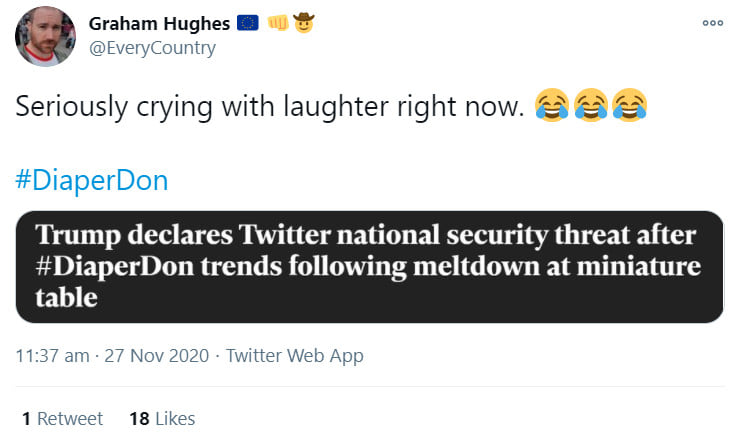
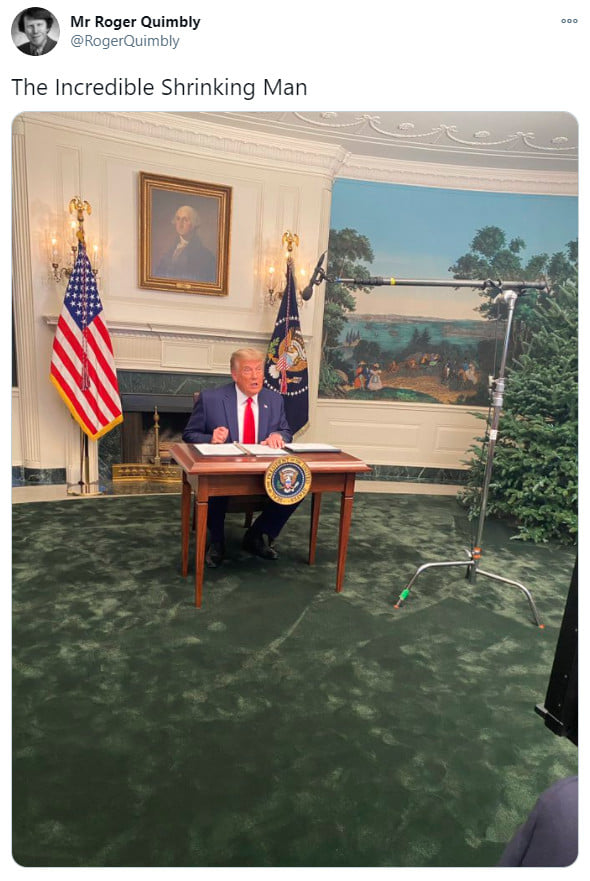
Trump has (another) paddy
The Sia Controversy
I had never heard of anyone called Sia before. Serkan tells me she’s some kind of singer. A few days ago, on the Disability Arts Facebook Group, I came across a post complaining quite vociferously that she has a new film coming out in the spring called Music: the problem was, while it was about an autistic person, Sia hadn’t cast an autistic actor to play her. That, of course, echoes or perhaps usurps an argument people with physical disabilities have been making for decades. Perhaps the most notable example is My Left Foot (Jim Sheridan, 1989), which famously involved Daniel Day-Lewis playing a man with severe cerebral palsy. Only people with disabilities should be used to play characters who have that disability; only they can convey the lived experience. Otherwise it’s the cultural equivalent of blacking up.
That is an argument I completely agree with, and which I have made many times myself. In this case, however, what I read did not sit comfortably with me. For starters, the articles linked to from Facebook made absolutely no reference to the campaigns preceding it. It read as though they were saying something new, and that only those in the autistic community had been treated that way. Frankly it felt like a form of cultural intrusion. These days, it feels like more and more people are defining theirselves as autistic or neurodiverse, based upon wider and wider criteria. They then define theirselves as disabled, although they have no real knowledge of what it’s like to live a life like mine. They then style theirselves as disability rights campaigners or activists, taking the very language others have used for decades and applying it to theirselves, while seemingly ignoring what went before.
I realise this is controversial, but I find it infuriating. Of course it isn’t my place to cast aspersions on anyone else’s disability. Yet I know from my experiences, both growing up in a special school and now volunteering at one, what autism, particularly severe autism, looks like. It is profoundly disabling: people with autism need constant support; many are unable to communicate, even with a communication aid. From the look of the character in the trailer for Music, she has quite profound autism. There is no way you could get a person with such severe autism to act in a feature film; they simply wouldn’t understand what they were doing and, as Sia herself has said, it would even be cruel.
Yet now there seems to be an abundance of (usually) self-defining autistics on the web up in arms because they didn’t cast a person with autism in the role. Without wanting to generalise, it seems these people often have fairly little first hand knowledge of autism, but have diagnosed theirselves based upon a rapidly expanding set of criteria and what they have seen on programs like the Big Bang Theory. They like to imagine they are different from others (and, let’s face it, who doesn’t like thinking they’re special?) Once they decide they are autistic, they, perhaps unconsciously, seem to adopt the sorts of behaviours they think suit their new identity. Yet, put bluntly, they don’t know what they’re talking about: most fall well within what constitutes normal, healthy and able-bodied; thinking of theirselves as different only causes further upset. Expanding the criteria of what constitutes conditions like autism only encourages people to play such games. To be clear I’m not disputing anyone’s right to claim to be autistic, rather suggesting that the spectrum is becoming so broad that most people have traits which could be termed autistic, and that more and more people are focussing on those traits to differentiate theirselves from those they call neurotypical; an act which is becoming increasingly political. They do not need the constant support those with severe autism do, and not so long ago would have probably just got on with their lives. At the very least, they are capable and aware enough to make things like vlogs. Yet they argue that they are being underrepresented and disenfranchised because an actor like them wasn’t cast.
In other words, this argument is not theirs to make. The irony is, a person with autism as severe as this film seeks to depict wouldn’t have the political awareness to make such arguments. Thus those criticising Sia are not only usurping an argument from the wider disability community, they also presume to speak for others within their own.
Shatner: Star Wars is Fantasy
After yesterday’s melodrama, it’s time for something a bit more fun. Amusingly, Bill Shatner has apparently stoked the debate over whether Star Wars is science fiction or science fantasy. No doubt he triggered quite a few Star Wars fans, but I see his point: the whole concept of the Force puts the franchise firmly in the fantasy category. Mind you, I must say that the same criticism could be made about contemporary Star Trek. While Warp drives might just be possible if we found some way to bend spacetime by manipulating gravity, the idea of a Spore drive which runs on mushrooms is utter bollocks. This might thus be a case of people in glass houses throwing stones.
The Wiser Course
Some of the wisest people I have ever known were also the most patient and forgiving. They knew when to fight and when to forgive, and that the latter was by far the wiser course than the former.
I regret to say that yesterday I had the same sort of trouble at Tesco that I experienced last week. Basically the same member of staff had been shirty towards me, and this time yesterday afternoon I was incandescent with rage. I again reported it to my parents, who then phoned the store manager.
This morning was quite busy for me: I had a couple of things I wanted to sort out up in Eltham. On my way back I was getting hungry, so I decided to grab a sandwich from tesco. It was then that I had an idea: enough, I decided, feeling Lyn’s wise old eyes upon me, was enough. After I had payed for my lunch, I asked if I could speak with the girl who had given me so much friction. I was asked to wait as she was busy, but ten minutes or so later she came to talk to me.
I told her that if I had done anything to upset or insult her, then she had my apology. I wasn’t at all sure I had, but surely this course of action was far better than letting resentment and misunderstanding simmer. She said she was sorry too, and hoped we could be friends.
I accepted her apology gratefully. I could tell she wasn’t a bad person: this whole debacle had probably just arisen from misunderstanding and ignorance, and I find the best remedy for both of those is communication. People sometimes act awkwardly around me because they don’t understand me or are afraid, and I find the best cure for that is just to talk to them. It has been a long, dark, shitty year, and people are feeling the strain. Tempers are flaring more and more, but if we just keep talking to each other, if we keep forgiving each other, we’ll get through this all the quicker.
With that, I bade her Live long And Prosper, and made my way home to eat lunch.
Darwin’s notebooks missing
No one even vaguely interested in either history or science could fail to be heartbroken by this news that Charles Darwin’s notebooks have been missing, presumed stolen, for twenty years. ‘One of them contains the 19th Century scientist’s famous Tree of Life sketch, exploring the evolutionary relationship between species. Following an “extensive search”, curators have now concluded they have probably been stolen. They are launching a public appeal for help in trying to find them.’ The theory of evolution is one of the most important scientific ideas ever. That the notebooks containing it’s very beginnings could have disappeared is surely tragic.
Takeaways
I’m not sure if this is really blog-worthy, given it’s something anyone else might do fairly regularly, but I’m just pleased how it turned out. Yesterday I had a nice little ride to Greenwich. It isn’t far, and I can easily make it in my powerchair. Coming back, it was getting dark and I knew I needed to buy something to eat. I thought I would have to go all the way up to Tesco, but, passing a friendly looking takeaway, I popped in.
Using my Ipad of course, I asked for two portions of fish and chips. This, I was told, they didn’t sell – would chicken be okay instead? That sounded fine, so I agreed. But then I asked for them to deliver it to my place at seven, about two hours later, when I knew Serkan would be here. The guy said that would be fine, so with that I set off home.
By seven, Serkan was here and I was watching television. I was starting to eye the clock apprehensively, wondering if my idea to take the initiative and sort out my own dinner was such a great one after all: had I told the guy the right address? A few minutes later though, halfway through Countryfile, to my great relief the doorbell rang – dinner had arrived.
I know it’s not much in the grand scheme of things, but it’s another of those small achievements which let me know what I’m capable of. Now I know it works, I can do it again; and it only cost four quid. The only problem was, I forgot fried chicken has bones in, making it a pain to eat. Next time I’ll get fish.
Festival UK 2022: Fiddling While Rome Burns
While I might have got slightly excited about the queen’s platinum jubilee in two years time, I’m not so keen about the fact it coincides with the much-derided Festival UK 2022. Artists and comedians are apparently distancing theirselves from it left, right and centre, on the grounds that it’ll essentially be an orgy of jingoistic nationalism. It’s blatantly obvious that the Tories just want to set the clock back to the golden summer of 2012, to a time when everyone felt good about the country and weren’t irreparably divided into two bitterly opposed camps. They’re using the platinum jubilee, combined with the ten year anniversary of the London Olympics, to try to paper over the horrendous damage they’ve done to the country over the last decade.
The tories have got Martin Green, former Head of Ceremonies for London 2012, to organise this charade, giving him a budget of £120m. He said it will be about ‘bringing people together’ and celebrating our nation’s diversity and talent, and that details of the ten planned events will be announced in a few months time. But you have to ask: what sort of perverse mentality thinks about organising a festival like that in the midst of a global pandemic, massive recession, and when the country is about to commit economic and geopolitical suicide? The UK is suffering, and rather than healing wounds this ‘Festival of Brexit’ will add insult to injury.
The country is being governed by bullies
It should be quite obvious to anyone even vaguely interested in politics that the country is now being governed by arrogant bullies. I have just watched the lunchtime news: Who the smeg does Boris Johnson think he is? His Home Secretary was indicted for bullying in a report by the civil service, and he just lets her off as though he believes that, as Tories and members of the supposed upper class, they have the right to look down upon and bully everyone else. Patel was found to have broken the ministerial code; she should be out of a job, but to Johnson that doesn’t matter. It’s as if he thinks he and his government have a right to look trample over the rest of us like some eighteenth century plantation owner, born to rule over slaves kidnapped from Africa. For all his pretence to be affable, roguish and likeable, it ought to be quite clear that Johnson is nothing but a bully who defends bullies. He doesn’t care what anyone else, including the civil service, thinks. Are we really going to let this bastard or Patel, get away with it?
There is no Disability Paradox
For the second time this week, I find myself incandescent with rage. This time, though, it’s not with my local supermarket but the BBC. I usually like the documentaries the Beeb airs, but last night they screened something I found utterly, utterly disgraceful. It is my honest opinion that, in terms of the representation of disability in the media, The Disability Paradox by Chris Lynch sent us back decades.
For a long time I have known that I am capable of anything I put my mind to. I may have a disability, but with the right equipment and support, I’m just as capable as anyone else. Let’s put it this way: I may use a special contraption to feed myself, but the food tastes just as good. Most of my friends with disabilities, including and especially Lyn, had the same attitude. Yet to hear Lynch talk, I should be feeling sorry for myself, bemoaning the fact I can’t do things others can; and the fact that I don’t wallow in my own self pity was some kind of paradox.
Why should I feel so sorry for myself? Here I am, living independently in one of the greatest cities on earth. So what if I need a bit more assistance to do things others may find easy? Other people may be unable to climb mountains, so they use a bloody helicopter! I also know that there are people who need far more support than I do. Thus what right have I to be any more happy or sad than anyone else, just because I have a disability? Further, my friends with Muscular Dystrophy, for instance, had a condition which slowly sapped all the strength out of their bodies, leaving them paralysed and eventually suffocating them, in most cases before they reached twenty. I never heard them spew the type of cloying, whiny bullshit we were treated to last night; they just got on with their lives. That’s why to hear it coming from someone so relatively capable pisses me off so much.
I fear that for the BBC to allow this program to be aired, to frame disability as something one could feel miserable about and to problematise how someone like me could feel happy, does a great disservice to the representation of disability. Granted, lynch could well have body dysmorphia, depression or other psychological issues, but truth be told part of me wants to find the lachrymose twat and slap him. In presenting disability so negatively, he invites others to feel sorry for us. For zark’s sake the dude was shown driving, bombing around in an awesome new powerchair, and doing things I can only dream of; yet he gives himself the right to pity himself because he can’t, or thinks he can’t, do everything others can. There’s no denying that we sometimes need to fight for the support and equipment we need, or to stand up for ourselves against discrimination; yet that is no reason not to be proud of yourself or question your right to ever be happy – indeed, it’s quite the opposite. My fear is, people might see this bald fool and assume all of us crips think like he does.
Issue closed
Just to update everyone about my entry a couple of days ago, after posting a formal complaint to the Tesco website, and after getting Dad to phone their customer services (Dad’s good at that sort of thing), I have now received an apology and an assurance from Tesco that the matter will be addressed. I now consider the issue more or less closed. Of course, one or two of my friends have suggested that I find another store to shop at, but given that that particular shop is my nearest and most convenient moderately sized source of daily essentials, I’m reluctant to change my shopping habits just yet. Mind you, that could change if I get any more trouble there.
Scottish Questions
The subject of Scottish independence is in the news again, and once again I find myself torn in two. I suppose it’s a question of which is more noble: is it better for a fixed group of people to govern theirselves and decide their own fate, or for everyone to work together as one? If everyone united we risk becoming one big grey homogenous whole; divided we risk separating into smaller and smaller groups forever bickering over fewer and fewer resources. Unification would eventually lead to the erosion of diversity and probably democracy, as states become too big and unwieldy to properly represent all it’s citizens; yet separation would lead to nationalism, animosity and xenophobia.
Which, then, is the more noble aim? As a liberal socialist, which should I support? In the case of Scotland, should I see the independence movement as the understandable urge of the Scots to free theirselves from a UK sinking under a catastrophic Brexit; or read in the SNP’s calls for a second independence referendum the same petty, power-hungry nationalism that I see in the Outists I despise? I could dismiss Sturgeon’s call for a second Scottish referendum as childish pettiness provoked simply because she didn’t like the result of the first; but would that not render my own desire for a second Brexit referendum hypocritical?
Don’t both Scottish Nationalism and Brexit boil down to the same basic nationalist drive? If the scots have a right to free theirselves from the UK because the Tories do not represent them, could the same be said of London, which is more left leaning and pro-European, with an even bigger population. If Scotland wants to be it’s own state, shouldn’t London? Why is one idea absurd and not the other? At the end of the day, isn’t it better to remain as one? Then again, where would that leave democracy?
Oh what a mess.
Disgraceful treatment at Tesco
Something happened just now which has me fuming. Yesterday on the bus home we passed a shop not far from Eltham I liked the look of, so this morning I decided that a trundle was in order. In the end it turned out to be a wild goose chase, but I enjoyed the roll anyway. Coming back though, I decided to pick up some lunch at my local Tesco, where I usually shop. Everything was going well until I got to the check-out.
One of the women who works in there really doesn’t like me. She always treats me like an idiot and talks as though I’m not there. This afternoon it was worse than ever: in front of all the other customers, she told her colleagues how she didn’t like helping me, and thought she shouldn’t have to do it. When I then tried to speak to her, she then totally ignored me. I have never felt so insulted. Given that this wasn’t the first time this particular member of staff has treated me like this, I now intend to take this further and possibly lodge a formal complaint.
This cannot be allowed to stand.
An afternoon out
I just got back from a bit of an adventure. I had heard a lot about the Bluewater shopping centre, being the biggest mall in Europe, but in over a decade of living in London, I had never actually been. Today though, thirsty for a change of scenery, curiosity got the better of me. I know the current advice is not to go five miles away from home, but I haven’t been outside east London all year. Checking the TFL website, getting there would only take two bus rides, so I didn’t think it would be too bad for an excursion on a gloomy Sunday afternoon.
As it turned out, it only took an hour or so to get there. Once there, I spent an hour or so whizzing about the massive shopping arcade: it was deathly quiet with half the shops shut. Of course I wasn’t there to buy anything, but to see what it was like for future reference; and I must say I was quite impressed. The architecture was fairly stunning, and it absolutely dwarfs The Trafford Centre. Built in a former quarry, it even has a small boating lake. Possibly the highlight, though, was bumping into and having a short conversation with a fellow powerchair user with CP who had quite a cool transparent cover completely enveloping his chair like a tent, presumably to guard against both viruses and weather. I assume he was just enjoying an afternoon out, like me, but if I’m going to enjoy many more outings like this I probably ought to look into getting a covering like his.
Diwali
I heard on the news today that it is the Hindu festival Diwali. Of course, my attitude to it is the same as my attitude to all organised religion, but thinking about it earlier, the word pricked my curiosity. It obviously comes from India, but could the word ‘Diwali’ share an etymology with the English word Devote or Devout? Wiktionary says that the latter two stem from Old French and before that Latin, but they sound so similar that it makes me curious enough to note it here. It could just be a coincidence, but the similarities in both sound and meaning strike me as rather uncanny. If they do share a root, that would suggest some form of ancient protoindoeuropean.
Anyway, to anybody reading this celebrating today, stay safe and have a good day. Namaste.
Tis but a scratch
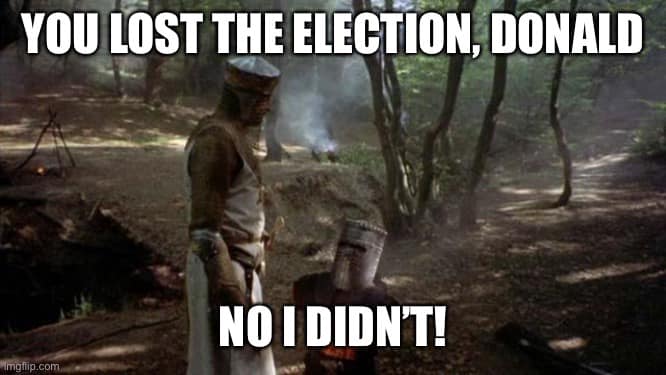
The final line of this scene, ”You’re a loony”, seems increasingly pertinent.
Platinum Jubilee Plans
Not that I’m particularly a monarchist or anything, but the plans for the Queen’s platinum jubilee in two years were announced today. I must say I find that quite incredible: arguments about democracy and monarchy etc aside, the fact that the queen has been on the throne so long, reigning throughout not just my lifetime but my parents’ is surely pretty extraordinary. I like the fact that they’re already planning the celebration. Of course, I’m hoping that James Bond makes another appearance, like he did in 2012 (I know that was for the London Olympics rather than the Golden Jubilee, but even so). The only question is, who would be playing him?
Should some mysteries remain unsolved?
Watching the news coverage of armistice day earlier, quite an interesting thought occurred to me: would it now be possible to find out who the unknown warrior buried in Westminster Cathedral was? These days we have pretty accurate DNA testing, so presumably it would be possible to open the tomb, take a sample probably of bone and find a bit of DNA. The identity of this anonymous soldier could then be found, and in theory his family could even be traced. A century-old mystery would then be solved. I’m sure I’m not the first person this has occurred to, and I suppose the question is, would we want to? The point of the Unknown Warrior is that he stands for all the soldiers killed in action, and finally establishing his identity would destroy that metonymic power. Solving historic mysteries is one thing, but maybe it would be better to let this one remain unsolved.
Corrections
All right, I admit I can be a bit of a numpty on here sometimes. Before writing yesterday’s entry, I should have checked what I was talking about. When I got to my computer earlier, there were a couple of emails (I won’t say from whom) reminding me that James Doohan was Canadian not Scottish; that Dominik Keating, who played Lieutenant Malcolm Reed in Enterprise, is from Leicester; and that Jason Isaacs is also British. I genuinely didn’t know about Scotty and Keating slipped my mind, but I must admit I ought to have remembered about Isaacs, having been watching Discovery so recently.
Oh well, in the grand scheme of things I don’t think such small mistakes matter, and are easily corrected. What concerns me more though is the way in which, these days, people seem less and less willing to correct their selves. Online especially, people are growing more and more belligerent. Even when faced with clear evidence, they refuse to admit they were wrong. This applies especially to politics, and the prime example is what is happening in America right now. I may have made a few silly mistakes in my blog entry yesterday, but at least I’m not refusing to concede an election I obviously did not win.
Two geeky, Trek-Related Thoughts
I have recently been binge watching Star Trek Discovery, rewatching it from the beginning in case I missed anything before going on to season three. Compared to other Trek incarnations, I still think it’s pretty awful: a lot of bunkum about spore drives, parallel universes, and chasing Spock around the galaxy without ever actually seeing him. If this wasn’t Star Trek I would have given up on it ages ago (in fact I did, and recently decided to give it another chance.
Now, indulge a trekkie if you will, but two thoughts occurred to me while watching an episode this afternoon which I think I need to note: firstly, have you ever noticed that all the best Star Trek series have British characters and/or actors in lead roles? The Original Series had Scottie, played by James Doohan; The Next Generation had Jean-Luc Picard, who, despite being a supposedly French Character, was played by a great english actor, sir Patrick Stewart; and Deep Space Nine had Dr. Julian Bashir, played by Alexander Siddig. Surely it can’t be a coincidence that these were by far the best, richest incarnations of star Trek, and they were the only three with British Actors? Of course you could add Colm Meaney to that list, who played miles O’Brian in DS9, although he’s Irish. Voyager, Enterprise and Discovery were flops in comparison, and none had any Brits.
However, that takes me on to my second geeky thought, also cast related: in Discovery, Section 31 looks like it will take a major role in future seasons. Starfleet’s secret service has been mentioned once or twice in past incarnations of Trek, but not really fleshed out. That got me thinking, how awesome would it be if the head of Section 31 was played by Dame Judi Dench? If that somehow became reality, and she was revealed sitting behind a desk on earth wearing a grey suit, I think it would make my year.
25 years of the DDA
I wouldn’t be much of a disability rights campaigner or commentator if I didn’t direct everyone here. Yesterday was a very auspicious day: Twenty-five years since the signing of the Disability Discrimination act. A quarter of a century since a group of Disabled people took to the streets of London, handcuffed theirselves to busses, and began the fight for the same basic rights everyone else naturally enjoys. Thanks to that Act, I, as a disabled man and powerchair user, can now live independently in London. I doubt many outside the disabled community would realise the profundity of the difference that act made to lives like mine. Every time I get on a bus or tube train, I think about the activists shown in this BBC news clip made twenty-five years ago. Yet, as noted in the video, there is still quite a way to go until equality is achieved: nowhere near all the tube stations are accessible for one, and that is just the tip of a very large iceberg, so it’s now up to guys like me to continue the pioneering activism began by these disability heroes.
Has the tide now turned?
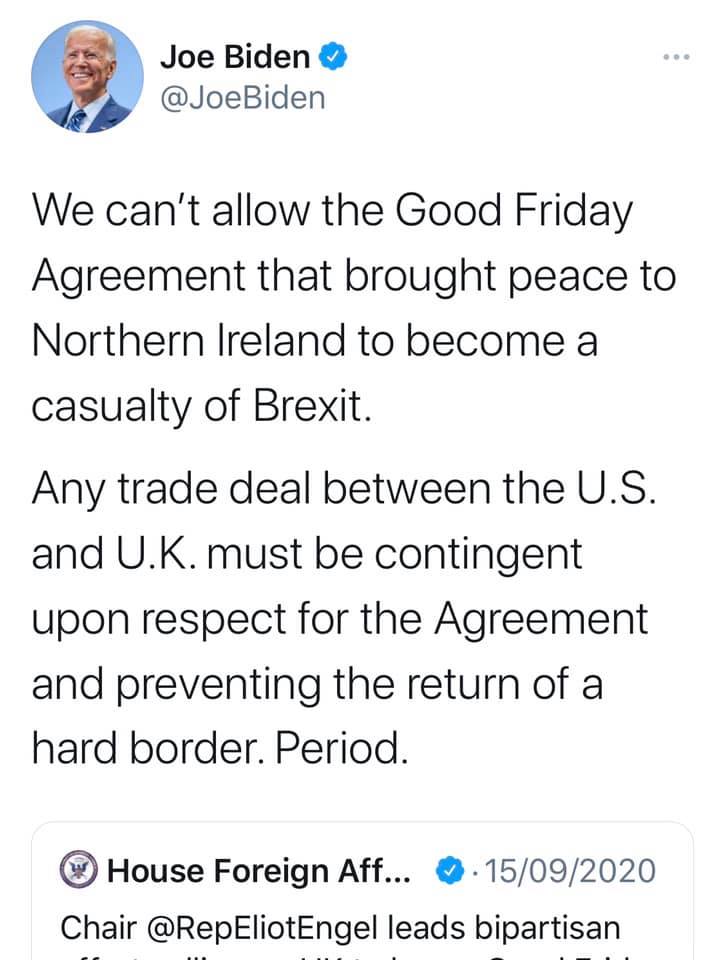
It’s definitely starting to look like the events of this week will have consequences for brexit.
America is Likeable Again
A couple of hours ago after posting my previous entry, I popped to the shop for some bits. When I got back to my computer, my heart filled with joy. I saw the best bit of news in months. Joe Biden is now president of America. In what has been a truly awful year so far, we at last have something to celebrate. Hopefully he can start to repair the damage done to his moronic predecessor. More to the point, what will the consequences be for us in the UK? We know that Biden is no fan of Brexit, so might the tories soon be forced to rethink? Now America has undone it’s stupid mistake of 2016, can we?
Breaking Middle-Earth News
I just got wind of some breaking news. Saruman is refusing to leave Orthanc, and is accusing the Ents of ‘stealing’ Isengard from him. Go here for the details.
The Real Deal
This morning when I got to my computer, one of the first things I read was this Disability News Service article. There has been a considerable backlash in the Crip Community against Liz Carr’s CripTales monologue, The Real Deal: many ‘activists’ are apparently appalled by it, saying it feeds directly into the right-wing tory narrative that benefit applicants cannot be trusted and are somehow faking their disability. Having just rewatched the short, I would certainly agree that it is very problematic. After all, it depicts a disabled person spying on her neighbour: he teaches her how to cheat in her PIP assessment, and she then reports him to the DWP. At best it is thus very morally ambiguous.
Of course, the whole point of art is to challenge perceptions and assumptions, and I think that is exactly what this monologue does. It isn’t at all clear whether Carr’s character is in the right or not, given that she judges another person for cheating the benefit system, yet is seemingly willing to get his help to do it herself. The way she describes both are quite horrific, for example going into explicit detail about the way she was told to present herself at her assessment. The viewer is thus deliberately challenged; this is clearly not the stereotype of the sweet, innocent disabled person.
I have had a few such assessments over the years. In each, I have found it best to be as honest as possible, telling the assessor what I can and cannot do. Can I cook for myself? Nope. Wash myself? Nope. Dress myself? Sort of. And so on. I have found it has given me broadly the amount of support I need to live independently. The thing is, I think the reason why others have reacted so strongly against this monologue is because there is a grain off truth to it. The assessment system sometimes forces people to exaggerate their impairment in order to get the level of support they think they need. The Disability News Service article cites people with hidden disabilities who say this film made them feel angry and distressed, as if it was accusing them of benefit fraud personally. I suspect those whose impairments aren’t as obvious and physical as mine might see it as a personal attack by illustrating strategies they might use, perhaps unconsciously. They argue that the assessment system is fundamentally geared towards those of us with physical disabilities by asking what people are and are not physically capable of, and so disenfranchises people with hidden or mental impairments. You can still be disabled even if you can do everything on the assessor’s checklist.
I can certainly see why beginning to articulate such moral ambiguities might cause certain people to feel challenged. Whereas people like me tend to want to minimise our disabilities and get on with life as independently as possible, albeit with the right support and equipment, others seem to feel forced to highlight the degree to which they are impaired. The way in which Carr describes her neighbour asking if he could borrow her powerchair for his assessment because ”You never know what will happen in a year or so” might well strike an uncomfortable chord in some. I have written on here before about how increasing numbers of people now seem desperate to have their (usually hidden) disabilities recognised; I think it’s pretty obvious why they would find a film like this, which addresses the subjects of benefit fraud and whether someone really qualifies as disabled head on, so challenging. However, it is only when we begin to address subjects like benefit fraud to a wider audience, articulating it’s problems and ambiguities, that we can start to dispel some of the dangerous stereotypes associated with it. Thus while I found this film problematic, it was also quite brave.
The Cult of Trump
It doesn’t look like we’re going to get a result from the states any time soon. I have been pondering what is happening there culturally: By claiming to speak for and represent an apparent ‘silent majority’, is trump doing something both sophisticated and insidious? He is a self-proclaimed millionaire who says he sides with the poor working class; a man who has been on television throughout his life yet who opposes the media and dismisses news as ‘fake’. Trump thus occupies a set of contradictory positions, perhaps most of all by claiming not to be a politician yet occupying the worlds most powerful political office. Does doing so let him appeal to the type of uneducated working class person, who may feel excluded from a Symbolic / Media sphere controlled by educated liberal ‘elites’? Newspapers and TV channels are usually controlled by people educated enough to reject the views of people like Trump and his supporters, which is why such views do not get much representation in the media. But by telling his supporters that they are an underrepresented majority whom he alone stands for, Trump lets his supporters believe that their reactionary, xenophobic views are as intellectually valid as any other, and that the only reason why they are not represented in the Symbolic is that the ‘elites’ are biassed. Trump thus legitimises the simplistic, reactionary thinking of the right by establishing himself as a figurehead for it. Due to him, people think it’s okay to be an uneducated xenophobe, and such thinking is rejected by the media not because it’s flawed, but because the media is controlled by despotic elites.
He thus effectively empowers right-wing reactionism by framing those who reject it as an oppressive, elite minority. Ignorance and the rejection of education, especially higher education, is framed as advantageous; this also allows Trump to establish himself as his supporters sole source of information. Trump therefore has a hoard of ignorant, reactionary zealots following him with cult-like fervour. I find that very concerning indeed: whatever the outcome of the election, such a state of affairs, with so many people following one despotic, egotistical man so blindly, is surely very worrying. Whether he did so intentionally or not (and I rather doubt he is intelligent enough to make such a plan) trump has set himself up as a messianic figure to his supporters, both of the people and superior to them. This means that if he looses the election, his followers are so brainwashed that they would simply see it as another form of oppression by evil liberal elites, refuse to accept the result and probably become violent.
The Two Things On My Mind
To be honest it’s one of those days when there is something I know I ought to write about on here, but there are other, bigger issues on my mind. The first two Crip Tales were on BBC Four last night, and I don’t think I’ve ever seen disability explored more frankly, brutally or honestly. One by Matt Frasier and one by Liz Carr, these Alan Bennett-esque monologues really seemed to allow the speakers to open up about what to most viewers would be a mysterious, perhaps even scary existence. I enjoyed Carr’s especially, as it confronted the myth that we crips are all playing the benefit system. It has Carr speaking about meeting a man who tries to cheat in his disability benefit assessment, telling us how appalled she is by his attitude. By doing so, she lets the audience know that we crips are just as appalled by benefit cheats as they might be, if not more so since it gives all of us who need benefits to live a bad name.
Today though, such matters feel less important than usual. I’m more concerned by what is happening in America. Of course, I hope to fuck Biden wins and things can at last return to some semblance of normality there. The problem is, if he does, how will Trump and his moronic supporters react? Could things become violent? Many are now earnestly predicting something tantamount to a civil war, or at least months of turmoil. I dread to think what we’ll find the breakfast news bulletins reporting tomorrow. The Crip Tales are certainly worth checking out, but today they just serve to take our minds off the impending storm in the States.
Coup 53
I just came across this Guardian review of a new TV film called Coup 53 and think it might well be worth checking out. ”Made over 10 years by Walter Murch, the celebrated editor of Apocalypse Now and The English Patient, in collaboration with the Anglo-Iranian director Taghi Amirani, it tells the story of covert British intervention in Iran after the second world war and stars Ralph Fiennes, … as an MI6 spy in a reconstruction of a key incident. The film’s fresh perspective prompted widespread positive reaction among foreign affairs journalists, including Channel 4’s news anchor Jon Snow, who called it “utterly brilliant”. Gripping stuff indeed, promising to give us quite an insight into British imperialism in it’s death throes; although what caught my attention most was the casting of Ralph Fiennes. Now he’s playing M in the Bond franchise, is he becoming associated with spy films? I may have to wait, however, as the film’s release has apparently been blocked by some top British documentary makers, who ‘allege the film undermines their reputations by suggesting they kept government secrets when they first told the story on television in 1985 in the landmark Channel 4 series End of Empire”.
So long, Sir Sean
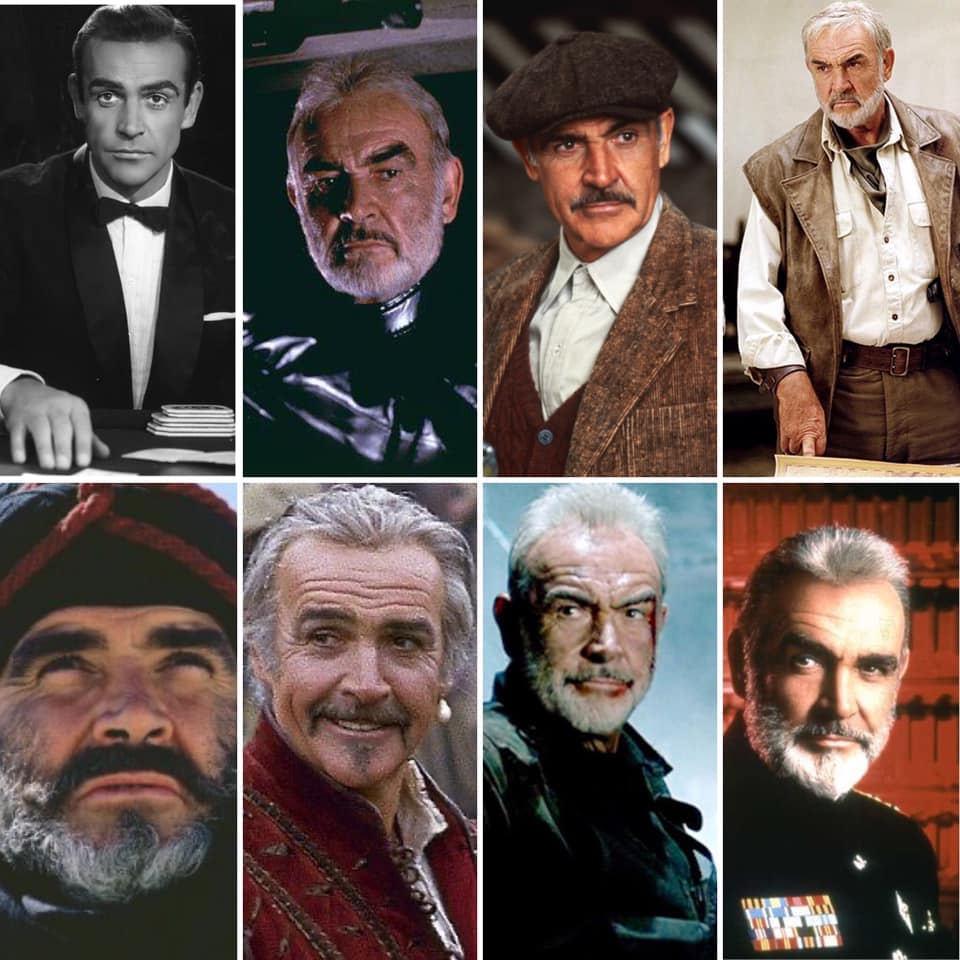
Cinema has lost yet another of it’s all-time legends.
 The Ill-Informed Ramblings of a Cripple