I know this is going to seem rather random and out of the blue, but I’ve recently become interested in the fact that Los Angeles is now trying to re establish its river. It stems from my interest in the Olympic Games, and how different cities use them as occasions to present themselves to the world. LA is now going to host the games in 2028 of course, but they are now apparently trying to breathe new life back into their river, which has been largely concreted over since the 1930s. What pricks my attention is how it might change the character of the city. The river appears in films like The Terminator, but it isn’t something which immediately comes to mind when you think about Los Angeles, and looks rather forgotten and drab from the pictures. I’ve written here before about how fond I am of London’s waterways, so I can’t help wondering how Los Angeles might change in light of this. Flowing water seems to give a new dimension to lived in areas, so I wonder whether they could be trying to break the city free of its image in popular culture as a concrete sprawl ready to host the world in two years time. Perhaps more to the point, you’ll recall how their respective rivers were large features of both the London and Paris olympic opening ceremonies, so I’d be very curious to see whether the Angelenos take up that thread.
Month: September 2026
Behind The Times with AI
Something happened a few minutes ago which made me feel very out of date. My PA Dom has an Ipad, and he was using an AI function on it to ask it about coffee. He was just kidding around, but what made my jaw literally drop was the way in which Dom was able to have quite a natural conversation with it: The machine seemed to be talking back to him, thinking, hesitating, considering it’s answers, switching between Polish and English on request.
I must admit to being rather behind the times on this. AI isn’t something I use much. I tap the occasional question into Google, but because I don’t speak clearly, I have never had the kind of conversation with my Ipad which Dom seemed to be enjoying. It thus amazed me how responsive it was, and how lifelike – you could have thought it was a real person talking back to my friend. Just how advanced are these systems becoming? As enthusiastic for new technology as I usually am, what I saw earlier was so astonishing that it made me feel rather behind the times. Such tech seems to be primarily controlled with your voice, so I can’t help feeling somewhat left behind.
No Right Whatsoever

Frankly, the mere sight of this self-important, egotistical scumbag speaking at the UN makes my blood boil with rage. He may somehow currently represent Americans, but he does not, can not represent humanity.
More Bus Guilt
Just to update this entry from last Sunday about taking up the bus wheelchair space, I ought to report that something rather similar happened today too. I was up at North Greenwich after quite a long trundle. It was getting cloudy and I was getting eager to go home for lunch. If you don’t know, at North Greenwich there is a large bus station where all the local bus routes converge. It’s also by the O2. It was really busy there today because there was a tennis tournament on.
I got to the right stop for my bus , and found there was not only a lady pushing a pram there, but also a fairly young man wearing a disabled person lanyard and pushing a walking frame. To be honest I assumed it would not be a problem: he could fold his walker up, sit on a bus seat and the driver could let all three of us on. However, rather to my horror and shame, after he had let me on in my powerchair, the bus driver shut the back door and retracted his wheelchair ramp. The, after letting the lady on with her pram through the front door, he refused to let the guy with the walker on because I was in the wheelchair space. I didn’t say anything, but it immediately struck me as blatantly unfair – the dude had been there before me. I thought I’d better blog about it because, with so many more people using wheelchairs and mobility aids these days, I suspect things like this are going to become more and more of a problem.
Jimmy the Giant on the Rise of the Far Right
It’s rather long and involved, but I certainly think this video by Jimmy the Giant is worth a watch. In it, he summarises the current status of the British far right. As we’ll all be aware, the movement, born largely from 1980s football hooliganism, is now seeing a resurgence. Certain demographics of people seem to be being drawn towards figureheads like Tommy Robinson through a misguided sense of insecurity. He highlights a few of the oddities and contradictions in the kind of nationalism we’re currently seeing becoming more and more prevalent. I wont’t try to summarise what he says, but to be honest it’s as interesting as it is horrifying.
Coyote Vs Acme
I went to see Coyote Vs Acme this afternoon. I must admit I was sort of looking forward to it, but left the cinema in Peckham rather puzzled. Don’t get me wrong: the animation was first class, and a reminder of just how advanced it is becoming, especially when it comes to the fusion of cartoons and live action. The thing is, I’m not sure what the film overall was trying to say. It is famously about a law suit between Wiley Coyote and the Acme corporation, but I was left wondering what there was to read into that: some kind of comment on big business? Capitalism? The American judicial system? The way in which neither of the two animated characters spoke but communicated by holding up written signs even made me wonder whether something about nonverbal communication could be read into it. Yet to be honest I felt it didn’t make any firm statements on any of these things. Thus While the film has quite a few cool jokes, and it was nice to see a few of the cartoon characters I grew up with making a comeback, to be honest it ended so openly and blandly that I was left very puzzled over what it’s whole point was.
Check out Mark Kermode’s much fuller review here.
General Draft Dodger
Not that I’m a very military guy, but does anyone else find all the pictures we’re currently seeing of Donald Trump saluting revolting? I just came across this report of President Xi’s visit to the US, and the bastard is pictured saluting like some kind of war hero or great general, hand pressed to his forehead as if he had spent a lifetime in the army. Don’t forget that this is a guy who famously dodged the draft to get out of being sent to Vietnam. Only a minor point perhaps, but surely there is no more vivid an illustration or demonstration of what a pretender Trump really is.
Totally Different Attitudes Towards Disability
I had an absence this morning, just before breakfast. It wasn’t a particularly bad one and nothing to worry about, but it was one of my first in a while so it was more or less due. I was thinking recently, though, about how I always tried to ignore those things, even convincing myself that I was imagining them: on the whole I think playing them down was far healthier than letting them get to me. Yet that seems to me to contrast starkly with the prevailing attitude today: sorry to go on about this, but people currently seem very eager to play up whatever medical conditions they might have, even blatantly exaggerating them and using them as the basis for their online personas. As someone who was always taught to play down his disabilities and just get on with life, this growing mass hypochondria is starting to seem very strange. Surely it is wiser not to focus on whatever disabilities or impairments you might have, rather than using them as the basis of your entire personality in order to attract attention and pity.
Insultingly Undeserved Awards
This morning finds me furious, by which I mean absolutely seething with rage. Over the last few months I’ve had my eye on a number of online sickfluencers now increasingly polluting the web with nauseating, self-pitying tripe about their supposed disabilities. It’s becoming more and more virulent, and the blatant misrepresentation of disabled peoples’ lives is becoming more and more perverse. It is clear that these people don’t have the faintest clue what life is actually like for disabled people, yet they continue to post their insulting videos online, presuming to speak for us as if they know our worlds better than we do ourselves. As I’ve said before, the whole phenomenon feels like a punch in the gut which I refuse to tolerate. One of them, a Youtuber calling herself Chronically Jenni, struck me as particularly patronising: an arrogant, self pitying young woman jumping into a powerchair and making videos about things she knows absolutely nothing about.
What has my blood boiling this morning, however, is that this girl is now bragging about winning a National Diversity Award for her work on disability representation. Quite frankly, I don’t think there could be a bigger insult to disabled people; it is akin to awarding the Black and White Minstrels an Oscar for African-American Representation. Watch her videos and you’ll be subjected to a stream of insufferably lachrymose bullshit in which people with disabilities are depicted as poor defenceless victims demanding everyone else’s pity. Hell, the first clue is in her title: no self-respecting disabled person would label themselves ‘chronic’, using an overtly medical term as a central component of their online identity.
Thus for this girl to have won this award – or at least be claiming to – really takes the biscuit. For one, there are a great, great many other disabled people on the web doing a far better job of disability representation than she does, and who have been online far longer than the laughable five years she has been calling herself disabled. Yet she is one of a growing number of online influencers identifying as disabled who think their obviously tenuous connections to the disabled community give them the right to speak for and over the rest of us. She is obviously totally ignorant of many of the political issues currently confronting the disabled community, but uses her YouTube channel to dress up and pose in powerchairs. I don’t know who decided to give her this ridiculous award, and they couldn’t insult the disabled community more if they tried.
I know I shouldn’t get so worked up about things like this, but it really feels like these ‘sickfluencers’ are attempting to rob guys like me of our voice and identity, using disability as a gimmick with which to attract online attention without really knowing anything about what they are talking about. To hear that such people are now being given awards for their insulting, condescending, gross mischaracterisations of life for disabled people really is more than I can stand.
Labels and Definitions
If you ask me, the question of the day – or perhaps decade – is, why does everyone suddenly want a label? On the breakfast news this morning, the top story was the alarming rise in young people being diagnosed with conditions like Autism and ADHD. As I think I’ve mentioned before, people also seem to be far more eager to categorise themselves as being Autistic or having ADHD than they once were: I now seem to hear people declare “I’m autistic” almost daily. The term seems to be being thrown around more and more lightly, as though people are becoming more and more eager to highlight their perceived eccentricity or other-ness. It’s almost as if it has become essential to be seen as a member of a minority or subgroup, particularly on social media, and that not doing so groups you alongside the oppressors. If you ask me, something very, very strange is going on.
Perhaps the obvious initial question is what could be causing this abrupt rise. If this was any other medical condition, there would probably be talk of an epidemic in the air. But I don’t think the normal rules apply here. Prevalence levels for more ‘traditional’ conditions and disabilities seem to have remained fairly stable, whereas those for neurological conditions seem to have shot up. If autism was like any other condition, surely you would expect it to follow similar patterns. Rather, I really suspect the difference is the definitions of conditions like Autism and ADHD has been dramatically widened: it is no longer the severe, extremely debilitating condition I observed at school, but now encompasses a wide range of – previously fairly normal – behaviours.
The thing is I can’t help suspecting that there is some kind of political motivation behind this definitional change. People seem more and more eager to assign labels to themselves, to be seen as belonging to one subgroup or another. It’s not that I dispute that levels of ‘mental distress’ are rising; I think rather that we are becoming too eager to categorise such behaviours and feelings as specific conditions, rather than accepting them as part of everyday life. As the definitions of conditions like autism have become forcibly wider, they have become little more than a sociopolitical bandwagon people are becoming more and more eager to jump onto. Thus we hear people ‘outing’ themselves as autistic, dropping it into the conversation at any opportunity, like it is some kind of badge of honour or status symbol. In assigning themselves such labels though, using such terms so arbitrarily, they gradually strip them of any real meaning, and force us to forget that autism is in reality a highly debilitating condition often requiring a lot of support.
Bus Guilt
I really feel ashamed of myself sometimes. I was in Woolwich again earlier, coming back from visiting Battersea. There is an array of bus stops there, and I was waiting for a bus to Kidbrooke as I needed to buy a few things before heading home. I had waited about ten minutes for the bus, and when one came I put my arm out to hail it as usual. It came to a stop just passed me, and when I swung my powerchair round to start to get on I saw a lady pushing her young daughter in a manual wheelchair towards it. What I now feel deeply ashamed of is my reaction: I just exploded, shouting my head off as though someone was robbing me. The lady let me onto the bus, obviously taken aback, but I now deeply regret my behaviour. I don’t know why I reacted so indignantly, and obviously should have allowed the woman and her daughter onto the bus; as it rolled away with me in the wheelchair space, I reprimanded myself that another would have been along in a few minutes. I have always had such outbursts due to my CP, but that doesn’t make me any less embarrassed by them.
How Could I Ever Like That Song?
I have a bit of a confession to make this evening. When I was small I was really into Disney films. I used to get my parents to play the videos again and again. I’m not sure why, but I think a large part of it was the music: as I touch upon here, I used to adore songs from films like Beauty And The Beast and Aladdin, to the extent that I used to insist my brother Mark played A Whole New World ad nauseum on the piano. When I was ten it was just about all I would listen to.
Something rather strange happened earlier though. I was going through Woolwich as usual, where there was a small funfair for children in the square. One of the rides was playing music, and as I was passing I caught a hint of the song: A Whole New World. Today, however, I was immediately struck by how cheesy it was. It sounded so saccharine and grating, as I rolled away I was astonished at how I could ever be so besotted with it.
Perhaps I’m just getting old.
On Masking
Look at me, look at me!
What do you see? The dribble sliding down my chin,
Or my wobbly, uncontrollable hands?
My disability cannot be hidden, cannot be masked.
It is part of me, part of who I am.
Obvious. Unquestionable. Real.
The first thing anyone notices, tethering me immediately
To a plethora of oppressive presumptions.
How wonderful it would be to deny my disability
Pretend it wasn’t there, mask it, as others now say they can:
To climb mountains, to play instruments, to cook dinner.
To break the binds of assumption, just for a moment.
Yet that would be to deny reality
For disability cannot be masked or hidden,
And those that can can’t be real.
As a chain which can be so easily broken does not truly bind.
Struggles Over Syrup
I admit I might be developing expensive tastes, but I seem to have developed a liking for toffee flavoured coffee syrup. It seems to add an extra dimension to my morning brew. The thing is, I have only been able to find it in Marks and Spencer’s food stores. That usually isn’t a problem, as there seems to be more and more of them popping up all over the place. Today, though, needing some more syrup I visited the one at the Woolwich Arsenal. I’ve been there quite a few times before and things seemed to be going well, but when the time came to pay the guy who was assisting me treated me so roughly and impatiently that I was really taken aback. He insisted that he could not find my wallet, even though I was pointing to the zip of my bumbag where it was. He quickly became rougher and rougher, more and more angry, and in fact he started to frighten me. No matter what I did, how hard I tried to indicate where he should look, he wouldn’t open the right compartment.
Fortunately in the end he found my wallet, and the incident only lasted a minute or so; but nonetheless it was extremely uncomfortable and undignified, and I immediately asked to speak to the manager. To have been treated in that way, to the point of almost being shouted at by a shop assistant, was completely unacceptable.
The Wrong Side of Knockholt
Today I thought it would be a great idea to go back to Knockholt. If returning from there had proven so easy two days ago, I reasoned, maybe it would be interesting to go back in explore the area some more. The thing is, what I hadn’t realised on Monday was that only half of the station was wheelchair accessible, and that the southbound platform could only be accessed via a footbridge with steps. That is why, at about two this afternoon, I found myself stranded on a platform with no way to go anywhere or get back onto a train. Needless to say it was extremely disappointing, as I’ve come to expect so much better from transport services in and around London.
Extremely fortunately, a group of maintenance guys were starting to work on the opposite platform: they spotted me, and one came across the bridge to see if I needed help. About half an hour later I was back on a train to Sevenoaks, then one back to the right side of Knockholt, from where I was able to enjoy a leisurely trundle home involving several long country lanes and several busses. Things turned out well in the end, but what baffles me is that, when I got onto the train at Lewisham, nobody warned me that I wouldn’t be able to leave the station I was heading for, and why only half a train station would be accessible.
City Limits
We all know what it feels like to be in a city: tarmac and concrete beneath us; buildings, often tall and metallic, on either side; the constant hum of traffic. An unceasing human maelstrom which, after a while of living within it, starts to seem like your entire world or the entirety of human existence. Yet I also know what it feels like to. be in the countryside: quiet, mellow lanes with vast patchworks of fields either side; blue skies and birdsong overhead; the occasional farmhouse, tractor, or fellow explorer. These two terrains are vastly different: one is modern, vibrant and dynamic, but the other might not have changed in centuries. So where does one end and the other begin? Where, exactly, is the threshold between a city and the countryside?
This is a question which I currently find very interesting. After so long living in a vast, wealthy city, can I find my way out of it? Of course, if I wanted to, I know I could just hop onto a train and get out of London within minutes, but that isn’t really the point. After so many years trundling around the city, through it’s parks and along it’s great river, I now want to find the point where the city ends and the country begins: where the urban landscape I’m now so used to gives way to the rural landscape of my childhood. I think that is what I was looking for yesterday, and for a fleeting moment I think I found it. Some time into my trundle yesterday afternoon, after leaving Orpington and navigating my way through increasingly labyrinthine streets I found myself trundling along quite a main road. It still had a good, well maintained pavement, but the buildings and infrastructure on either side had given way to open fields. I could even smell horse or cattle poo! I could still hear traffic, but for a few minutes it reminded me of the Cheshire countryside I used to know as a child.
Of course, I didn’t go far before I began to fret about getting home, but I think it’s safe to say that I caught a glimpse of the interesting liminal space I was looking for. That fascinating spot where the built-up concrete sprawl gives way to green. If the countryside is a place of peace, calm and quiet, and the city is a place of vibrant unceasing chaos, then what is the space in between? A nether-world between industrial and rural, modern and archaic, which straddles them both.
Getting Home From Knockholt
I’m feeling rather pleased with myself this evening. I got rather lost this afternoon: continuing my ongoing efforts to get out of London a bit more, I caught a bus to Orpington. On the map it looked pretty close to the M25, so I assumed that once I got there I could just trundle beyond the city limits and down into Kent. The problem was, I quickly found out that the distances in question were much larger than they looked, and although I was pleased to get a few glimpses of farmland, after a while I began to wonder how I was going to get home.
While I think I was still within the M25, I had stopped seeing any London buses. Just as I was beginning to suspect that getting home was going to be a struggle though, I came across a small, quiet train station called Knockholt. It struck me that it would be worth seeing whether I could get a train back into the metropolis: it was a bit of a long shot, but I didn’t have anything to lose.
The problem was , rolling into the station, barely more than a dilapidated shack, I couldn’t find any staff. I gathered from the map on the wall that I could get a train from there to Lewisham, from where getting home wouldn’t be an issue; but for that I needed to find someone who I could ask about wheelchair ramps. Ordinarily I roll up to a member of station staff and tap out what I need and where I want to go on my iPad, but there wasn’t anyone in sight.
However, on the wall I noticed one of those round things were you can press a button to request help. I had never used one before as I assumed that I would have to speak verbally into it, which would be problematic. Would they be able to hear my speech synthesiser? And if the person I’m talking to can’t see me, how will they know that I’m typing into my Ipad in order to communicate with them. This afternoon though, wanting to get home in reasonably good time, I decided to give it a try; and to be honest it went surprisingly well. The lady on the other end was patient, giving me time to type and then informing me that she would arrange someone to come on the next train to help me with the ramps. Twenty minutes or so later, the train arrived, a young woman in a high viz vest got out to help me aboard, and I was soon speeding my way back into the metropolis I had just been endeavouring to find my way out of. It went pleasingly smoothly, and I immediately decided that I ought to blog about it.
Something that I had assumed would be difficult had once again turned out to be remarkably straightforward; panic had given way to relief, and then pride. I had mastered yet another of those systems everyone else seems to find routine. While you can say that it was just a matter of me getting onto a train and nothing to get too worked up over, the fact that I was able to communicate with the lady over the intercom and get the assistance I needed is enough to demonstrate that such things are possible. By breaking down such barriers, it feels like my world just grows bigger and bigger.
Autism is being Politicised
I’ve just got back from quite a long afternoon out and about in the south-east London, so I’m feeling slightly worn out. One of the first things to greet me upon getting back to Facebook, though, was a picture of a Torygraph headline in which a Reform donor, Ben Delo claimed that his autism meant he cannot cope with lying, which is why he supports Nigel Farage. I won’t repost the image here as I don’t want to smear shit on my website’s carpet, but it was enough to instantly make my blood boil. The scum of Reform are obviously trying to pervert current trends to their own sickening ends. For good or ill, people are now much more aware of conditions like Autism than they were ten or even five years ago; many more people are now said to be on the autistic spectrum. Delo is now blatantly trying to exploit that trend and use it as some kind of justification for his fucked up, reactionary politics.
As a survivor of the special school system, I know how profound and debilitating Autism can be – it’s nothing to be laughed at. To see the term being thrown around like some kind of sociocultural frisby, as it currently is, was bad enough. Yet to see this wretch of a man attempt to commandeer it for his neo-fascist politics, obviously thinking that people are more likely to vote for him if he claims to have autism as they might do, really is beyond sickening. By making this claim, he is either trying to state his membership of some sort of ‘in group’, or to say that his autism somehow makes him more capable to discern the political truth. Either way it’s a crass exploitation and politicisation of a very serious medical condition, and I find it utterly perverse.
Assisted Dying Bill Defeated
Part of me is rather disappointed that I didn’t go up to Westminster yesterday, to join the protest opposing the Assisted Dying bill. It’s obviously an important issue, and the kind of thing I think I should get involved in. As I said a couple of years ago, the danger of such pieces of legislation is that, while they might seem well intended at first, the danger is they start us down dangerous, dark paths. “I want help to end my life” can become “wouldn’t it be better if you ended your life, now that we can help you” with alarming ease. Thus I was relieved to see the vote went the right way in the end, albeit narrowly. Mind you, while part of me regrets not actually being there yesterday to show my support, this is the sort of thing I can see myself getting extremely worked up about, so in the end it’s probably better that I went elsewhere.
Twenty-Five Years
I’m not quite sure why, but today I thought I would pop up to the 9/11 memorial on the Olympic park, just to pay my respects. I didn’t head up there in any hurry, but more to check out what was going on. As fortune would nonetheless have it though, I got there in time to watch the commemoration ceremony happening there.
We all know what happened twenty-five years ago today: most of us can remember exactly where we were when we first saw the dreadful image of the world trade centre wreathed in smoke. I don’t need to go over it. The thing is, while in that moment of pain the whole world stood with our American friends, since then and particularly in the last six years they have done everything they can to dash away that friendship. Trump has reduced America to an outcast and a laughingstock. To be honest I currently see the country as a sickening disgrace no longer worthy of my respect.
Thus, as I sat outside the London aquatics centre earlier, listening to the speeches and recitals, I couldn’t help feeling a strange mixture of sadness tinged with deep frustration. After all, the catastrophe we are commemorating today was born out of the same kind of animosity and hatred which has now become so rife. Speakers there pointed out that, due to things like intelligence sharing another attack on the scale of 9/11 is now extremely unlikely; but I can’t help thinking that, if we as a society continue down this current path of reactionary intolerance, all the tears shed today may be in vain.
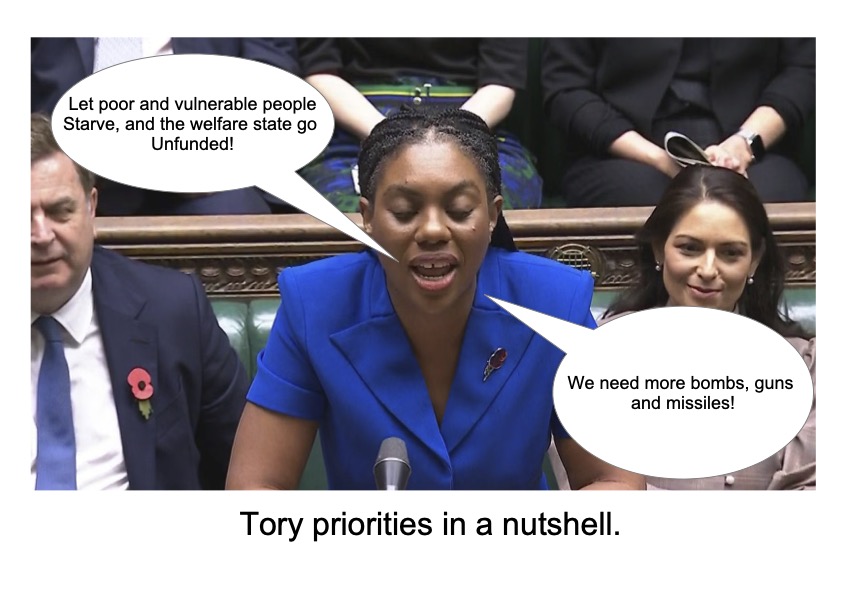
Tory Priorities in a Nutshell
Note On Not Blogging
Truth be told, with regard to blogging I’m now in a bit of a predicament. Particularly since the events of a few weeks ago, I’m now worried that if I fail to post an entry everyone will worry whether something catastrophic has happened to me again. That results in me forcing myself to blog, if just to make sure everyone knows I’m okay. Thus it’s probably best that I make it clear that if you don’t see an entry appear here every day, it doesn’t mean that I have been taken to hospital, exploded, or lost a cripple chicken contest with a granny on a scooter. After all, finding stuff to write about every day can be hard.
Taylor, Jackson and The Limits Of CGI
Picking up on what I was saying yesterday about AI generated videos and how advanced and impressive I find them, later in the day I came across this video rather putting that chain of thought into a different light. It’s an interview/conversation with Richard Taylor, the guy behind Weta workshop in New Zealand, the studio behind The Lord Of the Rings adaptations. To be honest saying it puts AI generated film in a new light is quite an understatement: it’s more like a direct conflict. It becomes very clear just how much care, love and attention guys like Taylor and Jackson put into adapting Tolkien for the screen, creating thousands of props and sets. Their effort was remarkable, and I think it shows on the screen. Over twenty years on, these films still look incredible.
The point these guys are making of course is that such films would never be made today – it just wouldn’t be an option. A studio would just go down the simplest, fastest, cheapest route and do everything using CGI. As stunning as I found the Star Trek videos I came across yesterday, I think it shows: it was ultimately obvious that I wasn’t watching real actors performing. The result is that something is taken away from film, which I think boils down to a form of love and passion for film-making. Frankly, as I touched upon here a few weeks ago, I think that goes some way to explaining the bland, uninteresting pap we see in cinemas these days.
How Are Videos Like This Being Made?
I don’t know who the zark made it or how, but I don’t think I could possibly call myself a Star Trek TNG fan if I didn’t flag this up. Not that I want to spoil it for anyone, but it’s a fan made video where the crew of the Enterprise find out they are actually a TV show. The thing is, it looks identical to how the show appeared in the 90s, with all the actors having been de-aged. I daresay it was created using some kind of AI tool, but nonetheless I find it remarkable (not to mention very funny!). I know I keep saying things like this on here, but if such videos are a sign of how advanced and sophisticated such fan production is becoming, then it really is jaw-dropping.
More Islands In The Thames
Just to follow up on what I was talking about a couple of weeks ago about islands in the River Thames, I just came across this fascinating video about that very subject. London’s largest river, it would seem, has quite a few islands, mostly upstream to the west of the metropolis. The majority are apparently small and difficult to get to, or protected wildlife habitats; but a few are large enough to visit or even live on. I’m not sure why this interests me so much, and I can see why you might find it boring; yet I just love how London still has the potential to surprise me through it’s vast geography, history, culture and everything else.
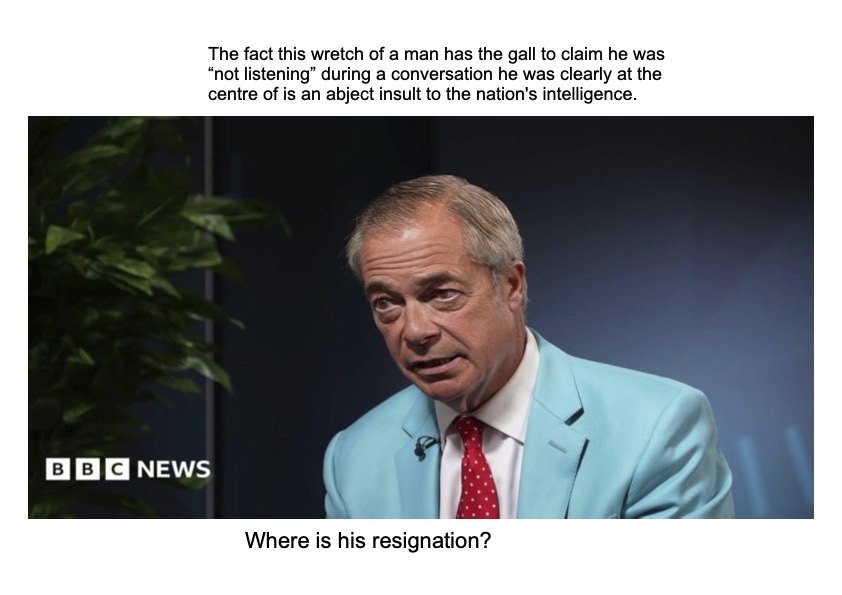
Not Listening My Butt!
Somebody Flips A Switch In Woolwich
I love how London always has the ability to surprise me. It had already been a fairly interesting afternoon: today I thought I would have a bit of a change and take a trundle along the north bank of the Thames, before finding my way up to Farringdon and catching the Elisabeth Line home. Perfectly pleasant, but nothing that noteworthy. Heading to the bus stop in Woolwich though, all of a sudden I found myself in the middle of a dance routine: a band was playing, an audience was gathering, and people, who were dressed like anyone else there, were staring to perform carefully choreographed routines. It was obviously part of GDIF. The square I had been passing through was suddenly filled with energy, music and joy, almost as if someone had flipped a switch. It was obviously a well planned piece of street art, but what excited me is the fact that I had just trundled straight into the middle of it: five minutes earlier or later and I would have missed the whole thing. It makes me wonder where else I could encounter such surprises.
Farage Caught Discussing How To Avoid Donations Law
The only possible place I can direct everyone to this morning is here. Farage and his mates have been filmed discussing how to get around UK electoral law. It’s disgustingly brazen of course, but to be honest it just shows how arrogant the scum behind Reform are: they think they are above the law, and have a right to do whatever they like just because of who they are. To add insult to injury, Farage is now denying any wrongdoing, claiming the footage is a hoax by climate change activists. If he had a shred of honour in him he would resign immediately; but of course he doesn’t, so he ought to be booted out of Parliament.
No Need To Worry
She’ll be fine you silly spasticated fool! Charlie is now a mother caring for her baby daughter. That and the fact that she always has about a thousand things going on means she is too busy to bother with social media these days. Not hearing from her or seeing her on facebook for about three months is no reason to leap to silly conclusions; and besides, the last thing she’ll need right now is you messaging her every few weeks or months just to ask how she is. Charlotte is a healthy, vibrant, able-bodied young woman. She isn’t like the guys at school: they all had serious life limiting disabilities. Thus there’s no reason for anything to have happened to her; no reason to expect an email, message or call from mum and dad with news which, this time, I simply would not be able to bear. No reason to continue to feel that chilling, agonising sense of dread in the base of your spine just because your old university friend hasn’t been on Facebook for a while. The same goes for Esther, Steve, Chris and the rest of them. Now cheer up, stop worrying and get on with the day.
Different Political Centuries
With regard to politics, all I really have to say today is that I would far rather the country was taken back to the 1970s, with it’s well regulated economy, properly funded state and membership of the European community, than the 1870s, with millions starving in the streets while the privileged, untaxed few looked down on the rest of us. For all Badenoch’s hollow words, the difference between Labour and the Tories has never been more stark: an open, progressive, left-wing party aware of the wreckage caused by Thatcherism and Brexit over the last forty years and keen to undo it’s damage; or a party of rich, ultra-privileged white toffs, craving the ability to exploit, dominate and persecute as they wish, resenting every penny of tax they pay, using a black woman as their puppet-leader while being as intolerant and racist as they come. In Andy Burnham, at last we once again have a voice of hope in British politics: someone aware of the mistakes and eager to undo them for the good of all. The Tories, on the other hand, just deny such mistakes were ever made as they seek to drag us all back into a neoliberal, Thatcherite cesspit.
Booyakasha!
You could say that it’s just another bit of nostalgia, and yet another revival of a nineties cultural icon, but I would be quite fascinated to check this film out in a few weeks. I remember Ali G being on way passed my bedtime, and only catching fleeting clips of him: Although I found it funny, I don’t think I really ‘got it’ at the time. Thus I’d be interested to see what my contemporary, urban self makes of him. In a world of wannabes and pretenders, I suspect that a spoof wannabe gangsta will have quite a bit to say.

