Stoke On Trent regeneration

I went up to the Westfield Centre in Stratford again this afternoon. I’m aware that I head there rather too often, but today I wanted to go somewhere where my cap wouldn’t keep flying off. I’ve mentioned here before how gobsmacked I am at the regeneration of Stratford, yet to be fair it’s happening all over London: brand new buildings are going up all over the place, and the city is about to get a glittering, new, multi-billion pound tube line. To me, though, that raises an obvious question: are other parts of the country getting the same amount of investment?

To that end, I just tapped ‘Stoke On Trent regeneration’ into Google and came across this BBC article. Stoke has – or used to have – a reputation for being a bit of a run down, neglected city. According to the article though, “Plans to turn a former industrial site into homes, bars and cafes in a £60m scheme have been approved. Construction work on the Goods Yard project in Stoke-on-Trent, near the railway station, could start this year, the city council said….The scheme has received £16m from the government’s Levelling Up Fund.” Say what you will about the Tories and their ‘levelling up’ bullshit, surely this is great news. As much as I adore London, I come originally from Cheshire and I still care about other, smaller places in the UK. I’m also aware of the giant imbalance in investment there has been between the capital and places which aren’t in the south-east. If this really is a sign that things are changing, it will be good to see places like Stoke come into their own after so much neglect.

Patronising Door-To-Door Salesmen

That is the second time that has happened in the last two or three weeks: I was just chilling at home on my computer, starting to think about lunch, when my doorbell rang. Of course I got up and answered it. A man I didn’t recognise was at the door, who started to explain that he was from some kind of alarm company. But as soon as he saw that I have CP, he started to back away and apologise for wasting my time. I tried to ask him what he wanted, but he continued to back away: he seemed to assume that I couldn’t understand what he was selling, or that I couldn’t be the person who is responsible for my own home. Not that I like door-to-door salesmen, but I find that very patronising indeed. Why do such people automatically think that someone else must be in charge of the security of my flat, or that I can’t be the person they need to speak to? As an independent man of nearly forty, such things really piss me off.

A Lack of Depth and Knowledge

I think the best thing I can do here today is flag this Owen Jones article up. In it, Jones furiously damns Boris Johnson as the privileged charlatan he unquestionably is: “If the phrase “educated beyond his intelligence” could sprout arms, legs and a contrived untidy mop, it would be [Johnson]. Oxbridge does not, unfortunately, lack his type: mediocre youngsters ensconced in privilege, whose pretentious vocabulary and unnecessary use of Latin disguises a lack of depth and knowledge.” Here we have a man who thinks political power was his birthright, and that the rules don’t apply to him just because of who he is. Today, the Met has issued twenty fines due to breaches in COVID rules at Ten Downing Street: while the rest of us were desperately trying to shelter from the pandemic, Johnson and his friends were partying as if the rest of us didn’t matter. I find that disgraceful, and if Johnson is allowed to remain in power after this, it would be nothing but an absolute insult.

The Oscars

I suppose there’s a lot for me to write about today. For one, film seems to be going through a total paradigm shift: last night at the Oscars, for the first time, a film released on an internet platform won best film. Apple TV’s Coda – a moving film about a deaf family with a hearing daughter – became the first streaming film to scoop the best picture award. This surely marks a shift away from cinemas and film’s traditional home. While of course you could put it largely down to the pandemic, I can’t help worrying that film is losing something: in the cinema, film is an all-consuming event which holds our complete attention for two hours. Watched on a computer monitor or mobile phone screen, film is rendered pausable and ignorable; it becomes far more lightweight and superficial. While I’m not saying streaming will be the end of film – if anything, it encourages people to watch more films because it’s so easy – I worry that it will start to be taken far less seriously.

More importantly though, this was the night when film about Deaf people starring Deaf actors won Best Picture. This is huge news in terms of disability representation. A small, low-budget film about people who are usually totally ignored in mainstream film has scooped the top prize. Surely this is a monumental, watershed moment.

But instead of talking about what an important night it was for the Deaf and Disabled community, everyone is talking about one guy punching another on live television for insulting his wife. It really makes me want to despair.

Charlie’s First Mother’s Day

Today is obviously Mother’s Day, so I’d first like to wish my Mum a great day. She and Dad are currently down in France with my brother Mark, Kat, and their grandchildren, having a great deal of fun playing Minecraft (among other things). More than that though, today is my friend Charlotte’s first ever Mother’s Day: the first Mother’s day since she gave birth to her daughter. I thought that was certainly worth noting. I really hope that she, little Olive and husband Alex are having a fantastic day, although, knowing them, I’m pretty sure they will be.

Exploring The Ravensbourne

The more I explore this city, the more it intrigues me and the deeper I love it. Following on from my exploration of the Leaway a week or so ago, I wanted to see what I could find of London’s other small rivers. Just west of Greenwich, on the south bank of the Thames, I had noticed another small river flowing into London’s mighty central current. I’d come across it last April, but had yet to explore it properly. Today I set out to see what I could find of it – it could well be as charming as the Lea. This morning, then, I set off down to Greenwich town via it’s mighty park, before heading west a few metres to find the mouth of the Ravensbourne. A few days ago I’d come across it again, running through a charming little park, Brookmill Park, near Lewisham. Today I wanted to see how far south you could follow it.

I soon refound Brookmill Park, and followed The Ravensbourne as it meandered south through the park. It is a much narrower river than the Lea; barely more than a stream. South of Brookmill Park, though, I was in Lewisham, and the river wasn’t so easy to trace. Saturday traffic hurtled along roads under which the river flowed through pipes. Yet, with the help of the handy maps which often spring, sapling-like, from London’s pavements, I navigated my powerchair through the maelstrom to refind the stream as it flowed down concrete channels past building sites and blocks of flats. South of Lewisham, it weaves in and out of an overground railway line: following the often-buried river wasn’t easy, yet eventually it brought me to Ladywell Fields, a wide, newly-established park through which the stream flowed in two or three channels. There, well maintained paths allowed me to follow the stream south through that peaceful place until I reached Catford.

By then, though, the afternoon was drawing on; trying to follow the river even further south may have been fun, but I didn’t want to make it too difficult to get home. I headed back to Lewisham, noting to myself how much harder the Ravensbourne had been to follow than the Lea: there was no lovely, wheelchair-friendly riverside path, and it had clearly received far less attention. You can occasionally find it running through well-maintained parks like Brookmill Park or Ladywell Fields, but between them the river is diverted through channels running alongside forgotten back streets. This was obviously one of London’s lost rivers UA Fanthorpe wrote of in Rising Damp. Yet perhaps that’s part of the fun: you only find rivers like the Ravensbourne if you look for them, but knowing they’re there and trying to trace them amid all the chaos of the metropolis is part of their charm.

“OK, fine!”

I’m not sure whether everyone has had a chance to watch the most recent episode of Picard, but I just did, and I really have to now flag up this moment of absolute gloriousness. It seems that Star Trek, as a franchise, has reached a stage where it can refer back and play with itself, nodding to previous episodes and films. Without wanting to spoil anything, this is one of those moments. As a fan of The Voyage Home, it really made my day not only to see this reference, but to see it being reread so amusingly. I love it!

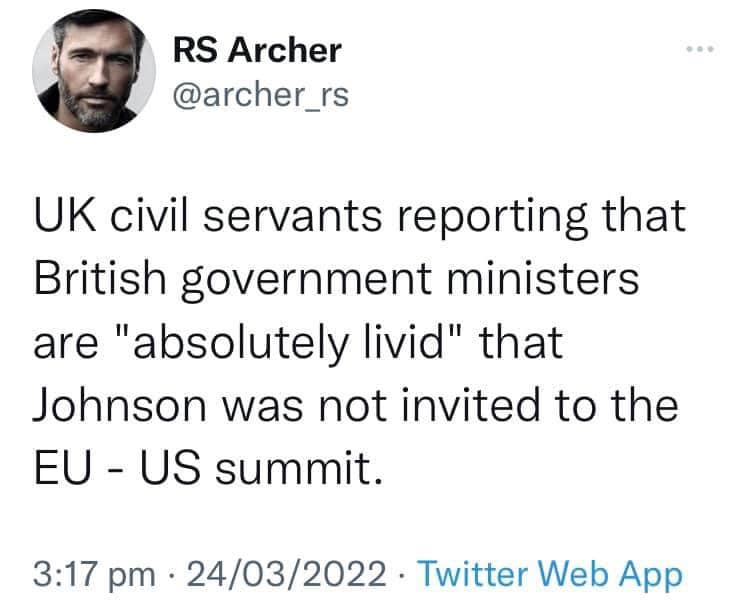
Absolutely Livid

Of course they’re livid, but it’s what they duped just over half the country into voting for.

Brexit has rendered the UK a total irrelevance, and the sooner the Tories crawl out of their own arses and admit that, the better.

The Second Dome

I’m not sure how much anyone else will have heard about this, but a jaw-dropping new dome has just been given the green light to be built in Stratford. The Maddison Square Garden arena will apparently be as tall as Big Ben and contain the world’s largest screen. I find it incredible, I must say: Interested in things connected with Stratford and the Olympic Park that I am, this is a story I’ve kept an eye on for a while. The regeneration of that area of London has been phenomenal, and this massive new dome will take it up another level still. Alongside the biggest shopping centre in Europe, I think an events/music venue was a logical next step.

Yet, it must be said, this project is not without controversy.  A thousand local residents have raised concerns about possible light pollution, and the O2 Arena has objected to having a massive new rival built so close. After all, the two venues will only be four stops apart on the Jubilee Line, and vie for the same business. Then again, by the time the MSG arena is up and running, the O2 – itself quite controversial in it’s time – will be about 25 years old, so I reckon it’s due some competition. As fond of the O2 as I am, I’m quite sure it will survive. Indeed, the two venues may well complement one another, and make East London even greater than it already is by drawing even more business, culture and creativity into the area. Either way, this is a project I’ll be keeping an eye on; another excuse to visit Stratford.

Today’s Trundle

I just found something rather cool out. I’ve mentioned here before how much I like to go for walks/trundles in my powerchair. Today’s was rather a long one, and I was wondering whether there was any way to plot my route out on Google maps. Getting home, I googled it and found there was quite a simple, straightforward way. It took me a couple of attempts due to the fact I ran out of destination points, and as a result only shows my rough route, but I’d like to invite you all to check this out.

A Watershed TV Moment

I think it’s safe to say that Then Barbara Met Alan is a landmark piece of television. When it aired on BBC2 last night it marked a watershed moment in disability politics and culture. It tells the story of the birth of the disability rights movement like never before, addressing an issue almost completely ignored by the mainstream media. It does so with passion and humanity, depicting disabled people as normal and average , who just happen to be fighting for the rights denied them by a society not yet equipped to meet their needs. At last truths which I, as a man with a disability, have known for a long, long time are being articulated and given voice on national television; our civil rights movement is often overlooked, but is surely just as important as any other.

Just as importantly, the people presenting such truths are their selves disabled people. As detailed here, many of the cast and crew who helped produce the film were disabled. This wasn’t a case of anyone presuming to speak for us for once, but disabled people speaking for ourselves. We are hedonistic and rebellious people who don’t want to be patronised by charity fests or pity porn. We know what rights we deserve, and are willing to fight for them. It felt so good to see disabled people at last being represented in this way: it was like an important, watershed moment. At last we can be seen for who we are, forced to fight for freedoms everybody else takes for granted.

Then Barbara Met Alan tells the a history which needed to be told; it’s just a shame it was so long in the telling. And I certainly hope there are more films like it to come.

I better just avoid the subject

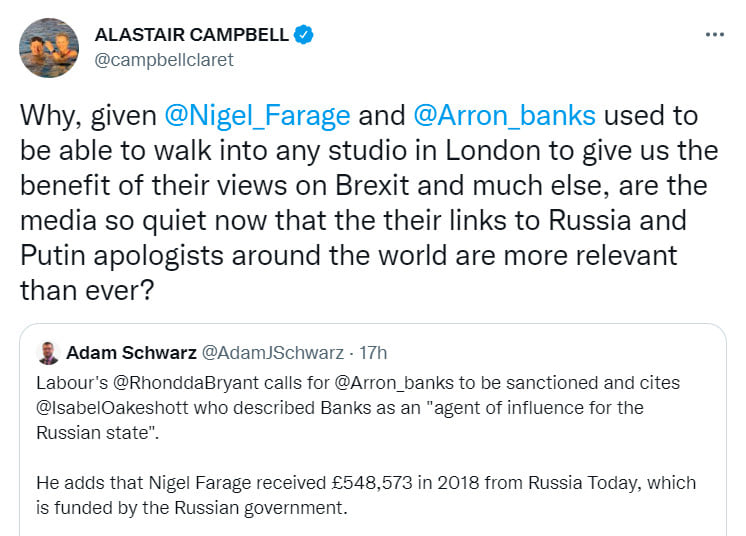
I suspect everyone might be expecting me to write something about certain comments made by a certain idiotic politician over the weekend, likening Ukrainian resistance to the Russian invasion to Brexit. But I’m not: I don’t want to comment on them, or even acknowledge that they were ever made. The fuckwit who made the comments is essentially likening those of us who oppose Brexit to Ukrainian traitors who side with Putin. How dare he? The scumbag must be booted from office immediately, simply for insulting the 48% of us who did not vote for Brexit so blatantly.

Writing anything more about these ridiculous comments would make me too furious; even the fact that the barely literate imbecile who made them has the audacity to think himself fit to be anything approaching our Prime Minister boils my blood. Thus I think I better just avoid the subject, for fear of damaging something.

On a far lighter note, remember to watch Then Barbara Met Alan, tonight, BBC2, 9PM. Should be awesome.

A Small Personal Act of Protest

I don’t know whether anyone else does this, but I seem to have fallen into the bad habit of raising my hard and shouting “Zeeg heil” whenever I see anyone picking up or carrying a copy of The Express or Daily Mail. I know I probably shouldn’t, but I doubt anyone recognises what I am saying or doing. It’s just a little personal act of protest, to mark my disgust at those right wing rags and their readership. How anyone can read, let alone believe, the right wing dross those rags spew on a daily basis really gets to me, and I can’t help taking the piss whenever I see yet another fool being duped. As I say, nobody realises what I’m saying or doing, so in a way it’s just my personal in-joke. Oh, how I enjoy having CP sometimes.

A March In March

I think it’s fair to say that yesterday was a very interesting day indeed. A week or so ago, I was invited by my friend Sue to go to a DAN protest up in Westminster. Truth be told, I didn’t quite know what to expect, but never having been to such a protest before I wanted to see what it was like. I have heard a lot about the historic actions of the Disabled People’s Direct Action Network (DAN): how, without their political activism in the seventies, eighties and nineties, guys like me wouldn’t be enjoying the freedom to live independently that I do; how, without them, public transport would still be totally inaccessible. The fact that yesterday was my birthday aside, I wanted to go and show my support for this historic movement.

I wasn’t disappointed by any means. I got there fairly early, giving me a chance to look at the statues. It had been a while since I’d been to Parliament Square, as every time I went I kept getting angry at the pro-brexit morons protesting there. Luckily yesterday they were gone, and the square was nice and peaceful. I waited a bit, before I began to spot other people in powerchairs arriving. I went to join them. I didn’t know them, but we instantly got chatting. As I said in my previous entry, it was a great chance to network.

Sat opposite the Houses of Parliament, close to the statue of Churchill (which sadly didn’t wave), we waited a bit. Before long, more crips arrived and the march got going. There were about twenty of us in all, with a wide range of disabilities. Sue Elsegood is a historic DAN activist of some renown, so she was asked to head the march. Escorted by two police officers, we headed from Parliament Square to the ministry of Health. There the plan was to deliver a list of demands and concerns to the Ministry, about the disproportionate impact COVID has had on people with disabilities. It hadn’t previously been clear to me that that was the purpose of the event, but nonetheless it had my full support.

Outside the Ministry we waited for a bit. The hope was that someone would come out to receive the list of demands, but it soon became clear that nobody was available. We were there for about an hour, blocking the doors: while the lives of many disabled people are a great deal better than they once were, there is a lot of work still to be done, making such provocative, direct action necessary. A lot of people with mental health conditions are still institutionalised, for example, making them especially vulnerable to things like COVID. I think it’s thus essential that we, as disabled people, keep alive the spirit of activism which got us to where we are.

After the protest, the plan was to meet up for a social at the BFI on the Southbank. Unfortunately this proved more complex than it should have been, but eventually most of the protesters met in a bar for a drink. Fascinatingly, I got talking to the producer of Then Barbera Met Alan, the forthcoming TV drama I mentioned a couple of days ago. By then it was getting late though, so I couldn’t stay long: I had dinner to eat. As I rode home on the tube, I reflected upon what a remarkable day it had been, the friends I had made and the networking I had done. It was my first proper experience of a DAN protest, but I hope now to get more involved in it. DAN is a truly historic, important movement: it has already won many battles, but it has a lot of work still to do. I hope I can now help it achieve it’s goals.
Tomorrow Will Be Interesting

I’m looking forward to tomorrow, and not just because it’s my birthday. Tomorrow sees the largest gathering of DAN activists in quite some time, up in Parliament Square. It’s to mark/celebrate the airing of the (probably) landmark BBC drama Then Barbara Met Alan on Monday. Of course I intend to go: it will be fascinating to experience a bit of disability culture/activism after so long a drought, as well as finally do some networking with some fellow crips. As much as I can’t wait to watch – and no doubt review – the TV programme itself, to be honest I think it has just given us a great excuse to get together after so much isolation and celebrate who we are.

Saharan Dust

I woke up this morning with an almighty cough. It worried me slightly, because I had gone to bed feeling perfectly fine. I got up and turned my computer on, still spluttering. And then I remembered: a large cloud of Saharan Dust had been forecast to invade the area. That must be it. I felt fine otherwise, but I’ve been spluttering all day. Apart from a short trip to the shop, I’ve spent the day at home. When I went, though, the sight was quite amazing: a thin layer of sand coated all the car bonnets and surfaces; it was quite incredible. Perhaps it would have even been pretty if it wasn’t so difficult to breathe. John and I kind of have a rough plan to go to the Sahara for our next crazy trip, but if this is what the Sahara is like I may have second thoughts.

The Leaway

London isn’t a place you usually associate with rivers. Think of the metropolis and brick, concrete and steel come to mind rather than pleasant little brooks. Yet as I have grown to know London I have fallen in love with it’s waterways. There’s the mighty Thames, of course, which I fell in love with ten years ago; but more than that there are the little tributaries which feed it. The river Lea as it flows down from Stratford is particularly wonderful. You can now stroll along it’s banks all the way from Cody Dock to the Olympic park, along a wonderfully peaceful, accessible path. It is a route I now take quite often. A great deal of time and care has clearly been taken to restore the Lea and the footpath which runs beside it to its rightful glory, and there are plans to extend the path to the Thames itself. The Lea, slightly wider and deeper than the river Dane at Congleton, seems to help ease my mind as it winds it’s way past the Victorian warehouses and seventeenth century mills of north-east London. As I follow the path the sprawling metropolis around me and the troubled world beyond it fade into the background, so all I can hear is birdsong, the wind, and the soft whirr of my powerchair motors. Where I once rolled along the Dane as it flowed through my childhood hometown, I now spend hours exploring the waterways of east London, once famously so polluted, yet now one of the city’s greatest features. Surely the Lea is one of London’s hidden secrets: one of it’s lesser-known gems.

Beijing Winter Paralympic Closing Ceremony

There isn’t much I feel I want to say about the Beijing Winter Paralympic Closing Ceremony. Having just watched it, there was nothing to get my teeth into really. It was shorter than usual, and I must say that, for a paralympic ceremony, I didn’t really see many performers with disabilities: for one, all of the musicians I saw appeared to be able bodied, which was disappointing.

Truth be told though, I’ve been too concerned about events in Ukraine to watch much sport recently, and it sort of crept under the radar. As I said about the opening ceremony a couple of weeks ago, sport is surely something which brings people together. It is a force for good in the world: opponents are not necessarily rivals or enemies. And yet, right now, such sentiments seem pretty pointless and futile when our news bulletins are full of images of suffering and destruction, and when a bald despotic nutcase seems intent on re-establishing a long faded empire at the cost of so much. While I still love global cultural events like the olympics, and am still enormously proud of what happened here in London in 2012, now doesn’t seem the time to be writing about ceremonies.

The End of an Era

As a film fan it would be pretty negligent of me not to flag this up. Mark Kermode and Simon Mayo have just announced the end of their historic Friday afternoon film review show. “The pair have presented the show on the network for 21 years, but their last programme will air on Friday, 1 April.

“It has not yet been announced who will replace them, nor whether the duo plan to take the format to another station.

“But Mayo, who also presents a show on Greatest Hits Radio, indicated that the pair would return elsewhere.” As pretty much the decent, informed thing about film on the airwaves, this really is the end of an era. I remember, when I first heard it at uni, being quite dismissive of Kermode at first; but then the name Lacan cropped up, and the Good Doctor was asked to explain who Lacan was. From then on, I was satisfied that he knew what he was talking about. It’s sad to see this Friday afternoon staple come to an end. Mind you, what could be meant by ‘return elsewhere’ has me interested, although I really hope they haven’t sold out to one of the Beeb’s commercial pretenders.

Greenwich doubles up as eighteenth century Paris

One of the biggest reasons why I love this city is that you never know what you’ll see or what will happen next. This morning I wasn’t feeling quite myself, so I thought I would take a walk to Greenwich. The route there is a pleasant one, across Blackheath and through Greenwich park. From there I was planning to go along the Thames for a bit, but as I was going through the park I began to notice large white lorries and film-making equipment parked there. “Aha,” I thought “Things may have just become interesting.”

I went down the hill into Greenwich. There were signs telling the public there was a film shoot going on in the Old Naval College, and warning us about horses and cannon fire. Intrigued, I headed for the college. It naturally reminded me of the time I came upon a film shoot in Charlton Park, and ended up meeting Danny Boyle. If anything, though, this one looked bigger: there was production equipment everywhere, horses, and people walking around in eighteenth century costume.

I rolled into the college grounds, but you could only go so far as the buildings were fenced off and guarded by a security guy. Nonetheless I could still see quite a bit, and judging by the costumes and equipment, this was a sizable production.

I stopped and decided to hang around there for a while; I had a feeling that something awesome might happen. As I usually do in such situations, I tried to start talking to those around me in order to find out what was going on. It turned out they were making a film about Napoleon, with Greenwich doubling up as eighteenth century Paris. But when I asked about the director, my jaw hit the ground. It was none other than one of the greatest directors ever, and one of the first auteurs I ever studied academically: Ridley Scott!

With that I decided to hang around for a bit: meeting the director of Blade Runner would be incredible. Cast and crew (and horses) were going in and out of the set. From what I could see, it was quite a huge production with some very expensive looking equipment. I got talking to one of the production assistants (I think) showing him my blog and Youtube films. I thought that if I stayed there long enough, there was a chance I could meet Scott like I met Danny Boyle.

But then I realised something rather problematic: I couldn’t actually remember what Ridley Scott looks like. After all, he isn’t someone I look at very often. I knew Boyle from his many TV appearances, but would I be able to recognise Scott if I saw him. Then there was the fact that there were so many other members of the public around, I doubted the director would want to come out to meet me. That, coupled with the fact that I was getting hungry, meant that I decided to come home at about half three. I might not have met another of the great filmmakers, but it was still an awesome day watching a film crew do their stuff. Part of me thinks I ought to have stayed there longer, but then, I can’t have everything my way, can I? After all, there’s always tomorrow.

If Things Had Been Different

I was twatting about on the web late yesterday afternoon when I came across something which, for me at least, really put the current crisis into some perspective. Did you know that the Ukrainian city of Lviv considered bidding for the 2022 winter olympics? It ultimately withdrew it’s bid in 2014, but when you think about it, I find that rather profound: in another alternate reality, if things had unfolded just slightly differently, one of the cities we are now seeing being devastated so terribly could now be hosting the world’s biggest sporting event. While so far Lviv has been spared the worst of the violence, no doubt residents there are looking at other Ukrainian cities and fearing the worst.

I go up to the Olympic park quite regularly for strolls. I went up there yesterday, and the area really is flourishing. Yet that could have been Lviv: if history had played out just slightly differently, Lviv could have had a similar area of sports arenas and stadia; the daily reports coming from there could have been about world records and medal tables, not casualties, destruction and refugees. Instead, Ukrainian cities like Kyiv and Mariupol are now being laid to ruin. By the same token, if such barbarity can happen in such European cities, then it can also happen in London. After all, not long ago Lviv was a modern, vibrant city just as London is, with aspirations to put itself upon the world stage. And now look at it, fearing the prospect of being devastated by Russian bombs. Imagine that the cities were swapped, that Lviv, Kyiv or Mariupol now had the parks and the stadia, and that London was the city now being ruined; such an exchange of roles could have happened all too easily.

I say again, how the fuck can this be happening in 2022?

Why There’s a Golf Ball in the Limehouse Cut

In two or three hundred years, when they drain and survey the Limehouse Cut canal, archaeologists might find a golf ball with a hole drilled into it. No doubt they will be puzzled: the spot was never anywhere near a golf course, and why did it have a hole in one side? For the sake of history, then, I would just like to record that I lost the ball trundling beside the canal today. The damn thing had already come off several times already, but until then I had been able to get it back. I was trying my best not to let it come off the control stick, but that last time, though, beside the Cut, about here, it rolled into the water and I lost it. It vanished into the dark water with a final ‘plop’. I was perfectly fine and so was my powerchair; it was just slightly uncomfortable to drive. Oh well, I suppose the only question now is, how to get another golf ball drilled?

Religious Opportunism

I went on one of my usual trundles this afternoon, where I passed a couple of churches. Outside one or two, I noticed signs asking us to ‘Pray for Ukraine’. Now, I realise most people will see this as a good, positive thing – an expression of concern for those currently suffering. But I need to point out that I see it as far more cynical: to me, the church is using the current crisis to try to bring people under it’s power. It’s opportunistically using an issue which we’re all rightly very worried about, telling us that it has the solutions so we should give it our attention and respect. I’ve described here before how I think religion is a form of social control; an undemocratic, unregulated body which uses a set of ancient myths to exert a form of authority over society. I’m afraid catastrophes like the one we’re seeing in Ukraine, which leave people feeling so powerless, give it an opportunity to reinforce that authority. Churches offer people solutions where none exist, and the only result is they gain people’s attentions, which they can go on to manipulate and exploit even further. Thus what might at first glance appear to be something kind-hearted is in fact rather opportunistic and cynical.

RIP Shane Warne

I am, of course, still a big cricket fan, and was galled to hear of the tragic and untimely death of Shane Warne. I still have very fond memories of watching matches Warne played in. Admittedly given they were Ashes test matches, I was cheering for the team Warne was playing against, but I remember him being one of the greatest, most dangerous bowlers ever. That he has died so young seems so unjust, and I’m sure he will be greatly missed.

Spelling Kyiv Properly

Attentive readers  may have noticed that, in my entry yesterday, I initially spelled the name of the Ukrainian capital Kiev but later changed it to Kyiv. This is because my Mum contacted me yesterday evening to remind me that ‘Kiev’ is the russian spelling, whereas Ukrainians prefer to spell it Kyiv, so we should adopt their spelling as a mark of solidarity. Mum was right of course, and I was more than happy to change it. I probably wouldn’t have mentioned it, but I just came across this article in the London Economic. Rather cooly, Sainsbury’s are now changing the spelling on their Chicken Kyiv packaging to the Ukrainian spelling. I think that is rather awesome, and worth noting here. We need to show solidarity and unity with those being attacked so callously in whatever way we can, even if it’s just how we spell the names of their cities. While changing how we spell names and words may not sound like much when people are suffering so horribly, on a cultural or semiotic level, it shows that we stand with the oppressed not the oppressor.

Beijing Paralympic Opening Ceremony

What I was talking about here a few weeks ago, about competition being a unifying phenomenon, seems to suddenly now have an added resonance. I just caught up with the winter paralympic opening ceremony. In it, IPC president Andrew Parsons made an unusually emotive, political speech condemning what is currently happening in Ukraine. “I want – I must – begin with a message of peace as the leader of our organisation. I am horrified at what is taking place in the world right now. The 21st century is a time for dialogue and diplomacy, not war and hate.” He continued “The Olympic Truce for peace during the Olympic and Paralympic Games is a UN resolution. It must be respected and observed, not violated. At the IPC we aspire to a better and more inclusive growth, free from discrimination, free from hate, free from ignorance, and free from conflict.”* This is clearly a reference to the increasingly bloody, disturbing images coming from places like Kyiv. What is going on there is the categorical opposite of the spirit of unity events like the olympics aim to foster. We should be coming together to compete and play, not murdering one another.

After all, Kyiv is a city full of ordinary people, just like London, Paris or Beijing; it might even host it’s own olympics one day. People there should be going about their lives as usual. Yet instead, it’s currently being bombed to bits by a hostile, arrogant neighbour with no respect for international law. Thus I’m glad that Parsons used his speech to comment about what is going on, and to express the revolt all of us are feeling. I’m also pleased to see that, in the end, Russian athletes were prevented from competing. While they may have been personally innocent and have no connection to the war, what the country they represent is doing is unacceptable and cannot be tolerated in any way. The world does not and can not accept aggressive, hostile states into it’s fold.

*Quotes lifted from this Guardian article.

Using Fictional Words for All Too Real Events

This morning, during my ablutions, I said Vladamir Putin was a P’tahk. Serkan has never watched Star Trek, but has heard me use such words and knows where they come from. He said that he didn’t think I should use words from a made up language when talking about what is now happening in Ukraine – it’s far too serious an issue. He had a point, of course, but at the same time I think the word fit. Fictional though they may be, Klingons are a people of honour. Although it was never fully defined on the programme, when they called someone a ‘P’tahk’, it meant they thought they were disgraceful or verminous. I think we should all be appalled by what Putin is doing. Theres now a full-scale ground war in Europe. Thousands are fleeing. How the fuck can this be happening in 2022? Putin really is a disgrace to human civilisation: I can think of no words to describe what he is doing, so by calling him a P’tahk, I invoke the values of honour I see in Klingons. War-like they may be, but they would not invade a neighbouring country for no reason, or displace thousands of innocent, defenceless people – they would see no honour in such wonton acts. By using a word from their (artificial) language, I don’t want to make light of what is now happening; I want to reference the values I read in their fictional civilisation to express my absolute revolt at what is now going on.

Russian athletes to be classed as neutral

I suppose what I was writing about here, about sport being a unifying force which brings nations together, is somewhat complicated when you have nutters like Putin running countries. While it’s a bit perverse to even be thinking about such issues when people are being killed, I’m glad to see that the IPC has chosen to make Russian athletes compete as neutrals in the upcoming winter games. The whole world must unite in telling Putin that what he has done cannot be tolerated, and that includes the world of sport. Pressure must be piled on him to stop what he’s doing in any way we can. If sport really is a force for good, I’m glad to see it being used to send a message to those who do wrong.

Birth Of A Community

I just noticed something rather cheerful and encouraging. I now live on a newly-built road flanked by two rows of two storey flats. The road itself was developed only recently, and the buildings are less than three years old. This is thus a new community of neighbours, woven into the far older surrounding area. It’s the type of community which has a Facebook group, and a couple of days ago a hand-written list of upcoming community events was posted through my door. I was just coming back from a quick trip to Tesco, and my heart was warmed to notice how many of my neighbours now recognise me and either say ‘Hi’ or wave. It’s as if we’re getting to know one another and develop friendships. While I suspect it’s progress was slowed by the pandemic, it’s lovely to see this little area form it’s own spirit and sense of belonging. It feels great to be recognised by my neighbours and greeted as a friend, and I really hope this community continues to develop and flourish. After all, with all that is happening in the world at the moment, I think we could all do with a bit more friendship.