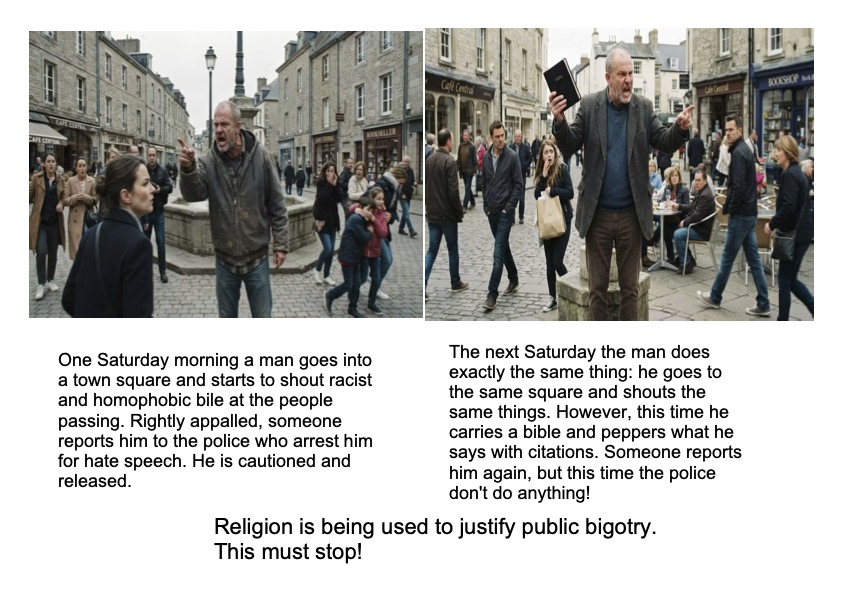
The Same Square

If it’s ‘religious’, it appears the police won’t do anything, no matter how hateful the bigots are.

(incidentally, this was my first foray into AI image generation. I think it worked quite well)

A Link So Obvious it’s Idiotic

I was just watching breakfast TV as usual, and I think I’ll point something out so obvious that just about everyone would have noticed it, but I feel compelled to blog about it anyway. One of the Beeb’s main news items this morning was of course the follow up to the horrific events in Cleveland, in which seven people were killed in a car crash following a police chase: teenagers baiting the police, thinking they could get away from the cops, their juvenile arrogance resulting in cataclysmic tragedy.

But then, just a few minutes later, the BBC has an item about the release of Grand Theft Auto 6, a video game where players steal cars and drive recklessly away from police; in which crime seems to be glamourised and presented to it’s naive young players as a sign of male bravado and masculinity. I surely can’t be the only person to see the blindingly obvious connection here! On the one hand we are lamenting carnage caused by teenagers stealing cars, while giving them games to play which glamourise and fetishise that very activity. The link is so obvious it’s idiotic. The weird thing is, nobody on the breakfast programme seemed to note it.

Flogging A Dead Stig

Can someone please tell me why oh why the Beeb is still flogging the dead horse which is Top Gear? I just got in from today’s trundle and saw this on their website. “Top Gear is to return to TV, the BBC has confirmed, four years after the show was ‘rested’ when co-host Andrew Flintoff was injured in a crash during filming.” I must admit I was once quite a Top Gear fan about twenty years ago, when Jeremy Clarkson was hosting it. Back then, the program seemed to have a rebellious feel to it, but it wasn’t rebellion for rebellion’s sake. The guys fronting the programme seemed to have both a genuine love of cars and seemed to know what they were talking about, so their stunts and items had a genuine point to them. Since they left, Top Gear has just felt like a lousy imitation of it’s former self, it’s hosts poor wannabe stand-ins for their predecessors.

007 At the Albert Hall

There are great nights and there are awesome nights. Great nights are, as the word suggests, perfectly enjoyable: fun, memorable events which you are glad to have attended. The thing is, they lack the special something that elevates them into the ranks of awesomeness.

Last night, I think, was a good example. Of course, on one level to have seen all the James Bond themes performed live by a full orchestra at the royal Albert hall was incredible: a few months ago my mum managed to get tickets; and as I made my way to meet up with my parents at the old family house in Harlesden yesterday, I was buzzing with anticipation. The Bond themes, like the films themselves, mean a lot to me, and have done since I played them over and over again as an MP3 playlist on my computer as a teenager. They seemed to encapsulate the suave, brutal rebelliousness of the character himself. Here was an ultra masculine, ultra able man who could go anywhere at will and perform any task with an ease I would never be able to muster. Absolutely nobody did it better than Bond: he seemed able to live and let die in an increasingly cold, brutal, unjust world.

Thus to have a chance to hear these pieces of music played at a venue as magnificent as the royal Albert hall was an opportunity I simply couldn’t miss. As I went into the hall with my mum last night, all the gravitas and power of the films swirled about in my head. Frankly, I could have killed a martini. The thing is, when the music started, that was all it really was: the themes from films which I had listened to many times before. The spectacle didn’t seem to have the impact that I was sort of expecting. They struck me as covers, played fairly rapidly one after the other, which didn’t quite have the resonance or aura of the originals. The compère for the evening, Nick Mohammed, struck me as quite lame; and the performances, although perfectly good, didn’t seem to have the impact I was kind of longing for. The only original performer in the entire evening was Lulu, but who on earth could replace the likes of Shirley Bassey, Tina Turner or Paul McCartney?

The event itself is due to be televised this Saturday, so I’ll leave you to make your own minds up about it. I’m not sure what, if anything, could have elevated it to the level I was longing for: the appearance of a Bond actor or two, perhaps, or a guitar solo by some awesome rock legend. I don’t want to sound too negative or ungrateful, as it was, after all, a pretty special night. Yet it didn’t quite hit the mark which for me comes with the martini swilling, adventurous legend that for me is Double O Seven.

The Garden Where Time Stops

In this garden time stops.

So sat here, outside this Harlesden house,

It is thirty years ago. 

My brothers and I play on the lawn before me

And all the turbulence of the last thirty years 

Has yet to happen, kept at bay by the garden fence.

Isolating this place from the ever changing maelstrom beyond 

So that all the plants and flowers, 

Tended so lovingly by my much missed grandfather 

Still grow strong. So that he could still be here 

Watching over me and my brothers.

For in this garden, time stops.

Pity Porn For Breakfast

I don’t know how many people reading this will watch the BBC Breakfast show, but it’s usually part of my morning routine, glanced at as I gulp down copious amounts of coffee. On this morning’s program, there was an item which, to be honest, I don’t really know what to make of: it was about Patrick McCabe, a sixteen year old with fairly severe Cerebral Palsy who has recently sat his GCSEs using eyegaze technology. Quite a bit was being made of his perseverance, and the fact that his exams took so long to sit. On one level, of course, it is indeed a remarkable achievement, and McCabe deserves all the credit he gets; yet the cynic in me can’t help detecting a whiff of ‘pity porn’ about it. After all, I have GCSEs, A Levels, a degree and a Master’s, and I didn’t get invited onto national breakfast TV – nor did I expect to be. I’m afraid there was an element of a condescending ‘didn’t he do well’ mindset to the item which ultimately does more harm than good.

If McCabe and guys like him are going to get anywhere in life, achieve independence and get a decent education, they’ll have to keep their heads down and just get on with it. It’s all too easy to get sucked into this ‘I’m so special’ frame of mind which ultimately leads to complacency. I don’t want to be seen as extraordinary, and nor should McCabe. If anything, part of me still feels like I underachieved because I never did a Phd. Treating people like us like exhibits in a freakshow just because we have done the exams everyone else our age does simply pidgeonholes us and puts us down, as it implies we have achieved all we are going to. We are not freaks: we are as intelligent and capable as anyone else, and thus ought to be treated like anyone else. I’m not writing this to diminish or belittle McCabe’s accomplishments, but rather to attest that I think too much was being made of them. He was obviously just as intelligent as I am or anyone else is, and as such his GCSE results are just the beginning of his achievements, rather than the grand final endpoint that they seemed to be being treated as this morning. With the right support he can achieve anything he puts his mind to. But if you give someone a prize for climbing a mountain when in reality they’re just in the foothills, they loose the incentive to go any further.

Grass, Housing and Claustrophobia

Believe it or not I’m still rather fond of the Olympic Park. I head up there every week or so, just for a trundle. I especially like how the River Lea meanders through the park. Yesterday though, I noticed something that I was not so happy about, and in fact rather pissed me off. When the park was first created, there was a large flat grassy area next to what had been the media centre during the Olympics. With a path running alongside it, it was just like any other area of grass in any other park, giving it a feeling of openness.

I had presumed that those spaces were part of the park. A couple of years ago, however, half of the space was hoarded off and builtover, and is now two rows of upmarket blocks of flats. I remember being quite dismayed about it at the time, but I accepted it. Yesterday, however, I noticed that the rest of that grassy space had been hoarded off, ready to be built on. I must admit I felt quite angry when I saw that. It’s as if the whole park, once so open and peaceful, is being eaten up one part at a time. It isn’t that I don’t know that the country has a housing crisis, and that new homes need to be built wherever possible; yet we seem to have reached the point where absolutely no value is placed on how pleasant a spot is. Any and all open areas are now just being concreted over and built upon, making the city feel more and more enclosed and claustrophobic. The Olympic Park, once the purpose built site of such awesomeness, is slowly seeing’s its character drained away into just another generic London suburb. The city may well need housing, but what about our need for open, grassy areas?

The Sooner Americans Realise, The Better

Probably like most other people these days, I watch quite a few political videos on Youtube, including ones about American politics. Most are made by Americans, and are of course highly critical of their current government. One thing I’ve noticed though is that, while they drop at nothing to criticise Trump, they all seem to think that the problem lies just with him, and that things will return to normal once Donald Trump is removed from office. That is to say, in terms of both content and tone, such videos are framed as if American economic and cultural preeminence is not under threat, and will simply continue once they get a new president. Even the more balanced, level-headed of such commenters don’t seem to have realised that the respect and veneration their country once commanded has now been shredded, and it is now nothing more than an international laughing stock. The makers of such videos don’t seem to appreciate that the era of American dominance is over, just as the British one ended around a century ago; so they carry on as if their culture is the only one that matters. But whether they realise it or not, Trump has rendered the US a joke, and other cultures and economies will soon take it’s place. Which they will be I’m in no place to say; but the sooner our American friends realise their time is over, and stop carrying on as if they run the world, the healthier it will be.

A Scuppered Plan

I think I ought to note that the plan today was to go and watch a screening of Trainspotting at an arthouse cinema in Angel which John seems to like. I was looking forward to it. However, J just phoned up to double-check accessibility, and was told there were steps into the building, and no safe space where I could leave my powerchair. Well, that’s scuppered that plan.

It’s a shame to see that there’s still so much more work to do before the world becomes truly accessible.

The Great ADHD Myth

To be honest, I saw a programme a couple of days ago on TV which I instantly knew I wanted to blog about, but the subject was so complex and controversial that I spent the whole of yesterday trying to decide what to say about it. The Great ADHD Myth is the kind of television which is always going to split opinions: my problem is, I know what I think about it, but I’m not sure I know enough about the subject to fully articulate and justify those opinions. Broadly speaking, the gist of the documentary is that Attention Deficit and Hyperactivity Disorder doesn’t really exist as a medical condition, but is just a vague list of symptoms which people are increasingly ascribing to children. I certainly agree: as far as I can make out, such kids don’t have any sort of neurological disorder, but were simply never taught to pay attention and stay focussed on what they need to do. It’s just a matter of childhood discipline. When I was little, my brothers and I were always taught that we needed to finish our schoolwork before we could go and play, or that we wouldn’t get any pudding unless we finished our main meal. These days, however, kids seem to be being allowed to get away with whatever they like; and when they start to play up, rather than being told to behave, their parents start to claim that they have a medical condition.

I probably sound like a grumpy old man for writing that. I know there will be people who resolutely disagree with it, and will be very angry that the programme was aired. To them, ADHD is very, very real, and to have it’s existence and validity contested will seem like a challenge to their identities. Indeed, according to this BBC article, ADHD UK has complained to Ofcom about the programme,  saying: “ADHD is not a myth. It is not a social construct.” Yet I think this speaks to something which is becoming increasingly obvious these days: people seem to be becoming increasingly eager to compartmentalise themselves, and categorise and pathologise behaviours which would previously be seen as perfectly normal as medical conditions. It’s as if being normal is no longer cool, so everybody is starting to claim to have a condition or disability. As someone who has had a clear-cut, unambiguous disability all his life, it’s frankly becoming increasingly insulting. I’m just glad to see that other people are starting to pick up on it.

Twenty-Two Years Since Woohoo

I just thought I’d take a glance at my archive and, coincidentally enough, today marks twenty-two years to the day since I wrote this entry announcing my A Level results. I can barely believe it: twenty-two years since I received the exam results which meant I was going to university; twenty years since the beginning of the incredible adventure which I am, more or less, still on. I didn’t know it at the time of course, but my experiences at uni saw me evolve and mature in a way which at the time I’d never have thought possible. It made me realise what I was capable of, and that I wouldn’t need to spend my life at home with mum and dad. That eventually gave rise to my current life here in London, via meeting Lyn.

Part of me wishes I could go back two decades and tell the guy getting those results of the awesomeness about to happen; but that would be giving the game away. Instead, I can just hope that everyone receiving their results this month has the same good fortune, and experiences the same wonders I have.

The Only Valid Communication

I made this last night, immediately after hearing about Reform’s plans for the welfare system. The party’s online advocates are now desperately trying to backtrack and say people who genuinely need disability benefits won’t be affected; but, as I said a couple of days ago, it simply boils down to their selfish, spoiled worldview and refusal, wealthy, arrogant snobs that they are, to need to help the most vulnerable people in society. Such people frankly sicken me, and I honestly believe there is no place for such inhumane vermin in our political discourse.

Great Does Not Always Mean Exciting Or Exotic

I have written here before quite a few times about my passion for trundling: my love of going out in my powerchair and exploring the city, following roads and paths for whole afternoons, just to see where I end up. The thing is, in all my trundles over the years, I have still never managed to get outside Greater London.

There’s obviously a hell of a lot of this city to explore. Even with such a great public transport system, getting around it takes hours. Yet, for all its vastness and for all its diversity, London is still essentially one place: one of the richest, most affluent economic centres of the world; where billions can be spent almost on a whim, the busses and trains run like clockwork, skyscrapers shoot into the sky like corn in a field, and the loudest sound I hear all day is the one that accompanies the bus wheelchair ramp. I started to reflect on this a few months ago: The fact that for all my trundling and bus riding I still haven’t managed to find my way beyond the M25 is starting to feel weirder and weirder, almost as if I’m trapped here, it has become my entire world and nothing exists outside it’s encircling motorway.

London is a great world city, capable of fantastic things. Yet great does not always mean exciting or exotic. Hemingway once famously called London boring, and think I can at last see what he meant. London is wealthy, orderly and privileged. It once seemed so awesome, but I think I have reached the point where I yearn to go beyond it. What about the grittier, more earnest parts of the world? Places which aren’t so privileged, and which haven’t been gentrified beyond recognition? Where people aren’t so used to having access to everything they need or being the centre of national attention? London is a fantastic, stable base; yet the adventurer in me is becoming keener and keener to go beyond it, back into more down-to-earth places. There comes a point where order and privilege begin to feel dull, and you become increasingly curious about the smaller, wilder, less well known corners of the world.

Reform Targets PIP

I was of course sickened to get to my computer a bit earlier and read of Reform’s plans to overhaul the welfare system. “‘Reform UK says it would aim to cut about £50bn from the benefits bill and scrap the disability payments system, Pip, if it comes in to government.” I was initially in two minds about blogging about the subject for fear of giving these scoundrels attention they do not deserve. But given this is an issue which would effect me directly and slashing Personal Independence Payment would have a dramatic impact on my life as a disabled man, I don’t think I can let it slide. It is blatantly obvious that Reform are just trying to A) present themselves as a credible, serious political party by coming up with policies on subjects unrelated to the xenophobic bile they usually spew; and B) distract us from their fhurer’s corruption.

In doing so, however, they have done nothing but reveal how callous and unfit to govern they are. Like any modern, enlightened society, we should care for those most in need of help: that means having a robust, properly funded welfare state. Surely a society can only really be judged by how it cares for those most in need. Yet the disgraces to human civilisation in Reform would do away with that completely, forcing the most vulnerable members of society to just fend for ourselves – probably even begging – just so they can slash tax rates and allow their rich, privileged friends to hoard their wealth. At the end of the day, that is the entire aim of their neoliberal, greed-is-good worldview. It frankly staggers me that we are continuing to allow this group of neofascists to pollute our political discourse, and that so many people are shortsighted enough to vote for them.

The Less Cool Side Of Yesterday

I think I better write a bit of a follow-up to yesterday’s entry, because to be honest it didn’t end quite as merrily as I would have liked. Getting home frankly turned out to be a bit of a nightmare. In order to get to the area of London we wanted to visit, Dom had advised me to take the Jubilee line to Waterloo and then the overground to Hampton Wick. On the face of it that sounded perfectly doable: I would take the train while Dominik would ride his bike. Getting to Waterloo though, I found the lift from the tube to the main station broken, so was told by the staff to go back one stop to Southwark, get up to the surface and trundle from there.

The two stations are fairly close so that in itself wasn’t too much of a problem, although it annoyed me and made me slightly worried about being late. It would have been fine if that had turned out to be the only issue of the day. When I reached Waterloo I managed to get on my train smoothly enough; but as it approached my destination I was told that Hampton Wick wasn’t step free so I would have to get off one stop early, at Kingston.

That, again, was fine, but the problem then was finding my way to the rendezvous point I had agreed with Dom. That took at least an hour, and involved asking four or five people for directions. When I eventually spotted my friend and his folding bike down a side street near the river, my relief was all the more palpable.

The rest of the afternoon went without a hitch. To get home, however, instead of returning the way I had come, due to the lift issue at Waterloo I thought I’d investigate the local busses to see if there was one which would take me to an Elisabeth Line station. From there I could get back to Woolwich and be home in no time. And, as luck would have it, I found a bus heading for Ealing Broadway, which of course I then hopped onto.

I didn’t realise it, but that was the beginning of a total nightmare. For starters, even though it gave me the opportunity to type my blog entry en route, the bus took a lot longer than I had expected; but getting to Ealing Broadway I was told that the Elisabeth Line wasn’t running due to a power failure, so I’d have to get the Central Line to Bond Street instead. I obviously had no choice but to accept this. The problem was, the Central Line is far older and much less accessible than the newer tube lines; it was also far slower and more crowded. It thus took far longer to get to Bond Street than I would have on the Elisabeth Line; and to make matters far, far worse, when the train reached the station, there was nobody waiting for me with a ramp.

I frankly began to panic. Stuck on the train, I tried to tell my fellow passengers what the problem was. Rather foolishly perhaps, this meant they lifted my powerchair off the train at the next station, Oxford Circus, but that made matters even worse as that station isn’t step free at all. That gave rise to a total farce where I had to wait for someone to find a wheelchair ramp from another station, in order for me to board a train back to Bond Street, from where I just caught a Jubilee Line train home. Apparently the guys at Bond Street had been told that I needed a ramp, which carriage I was in and so on, but ridiculously and insultingly had simply forgotten about me. It had been a long, slow, frustrating journey, and by the time I got back I was hungry and tired. Yet because nowhere near as much as the TFL network is as accessible as it should be, my journey back from that yet to be explored half of the city was far longer and more frustrating than it might have been.
Islands in the Thames

Just when I was starting to feel like I had begun to get to know this incredible metropolis, after today it once again feels totally alien. Dominik invited me to join him on an expedition to Kingston: he was planning to meet some friends on an island in the Thames there, Trowlock Island. Of course I was immediately intrigued, never having ventured that far into West London, and not having realised that the Thames actually had any islands in it. What followed was an incredible day of discovery, exploration and happy meetings of the kind I love the most. An afternoon of following paths I had never been down, and getting to know a part of London which felt completely different to the one I knew. To be honest it let me feel the surge of excitement and wonder I always seem to get when exploring somewhere completely new, even though I was technically still well within my home city. Above all, it made me realise how little I know of that pretty part of west London, where the Thames is far narrower, more tranquil and picturesque. Now I know how to get there though, I’ll almost certainly be heading back.

Not Watching the Eclipse

You could say that I chickened out a bit last night, and in fact I’m slightly disappointed with myself. Like so many other people, I really wanted to watch the solar eclipse, so at about half five yesterday evening I set off for Greenwich Park. The problem was, when I got there, I found it busier than I had ever seen it – it was absolutely crammed, and no place to observe the cosmic ballet. That and the fact my powerchair battery was starting to get low meant I opted to head to the bus stop to return home. By the time I got back to base though, the eclipse was already in mid-flow. While there is a patch of grass not far from my flat I could have watched it from, the fact that I didn’t have any protective eyewear meant I chose to cut my losses, get inside and check what was happening online. I told myself that it was ultimately just the moon coming between the Earth and the Sun, and it wouldn’t have been the first time I’d seen an eclipse as I was lucky enough to watch the one in 1999 in Bavaria. But the fact that I chickened out last night, and it won’t happen again for another sixty years, nonetheless means I’m fairly gutted.

This Must Be Happening To Everybody

I just have a quick question for you today: when you are out and about , exploring your city, and you stop to look at a street map, how often would a random person walk up to you and ask if you’re okay, or whether you have anyone with you? I presume it’s happening to everyone else, because it’s happening to me more and more regularly. I experienced it earlier today when I was trying to find my way to Green Park station: a woman came up to me and asked, in a hauty, condescending tone, whether anyone was looking after me. Never mind that I have a Master’s degree, or that I have been trundling around London independently for the last sixteen years; the fact that I use a powerchair and look a bit wobbly must automatically mean that I need someone with me at all times. Of course, this must surely be happening to everyone else, because if it was just me experiencing it, then it would mean that I am still being patronised due to my disability, and surely that can’t be the case…

Vast Expanses Of Straw and Dust

I’m usually fairly hesitant about just stating the obvious and blogging about something I know everyone else is thinking about, but I’m quite certain I’m not alone in becoming increasingly worried about how parched everywhere is becoming. Here in Greenwich there is quite a bit of grassland, including Blackheath and Woolwich Common. Looking out over such areas over the last few days, they have looked utterly desolate: they can’t have had a drop of rain in months, and now just look like vast expanses of straw and dust. It is a shocking, ominous sight. This might not be something I often blog about, but with this summer now on course to be the hottest on record, climate change is a problem which is becoming harder and harder to ignore.

Rewriting Basil Fawlty

I would certainly be doing everyone, including myself, an enormous disservice if I wasn’t to flag this fascinating article by my friend James Cullis up. I must admit to still being quite a fan of John Cleese, but here Cullis takes a really interesting look at Cleese’s recent politics and dabbling with the far right, placing it within the context of Fawlty Towers. I don’t want to summarise my friend too much, but as he explains, the whole point of Fawlty Towers was to take the piss out of Basil Fawlty and his insecurities, rather than to mock the object of his ire. As a character, Fawlty is a man at odds with the fast modernising world around him, refusing to adapt: the audience were supposed to laugh at rather than with him. As Cullis writes, “The show was written to mock him, not endorse him. We laugh at a man who is classist, racist, sexist, and obsessed with wealth and prestige — a man whose worldview is brittle, anxious, and deeply insecure.”

Fifty years or so on, however, Cleese seems to be trying to reframe his creation as some sort of right-wing hero giving voice to vitriolic opinions now being silenced. He has got into bed with p’tahks like Rupert Lowe to try to subvert the whole point of his classic comedy. In trying to re-frame Fawlty in this way, Cleese actively perverts the reason he was so hilarious and so resonant: “Cleese’s backing of Rupert Lowe signals something dangerous and counterintuitive about the legacy of Fawlty Towers. Basil’s stereotyping of migrants and his overall conservative disposition were part of a comedy that the audience was laughing at — his outlandish views, his prejudices, put on display for ridicule.” In trying to pretend that we were supposed to be laughing with rather than at Basil, Cleese is effectively attempting to bastardise and usurp his own creation.

Of course, you could just put it down to the changing views of an aging comedian, far past his prime; but if we are going to continue to cherish classic comedy series like Fawlty Towers, surely we cannot allow them to be rewritten by the reactionary right in this way. The very reason such comedies were funny was that they poked fun at the anachronistic views and behaviours of their protagonists, so desperately at odds with the fast changing world around them. It was the comedy of the cultural clash or fish out of water. For Cleese to now try to go back and put a completely different meaning upon it surely simply exposes his own discomfort with the modern world.

Could The Docklands Transformation Happen Elsewhere?

While I mentioned the awe and excitement I feel whenever I visit Canary Wharf in my entry yesterday, the truth of course is the jaw-dropping redevelopment there hasn’t been confined to the Isle of Dogs. The reason that area strikes me as so incredible is that, just forty years ago, all that was there is a bunch of decaying docks, but these days it feels like New York, Dubai or any other modern metropolis. The contrast could barely be more striking, and the amount of money which must have been ploughed into the area over the last half century is surely incomprehensible. The thing is, of course, that investment and regeneration wasn’t just confined to the Isle of Dogs but took place all over East London and the Docklands. I just need to head out of my flat to find examples of it: the Arsenal at Woolwich; the Royal Docks; Stratford with it’s olympic park, stadium and huge shopping centre. All chock-a-block with expensive, modern buildings; and all now linked together with a state of the art public transport system. I just came across this video from 1976 in which the redevelopment of the Docklands is being debated, and it’s a fair bet that East London today would be unrecognisable to them. They speak as if it is somewhere set apart from the rest of the city, neglected and forgotten; but thanks to infrastructure like the Jubilee and Elisabeth Lines, London feels more united and navigable than ever before.

The thing is, what I find concerning is whether this could have happened anywhere else. As incredible as such a transformation is, the fact remains it required a huge effort spanning several governments to transform a postwar wasteland into a thriving economic and cultural epicentre. As fortunate as I now feel to live in this fascinating area of domes, stadiums, skyscrapers and huge convention centres, I can’t help worrying whether areas outside of the capital are getting similar levels of investment. Was it just because the Docklands were part of London that they received such a transformation? There must be areas outside of the capital in need of such renewal, but which still aren’t receiving it. Large cities such as Manchester are doing rather well, but what about other, smaller places. Thus, as amazing as I find the story of the docklands, I can’t help worrying that it exposes an imbalance between the capital and the rest of the country.

A Warning I Probably Needed

I headed over to Canary Wharf again today. I think I’ve said here before how that area of London fascinates me, and how I find it thrilling to think that, just forty years ago all that was there were some decaying docks. I always feel a buzz.of excitement whenever I head out to explore more of this constantly changing metropolis. The problem is, recent events may have put that under threat. I have recently been told that, if I have another mishap like the one last week, questions may start to be raised about my capacity to live independently.

Of course, when I first heard that I was appalled: the last thing I would ever do is relinquish my life here in Eltham. I love having my own flat, my own routines and my own life. The thing is, I can sort of see where they are coming from: the powers that be obviously simply perceive me as a guy with a fairly severe disability who might have called for help once or twice too often. To them, the enormous value I put on my status within the wider community is neither here nor there, and it may be easier to shove me away where I can be cared for.

To be fair, it was probably only effectively a warning that I need to look after myself a bit more and drink more water; and the fact remains I feel very grateful for the help I received last Wednesday. On the other hand, the question that this revalation raises for me is, could anyone else be threatened in such a way? Would a county or borough council go to anyone else after they go through any kind of medical emergency, and suggest they might not be able to live on their own any more; or does the mere fact that I have CP change things, so that my agency can be threatened far more readily? Are councils still far more eager to step in and intervene in cases like mine? If that is the case, then it would seem that the progress disabled people thought we made towards equality may be far more fragile than we took it to be.

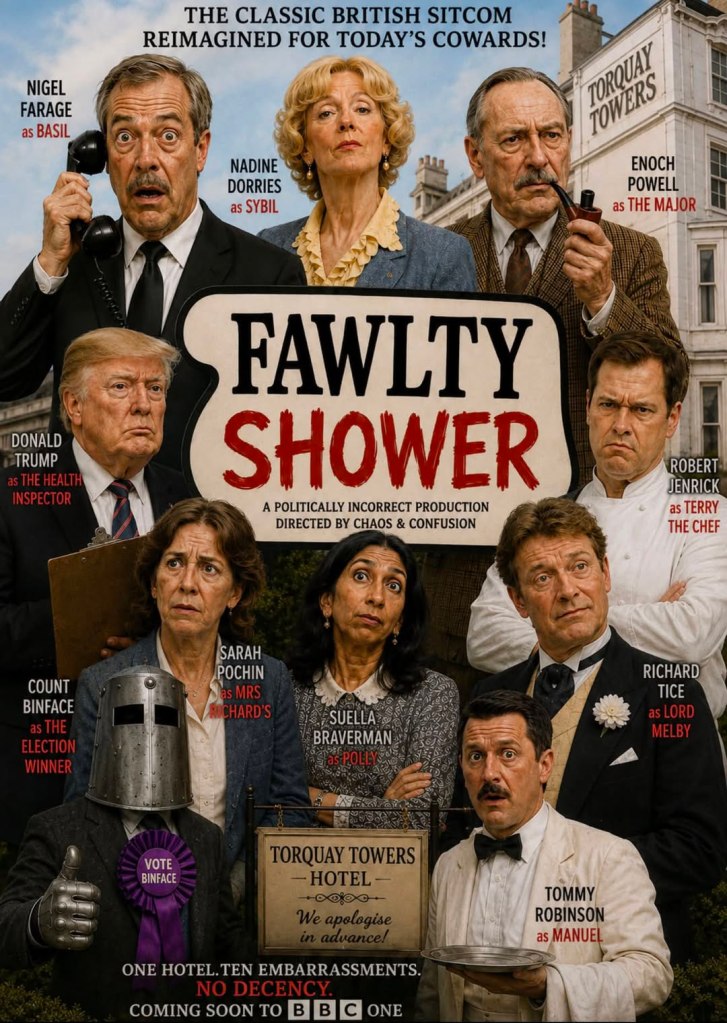
A Very Faulty Shower

When I came across this a few moments ago, my initial reaction was that it did a bit of a disservice to a British comedy classic…

But if you think about it, the absurdity of the original sitcom fits rather nicely with the way things are currently unfolding. We better not mention the war though.

Sudden Shocking Squalor

Out on my trundle today, I had a bit of a nasty shock which I think ought to be recorded. I had decided to just take one of my usual routes: the DLR from Woolwich to Star Lane, then a nice pleasant stroll along the Lea up to Stratford. It’s a trundle I now know well. Getting off the train at Star Lane though, I was met with something I definitely wasn’t expecting. It’s only a small DLR station, and there is only one lift. Whenever I have used it before it has been nice and clean, but today I was shocked to find a homeless man sleeping in it, his belongings strewn across the lift floor. It was a shocking, unpleasant sight; the smell was awful. As there was no other lift I could use, I had no choice but to wake the guy up and allow me in. Fortunately I only needed to go up a single floor; but having come to think so highly of London public transport and its stations, to have been so suddenly confronted with such squalor was to be honest rather haunting.

The Beep Chair

I would just be being an utter buffoon if I didn’t direct everyone here today. I know I flag Steve Shives’ videos up fairly often, as I usually find his analysis of Star Trek episodes rather insightful, but to my amazement today he ventures into another of my fields of interest. A couple of weeks ago I directed you all to watch his video on Captain Pike’s fate. Following on from that, this time he begins to explore Pike as a communication aid user, which obviously interests me inordinately.

As Shives points out, when Pike is reintroduced into Star Trek episodes after the original series pilot, he is shown using a ‘beep chair’, which functions as both a mobility and communication aid. This was obviously done to accommodate the change of actors playing Pike. Yet, Geordie Laforge aside, it is probably the most significant representation of disability in all of Star Trek; and it’s certainly very interesting to see someone like shives looking at it in this detail. As he points out, there is a huge amount of discrepancy between a portrayal of a supposed communication aid user from the sixties and what we are able to do today: we are capable of a hell of a lot more than just beeping at people, for one. We thus can use such episodes to glimpse how disability was. perceived sixty yers ago, and how such perceptions have changed largely due to technology. It is therefore very interesting to see someone like Shives, who I don’t usually associate with such fields, starting to look at disability representation and how a character with a communication impairment was portrayed. He touches on issues like facilitated communication and eyegaze in order to give a bit of background, so it is as if two areas of my personality – communication aid user and Star Trek fan – have met in a way I never expected.

Rory Stewart and Alastair Campbell Interview Count Binface.

I realise I haven’t made a political entry in a while, so I think the best thing I can do today is to direct you all to this piece of bizarreness. The spectacle of Alastair Campbell and Rory Stewart interviewing a dude dressed as a bin is Pythonesque enough, but it makes you wonder how the smeg we got to this point. To be fair the guy gives a pretty good interview, constantly seeming to straddle the line between satire and earnestness; and anyone who would expose Farage as the arrogant joke he is of course has my full and unwavering support. Yet, to step back a moment, it’s nonetheless slightly sad that British political discourse has reached this point, and that people have had to resort to such childishness. Then again, the only person we have to blame for that is Farage himself.

Could They Have Known?

When Seb Coe and his team won the Bid for the Olympic Games in 2005, I wonder whether they could have imagined that the park the bid would end up creating would become one of the nicest spots in all of London. A park where you can happily go to spend a whole afternoon, away from the murmur of the traffic. A place of beautiful plants, paths and rivers. Somewhere where, this afternoon, I had the pleasure of spending a wonderful couple of hours with my cousin Christina and her husband Tom, not having seen them in months. It was just a peaceful family chat in the park, and nothing that much to report; it was awesome to see them and catch up. It’s just that there is something thrilling about placing such quiet moments in the context of the history of that spot: somewhere initially designed to host the world, in all it’s sound and gusto, is now a place of something far more intimate and homely. Could they have ever known how delectable the park in the Olympic bid would turn out to be, or that it would one day host such wonderful family afternoons.

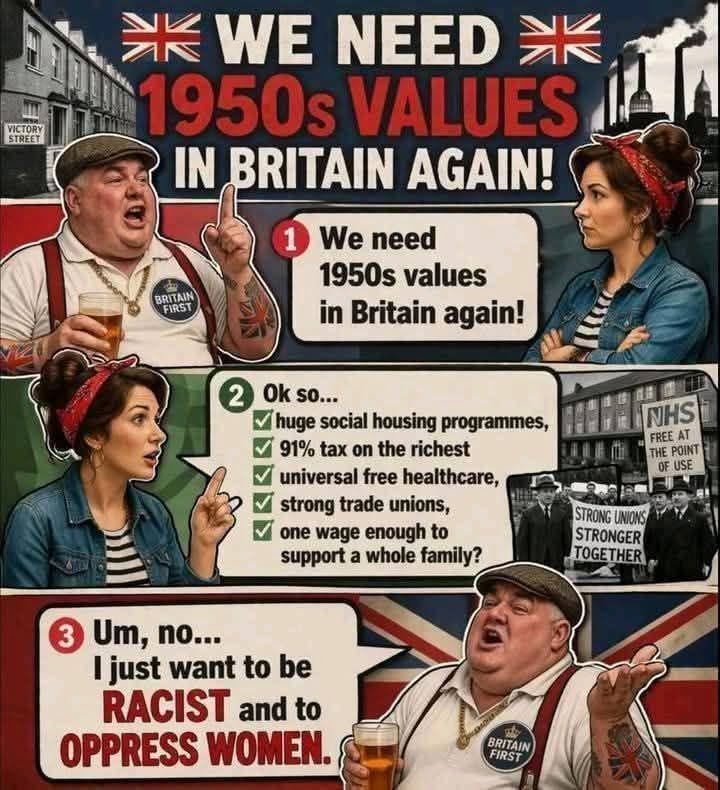
The Good Old Fifties

Frankly, this is slightly too close to the grain to be that funny.

I’ve come across such fifties nostalgia personally, and I’m sure many people reading this will have too. It always seems to be exhibited by people who weren’t actually alive at the time, and seem to know very little about the actual history of the period.

Drinking From a Drinking Fountain

It’s very strange how the least important and noteworthy things can sometimes suddenly become the most important and noteworthy. I have just got in from my daily trundle. As often happens, I spent much of it trying to choose a subject to write about here: it’s usually a question of deciding what I think everyone would like to read about: my current opinions on politics? A review of the last film I saw? But then it occurred to me that given recent events that the topic today should be obvious.

I spent most of my time outside today looking for something to drink. Keeping hydrated is obviously now paramount, and the glasses of water my PAs had left on my table had soon been emptied. Thus it seems to me that the most salient thing I can write about here today is how, going through Charlton Park, I managed to use the drinking fountain! I was able to get myself under the bowl and have a good hearty sip from it. It was actually very refreshing, and the process went far better than I expected it to. It immediately remedied my thirst, and the soaking I was half anticipating never occurred. It was probably the first time I had ever drank from a public fountain. Ordinarily such things would obviously be nothing anyone would want to read about; but given that it may well have meant I avoided another trip to hospital, I think it has suddenly become pretty salient.