Dom took this photo on the train home on Tuesday. It amused us both greatly. I am exempt, ok?

Dom took this photo on the train home on Tuesday. It amused us both greatly. I am exempt, ok?
After over eleven years of living in London, I feel I can use the tube pretty confidently: With the underground, it’s simply a case of checking which stations are accessible and taking things from there. Although, as explained here, nowhere near enough stations have wheelchair access, I find the tube network pretty easy to use unaided. However, the overground rail system is another matter. I have never got my head round London’s overground rail network. For starters, you need to ask for help with ramps when you’re getting both on and off the train, which means knowing precisely where you’re going. Another problem is the overground rail network seems far more complicated than the tube. However, Tuesday’s trip down to Richmond has made me think again: the journeys there and back were comfortable and quick, and organising ramps wasn’t that difficult. Like the tube and the bus, it was also free. With several train stations nearby, it might be time for me to start using the overground a bit more, mostly as an alternative means of getting about the city, but also to see whether I can.
Yesterday was a lovely day for me, but rather long and tiring. A couple of days ago, my old PA and friend Dominik suggested meeting him and going out to explore Richmond Park. I had never visited that area of London before, so of course I said yes. We met up at Waterloo, then got the overground to the south-west of the city. Getting there, the first thing that struck me was how different it felt from the rest of London: Richmond seems like a small, well-maintained town; there, the Thames is much thinner and prettier, so it looks completely different to the one I know here in the east. We walked along it’s banks, past pretty little shops, pubs and cafes, until we reached Richmond Park. I think that was what Dom wanted to show me: it is massive – the biggest park I have ever seen, and surely the biggest within the M25. It is also, of course, stunningly beautiful; we walked around it for most of the afternoon, admiring the well-kept trees and deer. Most of the paths were well-maintained, although I did have a bit of fun in my powerchair following some of the routes Dom lead me down.
The park is so big that it took us several hours to walk around, and by about five I think we were both getting tired and hungry. Eventually finding our way back to Richmond Town Centre, we bought a sandwich to eat on a bench before making our way to the train station. It had been a lovely day. This metropolis never ceases to amaze me: no matter how long you live in London, there will always be a new part of it to explore. Yesterday I discovered another of its wonders: a gigantic, four-century old park I had known nothing about, only about an hour away by train. I was stunned by it’s beauty, serenity and size. It makes me wonder what other surprises London – and indeed the world beyond – could still have in store.
I’m not going to suddenly claim to be a Transformers fan: I was never into them as a child, and the recent films don’t interest me now. I vaguely remember my brother Mark having a few of the toys though, one of which was Optimus prime: it was fairly unsophisticated, but even so the Ginger One never let me play with it. I had forgotten about it, but was reminded of it when I came across this video. A new Optimus Prime toy has been created, and it is so incredible that I had no choice but to flag it up here. To call it a toy doesn’t really do it justice: watch the video and you’ll see a highly sophisticated piece of engineering and computing. Essentially, it’s designers have taken a children’s cartoon character from the eighties and rendered it as a completely functional, seventeen inch high model, controllable by both speech and app. The result, I think you’ll agree, must surely be the most awesome toy ever (although the price tag is slightly less awesome).
Yesterday was a lovely, sunny day. It started quite well: I went out on my usual wanderings, and by mid-afternoon, having done all the sensible stuff I needed to do, I was beginning to think about having a beer somewhere. At first I tried at the Tudor Barn, a fine old place not far from here, but they were running on pre-bookings only. The staff know me there and tried to fit me in, but there wasn’t any space. I knew that was a long shot anyway, so I carried on up the hill to Eltham High Street. The Weatherspoons is still shut, but I found an Italian bistro serving drinks on a large square. There were several people there enjoying theirselves, but also several tables free.
I rolled up to one of the staff, and through my Ipad asked if I could have a beer. At first everything seemed fine, but then a person who I presume was the head waitress intervened, saying I wasn’t allowed alcohol: I could have coke or a soft drink, but not beer. She struck me as abrupt, stern and rude. Angered, I tried to ask why, but she refused to answer, stopping the other staff from speaking to me. I tried to ask to speak to the manager but was completely ignored; they were treating me like a child. I persevered for about ten minutes but then headed home, quite furious about what had just happened.
Back here I tapped the restaurant’s name into Google and, finding their website, emailed the manager to ask why I had been treated like that. I also messaged a friend of mine, Will, who normally works at the nearby ‘Spoons, to see if he could help. An hour or so later, Serkan got here for dinner. I was still furious and showed him the Email I had sent to explain why. He immediately became angry too and suggested going back to the restaurant together to talk to the staff.
I thought that was a great idea, and a short while later we got there. Of course the staff recognised me from earlier. Serkan asked them why they had treated me as they had, and they explained – talking to Serkan rather than myself – that they didn’t know whether I was on any medication or whether I was fully ‘up there’. The exchange didn’t last very long, but it was quite clear that they just hadn’t wanted me there.
We got back here still quite angry; I felt discriminated against, and still do. I’m still waiting for a reply to my email. It occurs to me that, had something like this happened to a member of any other minority, people wouldn’t put up with it, so why should I?
How much longer do we have to put up with the utter charlatan Boris Johnson calling himself Prime Minister? It has been widely reported that he promised his mate James Dyson a tax cut in exchange for favours, but I just came across this. The bastard doesn’t have the authority to make such a promise: “Boris Johnson’s claim that he arranged a tax break for James Dyson was impossible because he doesn’t have the power, according to former Attorney-General (the government’s top lawyer) Dominic Grieve.” Just how privileged, self-important and arrogant can anyone get? Johnson obviously just assumed he had the authority to do what he liked, as if he was above the rules. How blatant does it have to be that this despicable, self-important scumbag shouldn’t be anywhere near government?
Out on my trundle again today, I thought I would head for Charlton. I must admit, the direction of my daily wandering is chosen more or less at random and on the spur of the moment, unless there’s somewhere specific I need to go. I go to Charlton fairly regularly , but today, for the first time in months, I found the cafe in the park open for table service again. Until now, of course, it has been take away only, meaning I could not stop for a coffee. Today, however, the situation was different, and rolling up to one of the well distanced tables I asked for my time honoured combination of a double espresso and a cappuccino.
As I sipped my coffee, I thought about the innumerate times I had sat in that very spot over the last decade or so: of the memories I had built up there, and the friendships I had made. I used to spend hours there, talking to people. Lyn would often join us once she was ready, coming rattling around the corner in her powerchair. I half expected that to happen today, although I knew it couldn’t. I suppose it’s just an inevitable part of the human condition that, however much you want things to stay the same, however much you return to the places which once meant so much to you, nothing ever stays the same. Apart from the staff there was nobody I recognised there, and I didn’t stay long. The Old Cottage Cafe in Charlton Park may still serve the best coffee in South London, but for me, it can never quite be the place it once was.
When I was fifteen or sixteen, one of the poems I remember studying for my GCSE English literature was Rising Damp by UA Fanthorpe. It’s quite a nice piece about the lost rivers of London: the ancient rivers of the area, now trapped underground, diverted through tunnels. One of the rivers I remember it mentioning (although, strangely, having just Googled it, I can’t find a copy which does) is the Ravensbourne. I hadn’t thought about it in ages. This morning, though, heading out on my daily trundle, I decided to go and explore the other side of Greenwich, around Deptford. I don’t often go that way, and felt like a change. It’s a nice, pleasant area close to the Thames. After a while, I came across a river flowing through a new-looking park, a well maintained path running beside it. A sign nearby named the river, and my memories of GCSE English twenty-five years ago came flooding back: it was the Ravensbourne, now restored, cleaned, and looking rather pretty in the Spring sun. I think Mrs. Fanthorpe would be pleased.
Surely the only thing I can blog about today is this absolutely incredible news that NASA has successfully flown a helicopter on mars. “The drone, called Ingenuity, was airborne for less than a minute, but Nasa is celebrating what represents the first powered, controlled flight by an aircraft on another world.” Of course, there’s not much I can say about it, other than how awesome I find it. As a guy who has trouble controlling his powerchair sometimes, I can’t even begin to imagine the technical ingenuity which must have gone into this feat. In terms of human achievement, surely this is another huge milestone.
Shortly after posting my entry earlier I trundled out on my daily stroll. It was a lovely day and I was eager to enjoy thee weather. Today I thought I would head down to Woolwich, just to check out what, if anything, was happening down there. As I was passing the old military academy though, I caught sight of something I didn’t expect to see this early in the year: on the same pitch where I watched my friends the Blackheath Mighty Eights last summer, there was a cricket match being played. It instantly struck me as a glorious sight, and I decided to go in and watch; I wasn’t expecting to see it’s like for at least a couple of months. I didn’t recognise either team, and I only stayed for a couple of overs or so before resuming my walk; but nonetheless it is surely a great sign that summer is just around the corner.
I didn’t watch Prince Phillip’s funeral yesterday, preferring to get out and about and enjoy a lovely spring day. There’s not much I can say about it. Having caught a glimpse of all the pomp and ceremony on this morning’s news though, I think I’ll just say this: Given Phill’s send-off was so lavish, I think Sir David Attenborough should get the same treatment. Hopefully Sir David will be with us for a few years yet, but as the greatest broadcaster ever, who over seventy years on tv has had an enormous effect on our collective knowledge of the natural world, surely he deserves nothing less than a state funeral. He is just as much a part of the country’s cultural make up as any prince; I still think he should have played a role in the London Olympic ceremonies. A state funeral – albeit a carbon neutral one – would be a good way for the UK to thank this great, great man for the effect he has had on our collective knowledge and appreciation of the natural world.
As a life long Star Trek fan, it is with a heavy heart that I say that I’m beginning to think it’s losing it’s way. Throughout my childhood and adolescence, Star Trek was something special to me: a vision of a future in which humanity, at peace with itself, had united and set off to explore space. Every week, characters I loved were shown having wonderful adventures on awesome star ships. The TV program captivated me, and the films even more. It was sometimes all I could think about: there was something about this franchise which fascinated me unlike any other.
Yet now, that fascination, that excitement, is waning. Don’t get me wrong: I still love series like The Next Generation and Deep Space Nine. Captain Picard is one of my favourite characters in all of fiction; and I still love the Dominion War story arc from DS9. It’s just that Star Trek doesn’t seem to be what it once was. Read this, for instance. Five new Star Trek series are now in the works: three live action, two animated. Since the 2009 film, Star Trek has become a tangled mess of interwoven storylines and alternate universes; it has lost the artistic coherence it once had as well as the intellectual weight which was the foundation of so much of it’s appeal. It is just being churned out, series after series, merely to attract viewers hungry to see a return of the program they remember, with very little respect for what Star Trek once was. It is now serialised nonsense which doesn’t understand the boundaries between television and film, much less the combination of intellectually-grounded science fiction, compelling storylines and relatable, captivating characters that made Star Trek great in the first place.
I regret to say that a program I once loved has now lost my interest, and as long as it’s producers continue to churn out this lightweight, commercial dross, I can’t see it coming back.
I just want to note that today marks a year since Lyn passed away. I still miss her greatly. She was the most incredible person I’ll ever meet, with whom I had built up so many amazing memories. I still think about Lyn every day, trying to imagine what she would have said about certain things. After all, she had a huge effect on my life; I have Lyn to thank for my life here in London. I wish I could still go over to that old bungalow in Charlton for a coffee and a chat.
At fifty minutes, it might be a bit longer than most pieces of Youtube fan analysis, but I think Steve Shives needs to be congratulated for this video looking at the portrayal of disability – both physical and mental – in Star Trek. As Shives points out, when you look into it, there have been numerous representations of disability over the franchise’s fifty year history, and broadly speaking it has got it right. He goes through several episodes, ranging across the various incarnations of Star Trek, where disability plays a role: perhaps the most obvious is Geordi and his visor, foregrounded in several episodes of TNG and shown to be both an advantage and disadvantage. As Shives astutely (for a nondisabled person) points out, Geordi’s blindness was part of his character; it helped make him who he was. It is to Star Trek’s enormous credit that it presented a visually impaired man in this way. On the other hand, Trek hasn’t always got it right, sometimes depicting disability as negative, life-limiting, and something to be avoided at all costs.
Broadly speaking, this is a great video, well worth a watch: I’d have been a fool not to flag it up here. It broadly picks up upon what I was getting at in this entry. I must say, though, that in a way Shives only scratches the surface: he’s an able-bodied, white man, so while he seems to have a reasonable knowledge of things like the Social Model, it occurs to me he has no personal connection with what he’s discussing. To him, this is more or less an academic exercise. To guys like me it was great to see Star Trek presenting us with a vision of the future where everyone worked together to advance humanity, with disabled people playing an active role in that future. The only problem was it didn’t go far enough: as Shives points out, portrayals of disability in Star Trek are usually peripheral or fleeting; none of it’s incarnations has a central, major character whose impairment effects them significantly. There are no characters with cerebral palsy, for example, or characters with alternative ways of communicating. As hard as it tried, it couldn’t shake itself loose of the mindset that disability is always something to be minimised or escaped; there were no characters whose disabilities had a substantial impact on the way they interacted with others or carried out their role. Either that or it was something to be mocked or laughed at, as was the case with Reg Berkley, whose odd character traits could be read as a form of autism.
While Shives points this out, the fact remains he has no firsthand experience of what he is discussing, and as such ultimately belongs in the same group of people as the ones who created the programs he is trying to analyse: Trying to make sure a socially marginalised group is represented fairly, but not always getting it right. Inevitably in videos like this, there is an element of people trying to speak for us, ultimately reinforcing the normative ideas Shives is attempting to discuss. With that said, it is great to see people like Shives showing a willingness to engage with issues I had assumed were confined to the disabled community. Programs like Star Trek are ultimately all about the human condition, and the potential we have as a species if we work together while embracing our differences.
I suppose the notion of authenticity becomes a little complicated when it comes to animation. On the disability arts scene, there has long been the idea that only actors with disabilities should play characters with disabilities, otherwise it becomes the equivalent of blacking up. The only way you can get an authentic portrayal of a character with a disability is to cast an actor with that disability in the role. The same logic applies to members of any other minority. Yet I just came across this news that “Hank Azaria has apologised for voicing the Indian character Apu on The Simpsons.” Azaria has voiced Apu since 1990, but came under increasing criticism for reinforcing ethnic stereotypes. While I agree that it is only logical that an Indian actor should play an Indian character, was that apology really necessary? Nobody saw the colour of Azaria’s skin; he was just putting on a voice, as he did for all his other Simpsons roles. Isn’t making him apologise going a tad over the top? After all, The Simpsons is a cornerstone of popular culture, Apu included, and surely nothing to feel guilty about. Further, if the character reinforced ethnic stereotypes, then surely it is the writers and directors who created the character who should apologise, rather than the actor voicing him. I’m not saying Apu shouldn’t have been recast, but given the transgression wasn’t that overt, did the guy who played him for so long really need to apologise? It’s not like he was painting his skin black, or pretending to need to use a wheelchair.
So far today, the hardest thing for me to do has been to go past so many freshly opened pubs and resist going in. I now try to keep my drinking to a minimum, and Monday drinking is strictly off limits; but the sight of pubs finally being open, with people sat outside at last having something resembling a social life, proved very enticing indeed. It isn’t the beer per se (I can, after all, have a drink at home if I really wanted) as much as the way in which pubs function as community hubs. People gather in them, often after long days at work, and let their proverbial hair down. They are places where you can find people from all walks of life, with all kinds of background; they are places where you can make new friends. People are sometimes surprised to find a person like me in a pub, so they come up to me and introduce their selves. Occasionally we have remained in contact over Facebook. Alternatively I sometimes just sit and observe people, gathering ideas for stories and blog entries.
Best of all, they are places to meet up with your mates, which is what I’ve missed the most. Two years or so ago, I remember meeting my old uni mates Chris and Steve at the Royal Standard in Blackheath, and chatting like the three of us were still up in Alsager. I suggested the Standard because it was an easily findable pub we could all get to. Pubs are landmarks as well as gathering points. They are places where you can meet up and have a bit of fun. After the last year, I’m really, really looking forward to being able to do that again: as soon as I can, I plan to invite Steve, Chris, Charlotte and whoever else I can to my new place in Eltham to show them around and have a drink. It now feels far too long since I last saw any of those guys.
That is the point of pubs. Going in to one today as I passed them, just because I could, would have been pointless. I would have had a beer or two, and the rest of the day would have been useless. It was best to wait for an occasion which could be relished, shared and possibly blogged about the next day.
Just so everyone knows, I have no intention to blog about the death of you-know-who. I never met the man and don’t have much of an opinion on him, so what could I possibly contribute to the discourse? Besides, Old Phil’s passing seems to be the only thing all the mainstream news outlets are talking about at the moment, and probably will be for a while. That is concerning given the current violence in Northern Ireland, as well as the fact that CaMoron has been caught trying to get favours from his old Tory chums. As others are already pointing out, Prince Phillip’s death has come at quite a convenient time for the Tories – not that anyones accusing them of anything, mind.
I officially hate street preachers. I encountered some the other day in Greenwich, and again today in woolwich. They really, really get on my nerves. That they think they have a right to stand in public spaces and try to indoctrinate people, forcing their religion into passers by, really pisses me off. It seems so arrogant. They refuse to listen to any argument, or anyone asking them to stop. What gives them the right to interrupt everyone else’s day by shouting baseless rubbish which not everyone agrees with through portable speakers in public spaces? Well, if they have the right to do that then I have a right to go up to them, tell them to stop spouting bullshit and attempt to turn their speaker off.
I wouldn’t be much of a disability-related blogger if I didn’t flag up this extremely worrying Guardian article. Disabled people across the country are facing huge increases in care costs. “Adults with a disability or mental illness are receiving extra care bills running into thousands of pounds that they say could force them to cut back on food and heating and threaten their social independence.
Amid a care funding crisis, some English councils are quietly increasing charges to people with learning disabilities and mental illness, in effect clawing back welfare payments and leaving some working-age adults with little more than £3 a day to spend.” In other words, “we” are shouldering the brunt of the Tories’ tax cuts for their rich friends, as well as the obvious drop in business due to Brexit. Presumably, the bastards in government opted to place the burden on disabled people because we are least able to fight back or complain, or so they assume. Tell me, how is that fair, and why do we have to put up with such sheer heartlessness from the utter disgraces to human civilisation currently governing the country?
I have always liked to watch people doing things. When I was small, I could spend hours watching my dad garden or my mum cook. Watching people build things held a special attraction for me, although I’m not sure why. Perhaps it was the spectacle of someone doing something I physically couldn’t. A couple of weeks ago, I noticed something being done on a small area of greenery not far from my house: they seemed to be gearing up to build something there, but it wasn’t clear what. The space isn’t very large, so they can’t be constructing anything major; but every time I go past there I look to see what they could be making. I can’t seem to stop myself. Today, though, I took the time to go and have a proper look. There were four or five men at work there. The odd thing was, they didn’t seem to be doing that much: they had concreted a line of several tall iron posts into the ground, and the men, all with Liverpudlian accents, were checking to see whether they were upright. What that will eventually become is anybody’s guess, but in the mean time at least I have something to go and watch.
I Wrote this a couple of years ago, but wanted to post it here to make sure I had a good, referencable copy I could link to and show people.
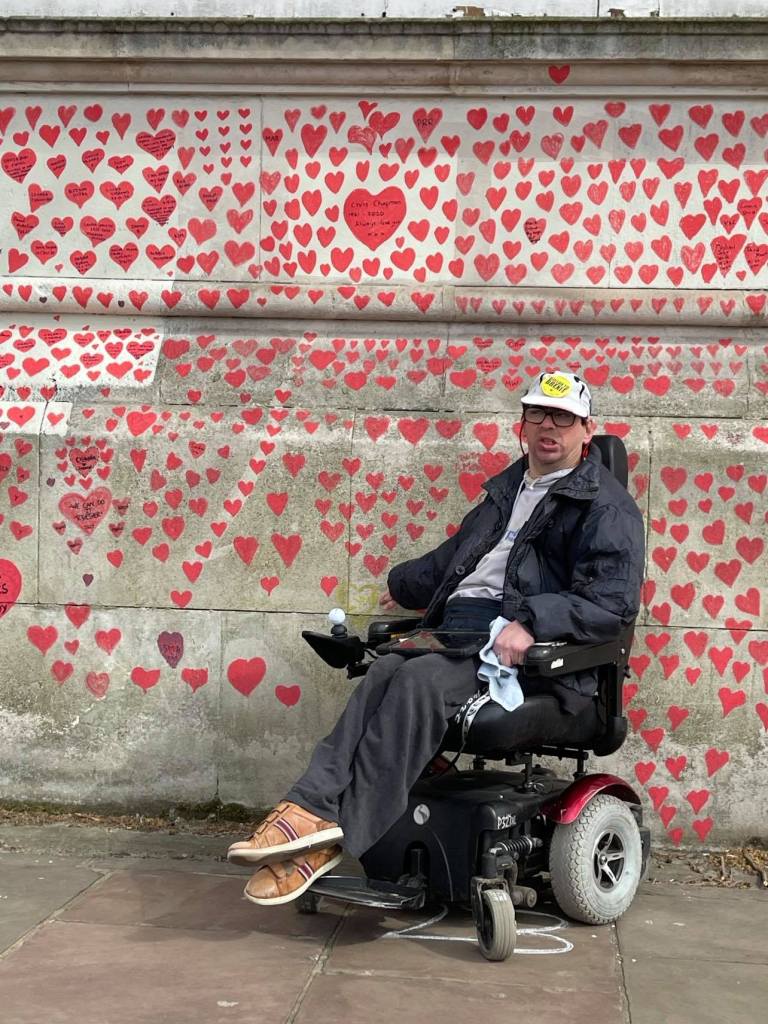
You may have heard about the Covid Memorial Wall up in London, across the Thames from Westminster. People are going and drawing hearts, usually in red, on a large concrete wall on the south bank of the Thames, and adding the name of someone they have lost during the pandemic. A couple of days ago, Serkan suggested we go up and add Lyn to it. I thought that was an incredible idea, (although what L herself would have said about it is another matter). Yesterday afternoon, then, we went up, catching the Jubilee Line to Westminster and then walking across the bridge. I now know the intricacies of the London Transport Network quite well; yet I can never forget that that is due to the fact I met Lyn. She introduced me to this great metropolis – she made me a Londoner.
On the way there, Serkan bought a marker. It was supposed to be red, but he could only find gold. As Serkan was drawing the heart, though, that struck me as very apt: Lyn’s heart was unique and stood out, just as Lyn was, and did. Looking at Lyn’s golden heart on the wall, I missed her. It is now almost a year since she passed away, but I still feel the absence of this wonderful, incredible person acutely. I suppose adding Lyn’s heart to that wall was a way to express that.

There are two very interesting things I’d like to flag up today, even if there isn’t that much I can say about either. Firstly, if you want to see what a low-budget, Soviet Russian adaptation of The Lord of the Rings looks like, go here. According to this Guardian article I came across yesterday, they were rediscovered after thirty years and uploaded to Youtube by Russian Tolkien fans. I haven’t watched the film so I can’t comment on it (not being able to speak russian) but needless to say, it looks very, very different to Peter Jackson’s adaptations. Mind you, it’s worth pointing out that it is probably thanks to the popularity of Jackson’s film(s) that the russian one was rediscovered.
The second thing which I want to direct you to today is this awesome looking trailer for the second season of Star Trek Picard. It’s only a short trailer, so again I can’t say much, but all the same it has my juices going. It looks splendid: we get a glimpse of Chatau Picard, and from the look of it, the great John De Lancie is reprising his role as Q. It’s definitely something to look forward to, although a cynic might point out that Q always was a fan favourite, so his reappearance is bound to increase viewing figures. Nonetheless Season 2 of Picard is definitely something I’m looking forward to.
I decided to go and explore Canary Wharf yesterday. It’s only one stop along the Jubilee Line, but I rarely venture there: I suppose I find it too corporate and imposing. What I found, though, stunned me: everything, from the expensive watches in the shop windows to the buildings their selves, seemed to glitter. It did not feel like anywhere else in London, but like a fragment of New York had been transported across the Atlantic and plonked down in the docklands. I must admit I was awe-struck by the architecture, and how the old docks now had modern skyscrapers sprouting between them. The whole place felt like a labyrinth of ultra-modern, obscenely expensive glitz, with paths winding through well-kept pleasure gardens and between skyscraper-lined docks. Even the Tube station doubled as a large shopping mall. You could tell there were ridiculous amounts of money around.
Yet I couldn’t help being reminded of what I was talking about here. I don’t think you’ll find anywhere like Canary Wharf anywhere else in the country. Indeed all over the city colossal sums are being pumped into urban development: I only need to trundle over to nearby Kidbrooke to see how an area, neglected until fairly recently, is being developed and gentrified beyond recognition. Is it the same case across the country? How come such huge amounts are being invested in london while everywhere else gets left behind? Why should London get all the swanky new buildings? It’s an imbalance which worries me, especially given that I suspect it’s reflected in levels of accessibility, with so much more public transport, infrastructure etc being wheelchair accessible than elsewhere. Almost everywhere I went yesterday, there was either a ramp or a lift.
That aside, I think I’ll go back to Canary Wharf soon: I was quite taken by it’s sheer, brazen opulence, and I feel there’s much more to explore. Mind you, I must admit that I was slightly disappointed that, despite the name, I didn’t find any tropical birds or Klingons.
I note that the Church is insisting that it should be able to open up for worship this easter, despite the ongoing pandemic. Does that not strike anyone else as arrogant? The clergy are essentially saying they don’t care whose lives they put at risk, their right to continue to indoctrinate people should take priority. As I have written on here before, I see religion as a form of social control: it simply uses a set of ancient myths as a source of authority in order to tell people how to behave. It’s usually highly conservative and oppressive. It also seems determined to cling to that authority however it can, including insisting on it’s right to carry out it’s rituals and preach to people when any other form of social gathering is prohibited. As soon as we start to peak behind the curtain and question why it should hold so much sway, the church’s authority evaporates and it becomes nothing more than a bunch of dogmatic old men ranting their heads off trying to tell us what to think and how to live our lives. Thus it will do all it can to remain open and retain it’s cultural position, of course insisting that faith gives people hope and comfort, when in fact it binds them to dogma. Only when we question religion can we free ourselves from the church’s cultural snare.
Here endeth the Sunday sermon.
I realise this isn’t much of a blog entry, but just to note that a couple of days ago I started to muse over whether, in creating the Mines of Moria, with its labyrinth of tunnels and caverns, JRR Tolkien could have been having a sly dig (pun intended) at the London Underground. The tube was in its infancy when Tolkien was writing The Hobbit; and he was famously opposed to such modern, highly industrial projects. Moria could have been his way of expressing his opposition to something he would have found outlandish. If that suspicion is right though, then I just hope that the guys behind Crossrail didn’t go too deep and disturb any balrogs.

 The Ill-Informed Ramblings of a Cripple